No, Castro's Cuba Was Not a Successful Example of Fully-Automated Luxury Communism. But There Are Lessons from Its Infant-Mortality Numbers: CHART OF THE DAY
Castro, coercion, & babies who live: lessons from Cuba’s infant-mortality numbers as an authoritarian regime aligns (mostly) with mothers’ interests, while rich America leaves too many babies to die as we make high‑touch prenatal care a privilege rather than an automatic entitlement…
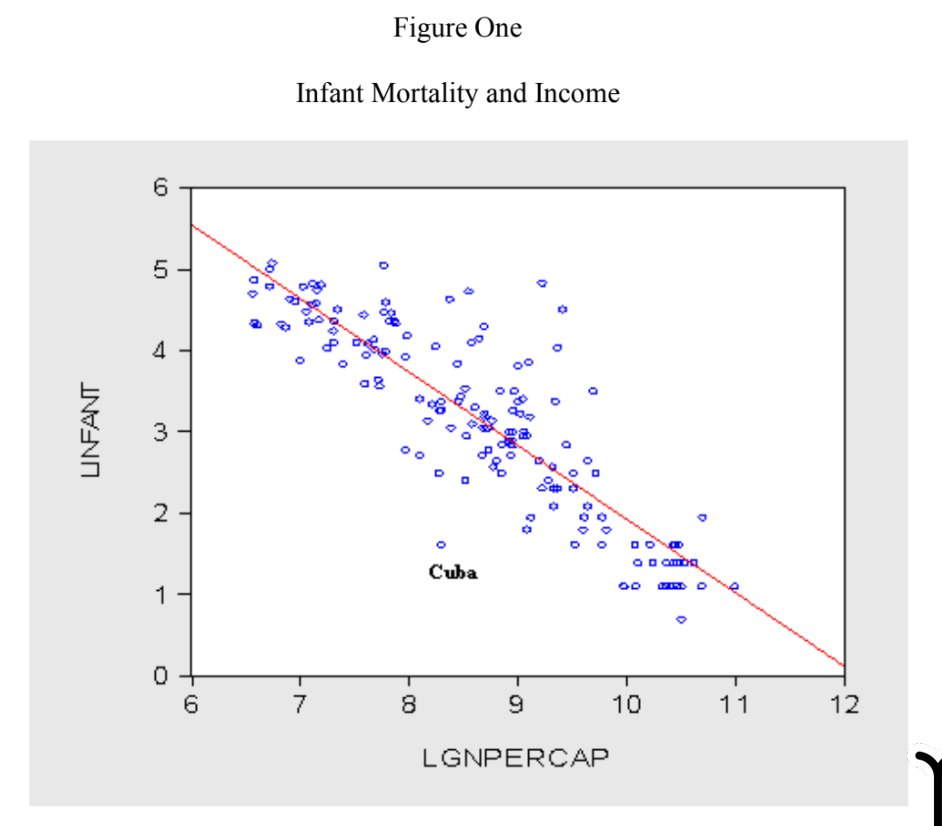
Cuban infant mortality is roughly 10 per 1000 live births. Countries as poor as Cuba are typically in the 50 per 1000 live births or so range. Cuba thus punches enormously above its economic-prosperity weight in terms of infant mortality.
My view is that, had Cuba remained a normal country rather than becoming the patrimonial-authoritarian really-existing socialist caudillismist Castroite state that it did, the likely counterfactual is that nearly everyone would have been much better off. People would have been better off even with respect to infant mortality. In brief, Cuba today would probably look a lot like Costa Rica today, with 9 infant-mortality deaths per thousand live births. The Revolution and the Castroite régime has been a 2.5-generation disaster for Cuba, and the ability of the medical system to punch well above its economic weight in infant mortality is 100% offset by the régime’s system that makes its economic weight so low.
Now comes Noel Maurer makes me aware of the latest developments in the Cuban economic development debate:
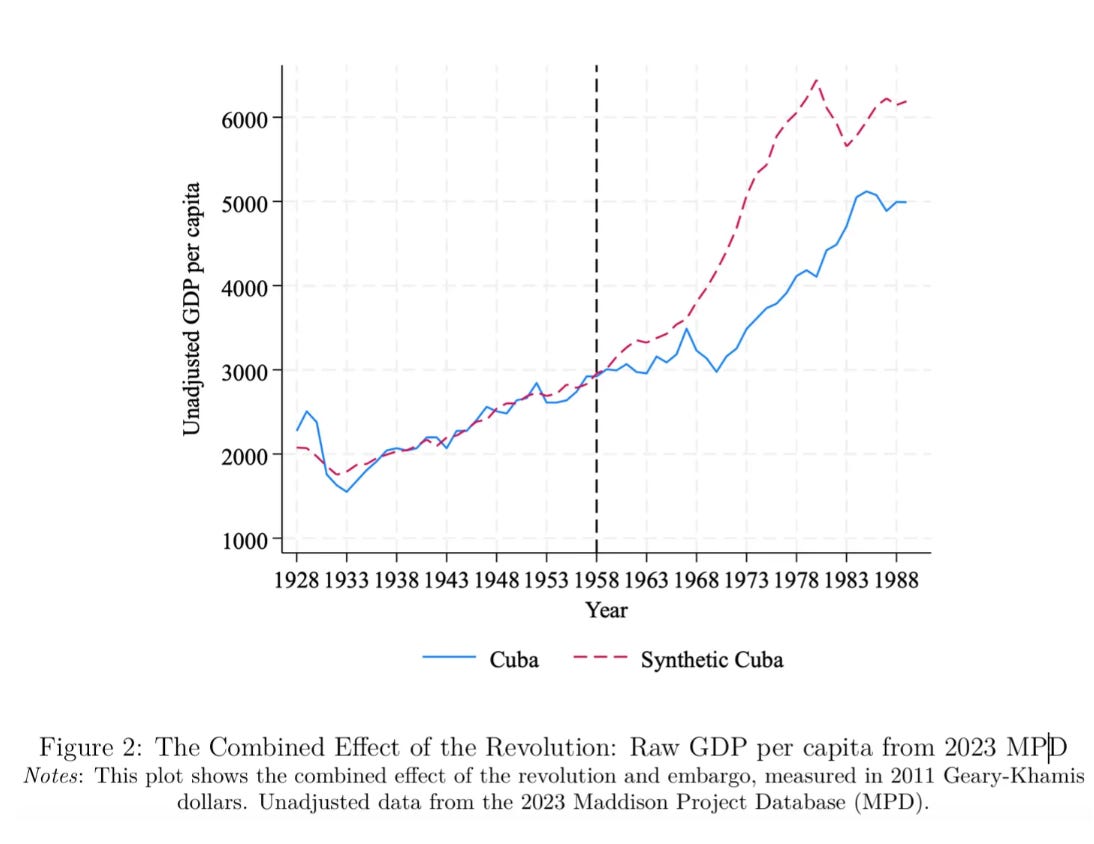
Noel Maurer: The Battle of Cuba(n Economic History) <https://www.noelmaurer.com/p/economic-history-week>: ‘John Devereux and Vincent Geloso (with João Pedro Bastos and Jamie Bologna Pavlik)… using different methodologies… presented evidence that Cubans would have been far better off had the Revolution never happened. Geloso et. al. use synthetic controls… [and] find that socialist Cuba fell behind counterfactual Cuba even as the Soviet Bloc pumped in billions of economic aid….
Now Giovanni Mellace (U. of Southern Denmark) and Rok Spruk (U. of Ljubljana) have struck back! They use synthetic controls to show that infant mortality in socialist Cuba falls dramatically and persistently compared to counterfactual Cuba… by “15–29 percent and average years of schooling rise 1.5-2 years; both effects are large, persistent, and robust.” Win one for the Revolution! Or maybe not…
Noel then reminds us of John Devereux writing back in 2010:
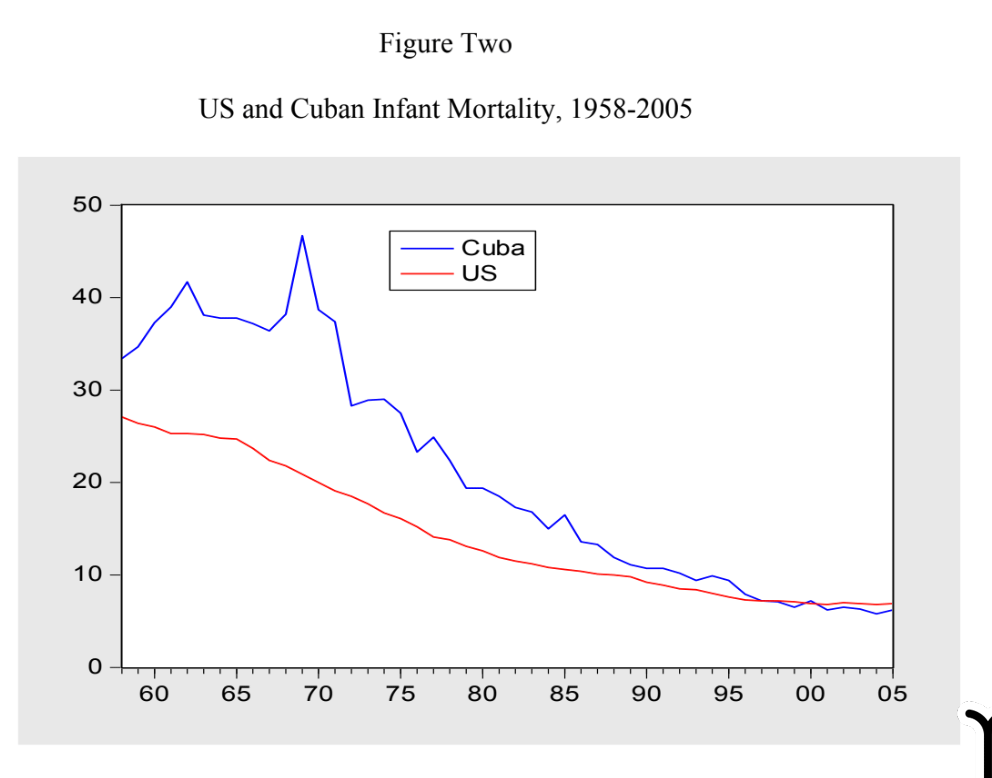
John Devereux: The Health of the Revolution: Explaining the Cuban Healthcare Paradox <https://drive.google.com/file/d/1NFnuqdCKekn14tManezoHkyJULFRCRWa/view>: ‘What lies behind the Cuban health care numbers?… My focus is on infant mortality…. Part of the answer lies in the fact that that the revolution inherited an economy with low infant mortality. [Plus] in the early 1970’s [when] infant mortality becomes a central goal of the Cuban authorities…. Cuba… developed… unique… institution… to monitor and to alter the behavior of patients and medical professional alike in ways that appear to have few parallels elsewhere… rest[ing] on the power of the Cuban State and its formidable security apparatus….
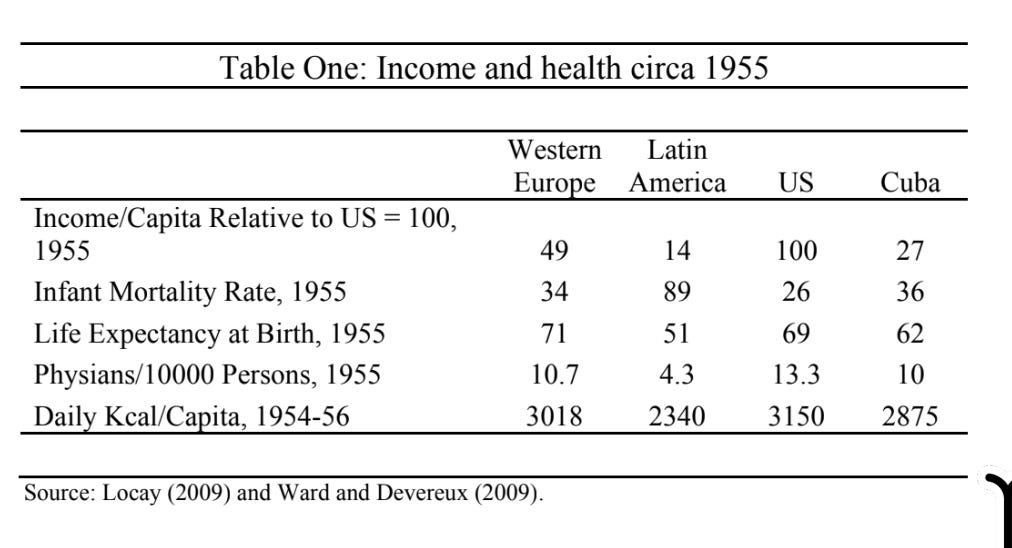
[Pre-Castro] Cuba had already achieved developed-economy levels of infant mortality…. Why did infant mortality fall so dramatically after the early 1970’s? Standard explanations emphasize Cuban investment in healthcare…. There is a large element of truth in these views….Cuba did not regain its pre-revolutionary levels of doctors until the early 1970’s, reflecting the exodus of doctors after 1959. Thereafter… from 1970 to 1980, doctors per 10,000 inhabitants doubled. They doubled again during the next decade…. Cuba has fifty-nine doctors per ten thousand inhabitants for 2005. The average for low-income economies is five…. For high-income countries, the average is twenty-eight…. Investment in hospitals/clinics/equipment as well as the provision of doctors/nurses played important roles in reducing infant mortality….
[Plus] the state places extraordinary pressure on Cuban doctors and hospitals to ensure healthy births. The authorities carefully investigate every infant death. They also impose severe sanctions on doctors…. Doctors have the ability to monitor their patients based on a comprehensive system of surveillance at the block level…. Local doctors work closely with the local agencies of the state, the Committees for the Defense of the Revolution and Federation of Cuban Women who keep detailed records on each family…. Doctors have direct access to women who because of social or other problems might avoid treatment elsewhere…. Doctors visit households at least once a year. All citizens must obtain certain services whether they want to or not….
Doctors assign women that are underweight, women pregnant with twins and women who have what Kath (2006 page 357) calls “social problems” to maternity homes…. During the early 1970’s, four percent of mothers used maternity homes. By 1989, this had increased to twenty three percent. By 2000, forty percent of mothers were resident for some period in the homes. The homes improve nutrition and provide health care to at risk women…. Pregnant women in the Cuban system are compelled to have at least two ultrasound tests with more tests at any signs of trouble. Among observers, there is a widespread belief that the appearance of abnormalities or any indication of potential problems leads to abortion…. Over recent decades, the abortion rate averaged between thirty-five and forty-five for each one hundred live births….
Some portion of Cuba’s low infant mortality rests on the coercive power of the Cuban state…. The current healthcare system may not survive in its present form with political change…
Devereux’s conclusions are the Cuba’s infant mortality is low by:
a factor of six relative to what one would expect given its poverty
a factor of two relative to what one would expect given poverty, health spending, doctor and nurse supply, and the share of babies born with low birthweight.
The vibe I get from his 2010 paper is that this last factor of two is only possible because the coercive power of the Cuban state is directed toward producing low infant mortality numbers via excessive pressure for selective abortion in at-risk pregnancies—bad—and also severe regmentation and population control: “citizens must obtain certain services whether they want to or not…. Pregnant women… are compelled to have at least two ultrasound[s]…”. Some amount of the good infant-mortality performance is thus a result of scrubbing the numbers, and because the number is a target one cannot make the normal inferences from a good infant-mortality number that things are going well with respect to other aspects of human well-being that one would normally make. Moreover, I get the vibe that this last factor of two comes only at the price of the authoritarian Cuban surveillance state, and thus that the game is not worth the candle.
But no pregnant woman wants to see their baby die—in the womb or just after birth. Except for the selective abortion of at-risk pregnancies possibility, the interests of mothers-to-be and the interests of the oppressive authoritarian Cuban state are aligned here.
Alta Bates Hospital, half a mile away from our house, did an amazing job when as me and my wife were having dinner with George Akerlof and Janet Yellen, her second pregnancy suddenly turned into an extraordinarily high-risk one. And we have a lovely daughter as a result, as all of high-tech American medicine as it existed in the early 1990s was deployed on our behalf at a resource cost I truly do not want to contemplate. But that level of care requires that you show up at the hospital with gold-plated insurance having figured out that you have to go there NOW, and believing you have enough social power to be willing to be very pushy in the emergency room.
But because you have to have the economic and social power and to take the initiative, America’s infant-mortality numbers are awfully bad given its extraordinary wealth.
Can we not have a high-touch healthcare system that gets pregnant women their nutrition, their ultrasounds, their counseling, and their other prenatal care by making it as easy as falling off a log? Does not the Cuban system show how much shifting away from insurance- and wealth- and social power- and hassle-surmounting gated systems to proactive ones would improve matters?
If reading this gets you Value Above Replacement, then become a free subscriber to this newsletter. And forward it! And if your VAR from this newsletter is in the three digits or more each year, please become a paid subscriber! I am trying to make you readers—and myself—smarter. Please tell me if I succeed, or how I fail…