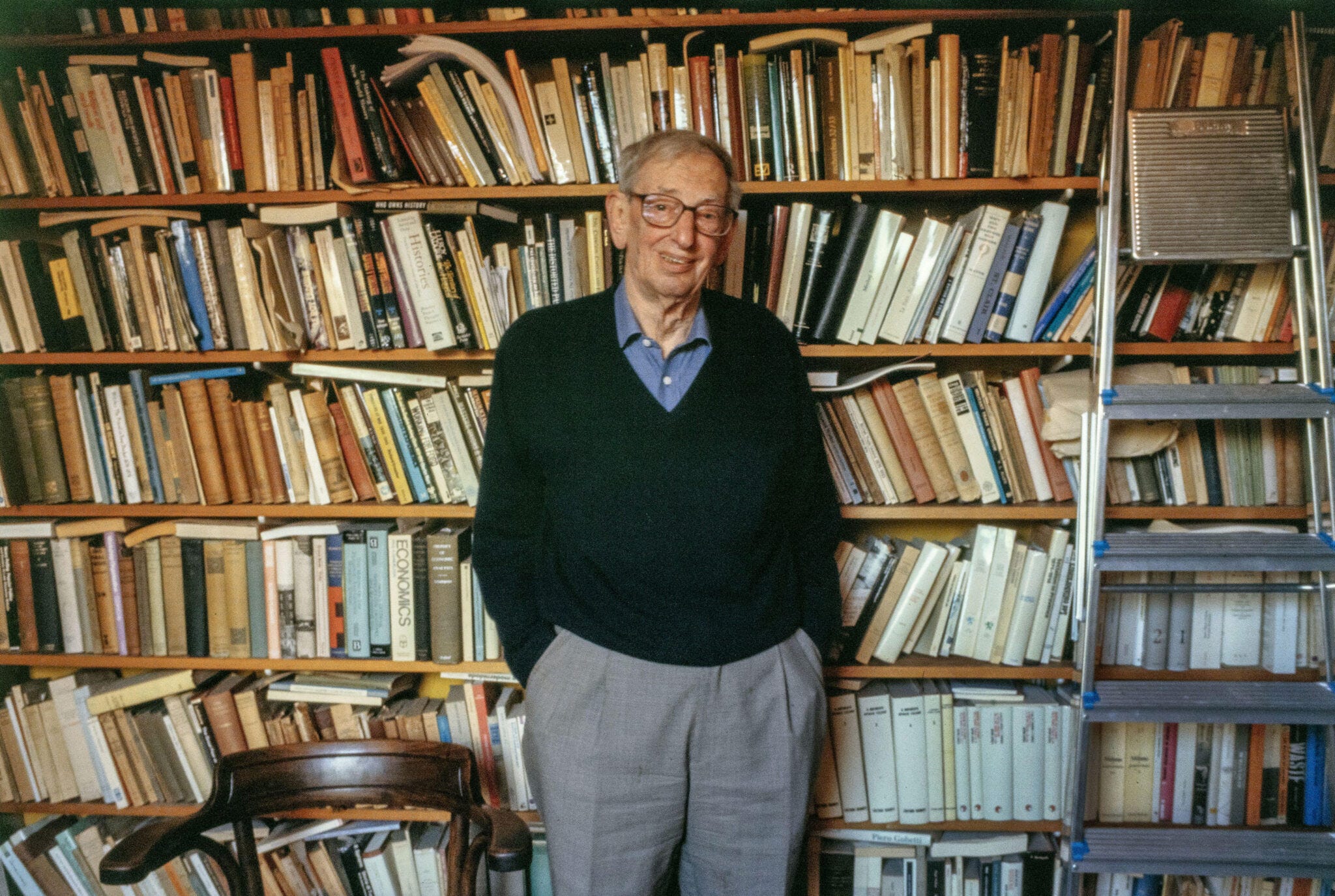
(SEMI-)CROSSPOST: ENZO TRAVERSO: The Centuries of Eric Hobsbawm
Reading Traverso reading Chabal reading Hobsbawm between historical method, historical imagination, and the myths of historians and of history. Hobsbawm as a historian who revolutionized our sense of the long nineteenth century—and stumbled when he turned to the age he lived through. Paradoxically, nobody did more to move history beyond and away from Great Men and to our current webs of understanding based on structures, classes, and global orders than did Eric Hobsbawm. Yet, ironically and paradoxically, nobody seemed to find their thought more permanently bound by the shadow of Iosef Stalin than Eric Hobsbawm. The same mind that gave us an extraordinary Grand Narrative through-line history of 1776-1875 also gave us a profoundly unsatisfying and deeply wrongheaded understanding of the Big Story of 1875 to today.
This morning I am reading this piece: half Enzo Traverso, and half Emile Chabal, whose forthcoming Hobsbawm biography Traverso is reviewing.
Extensive excerpts of the parts of this that I found most interesting below:
Eric J. Hobsbawm… published critically acclaimed memoirs, and today—fourteen years after his death—is the subject of two biographies, the latest of which… by Emile Chabal…. Richard J. Evans knew Hobsbawm… and his book… stands as… official biography…. Evans carefully reconstituted a historian’s life and wrote with empathy, not without an apologetic touch. Chabal’s… acknowledged distance is beneficial… his gaze more analytical… a fascinating critical portrait.
Hobsbawm is… the greatest historian of the twentieth century… if [that] means that he was the most important scholar to have written on the history of the past century…. Chabal speaks of… the man and the myth. The myth… when Hobsbawm published The Age of Extremes, the book that canonized him as a celebrity…. The twentieth century… as an age of cataclysms framed by the Great War and the end of communism (1914–91), broken in the middle by an eruption of apocalyptic violence during World War II…. A vast constellation of scattered events found its place in the puzzle and could now be viewed from a historical perspective….
[In Hobsbawm’s] trilogy… of the “long” nineteenth century… The Age of Revolution: 1789–1848, The Age of Capital: 1848–1875, and The Age of Empire: 1875–1914… Hobsbawm displayed his talents as a narrator and a conceptualizer, and his capacity to explain in clear and engaging prose the enchainment of events rooted in a complex dialectic between social structures, political institutions, and human agency…. The outcome is a form of critical understanding that… interprets the past as a living landscape, animated by flesh-and-blood human beings…. While Hobsbawm’s clarity… from British historiography… global scope and interdisciplinary approach… from his cosmopolitanism and his Marxism….
His Marxism… deeply shaped his entire life…. In 1939, he coauthored a pamphlet with Raymond Williams, who had also been at Cambridge, in defense of the German-Soviet Non-Aggression Pact; in the early 1950s, he was “tremendously impressed” by Stalin’s Short Course (the official history of the Russian Communist Party), which he held to be a “beautiful, marvellous piece of popularisation,” particularly remarkable for its chapter on “dialectical and historical materialism.” In 1956, he signed a petition denouncing the Soviet invasion of Budapest, but—unlike many other intellectuals, including most of his own friends—he did not break with the party. He wrote a letter to the party newspaper Daily Worker, in which he characterized this military occupation as a “tragic necessity,” expressing the hope that it would be quickly followed by a withdrawal….
Hobsbawm’s communism was born… when the… Nazi SA marched in uniform through the streets of Berlin. It was the choice of a Jewish teenager…. He belonged to “the generation for whom the October Revolution represented the hope of the world.” This hope was more than a universal ideal.… It was an ideology, a state, and an army, and his loyalty to them never wavered. This explains his contemptuous detachment toward the protest movements of the 1960s, like feminism and the New Left. Anti-authoritarianism, anti-patriarchalism, and sexual liberation struck him as signs of weakness, amateurism, and a lack of discipline….
Until 1956, Hobsbawm viewed Marxism, in Chabal’s words, as “something that covers everything” or a “totalising ideology,” and the Soviet Union as its temple.A corollary of this dogmatism was the hunt for heretics…. He wrote the introduction to the English translation of a pamphlet… against the Hungarian philosopher György Lukács written by the Hungarian Minister of Culture… which stigmatized Lukács… [as] a dangerous “bourgeois” tendency…. After 1956, Hobsbawm abandoned the Marxist orthodoxy… yet he maintained his hostility toward… “Western Marxism.”...
His Stalinism was… a belief grounded in a historical diagnostic… [that Stalinist] communism… had saved civilization from collapsing into barbarism. Despite the Gulag and Stalin’s tyrannical power, the USSR had resisted and, for him, embodied the legacy of the Enlightenment. [Hobsbawm’s]… conception of history remained teleological… as a long march of civilization toward progress and socialism, punctuated by revolutionary breaks and darkened by tragic throwbacks…. The collapse of the Soviet Union in 1989–91 dramatically called into question this teleological conception…. He always distrusted post-structuralism…. Having lived through the age of… Stalingrad, he could not consider history as a textual construction or as a narrative interchangeable with and indistinguishable from literary fiction. Historians write the past, but history is inscribed in the flesh and bones of living human beings…. Between universalism and the quest for identity, Hobsbawm’s choice was clear: Historians, he pointed out, don’t write history for Jews, or African Americans, or women, or homosexuals, or proletarians; they don’t write for “any special section of humanity.” They write for everyone….
Another upshot of Hobsbawm’s historical teleology was Eurocentrism…. The first half of the twentieth century undoubtedly constituted an “age of catastrophe” for Europe, but not so for Argentina or Mexico.… Perhaps Hobsbawm’s canonization… was a Western tribute to a great historian who[se]… entire life unfolded under the sign of decline and fall…. He had believed in the future of socialism, embodied by the USSR. The collapse of the Soviet Union, and of this universal hope, was, for him, a final failure, one he intimately endured and lucidly analyzed…
Brad here: The forthcoming book being reviewed here is:
Chabal, Emile. 2026 (August 18). The Age of Hobsbawm: The Life of a Revolutionary Historian. Cambridge, MA: The Belknap Press of Harvard University Press.
Clearly I am going to have to read it, as my irritation at the wrong-headed Grand Narrative of Hobsbawm’s The Age of Extremes was one of the principal burrs in my saddle leading me to write Slouching Towards Utopia. Writing that did not dispel but rather cemented my annoyance. Nevertheless, I want to second what Traverso has to say here:
Hobsbawm displayed his talents as a narrator and a conceptualizer, and his capacity to explain in clear and engaging prose the enchainment of events rooted in a complex dialectic between social structures, political institutions, and human agency…. The outcome is a form of critical understanding that… interprets the past as a living landscape, animated by flesh-and-blood human beings…. While Hobsbawm’s clarity was… inherited from British historiography… his global scope and interdisciplinary approach stemmed, respectively, from his cosmopolitanism and his Marxism…
And let me strengthen that: Hobsbawm’s The Age of Revolution (1962) and The Age of Capital (1975) are genuinely difficult to render justice to in a review: they simply cannot be summarized without losing everything that makes them great. Hobsbawm successfully wove together the economic logic of the Industrial Revolution with the political drama of 1776–1870 into a single, sweeping narrative that made it impossible to think about modern history any other way. His influence on thought here has been and remains truly profound.
Moreover, in my view, a second thing about Hobsbawm that will survive—the thing that will survive a thousand years beyond our own era—is his methodological revolution in historical writing. He did as much as any single person to drag history out of the cult of Great Men and into the broader, messier world of social processes, economic structures, and global orders. Before Hobsbawm, history’s attraction point was largely biography dressed up as narrative. After him, even readers who disagreed fiercely found themselves thinking in his terms: of long waves of structural processes; of social movements; of the long nineteenth century; of the hinge of history that was 1848, the dual revolution of industrialization and democracy, of the imperialist scramble; and so on.
His influence on method may well outlast his influence on thought.
If reading this gets you Value Above Replacement, then become a free subscriber to this newsletter. And forward it! And if your VAR from this newsletter is in the three digits or more each year, please become a paid subscriber! I am trying to make you readers—and myself—smarter. Please tell me if I succeed, or how I fail…