
(SEMI-)CROSSPOST: DAVE DEEK: GOVERNANCE CYBERNETICS
Dave Deek says: Synthesis, Not Triangulation…. The Cybernetic Approach…. This Publication…. Why This Matters…. I say: State Capacity Sanity. Costco, Safeway, the cybernetics of getting housing built—& infill, market incentives, & crowdsourcing…
Find it here:
Deek, Dave. Governance Cybernetics. <https://www.governance.fyi/>.
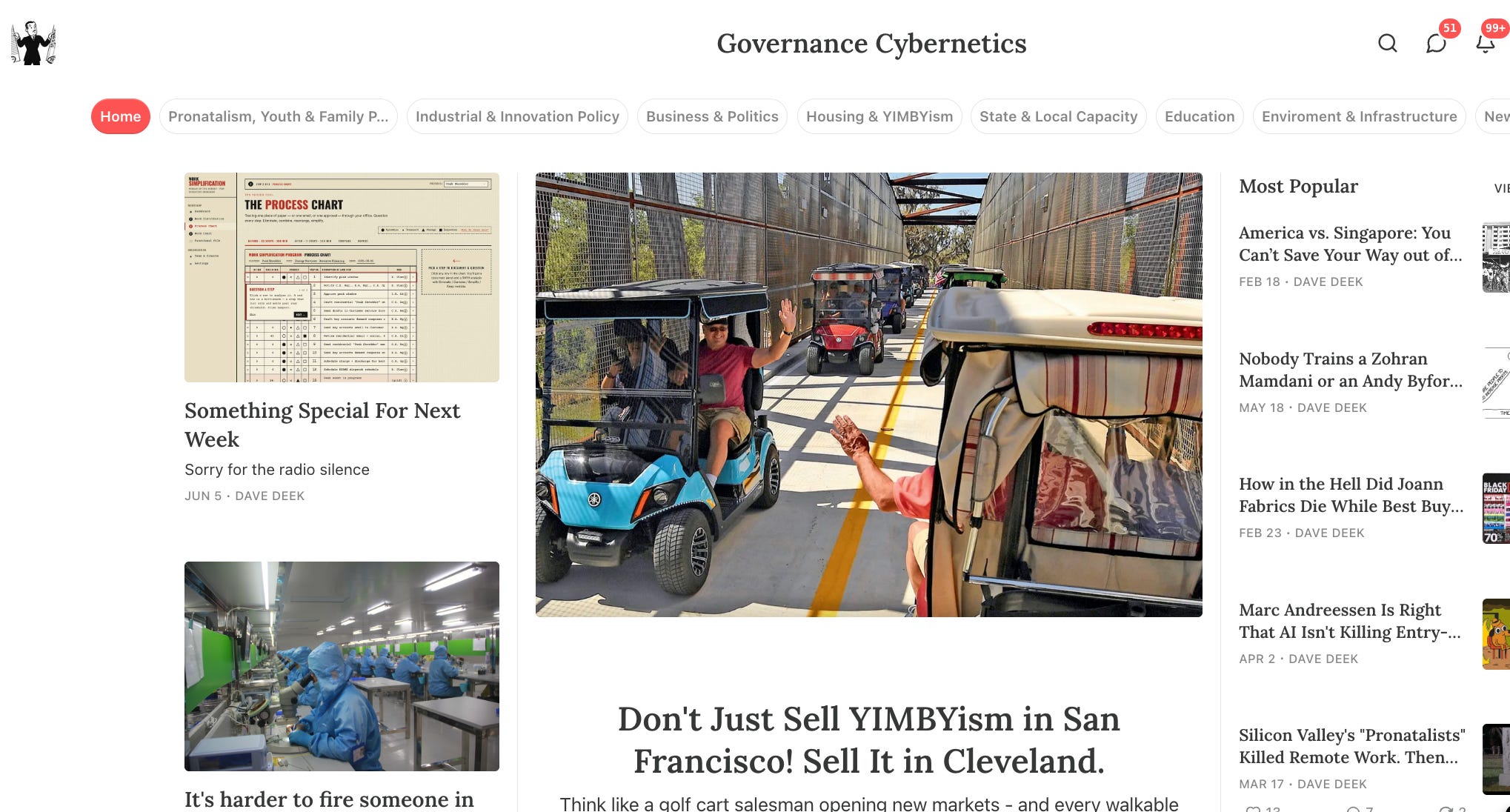
Here is a sample: When law, labor, and grocers align, buildings rise—when they don’t, we get angry neighbors and empty talk:
Dave Deek: Costco & Safeway are getting housing built where others fail. It isn’t because a mayor wants it <https://www.governance.fyi/p/costco-and-safeway-are-getting-housing>: ‘The real luxury isn’t square footage. It’s not driving for onions. Notes on why the building goes up even when the mayor doesn’t want it to…. The relevant question is not whether the rhetoric has shifted, but whether the rhetorical shift will translate into actual buildings. This matters because the answer determines whether the United States can build out of its housing crisis or merely talk out of it…. The pattern is not ideological inconsistency. It is loss aversion as urban policy. The anger of one miffed homeowner is felt by a mayor about twice as heavily as the gratitude of one new tenant….
The [San Francisco] Marina opposition is asking that its favourite neighbourhood Safeway not be allowed to get bigger and better. The thing the protesters say they love (the daily-life utility of the store, the Monday-night singles tradition, the iconic mid-century building) would, under the proposal, get a substantial upgrade. The thing they say they want to preserve, the surface car park, would be the only thing lost. Try writing that on a placard. Tesco in 2000s Britain mobilised the same dynamic: it was easier to argue with planners about flats than to argue with everyone who shopped at the Tesco….
[With] AB 2011… the supermarket is one supporting leg, the law is another, and the labour coalition is a third. Knock one out and the others hold…. AB 2011 cannot die without an act of the California legislature, which neither the building trades nor the grocers will permit…
Plus here are links to two more from Dave Deek h on related things that caught my attention as well: <https://www.governance.fyi/p/accessory-commercial-units-acus-the> and <https://www.governance.fyi/p/dead-malls-and-dying-downtowns-are>.
One thing that he doesn’t miss, but that he does not stress, is that large-scale projects that need a substantial political-mobilization push to get built are not the things that are ultimately going to move the needle far on housing affordability and commerce-presence quality of life. he truly needed development policy that works will look less like visionary megaprojects and more like permitting basements, backyards, and big-box parking lots for denser uses.
Here we have smart things from Andrew Burleson:
Andrew Burleson: Large Redevelopment Projects Aren’t the Answer <https://www.freerange.city/p/large-redevelopment-projects-arent>: ‘Incremental housing unlocks more supply…. Look at 94061, in Redwood City…. The area has some sites that could redevelop into apartment buildings, but the majority of lots are single family homes. The biggest opportunity is to open up new housing options for all those existing homeowners. That means allowing a family to build a backyard cottage,,, a retiree to convert their basement into an accessory apartment… a local builder to convert a run down house into a duplex… If those options were allowed by right, this part of Redwood City could mature to the level of the Outer Sunset; still predominately single family residential, but up from 14,006 homes to 24,623, an increase of 10,617 homes…. If we passed reform that that permitted ten thousand new homes in half of these, it would unlock 1.6 million new homes. This is why the Strong Towns Housing Ready Toolkit focuses on reform that can unlock incremental infill and evolution across entire regions, not just ideally located grocery stores…
Get the market incentives on your side. Then you crowdsource your way out of the housing crisis.
This is, basically, just a plea for state capacity sanity: use the state to set up a framework so that then the default, self-interested choice for thousands of actors make the world a better place as they then make good choices.
References:
Burleson, Andrew. 2025. “Large Redevelopment Projects Aren’t the Answer”. Free-Range City. December 19. <https://www.freerange.city/p/large-redevelopment-projects-arent>.
Deek, Dave. 2026. “Costco & Safeway Are Getting Housing Built Where Others Fail. It Isn’t Because a Mayor Wants It”. Governance Cybernetics. May 12. <https://www.governance.fyi/p/costco-and-safeway-are-getting-housing>.
Deek, Dave. 2026. “Dead Malls & Dying Downtowns Are the Best Places to Build (Local) State Capacity. Governance Cybernetics. April 20. <>
Deek, Dave. 2026. “Accessory Commercial Units (ACUs): The Alchemy of Turning Suburbs Into Walkable Neighborhoods. Governance Cybernetics. April 13. <https://www.governance.fyi/p/accessory-commercial-units-acus-the>.