Ask Not for Whom the Schumpeterian Creative-Destruction Bell Tolls This Time: KEY INSIGHT
In the bullseye of history: Why we literate intellectuals feel that this wave of technological change is so much more momentous than, say, the coming of mass production or of electric power. The sense of unprecedented rupture is itself an old story—what’s new is how often it happens and to whom it is happening this time…
What is the key insight that I, particularly, have to offer this week? What is the thing I have to say that is not already being widely said?
It is this: extremely book-sharp, literate, and articulate people like Adam Tooze—and many, many others—are greatly disturbed by the fact that, this time, they and their jobs and their lives are in the bullseye of the Schumpeterian econo-societal tech-driven creative-destruction waves that have been ongoing once every century since 1775 and once every generation since 1875.
The truly brilliant Adam serves as a representative poster child here:
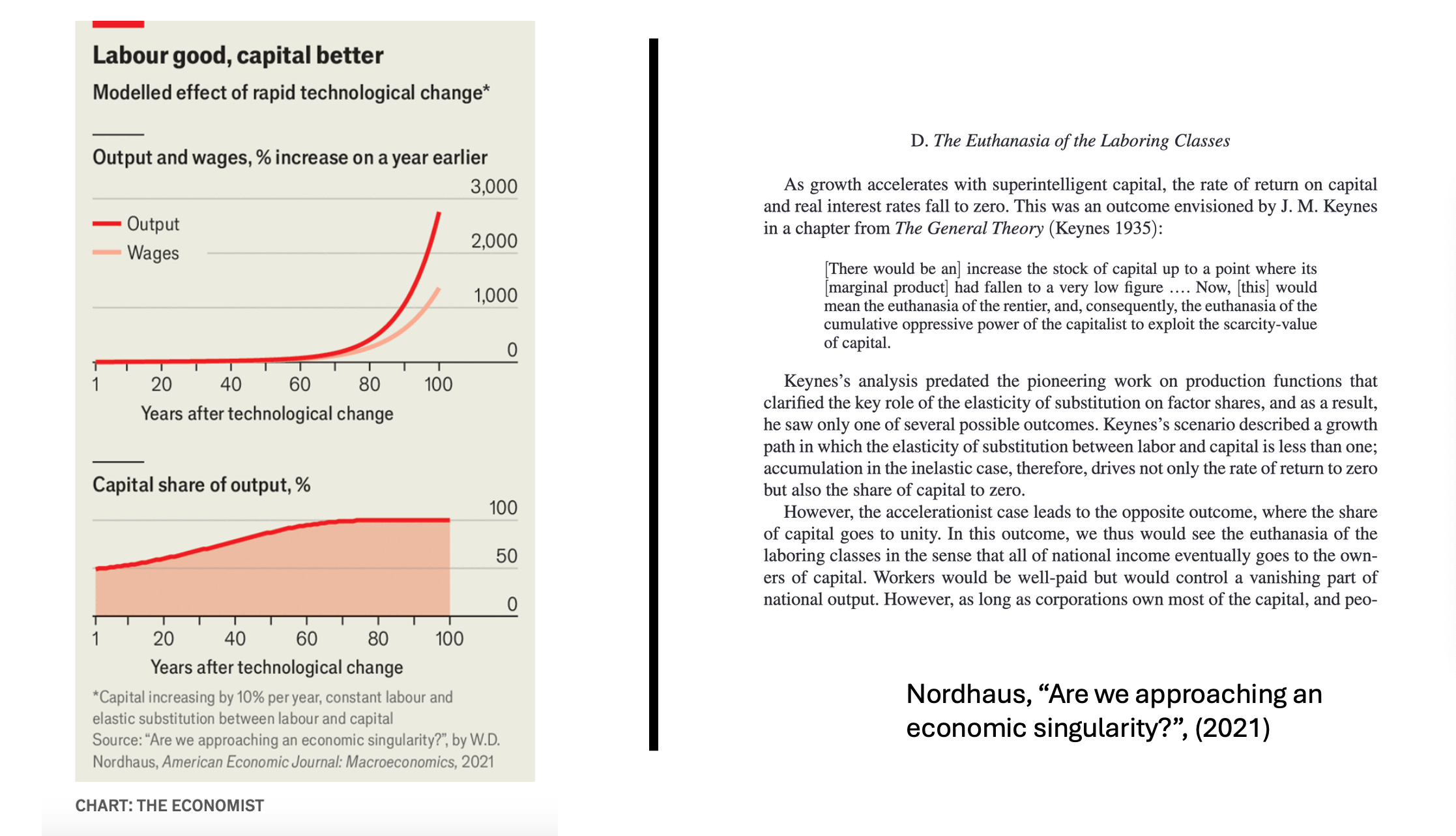
Adam Tooze: What times are these? Crying fire in a Berlin lecture theatre <https://adamtooze.substack.com/p/what-times-are-these>: ‘In Berlin last week, it was a panel with good, sensible people…. And, yet… I felt like the mad uncle in the attic, crying fire!… Which historical continuities can we still meaningfully invoke?… My co-panelists were playing pleasant historical tunes. Urgent, no doubt. Serious. But, ultimately, they were familiar tunes…. I could not carry that tune. Not only because I am not one for easy policy prescriptions. But because the world just seems too ruptured, punctuated, discordant…. Why assume the relevance of precedent? And with the loss of precedent, do we not also have to let go of inspiring examples?… I had Nordhaus’s (2021) vision of the “euthanasia of the labouring classes” (sic) in my head.
The sense of gathering anxiety, of truly radical uncertainty…. The range of possible answers is spectacular. No one knows. And all the while, anticipations of that future and trillion-dollar wagers are driving markets and creating wealth on a scale that dwarfs anything before seen.… AI has clearly been the driving force of US capital accumulation… And then a few hours later, starting some summer reading, I found the famous preface to Mann’s Zauberberg… published in 1924 about the era before 1914 - with this wonderful passage:
“The exaggerated pastness of our narrative is due to its taking place before the epoch when a certain crisis shattered its way through life and consciousness and left a deep chasm…. It took place, and had taken place—in the long ago, in the old days, the days of the world before the Great War…. Is not the pastness of the past the profounder, the completer, the more legendary, the more immediately before the present it falls?… Our story has, of its own nature, something of the legend about it now and again…”
And that patched things together for me…. Is there not a similar sense of rupture separating us from the the 20th century and its precedents, its models and its inspirations? Has that history not become legendary?
But, Adam, this sense of profound historical rupture is not itself a rupture:
This sense has been the human condition of those who have found themselves involuntarily in the bullseye of historical change for a long time. This has been the case since at least the Renaissance. Back then it was a combination of things like the invention of printing; the recognition that the Nine Worthies—Hektor of Troy, Aleksandr of Makedon, C. Iulius Cæsar of Rome, Yehoshua, David, Judah ha-Makkabi of Israel, Arthur, Charlemagne, and Godefroy de Bouillon—were not all 1300s Christian or Christian-like knights leading similar lives but were very different fo kinds of people; and Niccolò Machiavelli’s sudden recognition that he could not be an honest man and yet write just another Mirror for Princes in his attempt to attract the favorable attention of the Medici clan.
We see it again a century later with writers like Francis Bacon and Tomasso Campanella obsessing about technological change—the knowledge of the causes and secret motions of things—as potential total transformers of society. The American and French revolutionaries did not think they were overhyping things when they proclaimed a novus ordo seclorum, a New Order of the Ages. Marx and Engels in 1848 were not kidding or overstating when they wrote that all that is solid melts into air— or perhaps that all solid orders and patterns are steamed away. As Cosma Shalizi puts it, the singularity is in our past light cone <https://bactra.org/weblog/699.html>.
What is different, since 1875 or so, is that these profound historical ruptures no longer come along every century or two, in which case those who wind up in their bullseye have some excuse for being caught by profound surprise. Since 1875, it comes like clockwork every generation, albeit to different (although overlapping) tranches of society and economy.
As of 1775, nearly everyone in the world—except for the very, very important category of textile workers—if they just stepped into the socio-economic-technological frame that their grandparents had lived in, could have a productive job. They could have a place in society. They could have an income appropriate to their status. It might not have been high-status. But at least it gave them a visible and acknowledged place: you could know who you were, and what you were supposed to be and do. Yes: there were profound historical changes going on. But the underlying bedrock patterns of production and distribution in daily life were recognizable, and were an anchor to hold on to. for everyone.
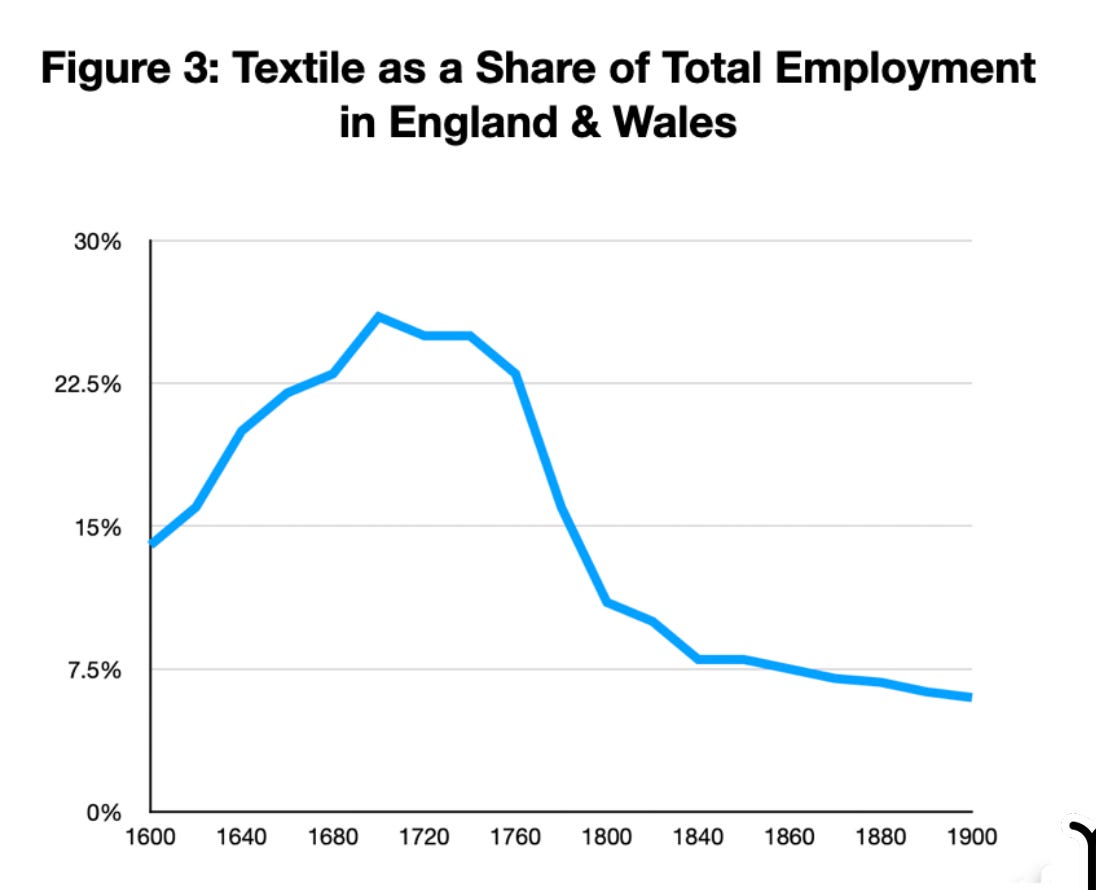
And then, over the next 75 years, worldwide: that ceased to be the case for the textile workers. Schumpeterian creative-destruction came for the poor stockingers, the hand-spinners, and the handloom-weavers worldwide. And then, with the coming of the sewing machine, it came for the hand-sewers as well. Something like a third of the non-agricultural work in the world vanished into the maw of the machine. The real relative price of garments fell by perhaps 90% over the post-1775 period, and so did your income if you tried to do the old thing in the old way. Yes, there were workers in textile manufacturing in the world in 1875, but a much smaller relative proportion of the population and one that had become astonishing concentrated in a few countries, principally Old and New England.
Even in Old and New England—far fewer as a share of the labor force than at the peak of 1700. And the textile jobs in 1875 were completely different in what they did and how their lives worked than they had been a century earlier.
People were very unhappy, and vey disturbed. They were much unhappier and much more disturbed than Adam Tooze is. One reference point is the Silesian weavers of the Hungry 1840s, at least according to Heinrich Heine:
Henrich Heine (1844): Weavers’ Song <https://www.marxists.org/reference/archive/heine/1844/silesian-weavers.htm>: ‘No tears from their gloomy eyes are flowing, They sit at the loom, their white teeth showing: “Thy shroud, O Germany, now weave we, “A threefold curse we’re weaving for thee,— “We’re weaving, we’re weaving!
“A curse on the God to whom our petition “We vainly address’d when in starving condition; “In vain did we hope, and in vain did we wait, “He only derided and mock’d our sad fate,— “We’re weaving, we’re weaving!
“A curse on the King of the wealthy, whom often “Our misery vainly attempted to soften; “Who takes away e’en the last penny we’ve got, “And lets us like dogs in the highway be shot,— “We’re weaving, we’re weaving!
“A curse on our fatherland false and contriving, “Where shame and disgrace alone are seen thriving, “Where flowers are pluck’d before they unfold, “Where batten the worms on corruption and mould,— “We’re weaving, we’re weaving!
“The shuttle is flying, the loom creaks away, “We’re weaving busily night and day; “Thy shroud, Old Germany, now weave we, “A threefold curse we’re weaving for thee,— “We’re weaving, we’re weaving!”
Very roughly and very schematically: When a wave of Schumpeterian creative destruction arrives, four-fifths of the economy see productivity increase by about 50%. That is by and large a very welcome thing. And it comes without a huge amount of structural change or pain. But for one-fifth of the economy productivity multiplies perhaps ninefold, with total reconfiguration of how people work and live, and which of their skills and practices have any value at all. The economy as a whole was about three times richer when the wave had passed. But one-fifth of it and of society had been leveled, and then rebuilt in a very different configuration. And this was terrifying to be caught up in. And this brought a lot of pain to the losers of the process. Moreover, the discontent, chaos, and disruption was a powerful engine of destruction for the rest of society as well.
In this respect, the second quarter of the 2000s are not that much more disrupted relative to the last quarter of the 1900s than that quarter was relative to the pre-1950s in which Thomas Mann wrote his The Magic Mountain. and indeed those years were very different from the pre-1900 post-1875 first tranche of the Belle Époque. And do not imagine that those years were the continuation of some stable pattern of the past to those who lived through them. 1875 to 1900 were as profoundly disorienting to them as living in 1925 to 1950 was to be to Thomas Mann.
So why Adam Tooze’s heightened sense of disruption I believe—for I feel very much the same way— that it is because this time Schumpeterian creative destruction is coming for me. It is my profession and the way I live my life that has the prospect of being totally upended.
I think we should put today’s AI‑fueled angst in the same frame as the 1775–1875 transformation that first ripped one‑third of non‑agricultural work out of human hands. For the vast majority, each wave of creative destruction raised productivity relatively modestly and left life‑patterns intact. For an unlucky fifth, it obliterated skills, roles, and identities and rebuilt them from scratch. Heine’s Silesian weavers were one such cohort. Thomas Mann’s sanatorium bourgeois another. The twenty‑first‑century twist is that the next cohort in the firing line looks a lot like Adam Tooze—and me: people whose jobs consist of synthesizing, explaining, and teaching the very history that is now melting, but this time beneath them, personally.
If reading this gets you Value Above Replacement, then become a free subscriber to this newsletter. And forward it! And if your VAR from this newsletter is in the three digits or more each year, please become a paid subscriber! I am trying to make you readers—and myself—smarter. Please tell me if I succeed, or how I fail…