
Would You Have Bet on the East African Plains Ape 75000 Years Ago?: Most Important Thing
Quite possibly the most important thing I have to say this week: Really big brains, imitation‑driven culture, and ultrasociality look to me as initially evolutionary gambles with very serious downsides, whose eventual success depended on a narrow, contingent, lucky path. Even as recently as 75,000 years ago, we look, to me at least, evolutionarily very marginal: not terribly successful among the great apes, who are a not very successful edge branch of the monkey lineage, who are a mammal group pretty much restricted to tropical forests—unable to survive even up in the trees once you move far enough from the equator for there to be a winter…
Of the perhaps five billion mammals in the world 75000 years ago, perhaps two million Great Apes. Of the perhaps two million Great Apes alive 75,000 years ago, how many were really “great‑grandma” (or grandpa) to us? I see three possible answers—a 10,000‑person bottleneck, a 200,000‑strong anatomically modern population, and a broader 400,000‑strong interbreeding population.
Those are very small numbers.
Consider the smallness of those numbers in the context of this piece that crossed my screen yesterday, à propos of how a group of jumped-up monkeys more-or-less accidentally became first a band-wide, then a continent-wide, and then a global-wide anthology intelligence, and then hunted frantically for institutions to make that work:
Joseph Heath: Harari vs. Henrich <https://josephheath.substack.com/p/harari-vs-henrich>: ‘Human[s]… 1. Intelligence… superior intelligence… with respect to instrumental tasks… [and] to engage in mathematical, hypothetical/counterfactual, and logical reasoning. 2. Language… complex grammatical speech… [with] context-independent representation of states of affairs. 3. Cooperation… ultrasociality… among large groups of genetically unrelated individuals. 4. Culture… transmission of learned behaviours, producing a large body of cultural artifacts and knowledge that exhibits cumulative improvement….
We really don’t know how any of these capabilities evolved…. The evolutionary time-line… is extremely short…. [80,000 generations.] This makes it extremely improbable that all four… evolved independently… [or] “from scratch”… [rather than]… some… small “tweak”… to a pre-existing system… already… in primates….
The big prize… [is for] identify[ing] a single, relatively small modification of primate behaviour… produc[ing] all four…. The problem with taking intelligence as the starting point, which… Hariri acknowledges, is the enormous costs… big brains impose… [in] energy… and… high levels of mortality in childbirth…. If the goal was just… controlling fire and making a few stone tools, the human brain seems strangely overengineered…massively costly and inefficient….
Henrich’s view is… culture is… primary… [and] made possible by… the “tweak”… of imitativeness. Human infants got really good… at mindlessly copying others…. Something like a tool-making procedure can become more and more complex, as people make little improvements to it, yet the next generation of humans is still able to reproduce it, precisely because they do not need to figure out how it works in order to copy it….
Children learn from… parents… role models and peer groups… [via] “imitate the successful”… and “imitate the majority”…. Between-group conflict… is a weak force supporting cooperativeness in biological evolution, [but itbecomes a strong force favoring cooperativeness in cultural evolution…. As cultural expectations diverged from our biological dispositions, cultural conformity began to act as a force for social selection, which set off… self-domestication…. Cooperativeness… started… as… a cultural pattern, but… became… gene-culture coevolution.
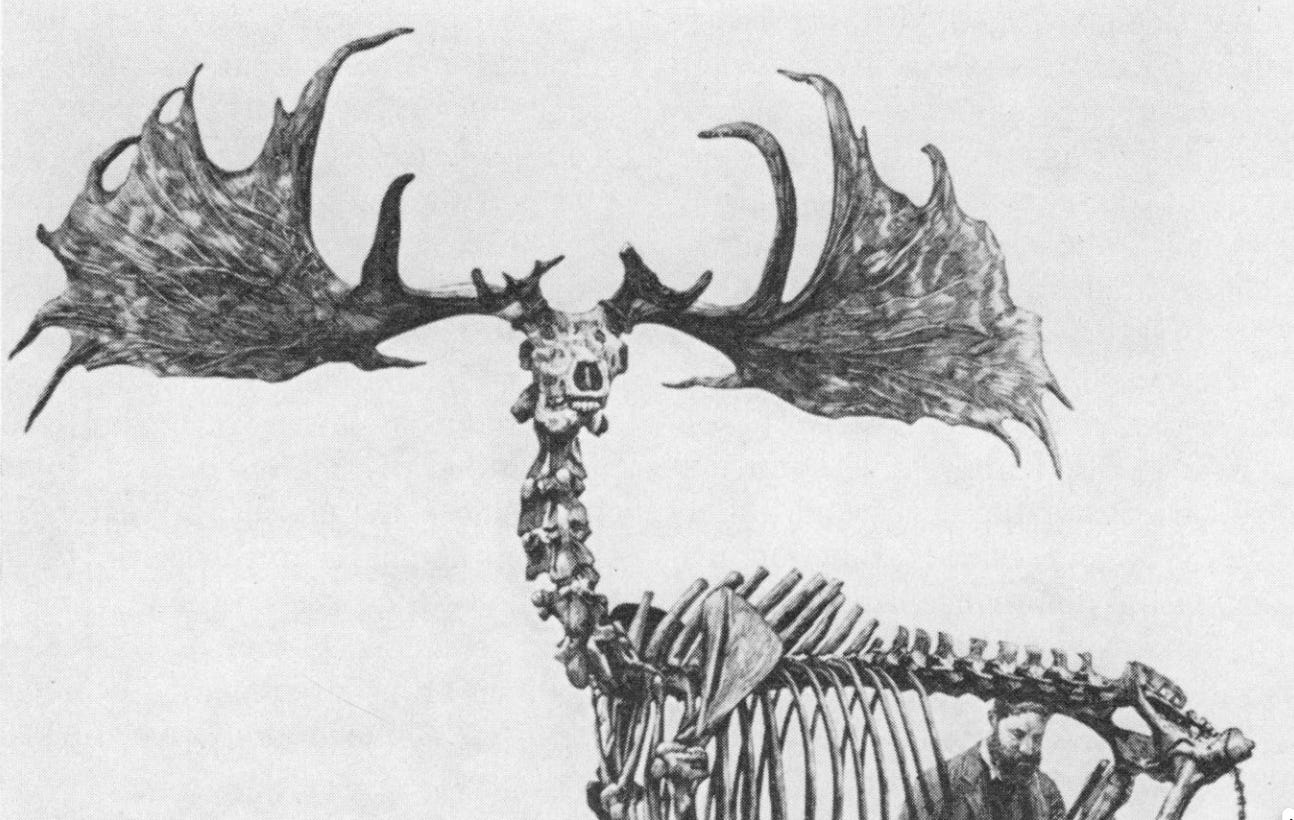
Once these two steps… are in place… humans are obviously going to be more interesting to talk to once there is some possibility that they will tell you the truth…. The direct fitness cost of our brains is so extreme that it must have arisen through some runaway process internal to the species (like the antlers of the Irish elk) and not in response to some fixed environmental challenge.
Henrich’s view is that encephalization was driven by the explosive growth of culture…. My own inclination, as a philosopher, is to put more emphasis on the role that language played in the development of rationality (I am particularly partial to Andy Clark’s account of the “language upgrade” that our biological brains received)…. [This] theory is worth explaining because, apart from being just monumentally clever, it is also one of the most exciting developments in the human sciences to have occurred during my lifetime…

What is meant by the reference to the Irish Elk, Megaloceros Giganteus? This:
And Stephen Jay Gould wrote:
Stephen Jay Gould: The Origin and Function of ‘Bizarre’ Structures: Antler Size & Skull Size in the ‘Irish Elk’ Megaloceros Giganteus <https://www.jstor.org/stable/pdf/2407322.pdf>: ‘Large antlers mark large bodies. Large bodied stags probably ranked highest…. If large antlers signalled this position without incurring the rigors of actual combat (either by female choice or… ritualized encounters)… they would have been of the greatest possible and most immediate selective advantage… in reproduction…. As Huxley wrote… “With increasing intensity of selection between males, epigamic characters that are hypertelic or even useless to the species are developed, and with polygamy such characters may be evolved to the limits of mechanical possibility, and even be disadvantageous to their possessors in all respects save that of mating”…
Back up:
10 million or so years ago—we think—the first things that we call Hominidae—Hominids—appeared on the earth. We have found in Kenya a right jawbone with three molars plus eleven isolated teeth: Nakalapithecus Nakayamai. It appears evolutionarily close to the last common ancestor of Central-African Montane Forest Apes, Central-African Mosaic-Woodland Apes, and East African Plains Apes—gorillas, chimpanzees, and humans. It appears to be just after the split-off of the Asian Rainforest Canopy Apes—orangutans.
The Hominidae—the Great Apes, the Hominids—have not been an extraordinarily successful group of species. They derived from an earlier superfamily of Hominoidae—Hominoids—that emerged about 25-20 million years ago. We Hominoids started at a very small initial population. We then grew to an apparent “Ape Peak” between 15 and 10 million years ago of perhaps 5 million individuals, who livedacross wide swaths of Africa and Eurasia in tropical forests.
But the climate cooled. The tropical forests that were their habitat shrank back. Populations fell. The gibbons and siamangs remained in the canonical arboreal habitat. Evolutionary pressure pushed what became the Hominids, the Great Apes, into other niches: gorillas to the mountain forests, chimpanzees to mosaic woodlands, orangutans to Asian canopies, and us to the East African plains.
As of 75,000 years ago there were perhaps 500,000 gibbons and siamangs, and perhaps 2 million of us Great Apes, Hominids proper—orangutans, gorillas, chimpanzees, and humans—on the earth. That was then, perhaps, about as many as there were lions. That was one-tenth the numbers of elephants. That was one-five-hundredth the numbers of antelopes.
Today, of course we East African Plains Apes number 8.4 billion. We have: 200,000 times the population of lions, 15,000 times the population of elephants, and 80 times the population of antelope. We are 34% of mammal biomass. Our domesticates are 62%, leaving 4% of the total biomass for all the wild animals left in the world. And the raccoons and the coyotes are now trying hard to domesticate themselves, with many other animals taking steps along the same road as we create enormous, spatially concentrated, predictable flows of garbage calory opportunities and shelter possibilities. Animals that can reduce their fear of us just enough but not too much, learn to navigate our built environment, and pass those tricks on have an edge everywhere outside our wilderness parks.
A question: of the perhaps 2,000,000 alive on earth 75,000 years ago of Hominids, of us and our very, very close cousins, how many were us proper? How many of those should we call “great-grandma”?
That is a question with many different answers:
One answer: the gene people say that more than 90% of humans alive today derived more than 90% of their genomes from a small population of 5000 or fewer breeding pairs that lived in East Africa about 75000 years ago. That does not mean, for those of us along with me in that 90%, that those less-than-10,000 or fewer fill more than 90% of the slots in that layer of our family trees. Rather, it means that chunks of genes coming from others have been selected against over the past 2,500 generations sufficiently strongly that they are no longer there. There was something maladaptive about those genes: even if it is only that they made you look funny, and hence got slotted into a marginal place in human society.
Were those less-than-10,000 simply an accident, and otherwise nobody very special? Descent is, after all, a Galton-Watson branching process. Or was there something very special in the cognitive toolkit of those less-than-10,000? Were they simply Mesdames and Messieurs Supremely Lucy? Or were they Mesdames and Messieurs Very Clever (for their day, for the important parts of that cleverness are now shared by all 100% of us in the here-and-now)?
We do not know. Whether 75,000 years ago there really were less than 10,000 of us for the most appropriate definition of us—whether “we” in some important sense were then almost extinct—hinges on the unknown answer to that question. So “10,000” is a possible first answer.
A second answer: There were 75,000 years ago perhaps 200,000 anatomically modern (and almost surely all behaviorally modern) members of our sub-species, Homo Sapiens Sapiens, walking around. Perhaps half in an East-African and half in a Southern-African population whose genetic markers are now most powerfully expressed in today’s Khoesan population. So: “200,000” is a possible second answer.
And then there is a third answer. 75,000 years ago there were not only the 200,000 or so of Homo Sapiens Sapiens walking around, but others. There were—perhaps—some 67,000 or so Newman Valley guys: Homo Sapiens Neandertalensis. Also: 67,000 or so Denisova Cave guys: Homo Sapiens Denisovensis. Also: 67,000 or So from “ghost populations” that we have found no physical evidence of, but that the gene people assure us were there and were interbreeding. So that is 400,000 total in the population 75,000 years ago. We can legitimately claim to be our great-grandfathers and grandmothers.
Here comes the point: That 400,000 is not very many people. On the most expansive definition of us, we were outnumbered four to one by the other great apes back then. We were outnumbered four to one by the lions. We were outnumbered 40 to 1 by the elephants. We were outnumbered 2,000 to 1 by the antelope. If we take the 10,000 number, the ratios become gonzo astronomical: 160-to-1 for the lions, 1600-to-1 for the elephants, 80,000-to-1 for the antelope.
A distant stranger to the world, a being of vast intellect—whether cool or warm or unsympathetic or sympathetic—gazing at the world 75,000 years ago would have been unlikely to see us as particularly interesting. They would have seen us as marginal.
Consider: Individually we are massively unfit for survival. Take us out of our civilization and cast naked into the wild—as happens on the shlock TV show Naked & Afraid—and even the most-fit and most wilderness-experienced of us start losing half a pound a day, and face death within months.
Yes, we were extraordinarily social, for something that lacked a worker caste that shared 100% of their genomes. Yes, we had incredible instinctive predispositions to imitate and thus to create, share, and transmit “culture”. Yes, we were much better in groups than on our own. Yet, we were extraordinarily social. Yes, we had huge and energetically expensive brains. Yes, those brains had given us powerful capabilities.
For example, we spend only two hours a day chowing down, not the eight or so of our close cousins. We do not eat raw broccoli for hours and hours, but rather food “pre-chewed” in various ways by fire and acid. Come to think of it, even the raw broccoli of today itself has been heavily biotechnologized. It has been made tasty, nutritious, and easy to digest. The Broccoli family created it before moving into “James Bond” movies. Plus today we see things like the more than one million of unrelated East African Plains Apes involved in the complex social division of labor that we have labeled ‘Toyota’.
But.
Not as of 75,000 years ago.
Back then, in biomass terms, baboons alone probably had all of us great-ape hominids beat. Our close cousins who had stayed fully or partly up in the trees, even with the diminished tropical forest cover, might well have been judged to have made a better evolutionary bet.
Back then, considered in evolutionary terms, in our niche of a really big brained, voice-using, anthology-intelligence fire-controlling cultural-technological species? We were not at all a clear success. What was our clear evolutionary survival pathway going forward?
Humans as dominating our natural environment in any real sense would have seemed absurd. Our hands and our brains and our culture with tool-making, fire-controlling, and all the rest would have seemed barely enough to keep our noses above water as we tried to stay afloat in the gene pool. Those features came with energy-requirement and maternal-mortality drawbacks, and did not then appear to have given us any Darwinian edge over either our closest cousins, let alone large mammal species in general.
Consider the Irish elk of 75,000 years ago: Megaloceros Giganteus. A typical mature male would have a 12-foot peak antler span, just as we have our 1400cc brains. But while the antler span was certainly advantageous to a potentially breeding male, it was a huge liability for the species’ long-term survival chances. The Irish elk went extinct 10,000 years ago.
We probably finished them off. They probably did not taste much like chicken.
References:
Boyd, Robert & Peter J. Richerson. 1988. Culture & the Evolutionary Process. Chicago: University of Chicago Press. <https://press.uchicago.edu/ucp/books/book/chicago/C/bo5970597.html>.
Boyd, Robert & Peter J. Richerson. 2005. The Origin & Evolution of Cultures. Oxford: Oxford University Press. <https://global.oup.com/academic/product/the-origin-and-evolution-of-cultures-9780195181456?cc=us&lang=en&>.
Boyd, Robert & Peter J. Richerson. 2006. Not By Genes Alone: How Culture Transformed Human Evolution. Chicago: University of Chicago Press. <https://press.uchicago.edu/ucp/books/book/chicago/N/bo3615170.html>.
Clark, Andy. 1998. “Magic Words: How Language Augments Human Computation”. I in P. Carruthers & J. Boucher, eds. Language & Thought: Interdisciplinary Themes. Cambridge: Cambridge University Press. <https://era.ed.ac.uk/server/api/core/bitstreams/b6cb5fbf-1d31-406c-aa38-e276a7d43e70/content>.
DeLong, J. Bradford. 2026. “Population, Living Standards, & Technology: Econ 196 Seminar”. Lecture Notes. May 7. <https://github.com/braddelong/working_20251227/blob/main/2026-01-27-DELIVERED-econ-196-week-2-pop-income-2.ipynb>.
Gould, Stephen Jay. 1974. “The Origin & Function of 'Bizarre' Structures: Antler Size & Skull Size in the 'Irish Elk,' Megaloceros Giganteus”. Evolution. 28:2 (June), pp. 191-220. <https://www.jstor.org/stable/pdf/2407322.pdf>.
Heath, Joseph. 2026. “Harari vs. Henrich”. In Due Course. June 12. <https://josephheath.substack.com/p/harari-vs-henrich>.
Henrich, Joseph. 2015. The Secret of Our Success: How Culture Is Driving Human Evolution, Domesticating Our Species, & Making Us Smart. Princeton, NJ: Princeton University Press. <https://henrich.fas.harvard.edu/publications/secret-our-success-how-culture-driving-human-evolution-domesticating-our>.
Huxley, Julian. 1938. “The Present Standing of the Theory of Sexual Selection. In G. R. de Beer, ed., Evolution. Oxford, Clarendon Press. p. 11-42. <https://www.journals.uchicago.edu/doi/10.1086/280795>.
Jones, Doug. 2016. “Toba? or the Sperm Whale Effect?” Logarithmic History. August 4. <https://logarithmichistory.wordpress.com/2016/08/04/>.
MacDonald, James. 2019. “The Cartoonishly Giant Antlers of the Irish Elk”. Daily JSTOR. November 8. <https://daily.jstor.org/the-cartoonishly-giant-antlers-of-the-irish-elk/>.
Shalizi, Cosma. 2026. “Branching Processes”. Bactra Notebooks. March 6. <https://bactra.org/notebooks/branching-processes.html>.