
CROSSPOST: RENÉE DiRESTA: Red Mirage, Blue Shift, Online Cope
!Spencer Pratt and the 2026 Fraud Script: Majority illusion, mail ballots, and the coming election-night panic. How a viral mayoral longshot, a predictable vote‑count pattern, and a right-wing grifter ecosystem prefigure 2026. “Dumped votes” and prediction‑market screenshots are tells, not evidence, in the next round of election denial. And it is Spencer Pratt’s LA flame‑out that teacheth the lesson about social media, mail‑in ballots, and weaponized delusion…
Online hype made Spencer Pratt’s LA mayoral bid look dominant, but normal vote-counting erased the illusion. Unfortunately, the count pattern did ot fuel but was used by right-wing grifters baseless fraud narratives.
This is important! Read it! Remember it!:
How social media’s “majority illusion” made Pratt’s online support look like real-world majority backing to naïve right-wingers, even though local polling never showed him leading.
There is a “red mirage, blue shift” dynamic in mail-in voting, where early in‑person votes skew Republican and later mail ballots swing Democratic, predictably eroding GOP election‑night leads.
Right-wing election-deniers and grifter-influencers weaponize this predictable counting pattern.
They add irrational prediction‑market moves into their argument to insinuate fraud whenever their side loses ground.
Last, the fraud claims are a form of “cope” for supporters who mistake their curated feeds for the electorate.
Understanding these dynamics is essential for understanding what is likely to go down on election night 2026.
CROSSPOST: RENÉE DiRESTA: Red Mirage, Blue Shift, Online Cope
Jun 07, 2026
<https://agentsofinfluence.substack.com/p/red-mirage-blue-shift-online-cope> <http://agentsofinfluence.substack.com>

Spencer Pratt is a man who understands spectacle. Even if you’ve never watched an episode of The Hills, you probably know the contours of his reality-TV villain arc — it fed the early-2000s gossip-blog machine. He has name recognition. And in 2026, in the age of politics as pseudoevents and kayfabe, he became the main character of the LA mayoral primary.
His candidate plotline was made for the attention economy: nontraditional longshot breaks out by saying what They Don’t Want You To Hear. Compelling personal story: he tragically lost his house in the LA fires. Strong trolling game. Online clipper accounts went crazy for him – not entirely organically, but hey — it’s called the attention economy for a reason. The algorithm ate Pratt up.
However, the season finale is upon us, and it’s taking the form of a proliferation of predictable conspiracy theories promoted by people who should know better.
The LA mayoral primary’s devolution into conspiracy tropes, Polymarket screenshots, and Grok fact-checks is useful because it shows a script we are going to see again in 2026: viral candidate overperforms in the feed, ordinary ballot-counting reveals a different reality, and the people who conflated engagement with votes decide that there’s something suspicious about the count.
The majority illusion
Network scientists at USC explained it years ago: your social media feed is dominated by the loudest, best-connected nodes. Their opinions can feel like the majority consensus even when it’s not. You might be thinking you’re seeing the population, when you’re really seeing the loudest people. The term they gave for misjudging where prevailing opinion is based on what you see around you is called the majority illusion.
Pratt, the former reality-TV villain, ran a campaign tailor-made for clipping and virality. The personal-loss story. The visible dysfunction LA continues to struggle with. The “incompetent incumbent” frame he was able to wield against Bass. The algorithm loves righteous indignation; people like an underdog; lots of voters are already inclined to believe existing government officials are useless; and Pratt is unusually well-suited to the age of vertical video. His opponents were politicians. He was a content creator.
The attention economy dynamics were compounded by the fact that California is a national content object. California politics is insane! It attracts a massive amount of attention from people who are not Californians. When I lived in SF for a decade, I was very involved in local politics and constantly bemused by the national interest in our algebra wars, school board recall, DA recall, and House, Senate, and governor’s races. California looms large in ‘Dems In Disarray’ storylines, and Fox News is always on it. There are also enough California-based influencers and poasters that its political discourse seeps onto everyone else’s feeds, and then they have feelings.
And that’s where things can get weird. Ten years ago, I was strongly advocating for a bill to improve vaccination rates in California public schools and constantly getting yelled at by nutjobs online. The bill was polling around 70% approval in surveys by the Sacramento Bee and other local media. Online, the conversation was almost entirely negative. But the online conversation was shaped by lots of people (Texas antivaxxers, hello!) who didn’t live anywhere close to California. There were also bots.
The Pratt feed really was inescapable. In certain parts of X and TikTok, he was once again as much a fixture as he was on the gossip blogs during his reality-TV heyday. He has more than a million followers on X. A fan-made AI video casting Pratt as Batman and Karen Bass as the Joker pulled more than 5 million views; another, featuring pilates moms confessing they were voting for Pratt, did nearly two million. The campaign barely bothered with traditional paid media, leaning on clips and boosting fan-made content while his rivals spent on TV. The Extremely Online right-wing influencer machine boosted him (for better or worse; Steve Bannon presciently remarked that he would endorse him but didn’t want to hurt him in LA).
When your feed is wall-to-wall Pratt — clips, endorsements, memes, weird AI propaganda — it is easy to slide from “Pratt is popular online” to “Pratt is popular.” But a clip with three million views just tells you the clip did numbers online, and presumably a lot of people who liked it are nowhere near Los Angeles. The engagement number alone does not tell you much about how a city of millions will fill out their ballots.
I pulled up polling data to see where the numbers were as Pratt’s campaign went viral. Polling experts, please correct me in the comments if I’m wrong, but as far as I can tell, Pratt advanced from about 14% in the March UC Berkeley IGS/LA Times poll to 22% in their final survey. That final poll had Bass at 26% and Nithya Raman at 25%. The only survey that ever showed him ahead was a 400-person McLaughlin & Associates poll — a Republican pollster — that contradicted every other survey of the race but Breitbart touted it. As the clips spread online, Pratt’s unfavorability climbed from 28% in March, when most likely Angeleno voters had no opinion of him at all, to 57% by late May. (Raman’s recognition increased, and her favorability climbed.) I went back and looked at Zohran Mamdani, who also dominated social media on his way to actually winning New York; his online momentum did show up as positive trends in the polls.
But the extremely online MAGAsphere on X seem to have equated high online engagement with high odds that Spencer Pratt was going to win, or make it to a runoff. The former was always a serious long shot. This is Los Angeles! Pratt is a Republican candidate, with President Trump’s public blessing, running in a city where GOP registration is under 15%. The last Republican mayor of Los Angeles was elected in 1993, and left office in 2001. Most people in LA hate Trump. They may be very frustrated with Bass and very, very reluctantly voting for her again, but it’s unrealistic to believe they would elect Pratt in a landslide. A runoff seemed possible, but the third candidate had to be considered.
Red mirage, blue shift
So did they take the loss like adults? Well, consider this post by Florida Governor Ron DeSantis. Quote-tweeting a post about Pratt’s declining odds on Polymarket, he wrote that California “keeps dumping votes,” that the ballot drops “always seem to go one way,” and asked whether officials were counting “until you get the result you want.”
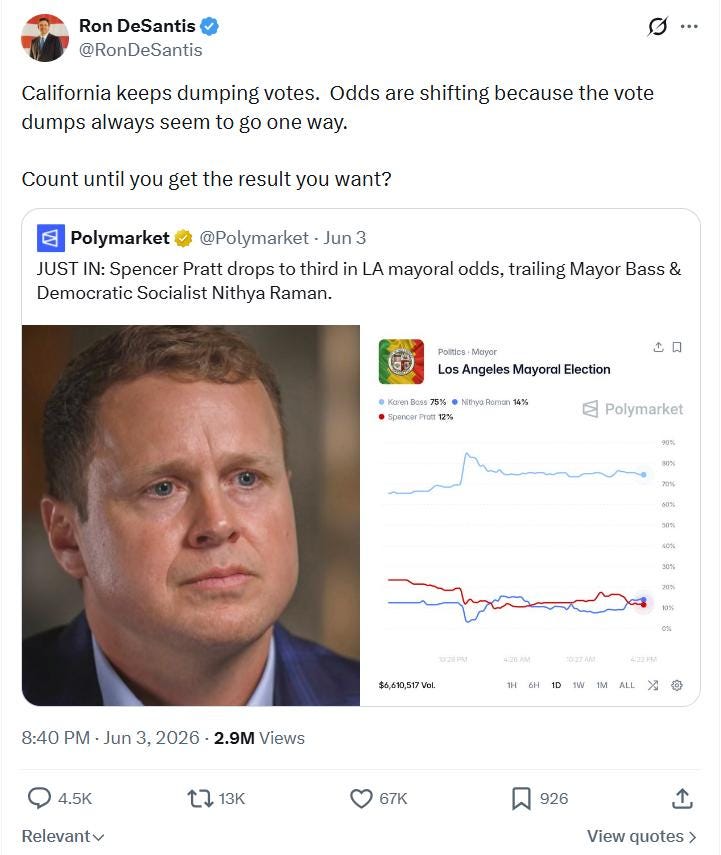
“Dumping votes”? Scheduled release of counted legal ballots, or things falling off the back of a truck? DeSantis, who is a governor, gets to gesture at fraud without having to produce any evidence of it. Why? Because most of the ballots are likely to go for Bass or Raman…which any competent prediction market bettor would ironically be aware of.
Here’s why the ballot drops “go one way”: Republican voters are more likely to vote in person. Democratic voters are more likely to vote by mail. California has lots of people who use vote-by-mail, which means it takes days to process ballots, verify signatures, cure problems, and update totals. As those later ballots are added, a Republican lead can shrink. Sometimes the order flips. This is one of the most predictable features of vote-counting in states with heavy mail voting. This phenomenon is commonly called the “red mirage, blue shift.”*
Every American should understand what is happening right now with the narratives surrounding the mail-in ballot count, because election deniers have learned to use ballot-counting timelines, and this very predictable shift, as a fraud-accusation template whenever their preferred candidate’s early lead shrinks.
On election night, Pratt was around 30% of the vote, roughly ten points and 40,000 votes ahead of Raman for the second runoff slot. By Friday evening, with about 71% of the expected vote counted, it was Bass 35%, Pratt 28.2%, Raman 24.9% — a lead of 20,672 votes, shrinking with every batch the Registrar released. The trend is appearing in the governor’s race on the same ballot: Steve Hilton, a Republican running for Governor, led on election night and watched Democratic challenger Xavier Becerra eat into his margin as mail ballots were processed. Becerra has now passed him.
In November 2022, in the LA mayoral race, Republican Rick Caruso led Karen Bass in the post-election count by about 12,000 votes — 51.25% to 48.75% — with many ballots still left to count. Bass overtook him days later as mail ballots were processed, and ultimately won by about nine points. Same city, same office, one cycle ago.
Election deniers have recently tried to reframe the fact that this pattern is predictable as some kind of plot in and of itself. Explaining its predictability is an effort to normalize election fraud, you see, because that is prebunking it, and prebunking is brainwashing, and we can’t prove that the ballots aren’t being manufactured or bussed in from China or whatever this time. Yes: as you read this newsletter explaining the basic predictable mechanics of online narratives and electoral systems, I am actually brainwashing you into accepting fraud as normal.
X has done quite a bit to feed the election rumor frenzy: there was a spate of misleading claims that a batch of 24,000 votes (the Notorious Searchable Statistic of this race) had been released, of which Pratt earned zero.
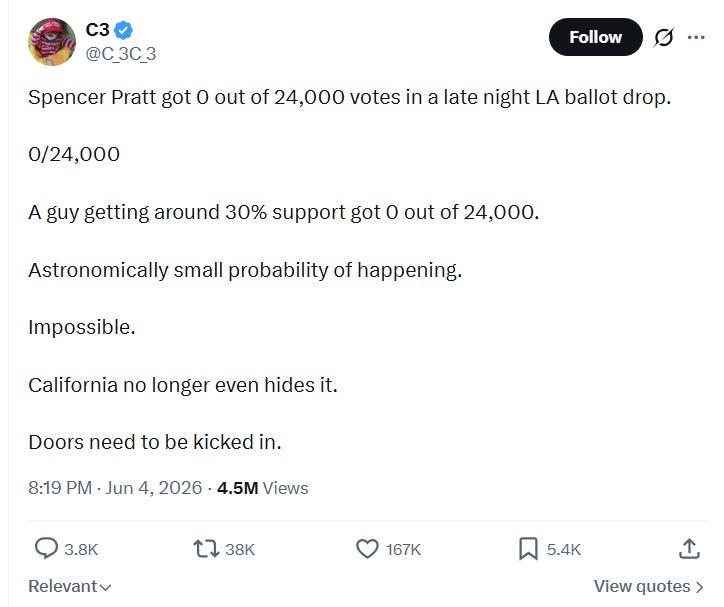
This turned out to be false – some screenshot had captured a moment before Pratt’s tally was updated. (AP told the LA Times that the two updates together actually included 21,870 votes for Pratt, 12,850 for Bass, and 9,521 for Raman.) Governor Gavin Newsom and an Assistant US attorney from the DOJ came out to debunk the claim. Grok had been confused in the early moments when the claim first began to circulate, but subsequently began to factcheck it correctly. Yet for some reason, no Community Notes showed up on tweets making the false 24,000 Pratt-Excluding Ballots claims.
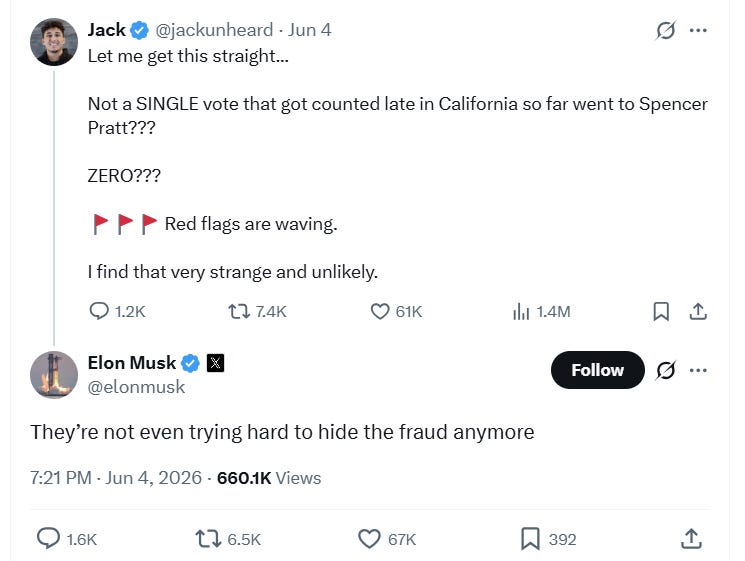
Elon Musk, who used to vote by mail in California, obviously weighed in.
There is, to be clear, no evidence of fraud anywhere. Pratt continues to gain votes. He is just not gaining them at the same rate as his Democratic opponents.
Prediction markets figure in a fair number of bizarre claims this time around as well; they have updated with each release count, which is the point of having prediction markets. Somehow, some of the same people screaming fraud have decided that the market moving against Pratt is evidence that traders “know” he will lose because the race is rigged. This is a strange theory of prediction markets. The whole premise is that the market updates as new information comes in. Prices should cut through the cope. Red mirage/blue shift likelihood affecting the outcome should be priced into the contract, since it is how election behavior works and people are committing real money.
The cope
Pratt tapped real anger. LA is expensive, and a lot of angry, exhausted people are living with the consequences of fires and compounding institutional failure. A candidate who points a camera at visible dysfunction and says, “it shouldn’t be like this” will attract attention from people who appreciate that he is acknowledging what they are feeling.
But clips and memes aren’t ballots. Going viral doesn’t translate to getting elected. A fraud narrative can be a comforting bridge between those two things: it lets supporters continue to trust their perception. The feed wasn’t distorted, the count was. If everyone you saw online wanted Pratt to win and Pratt didn’t win, someone must have interfered.
As of Saturday evening, Pratt still led Raman by 7,494 votes, with more ballots left to count. Pratt himself has not claimed fraud. If Raman ultimately takes the second runoff spot, we will see what he does. California’s count really is slow, and wanting it faster is a legitimate complaint. But “California keeps dumping votes” is not the language preceding a process-improvement proposal.The blue shift in mail-in ballots isn’t an anomaly, it’s a highly predictable event – which means that at this point, grievance-grifters on X have pre-positioned themselves to cry fraud every time a completely normal, predictable thing happens. They will never be lacking for “evidence.” The broader script for the midterms is already clear: early returns will be treated as the “real” election; everything counted afterward will be treated as contamination.
The Hills ended with the camera pulling back to reveal the “street” was a backlot set all along. The sooner Americans understand that political influencers screaming “fraud” are performers too, the better.
*Election law scholar Edward Foley named the “blue shift“; the data firm Hawkfish named the “red mirage“ half in 2020, warning — correctly — that Trump’s election-night lead would be an artifact of counting order.

Brad here: What do I hae to add? Little. She has said it most, and said it well. To recapitulate: there are three moving parts:
The network‑science “majority illusion” that fools people into overestimating their side.
The red‑mirage/blue‑shift mechanics of modern vote‑counting.
The incentive structure facing influencers and politicians who profit from permanent grievance.
The upshot is grim but clarifying: early returns will again be framed as the “real” election, and everything after as contamination by design. Democracy in the U.S. may not survive this election cycle.