
The Viking Ráðagerð Further Gels: IMAGE OF THE DAY
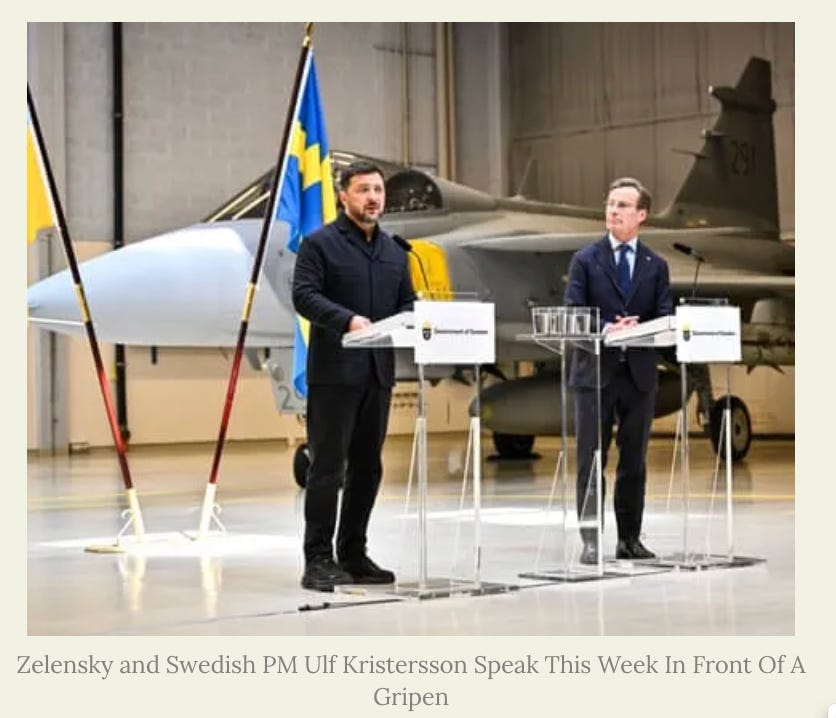
This picture of a Ukrainian president in front of a Swedish fighter jet may be a sign of a significant change in the wind: if opinion, industry, and force structure align, a northern VIking Ráðagerð could become the mid‑continent super‑region that keeps Russia deterred even in a post‑Pax Americana world…
Well! An interesting image:
And we have, in commentary:
Phillips O’Brien: Is Ukrainian Now A “Nordic” State? <https://phillipspobrien.substack.com/p/weekend-update-187-trying-to-collapse>: ‘Zelensky… flew into Sweden…. The Swedes donated 16 earlier generation Gripen fighters to the Ukrainians (they should arrive in early 2027) and from that point the Ukrainians will go forward to buy many more. The original purchase order looks to be 20 of the most advanced generation of Gripens—with an eventual order of up to 150 being mooted…. This is only the latest of what has been a series of strong commitments to Ukrainian defense by… Nordic states… [which] have gone far beyond most in their financial and military backing of Ukraine and, moreover, are more comfortable discussing Ukraine winning the war…. The Baltic-North sea states. The Nordics, Baltics, Poland, Germany, the Netherlands and the UK at this point are the key ones in determining whether Europe will both aid Ukraine to win the war and whether Europe will actually free itself from US strategic dominance…
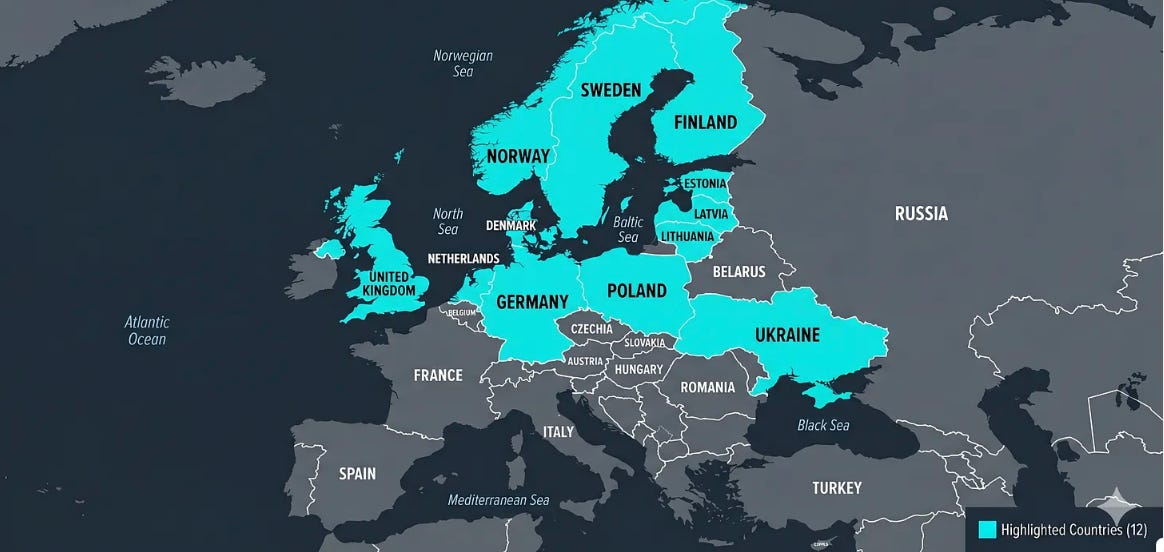
I would add Canada, Greenland, and Iceland to this list of countries that I see as becoming a Ráðagerð, as we used to say in Old Norse. As Dmytro Kuleba wrote last week, “the Vikings are returning to Ukraine… a fascinating turn of history”. Every place that real Vikings settled (save for Belarus and Normandy) plus the Netherlands and Germany (and Roumania?: a Russian drone hit an apartment building in Galati last week) is now a strong proponent of the creation of a pickup pro-freedom US-independent political and military alliance stretching from Vancouver to Lake Ladoga and the mouth of the Don.
The Viking Alliance ex-Ukraine spends about $150 billion a year, with Ukraine currently at $70 billion. The Viking Alliance ex-Ukraine has 300 thousand active-duty soldiers, with two million reservists. Ukraine now has a million-man well-bloodied army: the largest real combat-experienced land force in Europe right now, with enormous artillery, drone, and EW learning-by-doing. Plus: add up GDP, trade networks, and control over critical infrastructure and a Viking Ráðagerð is not a plucky band of small states but a mid‑continent economic super‑region
Opinion, élite and mass, in Nordics, Baltics, Poland, Canada, UK, Netherlands, and (increasingly) Germany converges on three points: Russia is revisionist; the U.S. is less reliable; and Ukraine’s victory is a core interest. That ideological and threat‑perception alignment is rarer than it looks, and it is exactly what successful alliances are built from.
A Viking Ráðagerð would almost certainly start as an overlay on existing structures internalizing shared air/missile defence, munitions procurement, undersea infrastructure protection. There is already, in the UK‑led Joint Expeditionary Force, a mini‑Viking rapid‑reaction construct with Nordics, Baltics, and the Netherlands. Can they pre‑commit their military spending, at least at the margin, to shared industrial capacity—joint artillery lines, drone swarms, air defence, Arctic and undersea capabilities?
A Vancouver‑to‑Azov bloc that explicitly defines itself as a provider of security, not a consumer of American guarantees, organized around “no free pass in the Arctic or the Baltic” has a clear strategic centre of gravity. But whether the Ráðagerð exists de facto will be visible in one place: does this coalition underwrite Ukraine’s long‑run force structure and defence industry on the scale required to keep Russia deterred? To the Trumpist neofascists, the message is: we are an alliance that can carry more than our share if you stay in, and muddle through if you don’t. To Moscow, it is: even if you pick off U.S. commitment, the northern front does not dissolve; it stiffens.
The biggest risk, of course, is not capacity but cohesion. This is a coalition of parliamentary democracies with proportional representation and potentially fragile governments. The Ráðagerð only “gels” if its members can firewall Ukraine and northern deterrence from domestic populist cycles—through multi‑year funding laws, binding industrial compacts, and pre‑delegated military cooperation—rather than treating security as something re‑litigated every election.