
Paul Krugman, Cui Bono from the Coming of the Bio-Info Tech-Attention Economy, & Embarrassing Conceptual Errors by Economists Who Really Should Know Better: CHART OF THE DAY
Aghion, Bergeaud, & Garicano claim America’s tech productivity-growth lead is materially widening a US vs. EU real wage and standard-of-living gap.
Product wage yes.
User wage no.
This is—or ought to be—elementary. And I at least, am horrified by Aghion, Bergeaud, and Garicano’s false claim that the benefits from US info-tech productivity growth are not primarily widely distributed among all users. Krugman’s Dutch thought experiment shows that once you ask who captures the surplus—producers or users—as an analytical matter, important elements of ABG’s story are reduced to absurdity…
Paul Krugman <https://paulkrugman.substack.com/p/challenging-the-narrative-of-european-478> <https://paulkrugman.substack.com/p/europe-versus-america-a-response> successfully performs a reductio ad absurdum against Aghion, Bergeaud, and Garicano <https://www.project-syndicate.org/onpoint/paul-krugman-is-wrong-about-us-europe-productivity-gap-by-philippe-aghion-et-al-2026-05>:
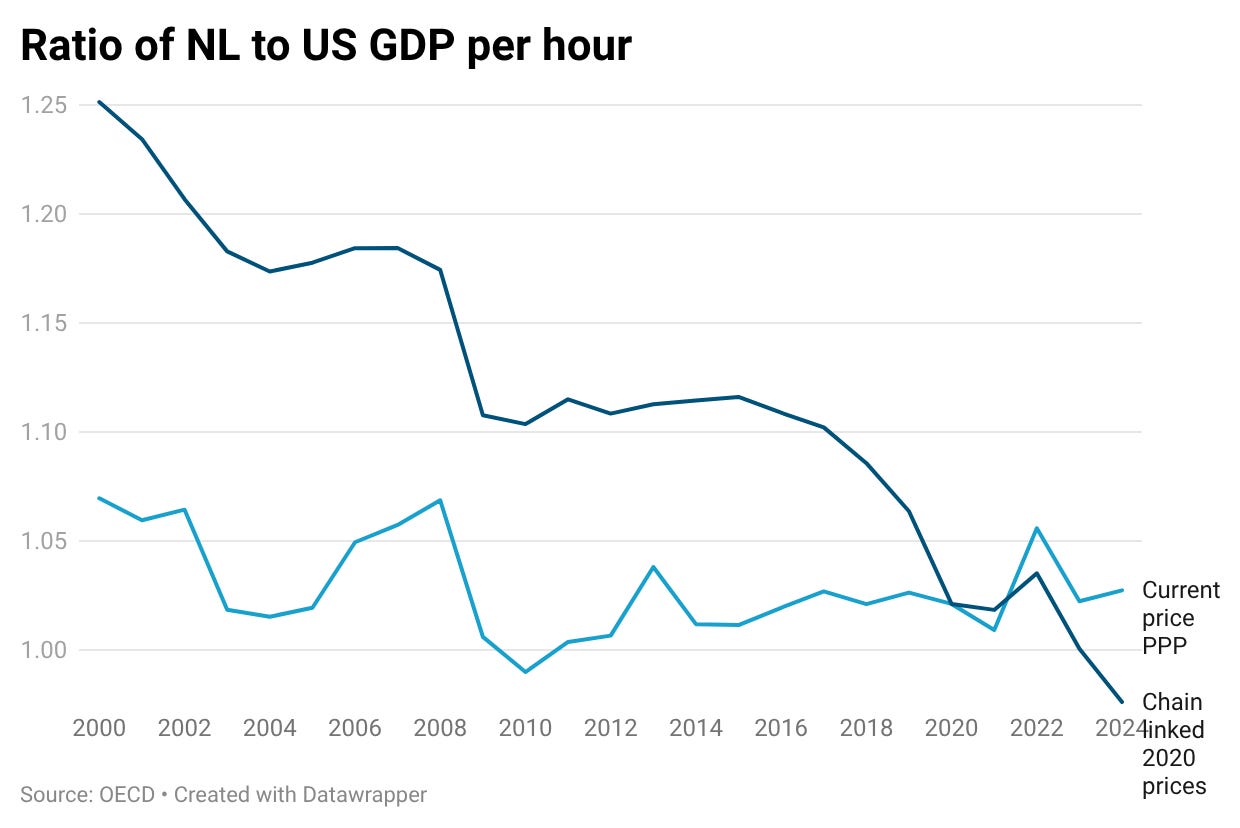
Aghion, Bergeaud, and Garicano correctly observe that the US and Europe have had similar very different productivity growth profiles since over the past generation.
Aghion, Bergeaud, and Garicano incorrectly assert that productivity growth trends translate effectively one-for-one into differences in real incomes:
Contrary to Krugman’s argument, the US lead in technology and innovation is not helping America and Europe in the same way. It has led to higher US wages and profits, and the gap is widening each year. So, Europe’s productivity problem is not an accounting issue. As Krugman himself once famously remarked, “productivity isn’t everything, but in the long run, it is almost everything”… <https://www.project-syndicate.org/onpoint/paul-krugman-is-wrong-about-us-europe-productivity-gap-by-philippe-aghion-et-al-2026-05>
Paul Krugman points out that there is a neo-mercantilist false assumption behind this incorrect assertion by Aghion, Bergeaud, and Garicano. That neo-mercantilist false assumption is that (1) the benefits and surplus from productivity growth are overwhelmingly concentrated among producers. That can be the case. That is not always the case. Alternatively, (2) the benefits and surplus can, alternatively, be diffuse as they are distributed across users.
In the past generation, as we have moved from the globalized value-chain into the info-bio tech-attention economy, it has been primarily (2). Krugman demonstrates this with his chart above. All agree that US and NL real GDP per hour at current PPP are very close. All agree that US productivity growth has significantly exceeded NL productivity growth over the past generation. But does that mean that a generation ago Dutch workers were 25% more productive and Dutch citizens were 25% better-off than Americans did? No. That is the absurdity.
It is is fact not the case that “the US lead in technology and innovation… has led to higher US [real] wages” relative to Europe. (Profits are a different story, and that I will give you.) European users of high-tech have seen their real earnings rise about as fast as American users have. And while the product wage of US producers has risen enormously in the high-tech sector, the user-consumption wage has not as the relative prices of high-tech goods have collapsed.
That Aghion, Bergeaud and Garicano are ignorant of this distinction and make their implicit neo-mercantilist assumption—that actually surprises me quite a bit. Paul Krugman is 100% right on the analytical point here. I try to teach this analytical point every single big sweep economic history course I teach:
I point out what I call the Lewis-Prebisch-Singer fact with respect to the rise of the extraordinary growth in cross-country income : The overwhelming benefit since 1870 of increased productivity in the making of primary products has flowed to users, while the overwhelming benefit since 1870 of productivity increase in making manufacturers has flowed to producers. Hence the “first world” has pulled ahead of the “third world”. But not because the third world has been stagnant technologically in its major export industries, Ratherm, it is because of this different allocation of the surplus and benefits of productivity growth.
I point out that the overwhelming beneficiaries from the establishment of cotton slavery across the U.S. South were not the slave-owners and -masters but instead the consumers of the textiles made from slave-grown cotton. Again: This was because of the differential incidents. Slavery enabled slave-masters to beat and sweat their workers to make more cotton. But the economic consequences of this showed up primarily not in higher real incomes foer them but rather lower prices of the cotton going into and then the textiles coming out of the mills. In terms of the actual beneficiaries, it was as if the consumers of cotton textiles were the real slave masters, and the formal-legal slave -masters were simply their employees, their hired gang-bosses.
I do wish to complain about and sharply admonish Paul Krugman about one thing, however. He begins his latest column with:
A note for most readers: This is inside economics
baseballfootball, a discussion mostly among professionals — and covers issues that even economists seem to be perplexed by. You have been warned…
The implication is that non-economics professionals do not really need to pay attention. Wrong wrong wrong wrong wrong. WRONG!!!
Everyone needs to pay very close attention to this, because it is a very important factor if you are to have any even half-coherent and half-correct understanding of the economy.
And the basic intuition can be drawn on the very simple bog-standard supply-and demand diagram:
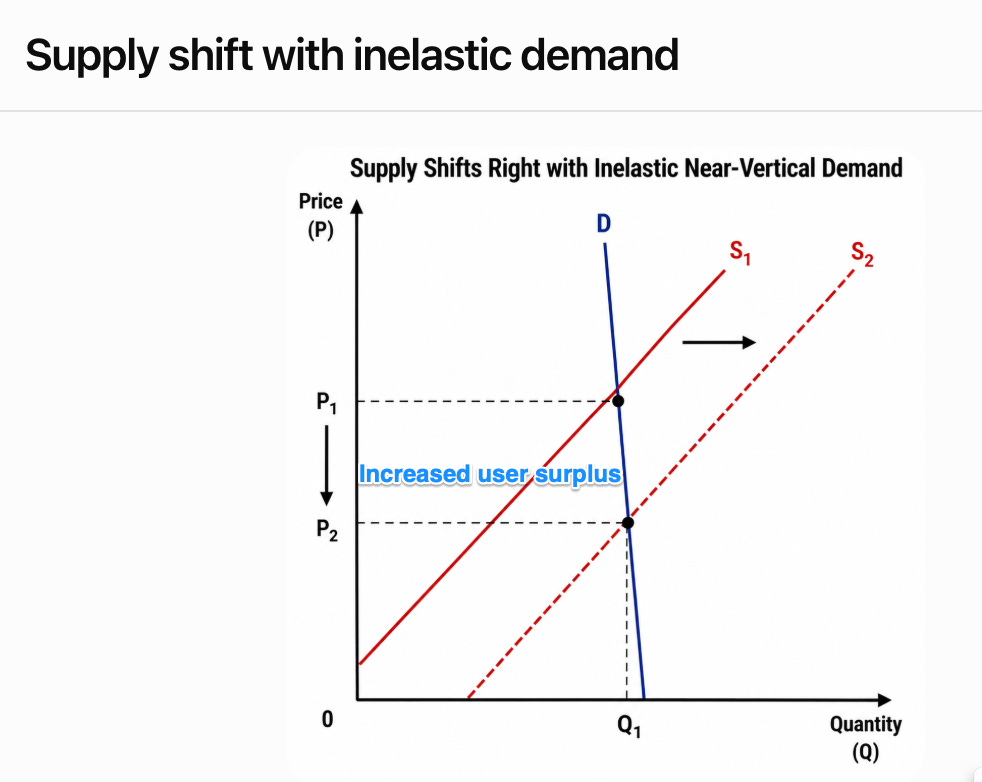
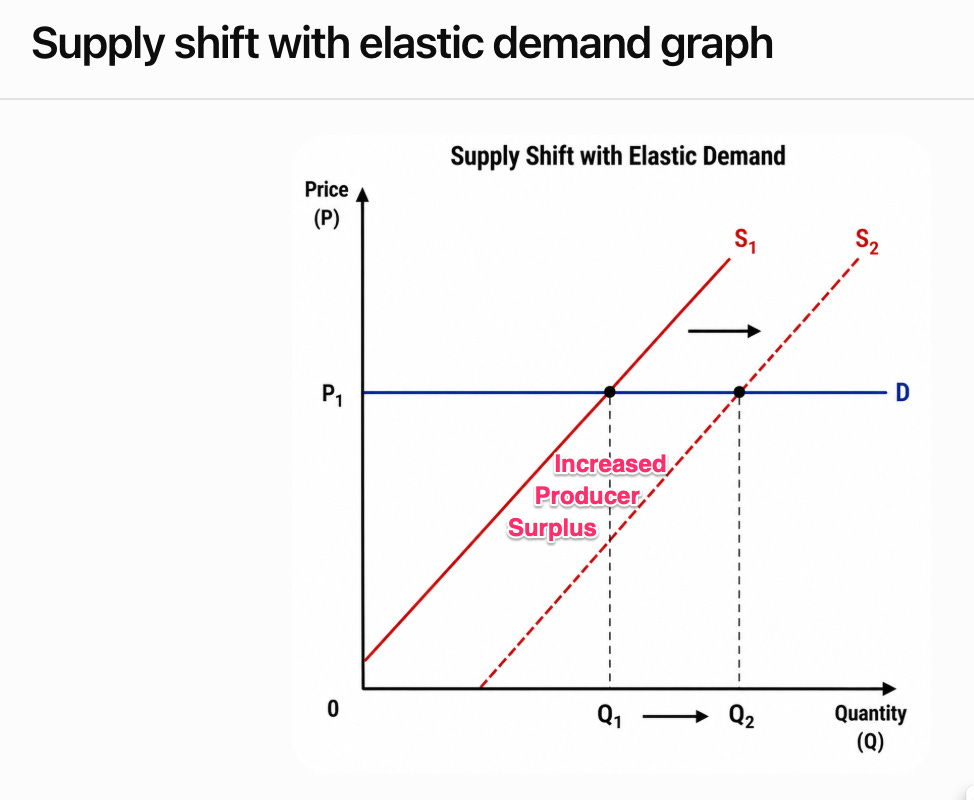
Do costs to producers fall while prices remain more-or-less the same? Or do prices fall along with costs? That is a very important thing to know about any market and any technology-driven economic transformationi.
And yet Aghion, Bergeaud, and Garicano do not seem to understand this.