
Big Trouble in Little Human Genetic Diffence-Worshipper Land
Eric Turkheimer and Sasha Gusev have very smart things to say about those—like Charles Murray—who continue to pretend that we are about to discover that almost all societal inequality is our genes, and hence it is useless to resist or complain about it.
The Hope that Genes Will Somehow Rescue Current Hierarchies
There is a recurring dream on the political right that modern biology will, any day now, deliver the long‑awaited scientific warrant for social hierarchy. The dream has been remarkably stable: It runs from Francis Galton himself through The Bell Curve to today’s Substack eugenicists. Once we can measure the “true” genetic endowment of individuals and groups, the argument goes, we will see that differences in income, status, and power are, in the main, a fact of nature.
Redistribution then becomes not just futile but actively perverse: trying to “fight” the genome. The rich and powerful are inevitable. There is a very strong sense in which their wealth and powerful are “natural”. And this has a strong corollary: there is a very strong predisposition in at least the human thought of our culture that what is according to nature is, in some very strong sense, both just and deserved.
This is what Charles Murray has been selling for three decades.
It has been updated with each new wave of statistical technique:
twin studies,
regression on AFQT scores,
candidate genes,
genome‑wide association studies (GWAS)
polygenic indices.
Now come Turkheimer and Gusev to summarize the state of play. The science, finally, has finally gotten good enough not to reveal the genetic basis of social inequality, but to show that most of the apparently exciting genetic “signals” for complex social traits all but vanish once you control confounding properly.
That is a very different story.
What Happens When You Actually Unconfound the Genetics?
Start with Turkheimer’s discussion of Tan & al. He points to the key numbers hiding in the supplemental tables. He brings good news. We have had a decade‑plus of GWAS for behavioral traits:
educational attainment,
income,
depression,
ADHD,
“cognitive performance”
So you can now do the thing. What is the thing? The thing veryone should have wanted all along: estimate genetic effects within families created by the vicissitudes of meiosis, not those just between them where environmental cofounders are always going to be rife. Within‑family designs hold constant the whole shared package of parental income, neighborhood, school quality, culture, and ancestry. Meiosis shuffles the deck of alleles more or less at random among siblings; that is as close to a randomized controlled trial as social science is going to get.
Once you do that, the “direct genetic effect” heritabilities for behavioral phenotypes come in with a median of about 5%. The celebrated behavioral traits that used to have twin‑study heritabilities of 50%-80% turn out, in this stricter sense, to be only very weakly “genetic.” And when you move from abstract heritability parameters to the actual predictive performance of polygenic indices—the numbers you would in principle hand to the school counselor, the IVF clinic, or the credit‑scoring algorithm—the median R² for behavioral traits is 0.1%. A tenth of one percent of the variance. Two educational‑attainment measures scrape over 1%. Anything less than 10% is, in practice, noise as far as being in any sense worth noting. 1% is noise noise noise. 0.1% is noise noise noise noise noise. And to pay any attention to it at all is to mount a cognitive-destruction attack on your interlocutors and yourself.
People who find themselves impelled to do so automatically disqualify themselves from any chance of membership in any kind of genetic élite.
This is not, I think, what one would have predicted reading the breathless “game‑changer” rhetoric about polygenic scores in the 2010s.
Now let us say the really weird thing: As Turkheimer notes, the discussion section of Tan et al. politely tiptoes around what their own tables imply. What looks to be a big field‑defining paper reports tiny coefficients. It then changes the subject rather than drawing conclusions.
Grandma Galton’s [Grandpa Darwin’s] Revenge
Francis Galton and Charles Darwin did not share a grandma. But they did share a Grandpa: Grandfather Erasmus Darwin. Turkheimer misnames his post.
In it Turkheimer reaches back to the nineteenth century and says: suppose you had asked Francis Galton’s grandfathermother why some people get more schooling than others. She would, he imagines, have given you a default naïve hypothesis: people both
differ in their “constitutions”,
are born into different circumstances
those two things get tangled up in messy ways over the life course that we cannot really separate.
One way of looking at modern behavior genetics is this: It been a 150‑year attempt to make that unsatisfying, squishy commonsense story go away. There have been successive attempts to do what Galton wanted to do for ideological as well as methodological reasons: find a large, clean “genetic” component in educational and social outcomes separable from the environment and hence, through some mysterious alchemy humans derive from the connotations of nature- and natural-talk, morally exculpatory for the current societal order.
But Jaishankar & al. have a “Genomic‑Relatedness‑Matched Association” method. It aims to zero in on within‑family genetic prediction for educational attainment. And the payoff is—again—vanishingly small. The polygenic score, treated as a kind of randomized trial of alleles, explains about 0.1% the variance in schooling. The heritability estimates do jiggle around depending on how you define the variance. Still, none of the within‑family PGS performance metrics gets you to anything that looks in any way potentially relevant for education policy.
Two hundred years of methodological ingenuity, and we are back where Grandpa Darwin would have started: genes and environment both matter in some hard‑to‑untangle way; but attempts to carve out a large, causal, manipulable “main effect” of genes on complex social outcomes keep reducing, on closer inspection, to approximately zero.
From the point of view of eugenic ideology, this is indeed “the gloomy prospect.”
From the point of view of a small‑d democrat, it is excellent news.
How We Mistook Environment for Genes
For context, step back, and turn to Sasha Gusev. He presents another channel by which the allure of genetic explanations ran far ahead of the underlying signal. His story is about population stratification—the fact that allele frequencies differ across subpopulations, and that those subpopulations differ in their environments.
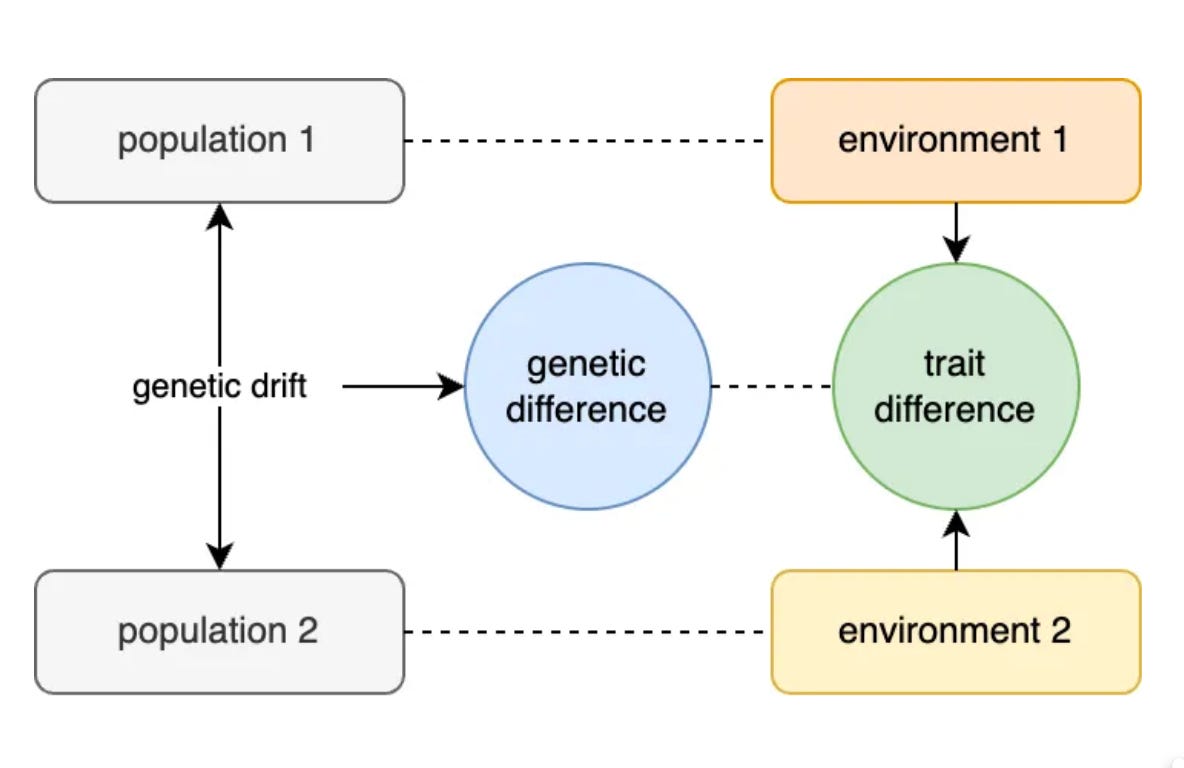
If you have (a) subtle structure in the gene pool—north vs. south, rich vs. poor, caste vs. caste—and (b) environmental differences that affect height, education, or whatever you are measuring, GWAS will happily ascribe to “genes” whatever those structured environments are doing. Every allele slightly more common in the taller, richer, better‑schooled group gets a weight with a plus sign; every allele slightly more common in the shorter, poorer, worse‑schooled group gets a minus sign. The important thing is to figure out which of the two populations the particular case you are examining is in. And everything and anything that helps to do that in any way will get dragged into the mix. You then build a polygenic score and find, wonder of wonders, that it “predicts” big differences between those groups. You even find that it does so in a holdout sample. But what you have really trained is a predictor of ancestry and social environment. You have not discovered deep biological essence. You have simply learned to reconstruct the existing social geography.
This is not an abstract worry.
Gusev walks through how a wave of papers a decade ago convinced much of the field that northern Europeans had undergone rapid selection for greater height and larger heads—fueling, among other things, ominous speculation about recent selection on brain size and intelligence.
Then Berg, Sohail, and co‑authors showed that the entire signal was an artifact of uncorrected stratification. The polygenic scores were picking up correlated environments, not evolved genetic differences. When you repeat the exercise with family‑based GWAS—subtracting out the shared family component so you focus only on the random within‑family genetic lottery—the big cross‑group differences in scores jump around or vanish.
Gusev demonstrates this in a particularly nice way by using an ADHD GWAS from Tan & al. with essentially null direct heritability. Yet Gusev can use it to find striking “genetic” differences between continental groups. However, when Gusev swaps in the within‑family weights, the pattern flips; European samples move from lowest to middling, African samples from highest to lowest. A machine in which you can reverse the apparent “genetic ordering” of continents by changing which noisy, confounded set of weights you use and twiddling a couple of hyperparameters or two is a Rube Goldberg machine for re‑expressing social structure.
Why This Matters for Arguments like Murray’s
Turkheimer says: Design studies to distinguish within‑family genetics from between‑family environment, and the direct genetic component of behavioral differences is small and the predictive usable component tiny.
Gusev says: Your “big” signals are overwhelmingly likely to be stratification—environment masquerading as genetics.
These pieces form a pincer movement on genetic determinist claims about social hierarchy.
They leaves very little room for the Murray‑style story in which, say, group differences in education, income, crime, or “middle‑class values” are mostly a matter of inherited cognitive potential.
You can still tell a story in which genes matter at the individual level—no one denies that people differ in innate talents, and that those differences have some genetic underpinnings. But the leap from “genes matter somewhat” to “social inequalities are mostly genetic” now runs into two hard walls:
tiny within‑family effect sizes,
strong evidence that between‑group score differences are dominated by confounding.
Meanwhile, macro‑evidence from elsewhere in the inequality literature runs in the opposite direction. The really large movements we observe over decades in health, education, and income—for racial minorities after civil‑rights legislation, for women with the entry of cohorts into higher education and professional work, for countries undergoing rapid development—are far too fast and too closely tied to institutional change to be stories about shifts in the human genome. Change schooling, nutrition, legal rights, neighborhoods, and labor‑market opportunities, and measured “intelligence” moves, as do the component of life outcomes. The environment turns out to be the margin on which policy and history operate, and on which inequality is produced and can be mitigated. Genetic differences may well modulate individual trajectories within a given social setup. But claims that we are on the verge of discovering that the poor, the marginalized, or disfavored groups are poor and marginalized “because genes” have now had their best shot. The result is a 5% heritability score here, a 1% R² there, and a large pile of confounder-generated false positives.
The emerging picture is one in which what matters is “circumstances”: Did you choose the right parents? Did you fall into the right school? What were the taxes and benefits you faced and found? Politics.
That is where the action is.
References
Chernomas, Robert, & Ian Hudson. 2026. “Claims About Genetic Superiority Ignore the Real Drivers of Human Inequality.” The Conversation. March 22. <https://theconversation.com/claims-about-genetic-superiority-ignore-the-real-drivers-of-human-inequality-275393>.
Gusev, Sasha. 2025. “How Population Stratification Led to a decade of sensationally false genetic findings.” The Infinitesimal, March 28. <[theinfinitesimal.substack.com/p/how-pop...](https://theinfinitesimal.substack.com/p/how-population-stratification-led>).
Herrnstein, Richard J., & Charles Murray. 1994. The Bell Curve: Intelligence & Class Structure in American Life. New York: Free Press.
Turkheimer, Eric. 2026. “Galton’s Grandma: The Long Road to Jaishankar & al.” Gloomy Prospect. May 20. [ericturkheimer.substack.com/p/galtons...](https://ericturkheimer.substack.com/p/galtons-grandma)
Turkheimer, Eric. 2025. “Is Tan & al. the End of Social Science Genomics?” Gloomy Prospect. April 4. <https://ericturkheimer.substack.com/p/is-tan-et-al-the-end-of-social-science>.