
CROSSPOST: NOAH SMITH: All Non-Drone Militaries Are Obsolete
From Bussaco in 1810 to Prince Sultan Air Base in 2026: cheap, easily hidden firepower’s rise from Arthur Wellesley’s British rifleman to Brovdi’s drones. Read Noah Smith on war in our timeline—the one with the killer robots—but realize it is best viewed through a much longer lens, starting with Arthur Wellesley’s thin red maximum-firepower lines and reverse slope deployments and now seeing FPVs over Russian trenches and US AWACS destroyed on the ground. Drone militaries now attrit non-drone militaries. But we lack sound doctrine for our future world in which all sides will fight this way…
I think this from Noah Smith is broadly right: To understand how the balance of military power has shifted under our feet—not in some misty sci‑fi future, but it already has—you should stop reading retired admirals’ op‑eds about aircraft carriers and start paying very close attention to drones.
Starting with—I guess it was at Bussaco, on September 27, 1810—infantry and cavalry in mass ceased to be queens of the battlefield, and especially after the coming of first the cheap rifle and then the machine gun offensive success depended on very expensive, technologically hypersophisticated forces like battleships and carriers, heavy bomber fleets, armored divisions, manned fighter squadrons. Those imposed a particular social technology on successful militaries: general staffs, procurement bureaucracies, alliance doctrines, officer corps career ladders.
In the past four and a half years we have seen Ukraine ‘Rus’s successful defense against Putin’s Moskva ‘Rus, and the—perhaps—<https://responsiblestatecraft.org/us-bases-in-middle-east/> transformation into soft targers of the U.S. forward deployments in the Persian Gulf at Fifth Fleet headquarters in Bahrain, U.S. Central Command forward headquarters in Qatar, Al Dhafra in UAE, the Camp Arifan logistical hub and the rest of the string of bases in Kuwait, and Prince Sultan Air Base in Saudi Arabia. Now things are very different: FPV drones do precision strikes for hundreds of dollars a shot, guided by off‑the‑shelf batteries, motors, and machine vision. They dominate missiles and artillery shells that cost a hundred or ten times as much and require vulnerable, slow‑to‑replace tubes and crews, as drone swarms make battlefields radically transparent, turning movement into an invitation to be killed from above.
Read Noah Smith as a more than half-right early-chapter take on the likely military‑industrial history of the rest of the century of the 2000s:
CROSSPOST: NOAH SMITH: All non-drone militaries are obsolete
All warfare is drone warfare now.
May 19, 2026


Drone warfare has been a fascination of mine for a very long time. When I read Daphne du Maurier’s “The Birds” as a kid, I imagined what would happen if the attacking swarms were mechanical birds, controlled with AI. When I read about Japanese kamikazes in WW2, I reasoned that someday we’d have drones do the same. In 2013, I wrote a post about the advent of drone warfare that’s still probably the most prophetic thing I’ve ever written. It simply made sense that if we could create AI-controlled swarms of exploding artificial insects, then as long as they had enough battery power to sustain themselves over long flights, they’d be an unstoppable weapon.
Thirteen years later, my imagination has mostly become reality. Batteries have gotten good and cheap enough to sustain long drone flights, and AI has gotten good enough to guide drones to their targets (and, often, to select the targets in the first place). All we need now to fulfill my vision is for AI to start autonomously directing large numbers of drones in concert. That’s coming very soon.
The Ukraine War isn’t the first war in which drones are proving decisive — that would be the Second Nagorno-Karabakh War in 2020 — but it’s the war in which drones have truly come into their own. Ukraine’s intensive use of drones has allowed them to inflict casualty rates as high as 5 to 1 on the Russian army in recent months, while giving up little or no territory. Around 96% of those casualties are estimated to be caused by drones. In just the past year, Ukraine went from using just a few thousand FPV drones per day to using around 60,000.
You can read lots of stories about how drones represent a revolution in military affairs; the recent Carnegie Endowment piece is a good one, as is the slightly older one by the Army University Press. But to really viscerally understand how deeply things have changed, you have to watch videos from the war. Here is a montage of drone strikes in Ukraine, including a terrifying final sequence where a drone flies into a Russian barracks and destroys it. It’s difficult stuff to watch, but if you want to understand the changes that have come to modern warfare, you have to see it.
The age of the human infantryman is rapidly drawing to a close. Simply surviving an FPV drone attack has become an almost impossible task for soldiers on the battlefield. The drone cordon has not yet become so airtight that territory can be held without humans, but these humans’ job is to hide out in dugouts for months at a time alone or in tiny groups, terrified of emerging above ground lest they be instantly droned. And ground robots are developing very quickly, to the point where assaults can sometimes be conducted without humans on the front line at all.
Drones are also slowly replacing bombers and missiles as a modern military’s primary tool for conducting long-range strikes. Russia has been pounding Ukrainian cities with Iranian-made “Shahed” drones for years, but Ukraine is now fighting back. Ukrainian drones regularly destroy Russia’s oil infrastructure and military supply lines. And Moscow was just hit by over 1000 Ukrainian drones, causing widespread damage and chaos:
To understand the changes that drones are bringing to modern warfare, I went on the Latent Space podcast with Yaroslav Azhnyuk, founder and CEO of The Fourth Law, one of Ukraine’s most important drone startups. Here’s the video and the transcript:

And here’s a YouTube version, if you prefer:
My interview with Azhnyuk clarified exactly why drones are in the ascendant as the universal modern weapon of war. The reason is cost. Drones are simply so cheap to produce in huge numbers that they can overwhelm any more expensive system.
Here’s Azhnyuk:
The CEO of Rheinmetall, recently sort of ridiculed [the] Ukrainian drone industry, saying that…there is nothing interesting there, no real innovation…One of the best quotes I heard on this topic is from my friend Alexey Babenko, who’s the head of and founder of VIARI Drone, which is one of the largest manufacturers of FPV drones. They’re our partner. They’re using our autonomy. So he said that the drones we manufacture in one day will be more than enough to destroy all the tanks Rheinmetall manufactures in a year…Cost-wise, of course, a drone is like, $500 and a Rheinmetall tank is what, probably 5 million-ish or maybe more…
An artillery shell for 155 caliber…is about $4,000 per piece. So compare that to say, $400 per drone. That’s 10 times more expensive. Account for the amortization of the artillery gun and for how vulnerable it is and what is the sort of tactical capabilities it gives you as compared to a drone. You’ll figure out that an FPV drone is maybe three orders of magnitude, more versatile, more useful, more capable than artillery…Basically, I think a good way to think about an FPV drone is like an iPhone of warfare. [emphasis mine]
People also don’t seem to understand how much AI is now controlling these drones. Azhnyuk and his company have been instrumental in this shift:
Instead of actually [having] a trained pilot who has this complex remote controller device which requires a couple months of training to actually pilot the drone, and then having to pilot it for 30 minutes, flying towards the target, etc., etc., now you…have a drone, you pick [up] your smartphone, you say, “We are here. The bad guys are here. Go and get them.” And the drone goes up, flies in a given direction, localizes itself on the map, finds the dedicated area where they, the bad guys are supposed to be, sees the bad guys, bombs them, return…watches…does a damage assessment, returns back, sits down, and then you can pick it up and watch the video[.]
In my experience, a lot of people — especially in America — still tend to dismiss the power of drones. Until recently, people would insist that electronic warfare would blast drones out of the sky. That excuse has mostly disappeared now that drone technology has found ways around EW (autonomy, fiber-optics, etc.). Now, you see people insisting that soldiers can shoot drones out of the sky with shotguns:
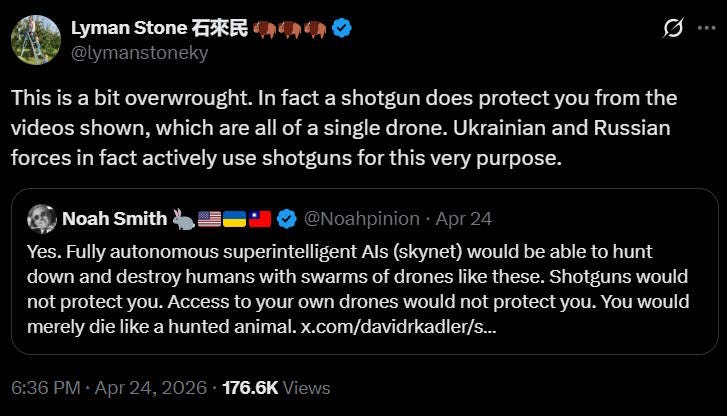
In fact, shotguns are probably a soldier’s best defense against drone attack. But “best” doesn’t mean “good”. Even if you have a shotgun, a drone will probably get you. Here’s Azhnyuk:
[A shotgun is] the main weapon that people use against [drones]…there are…hundreds, maybe thousands of cases of drones being shot down with shotguns…both by Ukrainians and Russians…I was talking to some Ukraine pilot group, and they told me like there was this Russian guy. He was just like Rambo…He shot down like seven FPV drones. They couldn’t…get him. They finally got him, but it was like nothing they’ve seen before, right?…Average non-Rambo will just die.
In case you have any doubt, here’s a video of people trying to shoot down attacking FPV drones with shotguns. It doesn’t go well.
What about lasers? A lot of people think that in the near future, laser weapons will operate as a sort of bug zapper, clearing the sky of drones and returning us to the age of maneuver warfare. That might happen, but Azhnyuk is highly skeptical. He recounted a conversation he had with the maker of an anti-drone laser:
I’m like, “Okay, 10 kilowatt laser, tell me about it…Okay, cool. How much time does it take to take down an FPV drone?” And [the manufacturers are] like, “Well, maybe three seconds.” I’m like, “three seconds. That’s like a lot of time. But okay, maybe fine. And what if [the] FPV drone tries to evade, right?” And he’s like, “Well, we will retarget it again.” And it’s like, “And then three seconds start again?” “Yeah.” “Okay. Well, can it take down like a dozen FPV drones?” They’re like, “Yeah, for sure.” I’m like, “Okay, a dozen FPV drones, 30 seconds? Maybe, yes. Two kilometers? Maybe yes, maybe no.” And I’m like, “Okay, how much does it cost?” And he said something like $3 million or something like that. I’m like, “Okay, $3 million. So that is 6,000 FPV drones…I doubt this thing will be able to handle 6,000 FPV drones or even 600 FPV drones coming at it at the same time.” So you have this kind of economic.
Lasers will probably be part of a layered defense that guards strong points against drones, alongside nets, various types of guns, etc. But essentially everything other than drones costs lots of money.
This is why the drone is the supreme weapon of the modern battlefield. It’s simply an incredibly cheap smart bullet.
As of today, every military that is not centered around drones is obsolete. Here’s a story from February about NATO realizing that its militaries are obsolete:
Russia and Ukraine have shown the world the future of warfare—and America and its allies aren’t ready for it. That’s the lesson of a major exercise that North Atlantic Treaty Organization members conducted in Estonia last May…The exercise, known as Hedgehog 2025, involved more than 16,000 troops from 12 NATO countries who drilled alongside Ukrainian drone experts, including soldiers borrowed from the front line…
During one scenario, a battle group of several thousand troops, including a British brigade and an Estonian division, sought to conduct an attack. As they advanced, they failed to account for how drones have made the battlefield more transparent, several sources say…The NATO battle group was “just walking around, not using any kind of disguise, parking tents and armored vehicles,” recalls one participant, who played an enemy role. “It was all destroyed.”…
A single team of some 10 Ukrainians, acting as the adversary, counterattacked the NATO forces. In about half a day they mock-destroyed 17 armored vehicles and conducted 30 “strikes” on other targets…
Overall, the results were “horrible” for NATO forces, says [Aivar] Hanniotti, who now works in the private sector as an unmanned systems expert. The adversary forces were “able to eliminate two battalions in a day,” so that “in an exercise sense, basically, they were not able to fight anymore after that.” The NATO side “didn’t even get our drone teams.”…
[T]oo many NATO members continue to show “a fundamental lack of understanding of the modern battlefield” and train their soldiers “based on doctrines and manuals that are not adapted to today’s realities,” says Maria Lemberg of the Ukrainian nonprofit Aerorozvidka…Multiple sources told the story of one commander, who observed the drill and concluded, “We are f—.”
Two years ago, it was clear that in a direct confrontation, the U.S. military would walk all over Russia’s clumsy, outdated post-Soviet army. Now, the reverse is probably true; the Ukraine War has forced the Russian army to learn how to fight with drones, while America is still mostly inexperienced with the new kind of warfare. Russia may not be quite as good at drone war as the Ukrainians, but the U.S. has so far made only incremental changes to how it fights. If the U.S. were to fight Russia today, it would be in for a rude surprise.
Of course, the same is true of China. Its military, like America’s, is still focused mainly on expensive high-performance platforms — aircraft carriers, hypersonic missiles, submarines, and so on. But there’s one big difference between China and the U.S. here — China’s peerless industrial base would give it the ability to construct an overwhelming drone-based force very quickly, while America’s withered industrial base would make it impossible to adapt in time.
I wrote about this last year:
In our interview, Azhnyuk said something very similar:
Last year, Ukraine produced 4 million FPV drones. Ukraine is not the most industrious nation in the world. China can produce 4 billion of these FPV drones…China can [also] make…fixed-wing drones, which go not forty kilometers far, but maybe two to three hundred kilometers inland…
They can also make them all fully autonomous. They have DJI, the world’s most advanced drone company. They can make them fully autonomous without GPS, without anything. Then they can put those drones on maybe tens of thousands of fully autonomous underwater submarines, or maybe not even that just on shipping containers and barges that ship goods or freight ships. And then they show up with millions of drones packed onto those sea vessels. They show up to any coastline in the world, be it Taiwan or be it California, and they have millions of long-range impactors targeted at a piece of land.
Here’s a quick snapshot of which countries make drones:
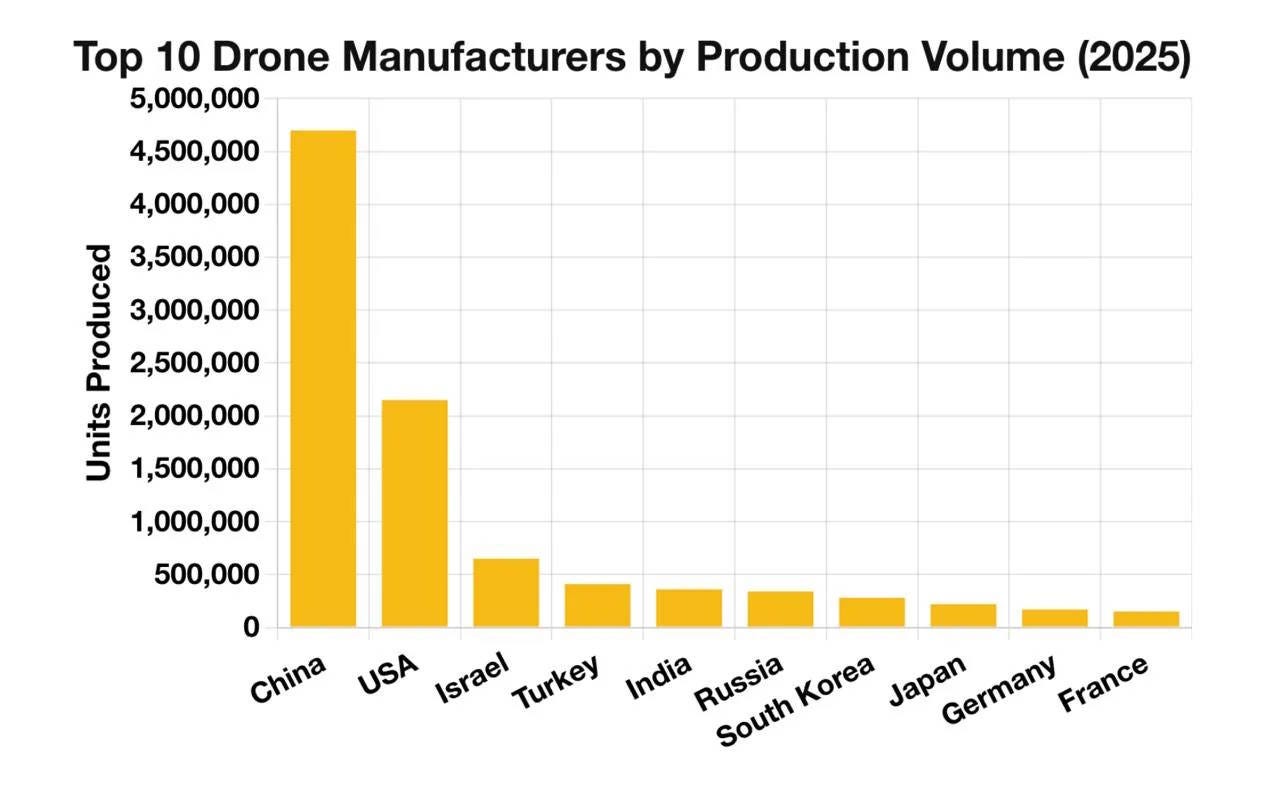
Interestingly, the U.S. is still #2 here — albeit a distant second. But worryingly, the U.S.’ traditional allies — Germany, Japan, France, Korea, etc. — make very few drones at all.
Even if they want to, the U.S. and its allies will have an incredibly hard time scaling up indigenous drone production. The reason is that drones are built using a set of technologies that the U.S. and its allies have mostly decided to forfeit to China. Drones use lithium-ion batteries and rare earth electric motors, both of which are almost entirely manufactured in China.
I warned about this in a post last September:
With its control of lithium-ion battery production, rare earth refining, and electric motor manufacturing, China has nearly monopolized the physical technologies that are at the core of the supreme weapons of the modern battlefield. And because China has also monopolized the manufacturing of EVs and electronics — the main commercial downstream technologies that use batteries and electric motors at scale in peacetime — they will be able to outbuild any country whose main demand for drone components comes from the peacetime military.
This should terrify everyone in the U.S. government, and the governments of India, Germany, France, Japan, Korea, Poland, the UK, Australia, and so on. Thanks to its control of electric components, China is now capable of manufacturing a drone armada that can easily outmatch that of every other country on the planet combined, if it wants to. And except for Ukraine, Russia is now the only country on Earth that has first-hand experience of how to fight a modern drone war. The democratic countries are laid bare and helpless before the armies of the autocratic powers, if the latter should choose to attack.
Realizing the truth — that we are in the Drone Era — is only the first step in correcting this fatal vulnerability. We must build an indigenous independent supply chain for the manufacture not just of drones, but of everything that goes into a drone. If we don’t do that, then the NATO commander from the recent military exercise is right: “We are f—.”

Brad here: It seems clear to me that a military that really knows how to use drones—cough, Ukraine ‘Rus—is highly likely to be able to successfully attrit one that has no real idea of what to do What is not clear to me is what the battlefield and the horrible human social practice of war look like going forward when both sides have and know how to use drones.
Is it back to the WWI Western Front, only this time with killer robots?: Tactical transparency and continuous contact: Battlefields become almost perfectly observable; concealment, massing, and maneuver without detection are very hard, so front lines congeal into continuous, attritional “drone fronts.” Humans are pushed further underground: into dugouts, hardened nodes, command posts, and logistics hubs—yet these fixed sites become priority targets for long‑range drones and loitering munitions.
Does victory continue to depend on industrial strength and societal economic mobilization capacity?: As in WWII, endurance and logistics become the center of gravity: Wars hinge on who can sustain cheap, attriting fleets of aerial and ground robots, plus the batteries, motors, chips, comms, and repair capacity to keep them in the fight.
Do mobile robot fortresses on land have a place?: Ground robots may decide who actually “wins”: Aerial swarms make movement deadly, but victory still requires occupying, supplying, and holding ground; unmanned ground vehicles that can haul supplies, move sensors and weapons, and persist under observation become as decisive as tanks once were.
What is clear is that force structure and doctrine need to undergo as much of a painful rewrite as we saw from 1939 to 1942.
But I do not know what that painful rewrite is to be.