
CROSSPOST: WILL LOCKETT: Starship Is Going Nowhere
Pre-IPO filings open SpaceX’s black box of financials. What spills out is a wildly expensive rocket, heroic technical risk, and a justified-equity-valuation story that leans heavily on very very distant cash flows. Google already had superprofits when it did its IPO, FaceBook had profits, Microsoft had profits. It was only Amazon among today’s Leviathans that did not—and Amazon had a clear path that penciled out, while SpaceX does not…
I do not know whether or not this from Will Lockett is right: I do not have the expertise to understand the technologies of spaceflight, and nobody really knows what the demand for what kinds of satellites will wind up being, either near-earth orbit or beyond, neither private nor public. I do know that the NASA budget is $25B a year, that Starlink’s revenues are $10B a year, and that Starlink’s competitors’ revenues are perhaps half that. So figure $40B a year in payments for rockets and satellites right now.
Then one (a) applies a growth rate g, (b) guesses at an appropriate risky required return on capital r, and (a) guesses that at most half of space spending could be profit, (c) guessing that only half of profits is available for pay-outs, (d) calculates that in order to meet a valuation of $1.5T with all of that budget transferred to SpaceX we need a payouts-valuation ratio of 150: that means a long-run growth rate of no lower than 0.67%/year below the cost of capital, with 85% of the preent value coming from profits to be paid to SpaceX after 2051.
Alternatively, if we suppose that in ten years SpaceX will be a “normal” business with a price-earnings ratio of 25, but that there will be no payouts until then, then at a real cost of capital of 4% per year profits then would have to be $900B—requiring an outer-space market of $1.8T or more, with the lion’s share going to Tesla.
Are either of these likely? No. Are either of these possible? I find myself more than just a little skeptical.
Let me give you some (brief) excerpts (because paywalled) from Will Lockett, who has at least a semi-informed view on this:
CROSSPOST: WILL LOCKETT: Starship Is Going Nowhere
<https://www.planetearthandbeyond.co> <https://www.planetearthandbeyond.co/p/starship-is-going-nowhere>

One of the few upsides to SpaceX’s rapidly approaching IPO is that we finally get to glimpse the murky world of its obscure finances…. Starship is critical to unlocking SpaceX’s future. Yet, these IPO filings only highlight that it is a biblically expensive mess…. It proves that Starship is nothing more than a hopeless money pit….
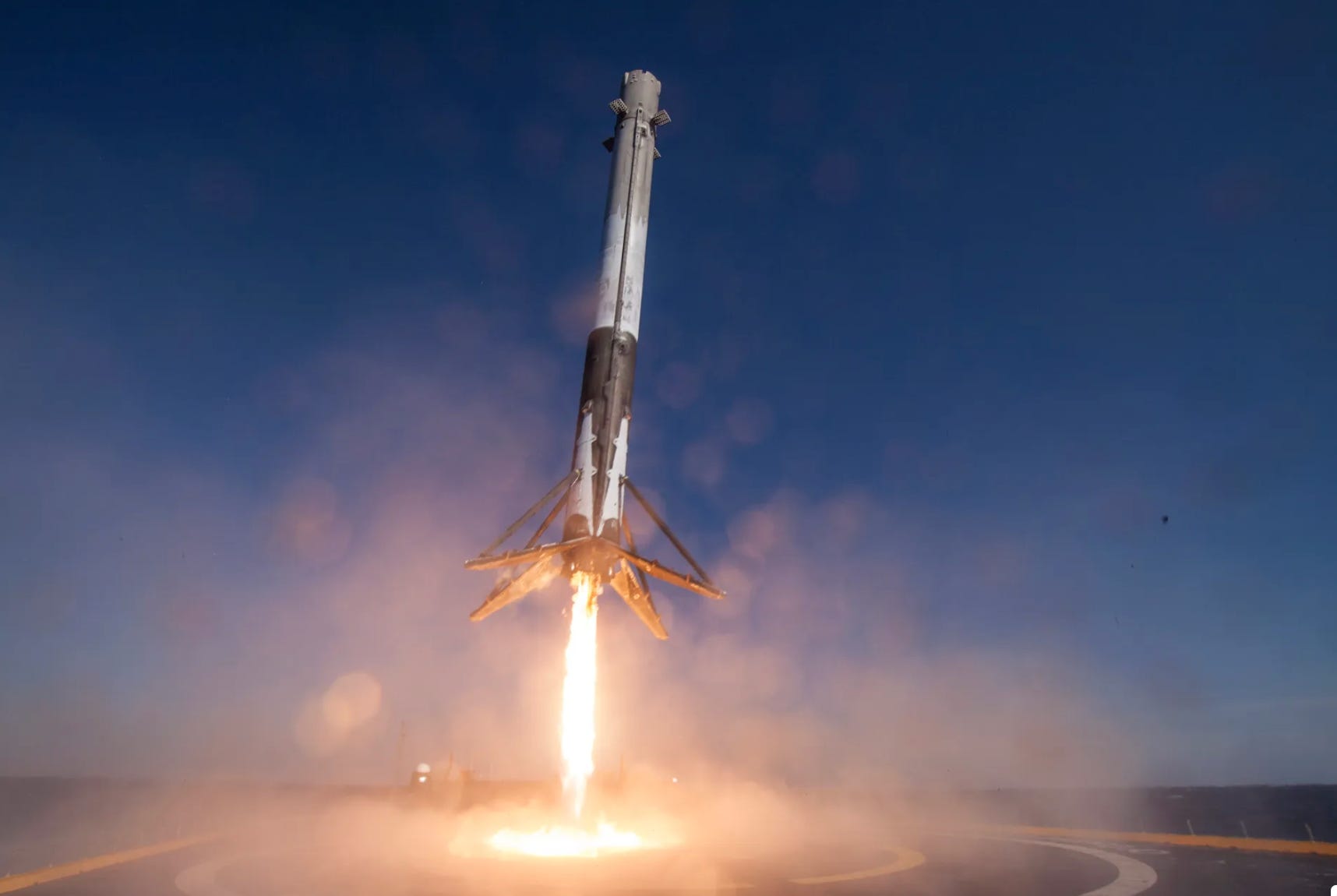
Reuters reported that… SpaceX… has spent more than $15 billion on Starship so far…. Falcon 9 cost just $400 million to develop, and the initial budget for Starship was $5 billion…. Musk has already blown the budget more than two times over. Yet, Starship isn’t even close to finished…. The only real targets it has achieved so far are completing a suborbital flight, reaching orbital velocity (but not orbit), landing and relaunching the booster (which is much easier than the upper stage), and conducting a splashdown landing of the upper stage….
Starship has two main use cases… launching Starlink satellites into LEO (Low Earth Orbit)… out-of-orbit flights like NASA’s Artemis missions and Musk’s Mars missions… [with] quite a complex and highly risky mission profile… a ‘depot’… Starship… sent into orbit, then multiple ‘tanker’ variants…shuttle fuel…. After this, the Mars/Moon-bound Starship launches to LEO, rendezvous with the depot, fully refuels itself from the depot, and then fires off to its destination….
Reach Orbit…. Starship needs to actually reach orbit. So far, the most it has achieved is take 16 tons on a transatmospheric flight at orbital velocity….. Increase Payload… transition from a max payload of 16 tons on a non-orbital flight to 100 tons…. Deploy Payload To Orbit…. Land & Catch Upper Stage…. Reuse Upper Stage…. Reduce Failure Rate…. …. Rapid & Long-Term Reusability…. Orbital Refuelling…. Develop, Test & Deploy Depot Variant…. Reduce boil-off to near zero in order to make this entire project viable…. Develop, Test & Deploy Tanker Variant…. Develop & Test Human Landing System…. It has taken SpaceX three years, (as of writing) 11 test launches and over $15 billion to meet four of its main targets…. But it still has 11 main targets to go, each one being significantly harder than the last….
SpaceX’s IPO is reportedly going to raise $75 billion… to be spent on building and launching orbital AI data centres as well as expanding Starlink into proper profitability…. If there is no Starship, then SpaceX can’t deploy AI data centres, or make Starlink truly profitable, as they both depend on… uber-cheap launch costs…. Starship costing over $15 billion to date undermines the narrative around SpaceX and its IPO. It should make any potential investor question where their cash is going and any pundit question Starship’s and possibly even SpaceX’s viability.
Brad here: Perhaps the sizzle being sold here really is that of Amazon? In 1997 Amazon went public very early in its corporate life, with tiny revenues and losses—the classic “sell the future, not the present cash flow” dot‑com era IPO. That story ultimately worked out spectacularly, but the equity value was overwhelmingly about hypothetical future dominance that somehow came to pass. In Amazon’s case it had very strong competitors in different segments of its businesses who could have but failed to grasp their opportunities (due, I think, to deep channel‑conflict and organizational problems). Walmart or Macy’s could not say: “we’ll destroy our margins for a decade to experiment with a new model that also cannibalizes our stores”. The money‑losing dot‑com’s advantage was that it found the tranche of investors most willing to delay cash flows in exchange for the option value of dominance.
But that is an exception: the historical template for mega‑cap tech IPOs is “already obviously profitable, but priced as if current profits are just a down payment on a huge, reasonably near‑term market” — not “loss‑making core project, with a valuation that only pencils out if most of the PV arrives after mid‑century.”