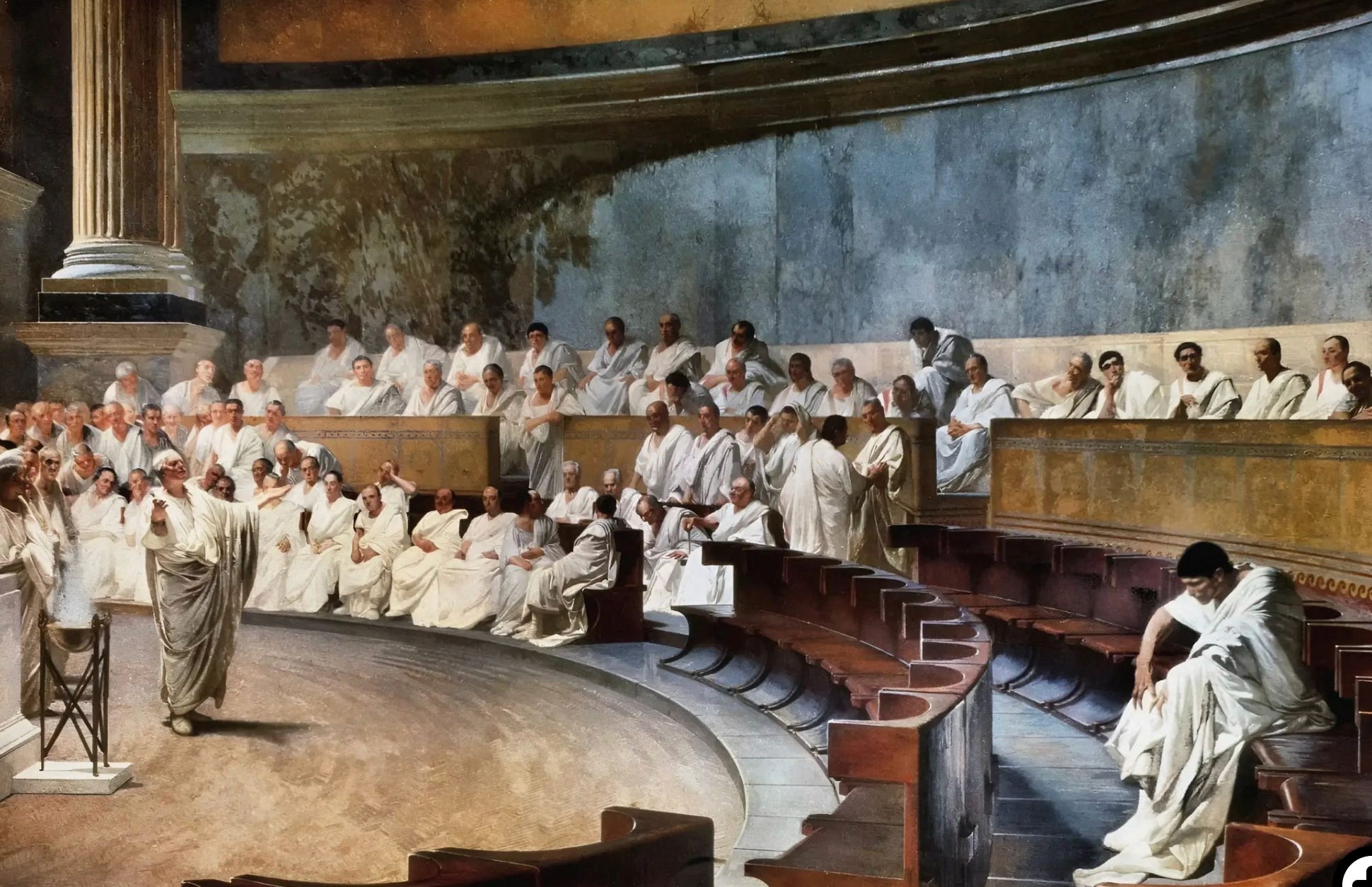
Having a MAMLM at Your Elbow Is a Great Help Confronting Cicero's Latin, But Not Enough of One: Saturday Humanitas
When Cicero breaks your brain: Latin, cases, word order, and my AI co‑pilot to serve as my Ariadne through the labyrinthine stuffing of clauses within clauses…
Yes. I’m having it give me a sentence a day to see if I can maintain semi-fluency, for a while at least. And so today we have a sentence from Tully:
Marcus Tullius Cicero: In Catilinam I <>: ‘Magna dis immortalibus habenda est atque huic ipsi Iovi Statori, antiquissimo custodi huius urbis, gratia; quod hanc tam taetram, tam horribilem tamque infestam rei publicae pestem totiens iam effugimus…
atque huic ipsi Iovi Statori — and to this Jupiter the Maintainer himself
antiquissimo custodi huius urbis — the most ancient guardian of this city
gratia — thanksgiving
That is: A great thing to the immortal gods must be offered, and to this Jupiter the Maintainer himself, the most ancient guardian of this city—thanksgiving is the thing.
Hiding the ball, gratia, until the end of the clauses.
Cicero could have said: Magna gratia habenda est—A great thanksgiving must be offered—dis immortalibus atque huic ipsi Iovi Statori—to the immortal gods and to Jupiter the Maintainer himelf—antiquissimo custodi huius urbis—the most ancient guardian of this city—quod—because—totiens iam effugimus—so many times now we have escaped—hanc tam taetram pestem rei publicae—this so loathesome plague afflicting the republic—tam horribilem tamque infestam—so horrible and so hostile.
But stuffing dis immortalibus inside magna… habenda; and then stuffing atque huic ipsi Iovi Statori, antiquissimo custodi huius urbis inside est… gratia; and then stuffing tam horribilem tamque infestam inside taetram… pestem—that leaves me with precisely zero chance of looking at the sentence and figuring out what Cicero means here.
Is it that I have hopeless English word-order brain? Is it that the Romans were smarter at linguistic things than I am? Or is it that the versions of his speeches that Cicero wrote down and that Tiro distributed after his death were to be read by the most literate 1%, and bear almost no resemblance to what was actually said in foro Romano?
The sentence is a small syntactic torture device, with core meaning hiding over and over again—until the very end. Cicero has embedded gods inside great obligation packed Jupiter and his epithet inside obligated gratitude, and wedged adjectives inside loathsome plague, and left me bewildered.
If reading this gets you Value Above Replacement, then become a free subscriber to this newsletter. And forward it! And if your VAR from this newsletter is in the three digits or more each year, please become a paid subscriber! I am trying to make you readers—and myself—smarter. Please tell me if I succeed, or how I fail…