
CROSSPOST: Ilari Mäkelä, Steven Broadberry, & Bishnupriya Gupta: The Big Picture: Measuring the Origins of the "Modern" World
Lots to talk about here: Around 1600, living standards in India and Britain are similar; by 1750, Indian real wages are less than half of British real wages (in grain‑wage terms). Under Mughal and then British rule, India’s agricultural productivity declines from the 1650s; by the late colonial era, yields per acre are below 1600 levels. In early 19th‑century China, a typical person works about 2 days a year to pay taxes; in Britain, it takes roughly 17–20 days, reflecting much higher fiscal capacity in small European states. & much much MOAR…
Brad here: Think of it this way:
(i) There is “technology” in the ability of an individual worker to make use of natural resources in one’s home territory.
(ii) There is “technology” that aids the individual worker non-intensively resource-dependent sector of the economy.
(iii) There is “technology” in the ability to organize society so that the division of labor can be properly drawn upon.
There is (iv) the power, through what we might as well call “unequal exchange”, to use resources elsewhere to boost your productivity and standard of living at home (even if only for your society-of-domination élite).
And there is (v) the strength of the braking force exerted by our ensorcellment by the Devil of Malthus, by which (i) through (iv) lead not to an increase in the standard of living but rather to an increase in population density and hence resource scarcity as a drag on prosperity.
Ilari Mäkelä, Steven Broadberry, & Bishnupriya Gupta have to keep all five of these balls in the air in their juggling as they attempt to understand the broad shape of world history over the “little divergence” between 1300 and 1800, in the era starting at the pre-Black Death Mediæval population maximum and ending on the cusp of the coming of the transformative GPTs of steampower and textile machinery. They, I think, do a very good job in this conversation. Highly, highly recommended.
CROSSPOST: Ilari Mäkelä, Steven Broadberry, & Bishnupriya Gupta: The Big Picture: Measuring the Origins of the “Modern” World
<https://onhumans.substack.com/> <https://onhumans.substack.com/p/the-big-picture-measuring-the-origins>

The interview is part of the Great Divergence series, produced by Warwick University’s CAGE Research Centre and On Humans. You can listen to episodes on Apple Podcasts, Spotify, or wherever you get your shows. Alternatively, you can keep reading for a summarised essay and a bibliography.
In 2002, a group of historians and economists gathered at the University of Oxford to discuss one of the most consequential questions at the intersection of their fields: when and why did Europe overtake China, India, and the Middle East as the dominant power in the world economy?
“The conversation was amazing,” recalls Bishnupriya Gupta, an expert in India’s economic history. “But we did not see much data in it.”

Gupta was particularly interested in the role of colonialism as a driver of this “Great Divergence” between Western Europe and Asia.
Together with her colleague, Stephen Broadberry, she started gathering numbers on early modern living standards in Britain and India, working through bills, receipts, and other hints of what was happening to the budgets of ordinary people in the two regions. They calculated day wages in local currencies for different time periods, then converted these to “grain wages,” based on how much food the wages could buy.
The data wasn’t quite what Gupta expected. “We need to show that colonialism was driving this,” she recalls saying before their work began. Yet data showed a more complicated picture. “India’s fall started before British colonisation,” Gupta explains. When the East India Company took power in Bengal in 1757, India was already in a century-long economic decline.
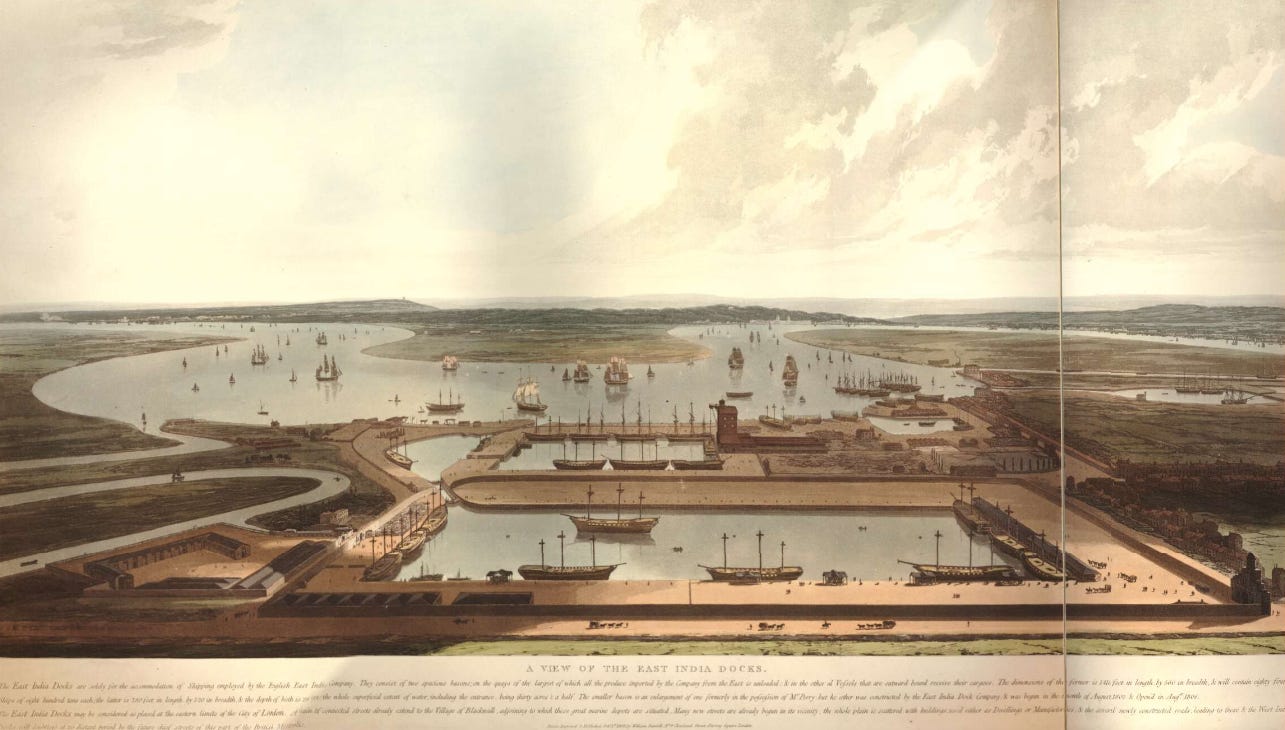
Things were not always so. In 1600, living standards looked similar in India and Britain. British workers could afford slightly more food, but the difference was marginal. The ensuing decades were good for the British economy, while India’s fate went the other way: wages declined. By 1750, real wages in India were less than half of those in Britain.
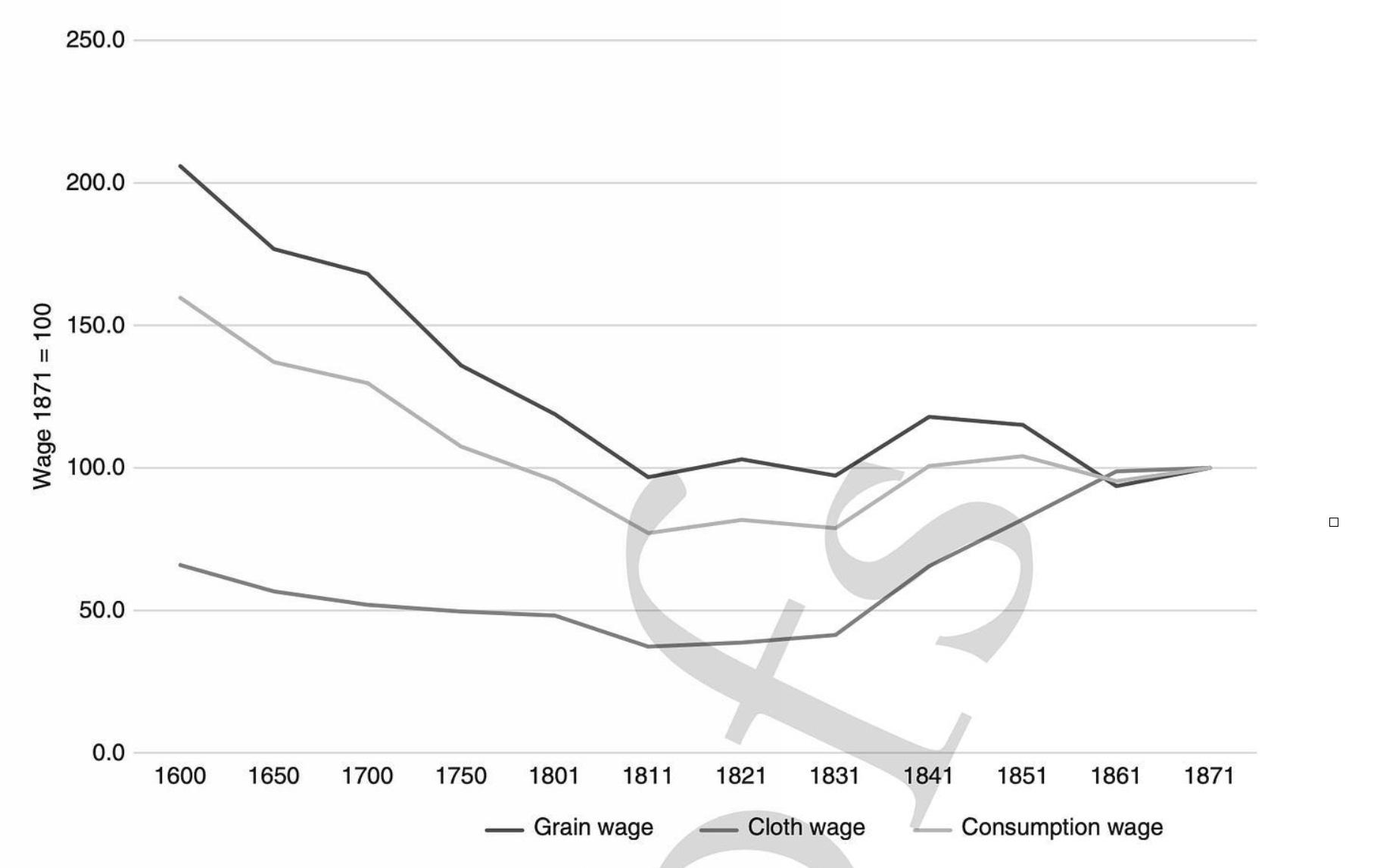
India’s troubles started before colonialism, but Gupta doesn’t think this supports a rosy view of British rule either. “Overall, I believe that colonisation was a story of extraction,” she says. “The British do not do much to the Indian economy. They don’t invest in agriculture.” There was no long-term growth in India.
For Gupta, farming is what really matters.
Many polemicists have used reports of India’s courts to paint a picture of an affluent pre-colonial India. The Mughal courts certainly were glittering, with terms like “real estate mogul” carrying these connotations to this day. Yet the riches of a court told little about what was going on for the average Indian family, its prospects tied to a decent harvest.
Gupta also warns against reading too much into India’s famous textile trade. The textile trade was good for weavers, but this was a small fraction of India’s economy. “India’s economic decline begins during the time of booming textile trade,” Gupta notes. Farming is the big story, and India’s agricultural productivity was in decline from the 1650s onwards. The British rule offered little relief. In the last decades of British rule, agricultural yields in India were below the levels they were in 1600. There is some truth, this shows, to the notion of a lost golden era under Emperor Akbar (1556–1605).
Yet even under Akbar, there was a curious way in which India’s economy was poorer than the British: Indians earned much less silver. Bread was more expensive in London than in Delhi, but British wages could buy many more things in the international market. “We see this in inventories of what people leave behind,” Broadberry says. “The British owned more luxury goods.” A kind of middle class had started forming in Elizabethan England. Both Gupta and Broadberry have argued against seeing this as a simple side-effect of American silver flooding the European market. Instead, they point to structural differences that were already making Britain a “high productivity” economy. ”Britain had a large sector specialising in trade, banking and insurance and manufacturing,” Gupta explains.
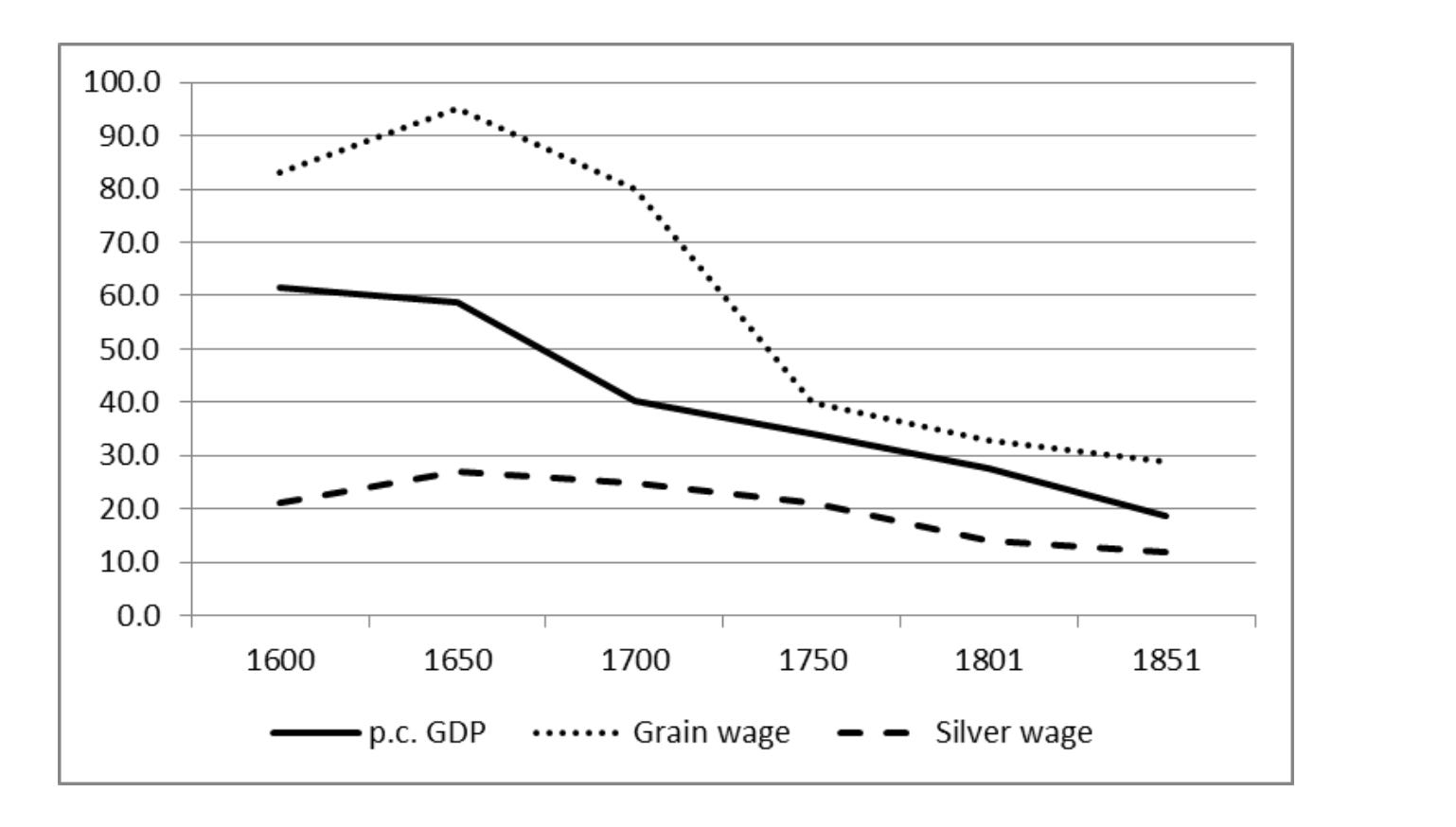
Comparing Britain and India is but one of the many contrasts that historians of the Great Divergence work on.
“A lot of the debate has focused on China,” says Broadberry, adding that China as a whole was behind Britain already in late medieval times. Yet this is hardly a fair comparison, picking Europe’s most dynamic corner and comparing it to the whole of China. “I would focus on the Yangzi River delta,” Broadberry says. This region, which includes modern-day Shanghai, is often picked as the most economically dynamic region in imperial China, and Broadberry agrees.

Narrowing the focus on the Yangzi Delta leads Broadberry to date the divergence between China and Europe to 1700. This is later than some traditional estimates that root Europe’s rise to the Renaissance or conquest of the Americas, yet the date is also comfortably before the Industrial Revolution, beginning around 1760. This puts Broadberry into disagreement with Kenneth Pomeranz, the author of the field-defining book, The Great Divergence, who argued that Britain was not noticeably ahead of the Yangzi Delta until deep into the Industrial Revolution.
My interview with Kenneth Pomeranz is available here.
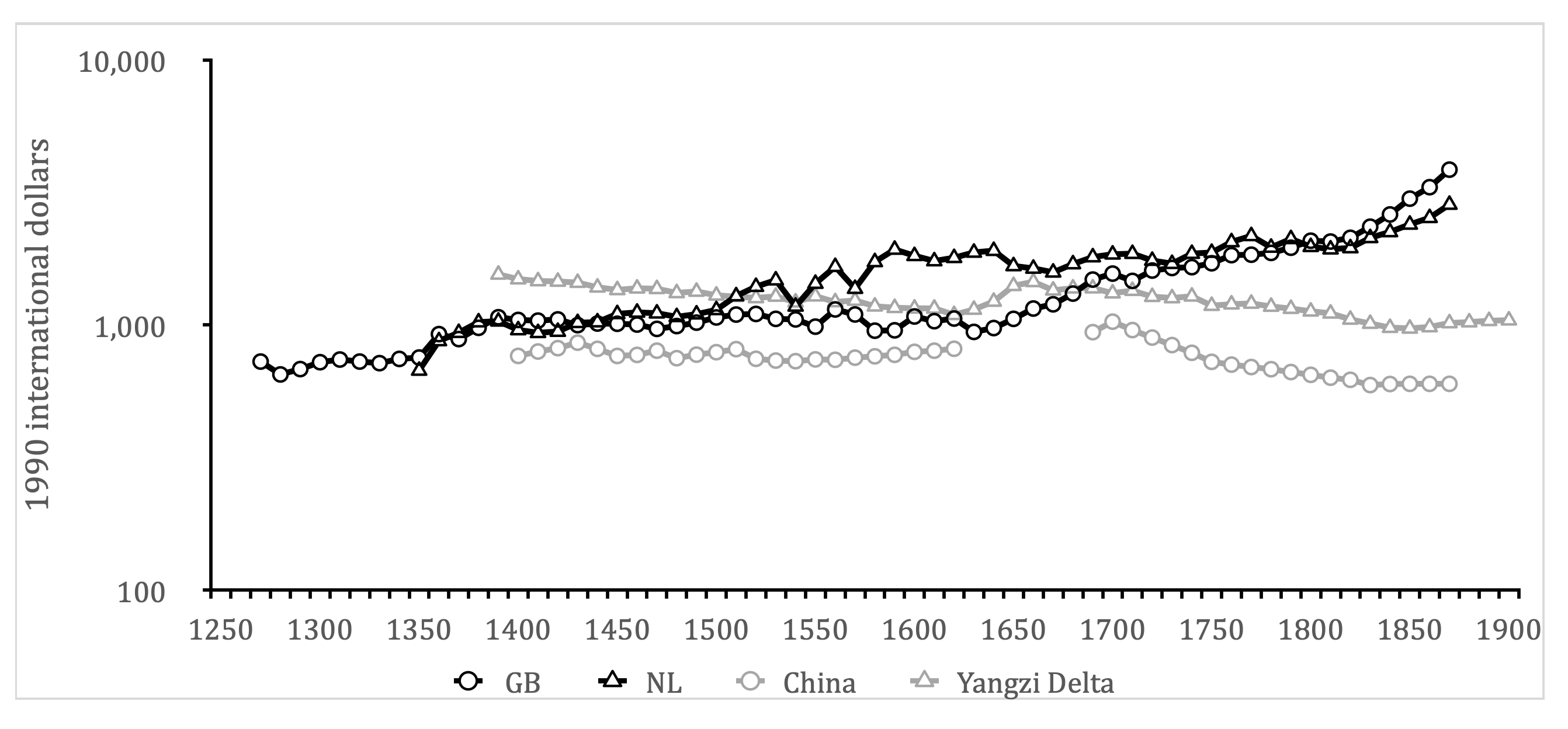
Moving beyond China, the data becomes sparser. Gupta says that it would be particularly interesting to have data from the Swahili Coast of East Africa, which was one of the most connected areas in early-modern global trade. Several other regions, such as the Middle East and Eastern Europe, have already been studied in the context of long-run growth.
“Each region has its own story,” Broadberry says. At the same time, he maintains that the broad contours of pre-industrial history are similar everywhere: the lines look flat. “There are periods of growth everywhere,” Broadberry explains, “but then there is a crash or decline, and incomes fall again.” Each region has its peculiarities, allowing for rich regional histories, but at a high level of approximation, the story is one of stagnation. There is but one exception: northwestern Europe. The British and the Dutch economies kept growing from the Black Death onwards, with clear gains to the masses.
What explains the uniqueness of the British and the Dutch economies?
Family dynamics might have played a role. One long-running argument holds that, compared to Asians, Europeans started marrying later and having fewer children. This allowed Europe to escape the “Malthusian trap” where new economic gains are dissipated by a rapidly growing population. Broadberry sees value in this hypothesis, adding that this pattern was actually restricted to northwestern Europe.
Gupta adds that Britain and the Low Countries might have had another, much darker, shield against the Malthusian trap. “These areas were urbanising fast, and people died in unhygienic cities,” she notes. Referring to work by Nico Voigtländer and Hans-Joachim Voth, she points out that high mortality from disease in urban centres, together with Europe’s frequent warfare, might have put the brake on population growth. In an ironic turn of fate, the high death rate in London and Amsterdam might have allowed the survivors to capture more of the new economic gains, doing what contraception and a preference for smaller families did more benignly in the 20th-century.
Even if population growth might explain some of the Great Divergence, Gupta is emphatic that it is not the only explanation.
“One difference between Europe and Asia lies in the capacity of states,” she says, explaining that small European states had much higher taxes than the large empires in India or China. “If you are a large empire, you are much more keen to keep the local elites on your side,” Gupta explains. “And therefore, you don’t tax them too much”. This echoes the argument by Debin Ma, who has calculated that in the early 1800s, a Chinese person had to work only two days to pay the year’s taxes. In Britain, that number was 17-20. “The story was similar in Mughal India”, Gupta says.
My interview with Ma is available here.
Technology might be yet another driver of the Great Divergence. “I strongly believe that it’s the caste system which limits technological diffusion,” Gupta says. The technological scene in Europe was more democratic, with more possibilities for everyone to participate in new inventions.
Further theories about the rise of London and Amsterdam are in abundance, ranging from overseas trade and American colonies to parliamentary politics and early modern financial capitalism. Is the abundance of theories a blessing or a curse? “I think we can get some consensus on the proximate factors,” Broadberry says. “But it is much harder to agree on the fundamental forces driving this. We don’t really have a framework to compare them.”
What about the 21st century?
Most of the world remains poorer than Western Europe and its settler colonies in North America and beyond. Yet the comparison most central to the Great Divergence debates – including that meeting “without much data” held in Oxford over twenty years ago – has been a comparison between the economic hubs of Europe and China. On this front, the picture is surprising.
“China’s GDP per capita is still far below that of Western Europe,” Broadberry says. “But if you compare Western European countries to Beijing or Shanghai, both with over 20 million people each, that gap has basically vanished.” Historians will keep studying the Great Divergence as a crucial pillar in the making of the modern world, but for economists interested in today and tomorrow, the Great Convergence is increasingly becoming the subject of choice.
You can listen to the full conversation on Apple Podcasts, Spotify, or wherever you get your shows.
This interview is part of the Great Divergence series produced by Warwick University’s CAGE Research Centre in collaboration with On Humans. The series explores explanations for why Western Europe and North America emerged as the most affluent and technologically advanced regions of the modern world. Guided by six expert guests, including a winner of the 2025 Nobel Prize in economics, we approach this topic with balance and breadth, exploring everything from colonialism and fossil fuels to science and technology.
1 | Why the West? Colonies, fossil fuels, and lessons from China (Kenneth Pomeranz)
2 | Why did so many inventions come from Europe? (Joel Mokyr)
3 | Why did the Industrial Revolution happen in Britain? (Robert Allen)
4 | A view from the East: China, Japan, and the other paths to prosperity (Debin Ma)
5 | The big picture: Measuring the origins of the modern world (Bishnupriya Gupta and Stephen Broadberry)
Bibliography
Key references
Broadberry, Stephen, and Bishnupriya Gupta. “The Early Modern Great Divergence: Wages, Prices and Economic Development in Europe and Asia, 1500–1800.” The Economic History Review 59, no. 1 (2006): 2–31.
Broadberry, Stephen, Johann Custodis, and Bishnupriya Gupta. “India and the Great Divergence: An Anglo-Indian Comparison of GDP per Capita, 1600–1871.” Explorations in Economic History 55 (2015): 58–75.
Broadberry, Stephen, Hanhui Guan, and David Daokui Li. “China, Europe and the Great Divergence: A Study in Historical National Accounting, 980–1850.” The Journal of Economic History 78, no. 4 (2018): 955–1000
Gupta, Bishnupriya. An Economic History of India: Growth, Income and Inequalities from the Mughals to the 21st Century. Cambridge: Cambridge University Press, 2025.
Works mentioned in the episode
Acemoglu, Daron, and James A. Robinson. Why Nations Fail: The Origins of Power, Prosperity, and Poverty. New York: Crown Business, 2012.
Broadberry, Stephen, and Runzhuo Zhai. “Innovation and the Great Divergence.” CAGE Online Working Paper Series, no. 771, Competitive Advantage in the Global Economy, 2025.
Maddison, Angus. The World Economy: A Millennial Perspective. Development Centre Studies. Paris: OECD Publishing, 2001.
Hersh, Jonathan, and Hans-Joachim Voth. “Sweet Diversity: Colonial Goods and the Welfare Gains from Global Trade after 1492.” Explorations in Economic History 86 (2022): 101468.
Voigtländer, Nico, and Hans-Joachim Voth. “The Three Horsemen of Riches: Plague, War, and Urbanization in Early Modern Europe.” The Review of Economic Studies 80, no. 2 (2013): 774–811.
Further reading
Li, Bozhong, and Jan Luiten van Zanden. “Before the Great Divergence? Comparing the Yangzi Delta and the Netherlands at the Beginning of the Nineteenth Century.” The Journal of Economic History 72, no. 4 (2012): 956–989.
Ma, Debin. “Rock, Scissors, Paper: The Problem of Incentives and Information in Traditional Chinese State and the Origin of the Great Divergence.” LSE Economic History Working Papers, no. 152/11, 2011.
Parthasarathi, Prasannan. “Rethinking Wages and Competitiveness in the Eighteenth Century: Britain and South India.” Past & Present 158, no. 1 (1998): 79–109.
Solar, Peter M. “China’s GDP: Some Corrections and the Way Forward.” The Journal of Economic History 81, no. 3 (2021): 926–957.