
Theories of Economic History VIII: In Place of a Conclusion :: Roughly-Edited Transcript:
J. Bradford DeLong brad.delong@gmail.com :: 2026-04-28 :: All Souls’ College, Oxford :: The 2026 Sir John Hicks Memorial Lecture in Economic History…
Link to Video:
<https://braddelong.substack.com/p/theories-of-economic-history-zoom>
Let me make the transcript less incoherent, less cryptic and compressed, and more sensible…
I said I’d have an inductive conclusion.
I lied.
My conclusion is that the task of figuring out what exactly is the right stage theory that will direct us—direct our work at the most productive and useful things, both in the sense of providing entertainment and providing intellectual illumination, and also in providing perhaps a slight improvement in a modicum of judgment for the future—well, that’s your task. Those of you younger than I am.
So get to it!
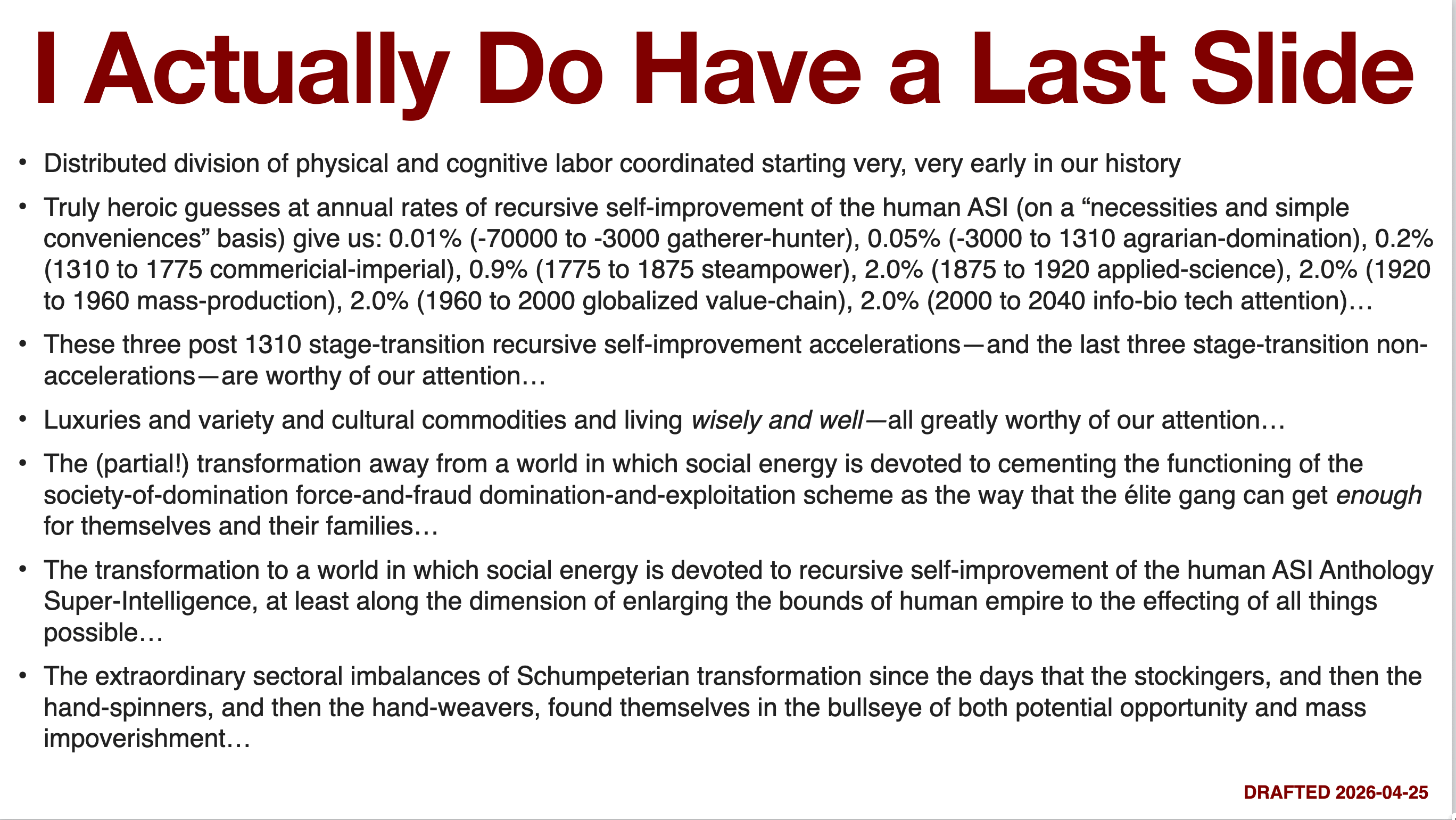
Actually, I do have a final slide. I cannot resist emulating Hicks, and not just passing the baton to you to run as you wish, but to instead give you all an assignment:
We have, very roughly, two and a half centuries of quantitative history now: from the 0.05%‑per‑year crawl of the agrarian age, when it took 1,500 years to double average material living standards, through the 0.5–1.0% of the early steam era, the 1.5–2.0% of the applied‑science and mass‑production age, and the roughly 2.0% world‑average growth of the globalized value‑chain economy since 1980. Maddison’s numbers say that between 1820 and today, world GDP per capita has risen by a factor of more than ten; for the North Atlantic core, the factor is closer to twenty. Life expectancy at birth in rich countries has gone from 35–40 to 80‑plus years. Literacy has gone from being a minority accomplishment to a near‑universal baseline. The share of humans living in what the World Bank calls “extreme poverty” has fallen from something like 70–80% to under 10%.
And yet, as every good economic historian from Keynes and Polanyi forward has insisted, this has not felt like a smooth, beneficent exponential to the people who lived through it. It has felt like the English weavers thrown out of work by power looms that doubled output per worker between 1780 and 1830; like the peasant smallholders displaced by tractors that cut agricultural labor’s share from 80% to under 5% in the industrial core; like the Detroit autoworkers who saw manufacturing’s share of U.S. employment fall from 28% in 1960 to under 9% by 2010; like the routine clerks and telephone operators whose occupations went, in the span of one generation, from high‑tech gateway jobs to historical curiosities. It has felt like 25–30% unemployment in the Great Depression; like 10–15% inflation in the 1970s; like a doubling of the top 1% income share since 1980; like a succession of crises—1997, 2001, 2008, 2020—in which the promise that “2% a year will solve everything” has looked, at best, incomplete.
My conclusion is that the task of figuring out what exactly is the right stage theory for this process—the right way of slicing up this 250‑year burst into analytically and morally meaningful “regimes”—is not, I think, something that can be settled by one overlong lecture, or one overlong book. We have had, so far, at least half a dozen such stage theories on offer:
The three‑stage agrarian–industrial–post‑industrial schema of the 1960s.
The Kondratiev‑Schumpeter “long waves” of clustered general‑purpose technologies: steam and railways; steel and electricity; autos and petrochemicals; ICT; and now, perhaps, AI and biotech.
The Marx–Engels class‑struggle sequence of feudalism, capitalism, socialism, communism (which, as we have seen, has not exactly played out as advertised).
The Rostow “stages of growth”: traditional society, pre‑conditions, take‑off, drive to maturity, age of high mass consumption.
The Polanyi double movement: disembedding markets from society in the nineteenth century; re‑embedding them via welfare states and regulation in the twentieth.
The more recent “orders” vocabulary: a liberal international order from 1870 to 1914; an interwar breakdown; a Keynesian–New Deal–social‑democratic order from 1945 to 1973; a neoliberal order from 1980 to 2008; and now… something yet to be labeled.
Each of these captures something important. None is quite right.
The version I have sketched here—agrarian Malthusian age; commercial‑imperial age; steam‑power age; applied‑science age; mass‑production/New‑Deal age; globalized value‑chain/neoliberal age; emerging info‑biotech‑attention age—is at best a useful caricature. It compresses into a few slogans what economic historians like Wrigley, Mokyr, Pomeranz, Allen, Crafts, Broadberry, O’Rourke, Gordon, Eichengreen, Maier, and many others have spent millions of words and thousands of regressions trying to unpack. It puts, perhaps, too much weight on a handful of numbers: 0.05% per year versus 0.5% versus 2%; 30 years versus 1,500 years to double average living standards; 80% of the labor force in agriculture versus 3%; 70% of humanity in extreme poverty versus 10%.
But if there is a “right” stage theory out there, I think it has to do at least three things better than what we have now.
First, it has to integrate growth and distribution rather than treating them as separable add‑ons. A stage theory that says, “we moved from 0.5% to 2.5% annual growth” and leaves it at that is not good enough. It has to explain, quantitatively and institutionally, why the same 2–3% growth rate produced relative equality and rising median wages in, say, Sweden between 1950 and 1980; rising top shares and stagnant medians in the United States between 1980 and 2020; and explosive catch‑up growth in China over roughly the same period. It has to take seriously Kuznets’s infamous inverted‑U hypothesis on inequality and then reconcile it with the Piketty–Saez evidence that top shares can and do rebound when political and institutional constraints are loosened.
Second, it has to link technology and politics more tightly. It is not enough to say “coal enabled steam” or “electricity enabled mass production” or “ICT enabled global value chains.” We need a theory that can connect, say, the 40% share of manufacturing in German GDP in 1913 and the coal–steel complex in the Ruhr to the political possibilities of Weimar and the rise of Nazism; that can connect the 35% unionization rate and 90% top marginal tax rate in the U.S. in 1960 to the stability of the New Deal order; that can connect the 8–9% manufacturing‑employment share and 20% top‑income share in 2010 to the fragility of the neoliberal order. Barry Eichengreen’s work on how exchange‑rate regimes condition domestic policy, or Charles Maier’s work on how social coalitions rise and fall around different “growth models,” are sketches in this direction.
Third, it has to be explicit about contingency—about all the ways things could easily have gone otherwise. The Marshall Plan could have failed; the euro could have been designed with different rules; China could have chosen to remain a semi‑autarkic, low‑growth state after 1978; the COVID pandemic could have killed 100 million people rather than 20 million. Franklin Roosevelt might have lost in 1932; Reagan might never have broken the back of U.S. unions; the 2008 crisis might have turned out more like 1929–1933 than it did. A good stage theory has to hold, simultaneously, the brute regularities—the march from 0.05% to 2% growth, the demographic transition, the fertility collapse, the rise in educational attainment from near‑zero to a global average of eight or nine years—and the wild counterfactual branches that might have led us to very different equilibria.
So my conclusion is that the task of figuring out what exactly is the right stage theory that will direct us—direct our work at the most productive and useful things—is not done. It is, I suspect, only barely begun.
“Productive and useful” here has at least three dimensions.
First, it should help us organize our research efforts: to decide which questions in economic history, growth theory, political economy, and technology studies are first‑order and which are garnish. Is the crucial margin the pace of total factor productivity growth (0.8% versus 1.5% a year)? The elasticity of substitution between skilled and unskilled labor (1.1 versus 1.7)? The political salience of national versus class identities? The thickness of financial intermediation? The carbon intensity of GDP? A good stage theory will, I think, give young scholars a better sense of where to deploy their scarce time and mathematical energy.
Second, it should help us entertain and illuminate: to tell stories that are not only correct in the econometric sense but also gripping enough to compete with the latest streaming show or doomscroll. E.P. Thompson did this for the English working class; Fernand Braudel tried to do it for the Mediterranean; more recent writers have tried, with mixed success, to do it for “the Anthropocene” or “the information age.” A stage theory that does not have room for the poor stockingers and the Detroit line workers and the Foxconn assemblers and the Kenyan call‑center workers—as human beings with agency and culture, not just datapoints—is, I think, not worth much.
Third, it should help us improve, perhaps by a very slight amount, the modicum of judgment we bring to the future. If you know that the second industrial revolution’s 3% annual growth in U.S. labor productivity did not prevent the Great Depression; that the postwar golden age’s 2.5% did not prevent stagflation and the collapse of Bretton Woods; that the neoliberal era’s 2% did not prevent 2008 or the current upsurge of authoritarian populism; then you may be less inclined to treat “growth” as a magic wand that makes all conflicts soluble. If you know that every past technological wave has both created new abundance and destroyed old securities, you may be better placed to think sanely about AI, biotech, and whatever comes next.
In my more hubristic moments, I once thought that we were, by now, close to having such a stage theory—that we could sketch, with some confidence, a narrative from 1870 to 2010 in which the big pieces were fixed and we were just arguing over footnotes. I no longer think that. The emergence of the info‑biotech‑attention economy, the fragility of the climate system, the unsteady wobble of the neoliberal order, the unexpected political pathologies of the early twenty‑first century—these all suggest that the work of interpretation is nowhere near finished.
And so, I think, that work is not mine to complete.
It is, rather, your task—those of you who are younger than I am, who will be alive in 2050 and 2080 and will see which branches of the tree of possibilities we actually clamber out onto. Your task is to read the Maddison tables and the Maier monographs and the Polanyi jeremiads and the Baldwin trade books; to play with the Penn World Table and the LIS microdata; to listen to the poor stockingers of your age—who may be adjunct professors, or Uber drivers, or TikTok creators, or radiology technicians, or care workers; to keep one eye on the 0.02 versus 2.0 versus 5.0% lines on the semilog chart of human prosperity, and the other eye on who is in the bullseye of creative destruction at any given moment.
Your task is to build a stage theory that is not just an after‑the‑fact intellectual party trick but a set of lenses that can guide, in some small way, our collective choices: about taxes and transfers; about antitrust and IP; about climate policy and migration; about how we treat attention and data; about what we owe to the people whose jobs the next general‑purpose technology vaporizes.
So, again, get to it.
<https://braddelong.substack.com/p/2026-04-28-scratch>
2026-04-28 17:00-18:30 BST (Tue): <https://zoom.us/j/8458651578?omn=95983788025>
Meeting ID: 845 865 1578
Passcode: 764724
If reading this gets you Value Above Replacement, then become a free subscriber to this newsletter. And forward it! And if your VAR from this newsletter is in the three digits or more each year, please become a paid subscriber! I am trying to make you readers—and myself—smarter. Please tell me if I succeed, or how I fail…
##fyi-theories-of-eeconomic-history
##lecture-notes
##enlarging-the-scope-of-human-empire
#2026-hicks-lecture
#economic-history
#grand-narrative
#stage-theory
#john-hicks
#oxford-lecture
#institutional-change
#technological-change
#macro-history
#global-economy
#theories-of-economic-history
<https://braddelong.substack.com/t/theories-of-economic-history>