
Theories of Economic History VII: Successive Post-1875 "Modes of Production" :: Roughly-Edited Transcript:
J. Bradford DeLong brad.delong@gmail.com :: 2026-04-28 :: All Souls’ College, Oxford :: The 2026 Sir John Hicks Memorial Lecture in Economic History…
Link to Video:
<https://braddelong.substack.com/p/theories-of-economic-history-zoom>
And let me start going through, making the transcript less incoherent, less cryptic and compressed, and more sensible…
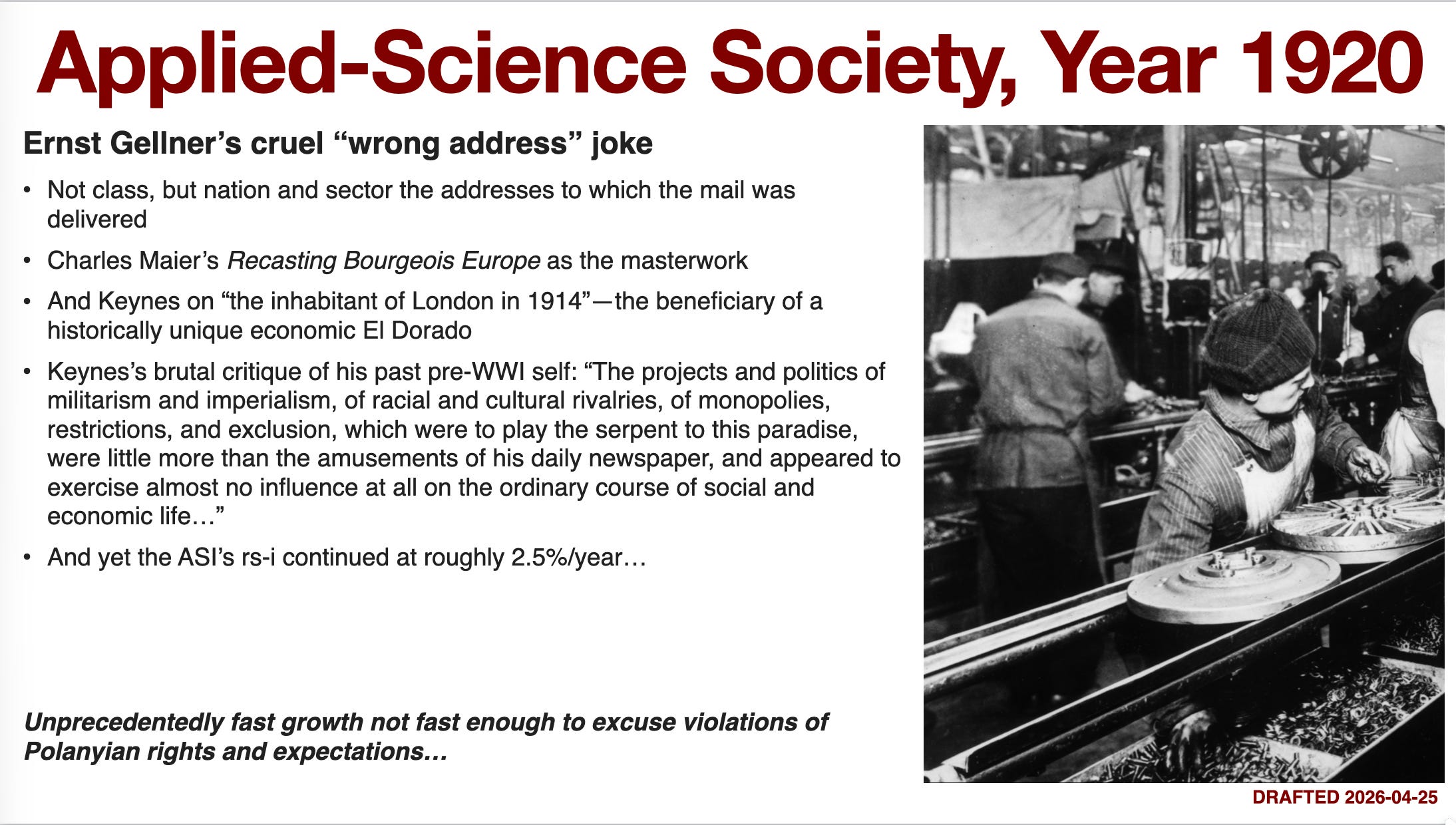
Friedrich Engels’s end-state of his stage theory is attractive. The 10–15% of national income that, in late‑nineteenth‑century Britain, accrued as rents and profits to the upper classes would be socialized and redeployed; the 1–2% of the population that constituted the traditional elite would be demoted to ordinary comrades. If you read him with some sympathy, you can absolutely see its attraction: stand on the floor of a steam‑powered factory in 1870, look up at the belts and shafts driven from a single engine, and imagine what things will be like once the machine is big enough and efficient enough that scarcity has been banished. You have, in Gary Gerstle’s phrase, a “forging” moment—except Engels thinks the forging will be socialist rather than nationalist or corporatist.
But that is not how history went.
We did not freeze in place at the steam‑power stage that Engels thought he was extrapolating from. Instead, over the late nineteenth and twentieth centuries we moved from a steam‑power society into what we might call an applied‑science society. And the pattern of growth and disruption in this applied‑science age was very different from what it had been in the steam‑power age.
Under steam power—call it roughly 1770 to 1870—growth was real but narrow. The canonical numbers from Angus Maddison and later refinements by Nicholas Crafts and Knick Harley suggest that Britain’s real GDP per capita grew at perhaps 1.0–1.3% per year in the first half of the nineteenth century, with total factor productivity rising more slowly than that. The gains were heavily concentrated in a few leading sectors: cotton textiles, iron, coal, and later railways. In 1830, cotton textiles were maybe 3–4% of British GDP but an order of magnitude more important in productivity growth than their share suggested; by 1860, railways absorbed up to 6–8% of national investment but employed only a small fraction of the labor force. Outside the steam core, however, much of the economy—agriculture, domestic service, small-scale craft production—plodded along with pre‑industrial techniques and near‑Malthusian dynamics.
The applied‑science age—call it 1870 to 1970—looks quantitatively and qualitatively different. Robert Gordon’s calculations for the United States give you labor‑productivity growth averaging around 2% per year between 1890 and 1972, with an extraordinary 2.5–3% in the interwar and immediate postwar decades. Europe, once it recovered from the wars, experienced similar or even higher rates during its “golden age” of 1950–1973; France and West Germany, for example, often clocked 4–5% per year in labor‑productivity growth as they caught up to the U.S. frontier. Angus Maddison’s long‑run data imply that world real GDP per capita rose from perhaps 2,000–2,500 dollars (in today’s prices) in 1870 to something like 7,000–8,000 by 1970—a factor of three. That is a very different world from the slow, sectorally narrow steam era.
The mechanism was also different. Steam power was a single, lumpy general‑purpose technology, deployed in discrete engines that turned shafts and wheels. The applied‑science era rested on a whole cluster of general‑purpose technologies, each with its own spin‑off industries and organizational changes: electricity, the internal combustion engine, synthetic chemicals, telecommunications, and later electronics. Paul David’s classic work on electrification, for example, shows that the adoption of electric motors did not yield full productivity gains until firms re‑engineered factories away from the single line‑shaft design. That process took decades, but once it was complete, you got both higher productivity and much greater flexibility in plant layout and work organization.
Concrete accomplishments in the leading sectors of this “second industrial revolution” are not hard to list; the difficulty is remembering how recent they are.
Take electricity. In 1870, electricity was still largely a laboratory curiosity and a lighting gimmick. By 1913, in the United States, about 30% of manufacturing horsepower was electric; by 1929, that figure was above 70%. The cost of a lumen‑hour of light fell by factors of hundreds from candles to gas to electric bulbs—William Nordhaus has a famous paper on the “price of light” arguing that conventional price indices underestimate this welfare gain by an order of magnitude. Urban households went from dim, smoky interiors to brightly lit, safer homes. Factories went from dark, dangerous, steam‑belted sheds to cleaner, quieter, more controllable environments. Electrified streetcars and subways re‑shaped cities: by 1910, U.S. cities like Boston and New York had streetcar networks that enabled daily commuting of miles rather than walking distances, and by 1930 subway networks under Manhattan and London had made possible the modern central business district.
Or take the internal combustion engine and petroleum. In 1900, the world had perhaps 10,000 automobiles and essentially no paved intercity road network; most freight moved by rail and water, most people by foot or horse. By 1950, the U.S. alone had over 40 million registered vehicles, and the interstate highway system was on the drawing board. By 1970, the car had become the dominant mode of personal transport in most rich countries. Transport costs fell dramatically: Joel Mokyr and other economic historians of technology note that the real cost per ton‑mile of moving goods over land fell by factors of 5–10 from the railway age to the trucking age, and travel times on many routes dropped from days to hours. That mattered for market integration, labor mobility, and the spatial organization of production.
Synthetic chemicals form another pillar. Around 1860, Germany’s fledgling dye industry began to commercialize coal‑tar derivatives; by 1913, firms like BASF, Bayer, and Hoechst dominated the world market in synthetic dyes and were pushing into pharmaceuticals and fertilizers. The Haber‑Bosch process for fixing atmospheric nitrogen, commercialized just before World War I, broke a key Malthusian constraint by allowing the mass production of nitrogen fertilizers. Vaclav Smil and others have estimated that by the late twentieth century, roughly half of the nitrogen in the proteins in human bodies comes from Haber‑Bosch ammonia. World cereal yields, which had stagnated around 1 ton per hectare in many regions for centuries, more than doubled to 2–3 tons per hectare by the 1970s under the combined assault of synthetic fertilizers, improved seed varieties, and mechanization. The connection to demographic history is direct: between 1900 and 2000, world population rose from about 1.6 billion to over 6 billion, and yet average calories per person also rose. That is the applied‑science age at work.
Telecommunications and information handling also changed character. The steam‑age telegraph—Morse’s dots and dashes over copper wires—was revolutionary but elite: in 1870, telegraph traffic was measured in tens of millions of messages per year, mostly business and government. By 1913, there were already about 13 million telephones in the United States, and call volumes were orders of magnitude larger than telegraph traffic had ever been. By mid‑century, long‑distance telephony, telex, and then early data communications had woven firms and households into dense networks of real‑time communication. Alfred Chandler emphasizes how these communication technologies enabled the rise of the multidivisional corporation; the ability to send instructions and financial information across a continent in hours rather than weeks underpinned national markets in a way that the steam‑age telegraph had only tentatively begun.
On the human side, perhaps the most important applied‑science gains came in health. In 1870, life expectancy at birth in even the richest countries was around 40–45 years; child mortality rates of 150–200 per 1,000 live births were common. By 1950, life expectancy in the industrial core was 65–70; by 2000, over 75. The epidemiological transition—driven by clean water, sewerage, vaccination, antibiotics, and improved nutrition—is a triumph of applied science. Economists who have tried to value the welfare gains from this health revolution, such as Nordhaus and Deaton, often conclude that the increase in longevity alone is worth as much as the measured increase in material consumption.
All of this—electrification, internal combustion, chemicals, telecommunications, modern medicine—looks, from 1910 or 1930, like what Keynes in 1919 rightly called a unique “economic El Dorado.” In The Economic Consequences of the Peace, he paints a portrait of “the inhabitant of London in 1914” as the beneficiary of a historically unprecedented regime. Such a person could order, by telephone, “various products of the whole earth” to be delivered to his door; he could travel cheaply and quickly across Europe; he could invest in global securities through a well‑developed financial system. Trade as a share of world GDP had roughly doubled between 1870 and 1913; capital flows from Britain and France to the rest of the world ran at 3–5% of their GDP annually. The North Atlantic economy, in Maddison’s data, was humming along at perhaps 1.5–2% annual growth in income per head, a long way above anything Engels’s generation had seen.
And yet people were not satisfied.
Interests of nation and interests of sector dominated the political imagination. Keynes has a brutal critique of what he calls the typical pre–World War I Londoner—by which he means himself and all the other people who ought to have been focusing on this—about how militarism and imperialism, racial and cultural rivalries, monopolies, restrictions, and exclusion were little more than the amusements of his daily newspaper. He confesses that, before 1914, he treated these as background noise, serpents in the garden not yet worth serious attention. He and his class were looking very much at the wrong thing.
Here Ernst Gellner’s cruel “wrong address” joke bites. The Marxist script said that as capitalism matured, the “mail” of political mobilization—anger, hope, solidarity—would ultimately be addressed to class: the workers of the world would unite; they would recognize their common interests across borders and sectors. Instead, for much of the applied‑science age, the mail was delivered to other addresses: not class, but nation and sector. Mass politics in the early twentieth century organized itself around nationalist projects, imperial competition, agrarian versus industrial interests, religious cleavages, and ethnic identities at least as much as around a simple capital‑labor divide.
Charles Maier’s Recasting Bourgeois Europe is the masterwork here. He shows in painstaking national detail—Germany, France, Italy—how the bourgeois order rebuilt itself after World War I not by yielding to a socialist “end‑state” but by hybridizing: incorporating some elements of mass democracy and social protection while preserving core capitalist structures, and always under the shadow of nationalist and sectoral conflicts. German industrialists might ally with agrarian elites one decade and with technocratic planners the next; French smallholders, Italian industrial workers, and German white‑collar employees all had distinct and sometimes incompatible conceptions of what “justice” meant. The applied‑science economy was producing 2% per year of growth in output per head, but the distribution of the gains, and the political narratives about who deserved what, were all over the place.
And yet, underneath this political cacophony, the ASI’s recursive self‑improvement—this human applied‑science intelligence—continued at roughly 2% per year. Research labs grew; engineering schools multiplied; patent filings exploded; the stock of useful, codified knowledge doubled and redoubled. If you had taken a cold, Martian economist’s view and simply plotted potential output, the line from 1870 to 1970 would have been a remarkably smooth upward curve, interrupted only temporarily by wars and depressions.
The trouble, as Karl Polanyi would have pointed out, is that unprecedentedly fast growth is not fast enough, or smooth enough, to excuse systematic violations of what people come to see as their rights and expectations. The applied‑science age, unlike the steam age, embedded markets and firms in societies that had universal male suffrage and then universal adult suffrage; that had mass education; that had newspapers and then radio and television shaping mass opinion. People who see 2% annual growth for a decade begin to take it for granted; they anchor their sense of “normal” on that trajectory. When the line breaks—when there is a crisis, a depression, a war, a wave of unemployment in a particular sector—those disruptions do not feel like acceptable fluctuations around a trend, but like intolerable violations of an implicit social contract.
Polanyi’s argument in The Great Transformation is, among other things, that human beings in the applied‑science age demand what we might call “Polanyian rights and expectations”: the right not to be suddenly thrown out of work by a global price shift; the expectation that the state will cushion blows and manage risks; the belief that markets should serve society and not the other way around. When creative destruction in the leading sectors—when the electrification of factories, the tractorization of farms, the automation of offices—throws millions out of familiar roles, 2% annual growth at the aggregate level is not enough to buy acquiescence if the distribution is ugly and the shocks are sharp.
So the applied‑science age gives you both the major accomplishments of the second industrial revolution’s leading sectors—electric light, motor vehicles, synthetic fertilizers, telephones, radios, antibiotics—and a pattern of disruption that differs from the steam age in scale, scope, and political resonance. Under steam, the disruption was intensely localized: the handloom weavers of Lancashire, the Luddites, the coal miners. Under applied science, disruption becomes pervasive and repetitive: the agricultural laborers displaced between 1900 and 1950, the blue‑collar factory workers displaced between 1950 and 2000, the clerical and information workers now under pressure.
And because this all unfolds in societies that are, by historical standards, rich and democratic, the bar for what counts as “acceptable collateral damage” is much higher than Engels, peering forward from 1870, imagined. The mail of discontent goes not only to class but to nation, sect, region, and culture. The growth rate that looks, from the vantage point of world history, like a miracle—2% per year, compounded—is, from the vantage point of the dislocated sector or the disrespected group, not nearly miracle enough.
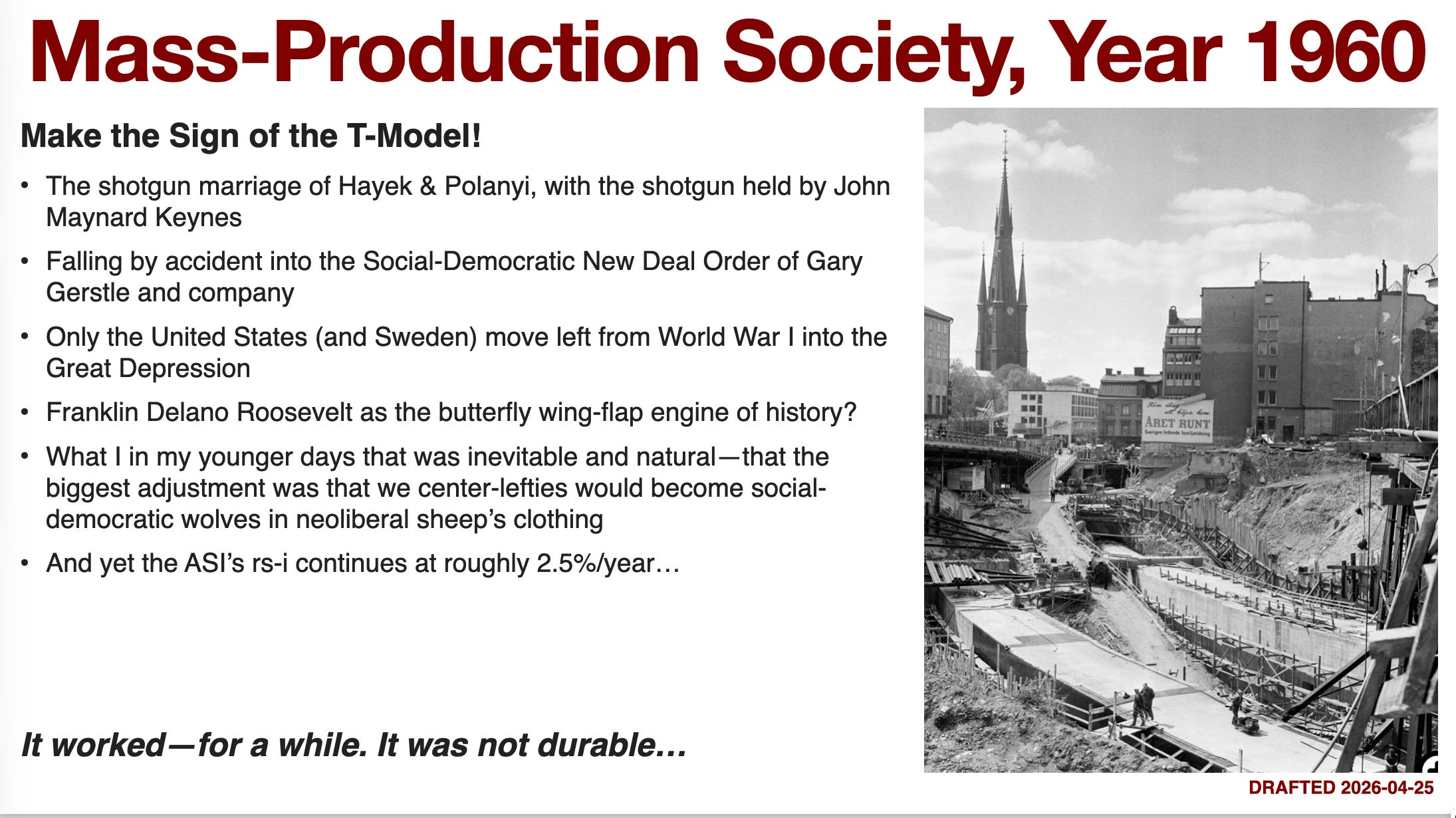
Somehow applied‑science society is succeeded by mass‑production society.
Make the sign of the T‑Model.
If you want a date, you could do worse than 1914–1920: Henry Ford’s Highland Park plant running in full cry; the Dodge brothers and Alfred Sloan absorbing the lesson; the experimental pieces of welfare capitalism and collective bargaining falling, by accident and improvisation rather than grand design, into a new configuration. By mid‑century you have what we might call “mass‑production society”: standardized products, standardized jobs, standardized life‑courses, and a political‑social settlement that, for a time, made that standardization tolerable—even appealing—for a very large slice of the population.
From steam age to applied science to mass production: different growth regimes
It is helpful, I think, to be explicit about how the growth pattern changes across these three regimes.
The steam‑power age—call it 1770–1870—gives you narrow‑sector, moderate‑pace growth. In Britain, Nicholas Crafts and Knick Harley put real GDP per capita growth at roughly 1.0–1.3% per year in the first half of the nineteenth century; total factor productivity increases are slower, 0.4–0.7% per year, and heavily concentrated in cotton textiles, coal, and iron. Agriculture still employs 35–45% of the labor force in Britain in 1850; in France and Germany, more. Outside the steam‑intensive sectors, techniques look remarkably like 1700. Global GDP per capita in Angus Maddison’s reconstructions inches from perhaps 1,100–1,200 dollars (today’s prices) in 1700 to 1,600–1,800 by 1870. Doubling times are measured in centuries.
The applied‑science age—1870–1914, and in important ways all the way to 1970—changes the breadth and inside‑the‑black‑box character of growth. Electricity, internal combustion, chemicals, telecommunications, scientific management: these are not just big lumps of capital you bolt to a line‑shaft, but a proliferating swarm of general‑purpose technologies that demand reorganization of factories, cities, households, and states. Robert Gordon’s numbers for the United States give labor‑productivity growth around 2% a year from 1890 down to 1972, with especially strong decades between 1920 and 1950. Western Europe, once reconstruction and catch‑up start in earnest after 1950, often exceeds that: France and West Germany routinely hit 4–5% annual labor‑productivity gains in their “trente glorieuses.” World GDP per capita, in Maddison’s data, more than triples from roughly 2,000–2,500 dollars around 1870 to north of 7,000 by 1970.
But mass production—Fordist mass production, as the French insist on calling it—is something more specific that emerges inside and on top of that applied‑science regime. It is the moment when the combination of (1) standardized, capital‑intensive production lines; (2) national or continental mass markets; and (3) political bargains over wages, unions, and social insurance lock together. The high‑wage, high‑volume, semi‑stable employment equilibrium that economists of my generation lazily treated as “normal capitalism” from 1945 to 1973 is historically very weird. It rests on assembly lines and flow production in a handful of leading sectors—autos, steel, appliances, processed foods, housing construction—and on a political order that channels productivity gains into broadly shared incomes and rising public provision.
Quantitatively, you can see the mass‑production twist in three numbers.
First, sectoral concentration: by 1950 something like one‑third of U.S. manufacturing employment is in durable goods tied to the auto–steel–rubber complex and related machinery; add in construction and you have 25–30% of the non‑farm labor force either directly or indirectly tied to mass production. Second, wage compression: the famous “Great Compression” that Claudia Goldin and Robert Margo document is a 20–30 percentage‑point narrowing of the wage distribution between 1929 and the early 1950s, achieved in part through the rise of unions in exactly those mass‑production sectors and reinforced by wartime controls and postwar norms. Third, macro volatility reduction: Christina and David Romer, Barry Eichengreen, Peter Temin, and others have argued that, relative to the gold‑standard world of 1870–1914, the postwar OECD sees both higher average growth (2–3% per capita versus 1–1.5%) and somewhat lower peacetime volatility—until the 1970s shocks blow the regime up.
So, yes: applied science gives you the possibility of 2% annual recursive self‑improvement of the human ASI; mass production is what happens when a particular organizational and political configuration grabs hold of that potential and channels it through a set of standardized products and life‑paths.
The T‑Model and the accomplishments of mass‑production leading sectors
Make the sign of the T‑Model, indeed.
The iconic accomplishment is the car. In 1900, the United States has perhaps 8,000 automobiles and almost no paved rural roads; by 1929 it has more than 23 million registered vehicles, one for every five people. Real prices per vehicle, adjusted for quality, fall by something like 60–70% between the Model T’s debut in 1908 and the late 1920s, as unit labor requirements on Ford’s Highland Park and River Rouge lines drop by a factor of three or four. Beverly and Daniel Raff, and Daniel Bresnahan and Timothy Bresnahan, have written the micro‑stories of how assembly‑line reorganization and model proliferation generate enormous productivity gains and consumer surplus.
Around autos cluster other mass‑production leading sectors. Steel: U.S. raw steel output rises from 28 million metric tons in 1910 to 88 million in 1950—and 137 million by 1970—while labor hours per ton fall by an order of magnitude as open‑hearth and then basic‑oxygen furnaces and continuous casting diffuse. Household appliances: in 1920 fewer than 10% of U.S. homes have electric refrigerators; by 1960 that share is above 80%. Washing machines, vacuum cleaners, radios, televisions: mass‑manufactured consumer durables become standard equipment in an average worker’s home. Housing: Levittown, built starting in 1947, churns out 17,000 nearly identical houses in less than a decade; by 1960, suburban tract housing has become the aspirational norm for the entire white American working and middle class.
Productivity in these sectors is extraordinary. Robert Gordon’s sectoral decompositions suggest that between 1920 and 1970, manufacturing TFP in transportation equipment, electrical machinery, and certain metals rises at 3–4% per year, roughly doubling every 20 years. When you pipe that through to the cost of a mile of car travel, a kilowatt‑hour of electricity, a cubic foot of heated suburban space, or a load of laundry, the fall in the labor time required per unit of “consumption service” is immense—factors of five, ten, or more compared to 1910.
There are, of course, other mass‑production miracles. In food processing and agriculture, the number of farm workers in the U.S. falls from roughly 10 million in 1940 to under 3 million by 1980, even as farm output doubles. Tractors, combines, hybrid seeds, synthetic fertilizers, refrigerated transport, and nationally branded processed foods make calorie scarcity disappear for the median rich‑world resident. In 1900, Americans spend 40–50% of household budgets on food; by 1970 that is down to 15–20%. The mass‑produced cheeseburger is, in its own horrible way, an emblem of the regime.
And yet the disruption is just as real as the accomplishment.
The same assembly lines that pay $5 a day in 1914 also destroy artisanal skill. The same tractors that quadruple yields and free labor for the cities also empty out the rural countryside—Barnes and Olson have those haunting charts of county‑by‑county depopulation in the Great Plains after 1930. The same low‑cost appliances that liberate housewives from some drudgery also trap them in an ever‑higher normative standard for cleanliness and domestic performance. The same standardized factory jobs that create stable unionized employment for white men also lock women and racial minorities into lower‑paid, less secure segments of the labor market.
From a distributional perspective, the mass‑production miracle is conditional. If you are a white male high‑school graduate in 1955 with a UAW card in your wallet, you are sitting pretty: one breadwinner can support a family, buy a house and a car, and send the kids to a decent public school and maybe a state college. If you are a Black sharecropper in Mississippi, a Mexican migrant in California’s Central Valley, or a woman trying to raise children on a clerk’s wage, you are not exactly in Keynes’s El Dorado.
The shotgun marriage: Hayek, Polanyi, and Keynes
The political‑social equilibrium that made this system feel, for a while, like “the way things are supposed to be” is, as Gary Gerstle and many others have argued, a shotgun marriage between two incompatible principles: Hayek’s insistence that decentralized market signals are the only reliable way to allocate resources in a complex economy; and Polanyi’s insistence that labor, land, and money cannot be treated as mere commodities without tearing society apart. The shotgun is held by John Maynard Keynes—or rather, by the global cohort of mid‑twentieth‑century macroeconomic managers who took it upon themselves to use fiscal and monetary policy to keep aggregate demand high and unemployment low.
On the one hand, mass production needs Hayekian markets. Central planners cannot design a car model mix, a steel capacity path, a housing subdivision layout, and a consumer‑durables bundle that matches evolving tastes and technologies as well as millions of firms and households can. Germany’s brief experiments with Four‑Year Plans and Nazi corporatism illustrate the limits: you can build a lot of Autobahns and Volkswagens when you are rearming and repressing labor, but you do not get the same dynamic product innovation as in the U.S. competitive oligopoly of GM–Ford–Chrysler.
On the other hand, mass production needs Polanyian protections. If you throw workers into the industrial machine with no unemployment insurance, no minimum wage, no right to organize, no social insurance, and no public education, you get Weimar‑style political breakdown, not stable consent. Karl Polanyi’s “double movement” description in The Great Transformation fits the interwar and postwar histories rather well: the attempt to disembed markets in the nineteenth century produces social catastrophe; the response, after 1945, is a re‑embedding of markets in welfare states, collective bargaining systems, and regulatory regimes.
Keynes’s role—exaggerating slightly—is to convince enough elite actors that you can have both: that you can preserve profit‑seeking, private property, and price signals, and use the state to smooth the business cycle and underwrite a floor of security. Full employment at 3–4% unemployment, 2–3% inflation, a trend growth rate of 2–3% per capita: those become plausible policy targets, and, for a time, they are more or less hit.
Gerstle calls the resulting configuration the “New Deal order” in the United States: a regime of ideas, institutions, and interest coalitions that, roughly from the late 1930s to the late 1970s, frames both Democratic and (reluctantly) Republican politics around acceptance of a large mixed economy, strong unions in key sectors, progressive taxation, and some measure of racial and gender liberalization. One sees cognate formations in Western Europe: Christian‑Democratic welfare states in Germany, social‑democratic hegemony in Scandinavia, Gaullist dirigisme in France.
The unlikely path by which FDR gets us there
It is important, I think, to stress how contingent this New Deal‑mass‑production order is. There is nothing “natural” or inevitable about landing here.
In 1914, the United States is already an applied‑science giant and an emerging mass‑production pioneer, but its politics are still Gilded Age plus Progressive Era: limited social insurance, weak unions, racial apartheid in the South, nativism in immigration, the gold standard fettering macro policy. World War I and its aftermath shake that structure, but the 1920s see a reassertion of laissez‑faire in economic policy even as Fordism advances in the factories. Only two countries, as you note, move substantially leftward in the crisis sequence of 1914–1945: the United States and Sweden. Germany, Italy, Japan, Spain, and a host of smaller states move fascist or authoritarian; Russia and then the Soviet Union move Stalinist. Britain and France muddle through with weak social‑liberal experiments beset by debt, reparations, and deflation.
Franklin Delano Roosevelt becomes, in this reading, something like the butterfly‑wing‑flap engine of history. There is no reason the U.S. had to elect a Hudson Valley patrician with an intuitive appetite for experimentation and coalition‑building in 1932. It could have stumbled on with Hooverite austerity; it could have moved toward technocratic authoritarianism; it could have generated its own version of fascism. FDR’s willingness to throw policies against the wall—bank holiday, Glass–Steagall, the National Recovery Administration, the Wagner Act, Social Security, the Works Progress Administration, deficit spending—and keep the ones that stuck gradually assembles a toolkit for managing a mass‑production economy in a socially sustainable way.
Barry Eichengreen and Peter Temin have long argued that the abandonment of the gold standard is the key turning point. Countries that left gold early—Britain in 1931, the U.S. in 1933, the Scandinavian bloc—are the ones that recover first and are able to experiment with demand management and social policy. The U.S. also has the luxury‑curse of enormous internal resources and a relatively small pre‑existing welfare state: it can improvise without immediately running into state‑capacity limits. Sweden, interestingly, gets to a somewhat similar social‑democratic mass‑production order through a different path: the 1938 Saltsjöbaden Agreement between unions and employers, combined with Social Democratic political dominance, yields a centralized bargaining system and a universalist welfare model, all undergirded by export‑oriented manufacturing giants like Volvo, Saab, and Asea.
So by 1950 or so, you have a mass‑production New Deal order in which:
In the U.S., union density is near 35%; top marginal income tax rates exceed 90%; the federal government spends 20–25% of GDP (rising toward 30% if you include state and local); and real wages for production workers rise roughly in line with productivity, at 2% per year.
In Sweden, the public sector is even larger; wage bargaining is centralized; and big manufacturing firms operate in a coordinated‑market‑economy environment that Hall and Soskice later label “Nordic corporatism,” but which, to the median Swede, looks like a well‑padded mass‑production social democracy.
Everyone else—Germany, France, Italy, Japan—gets their own variants only after the war, often under American pressure and with Marshall Plan resources as lubricant.
Mass production, social democracy, New Deal order: overlapping, not identical
It is worth, as you request, distinguishing three overlapping but distinct things: mass production as technological‑organizational regime, social democracy as ideological‑programmatic project, and the New Deal order as a specific institutional settlement.
Mass production is, at bottom, a way of organizing production. It is about assembly lines, standardized parts, long runs, capital‑intensive machinery, and the learning‑by‑doing curves that make unit costs fall with cumulative output. You can, in principle, have mass production with fascism (Germany 1936–1944), with Stalinism (Magnitogorsk, the Soviet auto and tractor plants), with laissez‑faire (U.S. steel and autos in the 1920s), or with social democracy (Sweden’s postwar manufacturing model). Its economic logic is indifferent to the distribution of its surplus or the political mechanisms of control, beyond wanting predictable property rights and a supply of disciplined workers.
Social democracy is a political‑ideological project: use a democratic state to tame capitalism, redistribute income and risk, and provide universal social rights, while retaining private property and markets as the basic allocative mechanism. You can have social‑democratic rhetoric and institutions without a very advanced mass‑production sector (Norway in the early postwar era, Portugal in more recent decades), and you can certainly have mass production without much social democracy (Brazil’s auto plants under the military regime, South Korea under Park Chung‑hee).
The New Deal order is a historically specific American compromise: mass production in the core sectors, embedded in a political economy that accepts unions in those sectors, builds a patchwork welfare state (Social Security, unemployment insurance, later Medicare and Medicaid), regulates finance, and uses fiscal and monetary policy to avoid Great Depression‑scale downturns—but leaves race, gender, and a large chunk of the service sector in a semi‑feudal condition for far too long. Its ideological umbrella is broad enough to contain both left New Dealers and “vital center” Cold War liberals; its institutional backbone is the Democratic Party coalition plus the grudging adaptation of Republicans who, by the 1950s, run on “we can manage this better” rather than “tear it all down.”
For a time—say 1945–1973—these three things line up. The leading mass‑production sectors are unionized and relatively high‑wage; social‑democratic ideas are hegemonic enough to make full employment, progressive taxation, and social insurance common sense; the New Deal order translates those into policy in the United States, while Western Europe and Japan build their own cousins under American hegemony.
And then, as you and I both know, it stops lining up.
It worked—for a while. It was not durable…
The internal contradictions of the regime are well‑known: productivity growth slows in the 1970s; the oil shocks and the breakdown of Bretton Woods expose the fragility of a system built on cheap energy and quasi‑fixed exchange rates; inflationary pressures collide with institutions designed for a different era. Barry Eichengreen’s The European Economy Since 1945 and Gordon’s The Rise and Fall of American Growth trace the economic side; Gerstle and others tell the political‑cultural story: tax revolts, backlash against racial integration and feminism, business mobilization against regulation and unions.
In my younger days I thought that the right strategy was to try to get back, as much as possible, to that mid‑century mass‑production–New‑Deal alignment—that we center‑lefties should simply become social‑democratic wolves in neoliberal sheep’s clothing. Accept some deregulation, flatter taxes, freer trade, more independent central banks; in exchange, quietly preserve the welfare state, nudge up the Earned Income Tax Credit, expand access to education and health care, and ride the next wave of ASI‑driven growth to a kinder, more inclusive version of 1965.
Didn’t work. Or, rather, it worked for some people, in some places, for some years—and then it didn’t.
The ASI continues at roughly 2% per year of recursive self‑improvement. But now the sectors doing the creative destruction are not auto and steel but information technology, global logistics, and finance; the jobs being eliminated are not just farmhands and unskilled factory workers but routine clerical staff, mid‑skill manufacturing workers, and, increasingly, medium‑skill white‑collar roles; the geography of production is reorganized around global value chains. East Asia absorbs a huge chunk of the world’s mass‑production manufacturing; the OECD core moves up the value chain into design, branding, engineering, and high‑end services.
Arthur Lewis’s dual‑sector model suddenly looks relevant again, but at a global scale: a Lewis equilibrium in which a core of rich countries plus a handful of successful industrializers capture the high‑productivity segments of manufacturing and knowledge work, while a vast periphery supplies labor and raw materials at low wages. Inequality within rich countries rises as the returns to capital and to very high‑skill labor outstrip the returns to routine labor; inequality between some rich and some poor countries narrows (China, Korea, Taiwan) even as others stagnate or fall further behind.
Hence Simon Kuznets’s grim joke in the 1960s that there are, in practice, four kinds of countries and that their statuses look disturbingly permanent: there are rich countries; there are poor countries; there is Japan; there is Argentina. Japan, the one that improbably climbs from poor to rich in a single century via disciplined late‑industrialization and export‑led mass production; Argentina, the one that seems to have all the factor‑endowment advantages of a rich country in 1900 and yet contrives, through a dazzling sequence of policy errors and political breakdowns, to miss every boat.
The mass‑production–New‑Deal–social‑democratic alignment of 1945–1973 turns out to be less a natural equilibrium and more a lucky constellation: contingent on the Depression, the war, FDR, the particular balance of class forces and ideas, and the temporary exhaustion of capital’s political will to fight. Once the ASI’s recursive self‑improvement shifts into different sectors and is mediated through different institutional channels—globalized value chains, digital networks, hyper‑mobile finance—the old compromises crack.
We do not, so far, get Engels’s blue‑overalled comrades. We do not get Hayek’s minimalist night‑watchman state. We do not, yet, get Polanyi’s humane embedding of markets in solidary social relations. We get something more unstable: a post‑Fordist, post‑New Deal world still running, more or less, on the 2% growth engine inherited from the applied‑science and mass‑production ages, but increasingly poor at turning that aggregate progress into legitimate and widely accepted life‑trajectories for the median household.
Yet that called forth from the Vasty Deep the Neoliberal Order of the Globalized Value-Chain Society, which in my estimation, at least, did considerably worse.
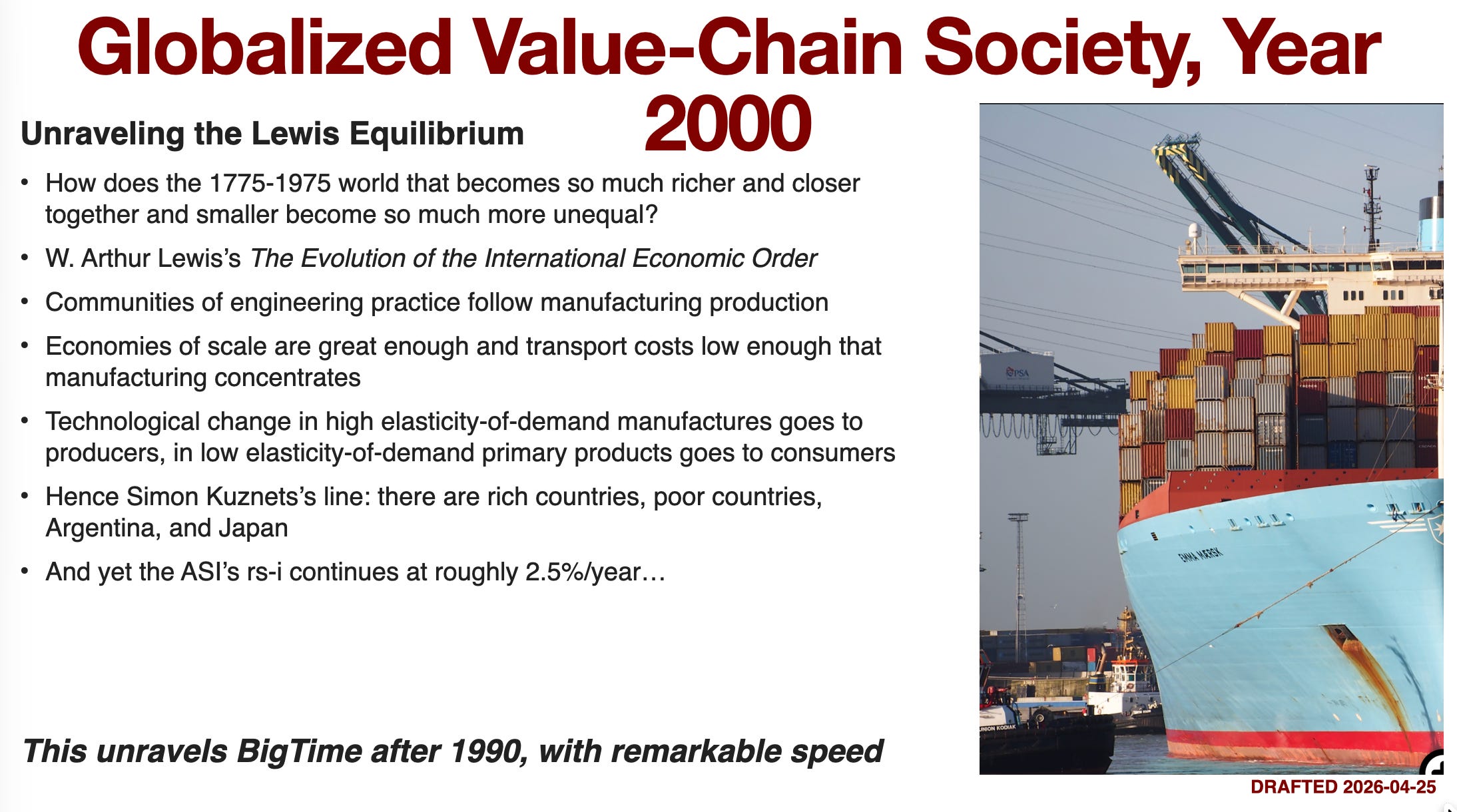
The inadequacies of New Deal Order–Social Democracy–Mass‑Production society were manifest by the late 1970s. Stagflation—simultaneous high unemployment and high inflation—had become entrenched across the OECD. Productivity growth slowed sharply: in the United States, labor‑productivity growth fell from roughly 2.5–3.0% per year in the 1950–1973 “golden age” to barely 1–1.5% between 1973 and 1990; Western Europe saw a similar halving of growth rates. Oil prices quadrupled in 1973–1974 and doubled again in 1979–1980. Union wage norms and cost‑of‑living escalators amplified the inflationary shock; fixed‑exchange‑rate regimes and commodity‑price swings transmitted it across borders. The Bretton Woods monetary order fell apart in 1971–73, and with it the stable macro framework that had underpinned the postwar compromise.
By the late 1970s, you had double‑digit inflation in the U.S., the U.K., and much of Europe; unemployment rates well above the 3–4% “full employment” standard of the 1950s and 1960s; and, in several countries, profit shares so squeezed that corporate investment sagged. The “social democratic–New Deal–mass production” triangle no longer looked like a self‑sustaining equilibrium. It looked like a regime that had lost the capacity to adapt: ossified nationalized industries, sclerotic labor‑market institutions, fiscal systems struggling with rising welfare‑state commitments and slowing tax bases.
And so it cracked, and the groaning of the cracks called forth transformation.
What was called forth from the Vasty Deep—summoned by inflation, by the Volcker shock, by deindustrialization, by elite impatience with unions and controls—was what we might as well call the Neoliberal Order of the Globalized Value‑Chain Society. And this new order, I think, did considerably worse at turning the underlying technological miracle into broadly felt security and dignity.
From mass production to globalized value chains: a different growth pattern
The pattern of growth in the globalized value‑chain economy that takes shape after 1980 is very different from what it had been in the classic mass‑production era.
In the mass‑production economy of, say, 1945–1973, growth is domestically anchored. The leading sectors—autos, steel, consumer durables, construction—are physically located in Detroit, the Ruhr, the Midlands, the North of Italy, the Tokyo–Nagoya–Osaka corridor. The modal worker is a male, unionized, semi‑skilled production worker in a factory that ships standardized products into a national mass market. Productivity growth is driven by learning‑by‑doing within firms and industries that are largely national in scope, with some trade at the margin. The postwar Fordist bargain channels 2–3% annual productivity growth into 2–3% annual real‑wage growth for that worker, plus expanding public services.
In the globalized value‑chain economy of 1990–2010, by contrast, the geographic and functional structure of production splinters. Richard Baldwin’s “second unbundling” story is the best short version here. When information and communication technologies make it cheap to coordinate tasks across long distances, firms stop just trading finished goods across borders and start slicing up the value chain itself. Design, R&D, branding, and high‑end services stay in the old core; assembly, component manufacture, and a great deal of process engineering move to lower‑wage sites. Instead of a single vertically integrated plant in Ohio or the Ruhr, you have a network: chips fabricated in Taiwan, boards populated in Malaysia, final assembly in China, software written in Bangalore, marketing in California.
Quantitatively, you see this in the explosion of trade in intermediate goods and in the rise of global value‑chain participation indexes. Between 1985 and 2008, world trade as a share of world GDP rises from roughly 30% to nearly 60%. The share of intermediate goods in total trade rises above 50%. Foreign direct investment stocks quadruple as a share of global GDP. At the same time, labor’s share of income in the advanced economies falls by several percentage points; top‑income shares, which had been compressed from the 1930s through the 1970s, surge back toward Gilded Age levels.
Growth itself does not vanish. Global real GDP per capita continues to grow at 1.8–2.0% per year from 1980 to 2019, about the same as in the earlier postwar era. But its distribution is reconfigured. The old cores—the U.S., Western Europe, Japan—see modest per‑capita growth (1.5–2% a year), decelerating after 2000. Newly industrializing East Asia—Korea, Taiwan, then China and, to a lesser extent, Southeast Asia—sees hyper‑growth: 5–8% per‑capita growth for decades, pulling hundreds of millions out of poverty. Large parts of Africa and Latin America, meanwhile, oscillate between brief booms and painful busts, rarely stringing together two uninterrupted high‑growth decades.
In that sense, the globalized value‑chain economy improves on the old Arthur Lewis “rich‑core/poor‑periphery” equilibrium at the global level: China and its neighbors rise from poor to middle‑income or rich, and global inequality between individuals falls even as within‑country inequality rises. But from the standpoint of the old industrial cores, and from the standpoint of their median workers, it feels like a downgrade.
Rust belts and deindustrialization: disruption in the core
The most visible disruption is the transformation of manufacturing cores into rust belts.
In the United States, manufacturing employment peaks in absolute numbers around 1979 at roughly 19½ million jobs—about 22% of total nonfarm employment. By 2007, before the Great Recession, that number is down to 13–14 million, under 11% of employment; by 2019 it is closer to 12 million, or about 8–9%. Productivity in manufacturing more than doubles over that interval; real output grows, but the jobs disappear. The Midwest and Northeast lose auto plants, steel mills, machine‑tool factories, textile mills. Entire communities from upstate New York through Ohio and Michigan to western Pennsylvania see their economic base erode. The U.K. sees a sharper version: manufacturing falls from more than 30% of employment in 1970 to under 10% by the 2000s; coal, steel, shipbuilding in the North and in Scotland collapse; the Southeast around London survives and thrives as a services and finance hub.
Germany and Japan manage a somewhat softer landing, partly because of stronger manufacturing policy, co‑ordinated wage bargaining, and industrial districts that remain export‑competitive. But even there, the share of manufacturing in employment falls by half; young workers avoid factory careers; old industrial towns stagnate.
Richard Baldwin’s work helps us see what is going on: the second unbundling isn’t just about “China taking our jobs.” It is about firms in the core having the option to arbitrage labor costs globally, which shifts the bargaining power in every wage negotiation, every location choice, every investment decision. The credible threat to move the next plant to Shenzhen or Monterrey disciplines unions and local governments even if no move takes place.
On the accomplishment side, the globalized value‑chain regime is dazzling. A smartphone assembled in China sells in rich countries for, say, 800 dollars; the assembly wage bill embedded in it may be 5–10 dollars; the cost of the physical components perhaps 200–250 dollars. The rest is rents to intellectual property, design, software, and branding. Global consumers enjoy a cornucopia of cheap manufactured goods: clothing prices in real terms fall by 25–50% over a generation; electronics prices collapse in quality‑adjusted terms; “Walmart–IKEA–H&M–Amazon” capitalism delivers an abundance of stuff to households whose real wages are not rising much.
The major accomplishments of the leading sectors in this era are less about producing more of the old things and more about re‑architecting the system: container shipping and logistics (Malcom McLean’s standardized container, port automation, just‑in‑time inventory); ICT (TCP/IP, the Web, broadband, smartphones, cloud computing); financial engineering (good and bad: global capital mobility, securitization, derivatives). Productivity improvements in logistics alone are enormous: the cost of shipping a container from Asia to North America falls by an order of magnitude compared to break‑bulk cargo; inventory–to–sales ratios fall as supply chains become more tightly managed.
But from the standpoint of the median worker in Detroit or Sheffield, what matters is that the old deal—“you give us labor discipline on the line; we give you a rising wage path and some security”—is gone. The new deal is: “you are in competition with workers half a world away, your union has been broken or marginalized, and your local tax base is shrinking.” The mass‑production cores become rust belts; their political mood sours.
From social democracy to left and right neoliberalism
The political–social equilibrium shifts accordingly. The New Deal order gives way to the Neoliberal Order.
Under the New Deal order (and its cousins in Europe), the implicit rules were:
Full employment is a legitimate macro goal.
Finance is a servant, not a master.
Unions are legitimate representatives of labor.
Progressive taxation and social insurance are part of the deal.
The state can and should steer the economy through fiscal and monetary policy.
By the early 1980s, that consensus has cracked. Inflation and macro mismanagement have discredited demand management in the eyes of many; capital has re‑mobilized politically; the intellectual atmosphere has been transformed by market‑friendly economics.
What emerges first is right neoliberalism: the Reagan–Thatcher wave. In practical terms:
Tight monetary policy to break inflation (Volcker in the U.S., Howe and Lawson in the U.K.).
Tax cuts for high incomes and corporations; flattening of tax schedules.
Deregulation in transport, telecommunications, finance, and product markets.
Privatisation of state‑owned enterprises (especially in the U.K.).
Attacks on unions: the PATCO strike in 1981; the miners’ strike in 1984–85; legal and institutional weakening of collective bargaining.
Liberalisation of capital flows and financial innovation.
Reagan’s route is, in some ways, odd. He rides a coalition of Sunbelt business, Cold War hawks, white suburbanites resentful of taxes and racial integration, and religious conservatives into office. His personal charm and rhetorical optimism smooth over the pain of early‑1980s unemployment and the brutal Volcker disinflation. The U.S. benefits from a cyclical rebound and from being the central node of the new ICT wave; by 1984, “morning in America” is just credible enough.
Thatcher’s route is harsher: she comes to power in a Britain battered by the IMF crisis of 1976, militant unions, and decades of relative decline. Her government’s explicit aim is to break the postwar corporatist bargain. The early 1980s see unemployment above 10%, deindustrialization on a massive scale, and the crushing of the miners. North Sea oil money and the rise of the City as a deregulated global financial center provide a partial economic offset—but also deepen regional inequality.
Alongside right neoliberalism, we eventually get a left neoliberalism, as center‑left parties adapt rather than resist. Blair and Brown in the U.K., Clinton in the U.S., Schroeder in Germany, later Obama: all attempt to make the best of a bad bargain.
Their bet, roughly, is:
Accept the new constraints: open capital markets, central‑bank independence, inflation targets, trade and investment liberalization, a weaker union movement.
Use the fiscal space and growth that remains to expand “social investment” rather than old‑style redistribution: education, health care, earned‑income tax credits, active labor‑market policies.
Rely on the ICT and value‑chain booms to create high‑skill jobs in design, software, finance, and professional services.
Make peace with markets ideologically (“third way,” “New Democrats”) while arguing that a bit of technocratic nudging will mitigate the downsides.
In practice, this produces some real gains—expanded health coverage under Obama, poverty reduction via tax credits, significant boosts to education access—but does not rebuild a robust economic base for the old industrial regions, nor does it reverse the rise in top‑end inequality. It also leaves the structure of financial capitalism largely intact, setting the stage for the 2008 crisis.
Neoliberal Order, Washington Consensus, globalized value‑chain economy: overlapping, not identical
Here it helps to disentangle three overlapping but distinct notions.
The globalized value‑chain economy is fundamentally an economic–technological configuration. It is about the second unbundling that Baldwin describes: cross‑border fragmentation of production, ICT‑enabled coordination, containerization and logistics, the dominance of multinational enterprises, the spread of just‑in‑time systems. You could, in principle, run such an economy under various political regimes, from social democracy to techno‑authoritarianism. It is the hardware.
The Washington Consensus is a specific policy package for developing and emerging economies, coined by John Williamson in 1989: fiscal discipline, tax reform, market‑determined interest and exchange rates, trade liberalisation, privatisation, deregulation, secure property rights, and a minimalist state in production. It is an attempt to codify what the IMF, World Bank, and U.S. Treasury were pushing on Latin America and elsewhere. You can have a globalized value‑chain economy without full Washington‑Consensus orthodoxy (China never fully signed on; neither did East Asian developmental states), and you can in principle adopt Washington‑Consensus policies without embedding yourself deeply in global value chains (although in practice the two go together).
The Neoliberal Order is broader and more diffuse: it is the ideological and institutional settlement in the rich world that says, roughly:
Markets and private ownership should be the default in more and more domains.
The state’s economic role is to secure property rights, maintain low inflation, and provide a minimal safety net; redistributive ambition is suspect.
Global openness to goods, capital, and, to a lesser extent, people is a good in itself.
Distributional outcomes of markets should be treated as mostly legitimate, with only marginal correction.
New Deal order versus Neoliberal order is thus about the deep background assumptions of policymakers, pundits, and mainstream parties. Washington Consensus is the export version of neoliberal policy to the Global South. Globalized value chains are the material substrate that both shapes and is shaped by that order.
By the early 1990s, the old Arthur Lewis‑style picture that Simon Kuznets encapsulated in his rueful 1960s joke—there are four kinds of countries and their statuses seem permanent: rich countries, poor countries, Japan, and Argentina—has already begun to unravel. Japan, once the exceptional latecomer success, runs into its own financial and demographic headwinds; China and a dozen other East Asian economies crash the party; Argentina continues to find new ways to disappoint.
After 1990, that equilibrium unravels extraordinarily rapidly. The fall of the Soviet Union brings a vast new labor pool into the global system; China’s WTO accession in 2001 accelerates the reconfiguration of manufacturing; digital technologies accelerate the second unbundling. Global inequality between persons falls, as billions in Asia see rising incomes; but inequality within many countries rises sharply, and the rust belts of the old cores seethe.
Richard Baldwin in Geneva is the place to go for a clear take on where this might be coming from: “The Great Convergence,” “The Globotics Upheaval,” and related work spell out how trade in tasks, not just goods, and the looming automation of white‑collar work reshape the landscape. The curse—or blessing—of recursive technological self‑improvement of the human ASI at something like 2% per year remains in force. What changes, again and again, is the institutional and political superstructure that channels that compounding into some combination of abundance, anxiety, and anger.
We have, I think, moved from steam‑age Engelsian dreams to applied‑science El Dorados to mass‑production New Deals to neoliberal global value chains, without ever quite building an order that matches the productive potential of the system with a stable, legitimate distribution of its fruits. The Neoliberal Order is the most recent failed attempt.

And now we are heading for the info‑biotech‑attention society, which—if current trajectories hold—we will have more or less fully backed into by around 2040. We are not standing outside it, contemplating it with scholarly detachment. We are in the bullseye now. It is our sector—information work, cognitive tasks, symbolic manipulation, “thin” professional services, media, research—that is sitting where textile handloom weavers and stocking‑frame workers sat in 1810, where assembly‑line operatives sat in 1950, where back‑office clerks sat in 1990: at the key creative‑destruction point.
E.P. Thompson wrote his Making of the English Working Class in very large part, I think, out of a lifelong rage against confident scholars of human economic progress and the “awesome condescension of posterity” they aimed at the poor stockingers of 1800. Those stockingers belonged to what he called a labor aristocracy: skilled, well‑paid male craftsmen, sustaining communities and cultures of mutual aid and political radicalism, suddenly watching their livelihoods vanish behind new stocking frames that no longer needed a strong, trained man at the pedals, but could be operated by unskilled boys, by unskilled Irish immigrants, even by women. The technology was productivity‑enhancing in the aggregate; the local impact was catastrophic, and the line from there to the Luddite hammers is not hard to draw.
We should be honest enough to admit that, in the info‑biotech‑attention transition, we are the stockingers. The people whose comparative advantage is reading and writing, drafting memos, doing mid‑level analysis, summarizing meetings, producing PowerPoints, grading papers, generating advertising copy, even proving theorems and running regressions—those are precisely the tasks that the current wave of large‑scale machine‑learning systems can already nibble at and may soon, in many niches, gulp down.
Is this going to be another step‑change in the pace of recursive self‑improvement on the part of the real ASI—the human aggregate applied‑science intelligence, embodied in scientists, engineers, organizations, and institutions? Or is it “merely” another redirection: the same 1.5–2.5% annual growth in effective knowledge and productivity we have had since 1870, now channeled through different bottlenecks and sectors? We do not know. That, I can say with some confidence at the moment. History is not running controlled experiments for our benefit.
We can, however, say something about the pattern of growth, and about how it is likely to differ from the pattern that characterized the globalized value‑chain economy of 1990–2010.
The globalized value‑chain regime gave you, roughly, 2% annual growth in world GDP per capita, with the composition skewed toward tangible manufactured goods and infrastructure, and the geography skewed toward East Asian industrialization. Between 1990 and 2019, world output per person in Maddison‑style reconstructions rises from roughly 8,000 to 15,000 dollars (today’s prices). China alone goes from maybe 2,000 to 16,000 dollars per capita, an eight‑fold increase in a generation; global merchandise exports as a share of world GDP climb from about 15% to almost 25%; foreign‑value‑added content of exports doubles in many sectors. Baldwin’s “second unbundling” is a story of factories arriving in Guangdong and Penang and Tijuana, even as design, IP, and finance stay in Cupertino, Munich, and Boston.
The info‑biotech‑attention regime unfolding now looks different on at least four dimensions.
First, the object of production shifts further from atoms to bits and bases and brains. In 1980, intangible investment—software, R&D, brand equity, organizational capital—was well under half of total business investment in the U.S.; by 2020 it is more than half. In some leading firms, the ratio of market capitalization to tangible book value is 10:1 or more: you are paying not for machines and buildings, but for code, data, patents, brands, and organizational know‑how. The value‑added in a modern smartphone, a streaming platform, or a gene‑therapy company is overwhelmingly intangible. The info‑biotech‑attention economy accelerates that trend: personalized medicine, AI‑mediated education, entertainment designed and iterated on real‑time engagement data, “digital twins” of factories, financial markets running on machine‑generated signals.
Second, the unit cost curve steepens in the sense that marginal cost falls further and further toward zero for more and more important goods. Once you have trained a large language model—or designed a CRISPR‑based gene‑editing protocol, or recorded a hit song, or developed a successful piece of therapeutic software—the cost of serving one more user is essentially the electricity to run a GPU for a few milliseconds, or the bandwidth to stream another copy, or the marginal reagent cost of a genomic test. In standard growth theory terms, the share of non‑rival, infinitely replicable inputs in the production function goes up. That pushes us into the territory that the endogenous‑growth theorists have been waving at for 30 years: Romer’s world of idea‑driven increasing returns, Jones’s warning that the “scale effects” you get from more brains and better tools require more and more policy intervention to keep from producing monopoly choke points.
Third, the labor‑demand profile changes. The globalized value‑chain regime destroyed routine manufacturing jobs in the core and created mid‑skill manufacturing and service jobs in the periphery, while expanding high‑skill professional and managerial work in the core. The info‑biotech‑attention regime threatens routine cognitive work everywhere: paralegals, junior programmers, radiologists, accountants, copywriters, customer‑service representatives, even some of the grunt work of economic research are squarely in the firing line. Acemoglu and Restrepo, in their work on automation and “so‑so technologies,” have been arguing that when the automation frontier moves into tasks that are not only routine but also easily codified and monitored at a distance, the wage squeeze can extend quite far up the skill ladder. You can outsource a call center to Bangalore; you can also, now, automate substantial chunks of the call‑center workflow with speech‑to‑text and dialog agents.
Fourth, the binding constraints may shift from energy and capital to attention, trust, and institutional capacity. In a world where you can spin up another million AI‑generated videos, or personalized ads, or synthetic news articles at negligible cost, the scarce resource is humans’ willingness to look and believe. The advertising‑supported platform model has given us a first look at this attention economy: global daily time spent on social media has gone from zero in 2003 to more than two hours per adult in many countries today. The marginal engineering effort goes into extracting a few more minutes of engagement from you; the marginal economic damage shows up as polarization, misinformation, and regulatory fatigue.
On the biotech side, the binding constraint may be regulatory and ethical rather than technical. We know how to sequence genomes at well under 1,000 dollars a head (down from roughly 100 million dollars in 2001); we know how to design mRNA vaccines in weeks rather than years (witness 2020–2021); we are learning, frighteningly fast, how to edit genes in vivo. The rate‑limiting steps are going to be political and social: who gets access, on what terms, with what oversight, under what global biosafety regime. The growth accounting will not capture much of this directly, but the welfare stakes are enormous.
So: will the info‑biotech‑attention regime produce faster aggregate growth than the globalized value‑chain regime? It might not, at least as measured in GDP. Robert Gordon’s pessimism about the long‑run U.S. growth rate (he likes 1–1.5% per capita going forward) rests on the idea that we have already reaped the low‑hanging fruit of electrification, plumbing, cars, and basic health. On the other hand, people like Erik Brynjolfsson and his followers think that we are only just beginning to see the productivity payoff from digital general‑purpose technologies, and that AI‑driven automation and augmentation could, if managed well, push frontier growth back up toward 2.5–3% per capita for a while. My own guess—tentative, of course—is that measured GDP will underestimate the real welfare gains, for the same reasons Nordhaus found when he looked at the price of light, and Varian invokes when he points to search, maps, and email: zero‑price or under‑measured digital services, quality improvements, variety explosions, and health gains will swamp what shows up in the national accounts.
What seems clearer is that the distribution and lived experience of growth will change radically.
On the disruption side, you can already sketch the list.
Think of a university with 40 assistant professors, 120 adjuncts, and 10 administrators, turning out 1,000 degrees a year. How many of the 120 adjuncts’ jobs are vulnerable to AI‑assisted courseware, automated grading, and recorded lectures plus chatbots? Half? More? The answer depends less on technical feasibility (a lot is feasible) and more on institutional choices and student tolerance for automation.
Think of a mid‑tier law firm with 200 associates spending half their time on document review and drafting boilerplate contracts. How much of that can a well‑tuned model do already? Some legal‑tech startups claim order‑of‑magnitude gains in throughput; Acemoglu’s cautionary tale is that the quality of the substitution matters—if the AI is only “so‑so,” you get cost cuts without much augmentation of human capabilities, and the gains accrue mostly to firm owners.
Think of radiology, dermatology, pathology. There are already computer‑vision systems with error rates comparable to or better than median human practitioners on narrow diagnostic tasks. Scale that up, and you have a scenario in which one human specialist, armed with a battery of diagnostic models, can oversee ten times as many cases. That is good news for access in poor countries; it is not obvious how good it is for the earning power of the median radiologist.
On the accomplishment side, the potential is staggering if you are willing to take off the hair shirt for a moment.
Personalized medicine, if you believe the optimists, could cut age‑specific mortality by another 30–50% over a few decades: better cancer detection and treatment, gene therapies for single‑gene disorders, tailored drug regimens for complex chronic conditions. A rise in life expectancy at birth from the current global ~73 years to, say, 80 or 85 by 2100 would—if Nordhaus’s earlier estimates hold—be worth at least as much in welfare terms as doubling measured consumption again.
AI‑driven tutoring and instruction could deliver, at low marginal cost, something like a one‑on‑one coach for every student, every worker retraining for a new job, every patient managing a complex treatment regimen. If you move the global distribution of human‑capital attainment even one year to the right—if average effective schooling rises from, say, 8 to 9 years worldwide—that is a massive boost to the long‑run growth rate in any Mincerian or semi‑endogenous growth framework.
On the attention side, there is a best‑case scenario in which we figure out, belatedly, how to build platforms and institutions that treat human attention and cognition as scarce, fragile assets rather than resources to be strip‑mined. That would mean new regulatory regimes, new business models (subscription over advertising), and perhaps new cultural norms about screen time and digital hygiene. The welfare gains from reducing polarization, conspiracy‑thinking, and addictive design are not easily quantified, but you do not have to be a utilitarian obsessive to think they would be large.
And hovering over all of this is the question you pose about recursive self‑improvement. If our machines have an edge over us for quite a while, it will be their ability to rapidly search through the corpus of the real collective human mind and find the tallest giant—the right giant—on whose shoulders to stand, or crouch. A human graduate student can read, at most, a few hundred serious papers a year, and remember a fraction of them; a decent retrieval‑augmented model can, in principle, scan millions of documents, find the ones relevant to an obscure question, and synthesize them in seconds. A human programmer can debug perhaps a few hundred lines of code per hour; an AI assistant can run thousands of test cases and propose dozens of patches in the same window. A human scientist can try a handful of experimental designs in a month; a model‑guided lab can explore a combinatorial space of hypotheses by simulation before touching a pipette.
In some sense, we are training millions of Clever Hanses: systems that can generate answers at industrial scale and speed, while we sit there, trying to spot the ones that look right. Clever Hans, you will recall, was the horse that could “count” because its human audience gave it subtle cues and then applauded when it stopped at the correct number. These models can now generate millions of symbolic hoofbeats a minute. Human cognition is very good at pattern recognition and at saying, “ah, that one!” when something looks plausible, insightful, elegant. It is much worse at generating that thing from scratch. So we are setting ourselves up, again, to become the reinforcement‑learning environment for our own tools.
If that sounds familiar, it is because, in retrospect, we can see the single threads in the last five Schumpeterian episodes. Sunlight stored in coal for steam power: a one‑time‑only escape from the land‑energy constraint. Science‑based nature manipulation for applied science: the conscious harnessing of experiment and theory to bend materials, chemicals, and organisms to our will. Electrification and internal combustion for mass production: the marriage of general‑purpose energy carriers with factory organization and welfare‑state politics. Globalized value chains for the neoliberal era: the disaggregation of production across space and the elevation of intangible capital.
Is there a single thread in the waves of general‑purpose technologies driven by general‑purpose transformers and their kin overwhelming us now? Perhaps it is this: the externalization of more and more of human cognition into artifacts that operate at non‑human scale and speed, while the political and social institutions for steering that cognition lag behind by decades.
That is, I think, a big question—and not one we can answer by extrapolating another smooth 2% line on a log chart and calling it a day.
2026-04-28 17:00-18:30 BST (Tue): <https://zoom.us/j/8458651578?omn=95983788025>
Meeting ID: 845 865 1578
Passcode: 764724
If reading this gets you Value Above Replacement, then become a free subscriber to this newsletter. And forward it! And if your VAR from this newsletter is in the three digits or more each year, please become a paid subscriber! I am trying to make you readers—and myself—smarter. Please tell me if I succeed, or how I fail…
##fyi-theories-of-eeconomic-history
##lecture-notes
##enlarging-the-scope-of-human-empire
#2026-hicks-lecture
#economic-history
#grand-narrative
#stage-theory
#john-hicks
#oxford-lecture
#institutional-change
#technological-change
#macro-history
#global-economy
#theories-of-economic-history
<https://braddelong.substack.com/t/theories-of-economic-history>