
Theories of Economic History V: Commerce & Industry & Empire :: Roughly-Edited Transcript:
J. Bradford DeLong brad.delong@gmail.com :: 2026-04-28 :: All Souls’ College, Oxford :: The 2026 Sir John Hicks Memorial Lecture in Economic History…
Link to Video:
<https://braddelong.substack.com/p/theories-of-economic-history-zoom>
And let me start going through, making the transcript less incoherent, less cryptic and compressed, and more sensible…
Part I: Sir John Hicks & His Apostasy
Thank you very much. I find I have a lot to say, so let me talk fast.
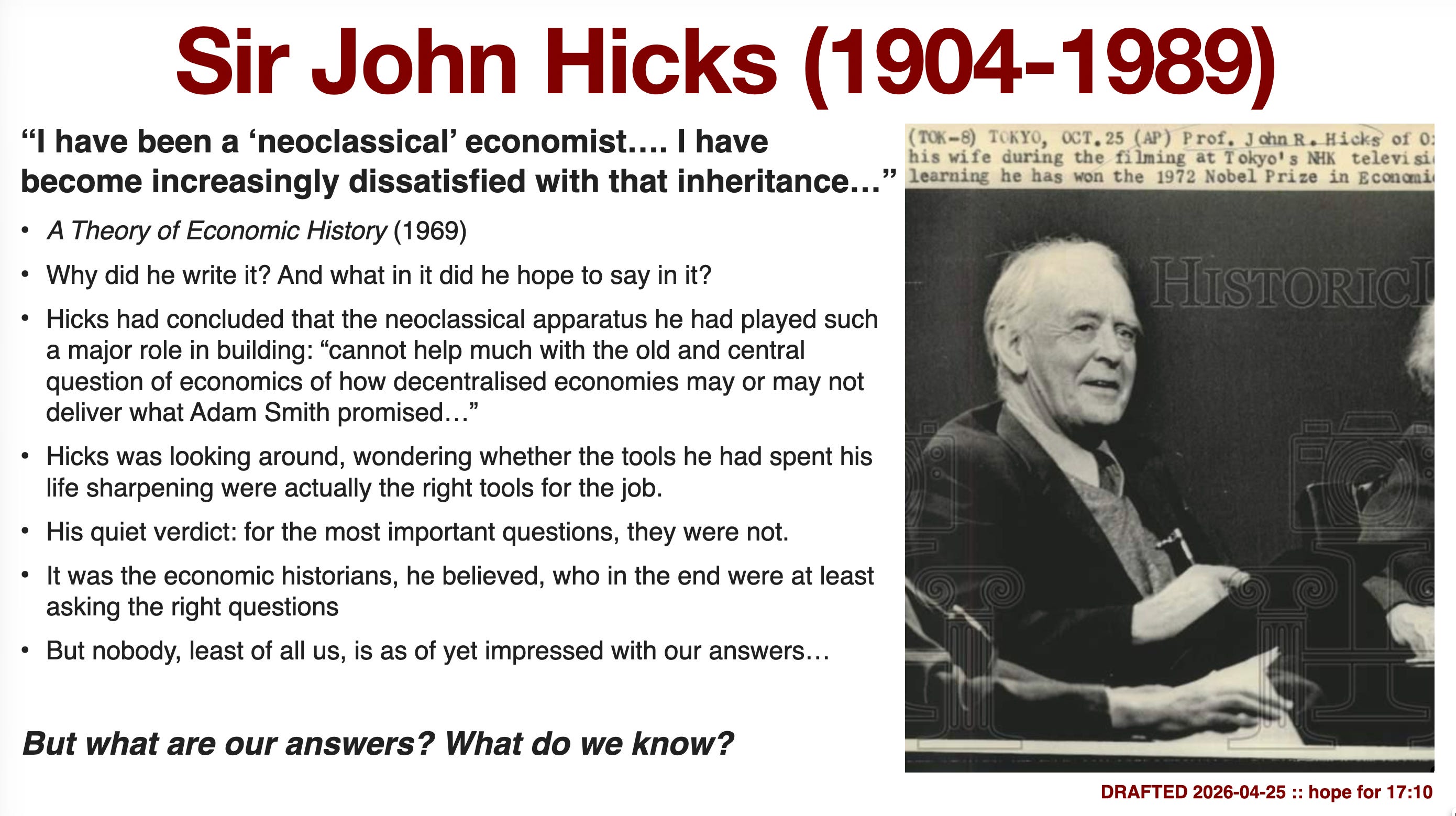
Sir John Hicks: A Theory of Economic History, 1969. Why did he write it, and what did he have to say in it?
He wrote it looking back on his career. He wrote it becaues he concluded that economics had made a wrong turn with the neoclassical synthesis apparatus that he had played such a major role in building. And he did play a major role in building it. You can probably say with confidence that both Samuelson and Solow did more to create the neoclassical synthesis. You can say that Milton Friedman, George Stigler and company then wrenched it from its role as institutional-ideological support for social-democracy and made it into the ideological foundation of that modern neoliberalism we all know and love so much. But besides those four, John Hicks was next among those who built the edifice.
Let me stress: The neoclassical synthesis in economics is not a bad thing or a wrong thing. it is a powerful edifice It is a useful edifice. I find myself using its analytical tools every single day, to my great intellectual benefit.
Yet, by the end of his career, Hicks had concluded that it was substantially a dead end. Hicks had concluded that it could not help much with the old and central question of economics: how decentralized economies may or may not deliver what Adam Smith promised.
Looking around, wondering whether the tools he had built were adequate for the job, Hicks concluded that they were not. He concluded that it was the economic historians who, in the end, were at least asking the right questions, even if nobody then or even right now—least of all us—is terribly impressed with the answers we have.
So it was back then.
And at much greater length & depth, we have:
DeLong, J. Bradford. 2026. “Not My John Hicks Lecture: ‘John (Hicks) the Apostate’”. DeLong’s Grasping Reality. April 25. <<https://braddelong.substack.com/p/not-my-john-hicks-lecture-john-hicks>>.
Part II: Stage Theories
And so Hicks wrote his Theory of Economic History as his own attempt to provide some guidance for what economic historians should be doing and studying. And in writing that guide, Hicks wound up with a stage theory.
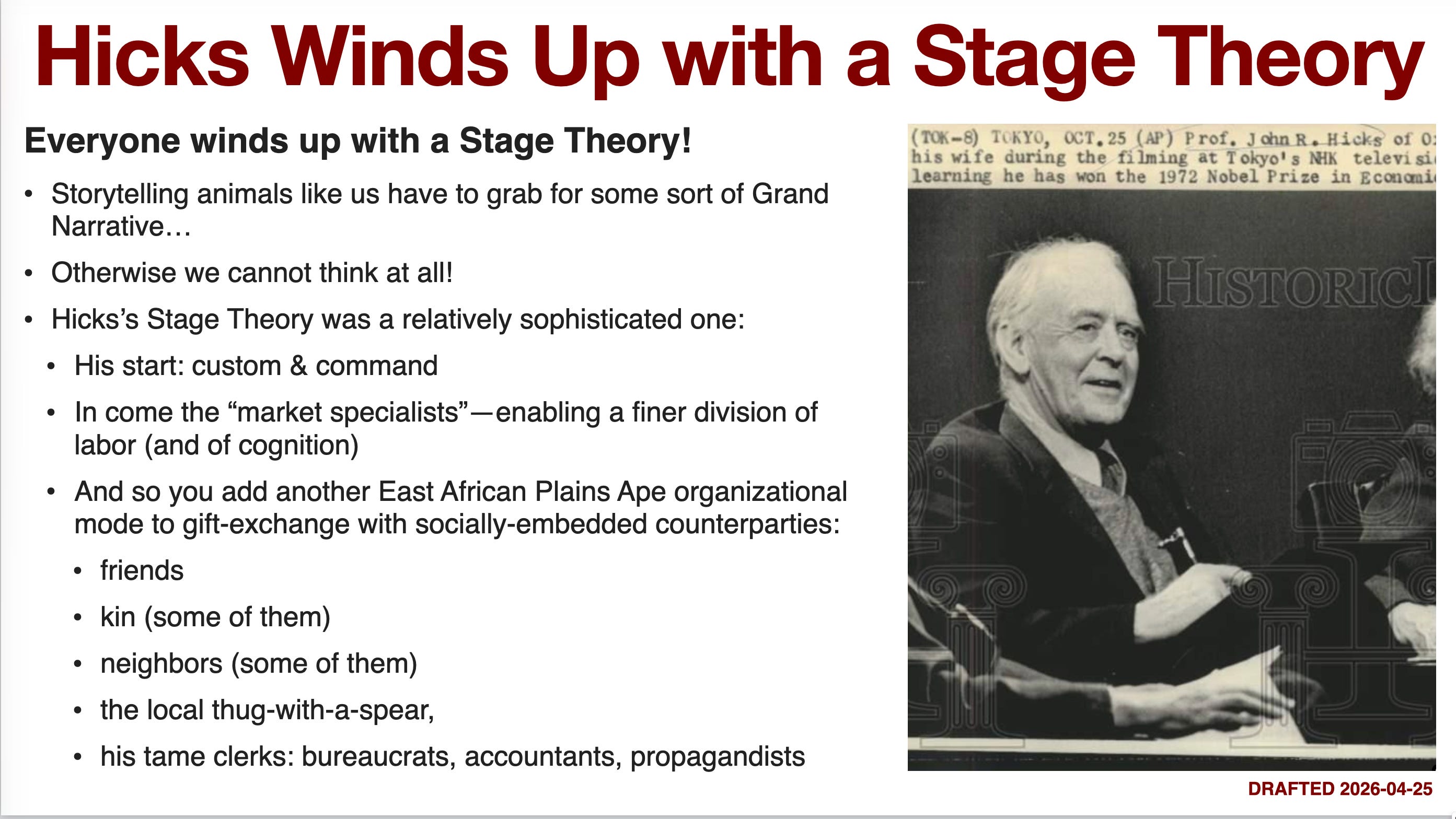
Now that is not surprising. Everyone winds up with a stage theory!
You cannot not wind up with a stage theory.
We are storytelling animals. We cannot think without grasping forms of narrative through-line. We do not react well to tables and charts of statistics about the likelihood of leopard encounters at the waterhole, as a function of time of day on the one hand and size of the band that actually goes down to the water hole on the other. But “Ogg went down to the water hole at 6 p.m. alone, and the leopard got him!”—that gets our attention, and gets engraved on our brains,
One of the assets of Hicks’s stage theory is that it was a relatively sophisticated one> He starts from an ideal type of an economy governed by custom and command. He asks how we then got to, or in some logical sense should have gotten to, the modern prosperous fixed-capital industrial exchange-based market economy.
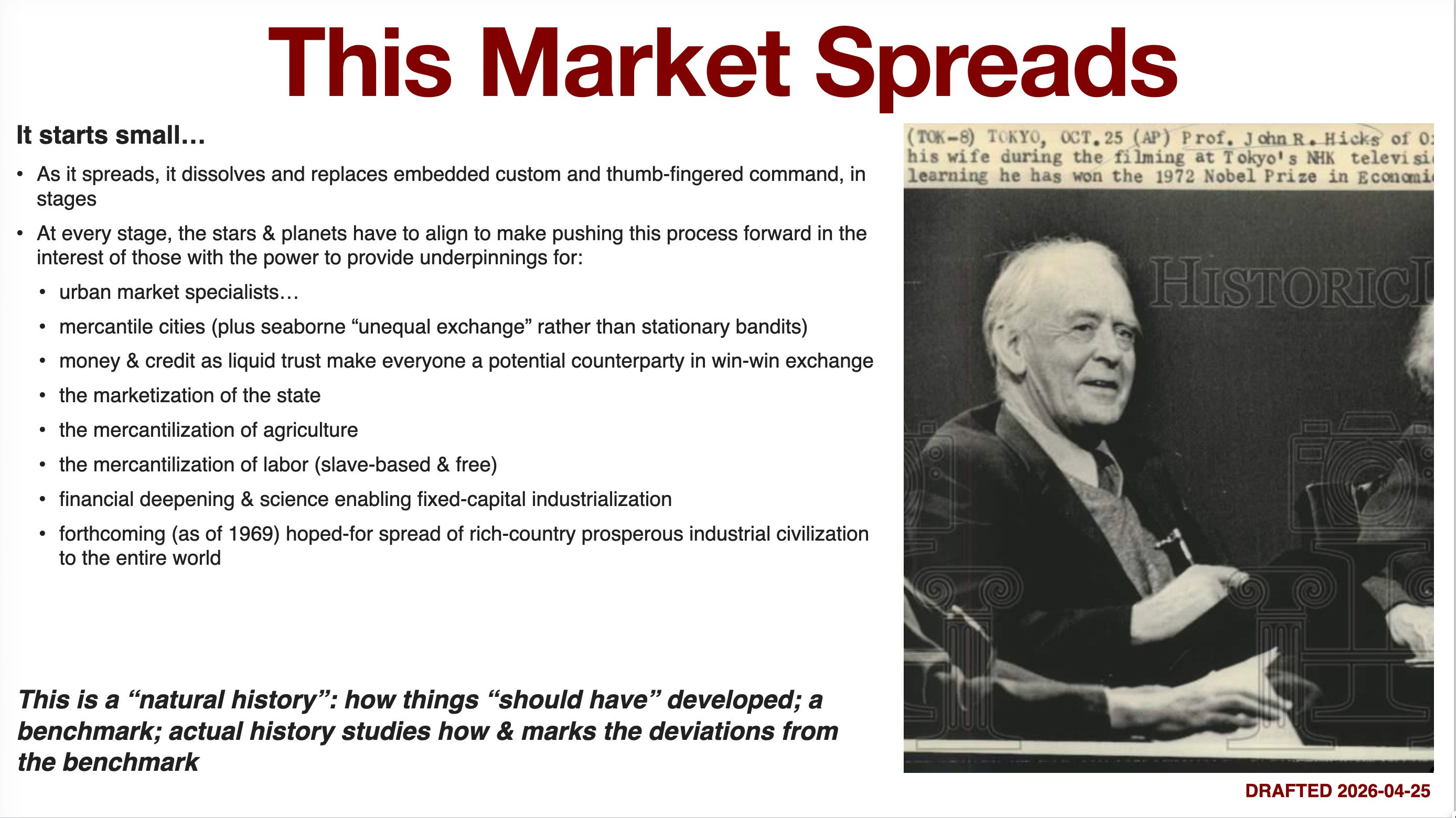
I do not have enough time now to even summarize the book. But do note that it is a stage theory with a lot of stages. In each of those the market slowly encroaches on and dissolves other, less flexible, less adaptable, less scalable forms of human social, economic, and cultural organization. Note that Hiks ends with the hoped-for forthcoming, as of 1969, hoped-for spread of rich-country prosperous industrial civilization to the entire world.
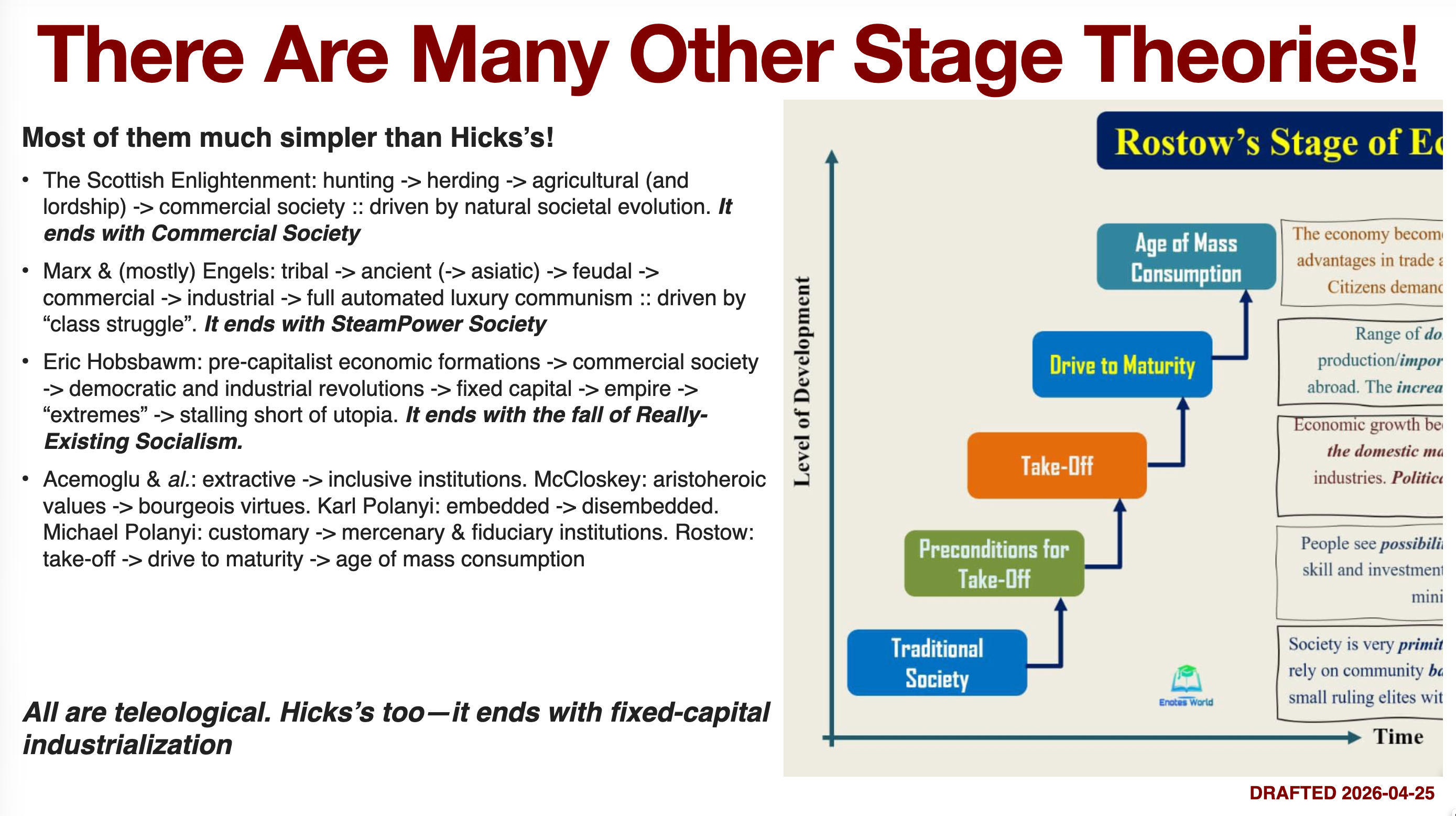
There are all the people whose stage theories shrink until there are only two stages.
We have my friend Daron Ashimoglu: two stages: extractive → inclusive institutions.
We have my friend Deirdre McCloskey: aristo-heroic → bourgeois virtues.
Karl Polanyi: embedded → disembedded, with big pluses and minuses from the “disembedding”, as you wind up with an inhuman society in which the only rights that are vindicated are property rights, and the only property rights that are vindicated are those that give you control of things that are valuable. People believe and demand that they have lots of other rights, and that society should vindicate those rights in addition or instead.
We have Carl’s brother Michael: customary → mercenary + fiduciary institutions.
We have Walt Rostow’s non-communist manifesto: takeoff → drive to maturity → age of mass consumption.
All of these strongly teleological. All of these end with the belief that we, whoever “we” are, are in fact the end-state and the process has been building toward us. Which makes for a lot of bad history. We are not the end point. Even though it is certainly the case that
we have gotten here,
given that we have gotten here, which is an unlikely thing,
we probably got to this unlikely endpoint outcome by processes that are the most likely processes that could have led to this unlikely outcome.
but still it could have gone lots of other ways.
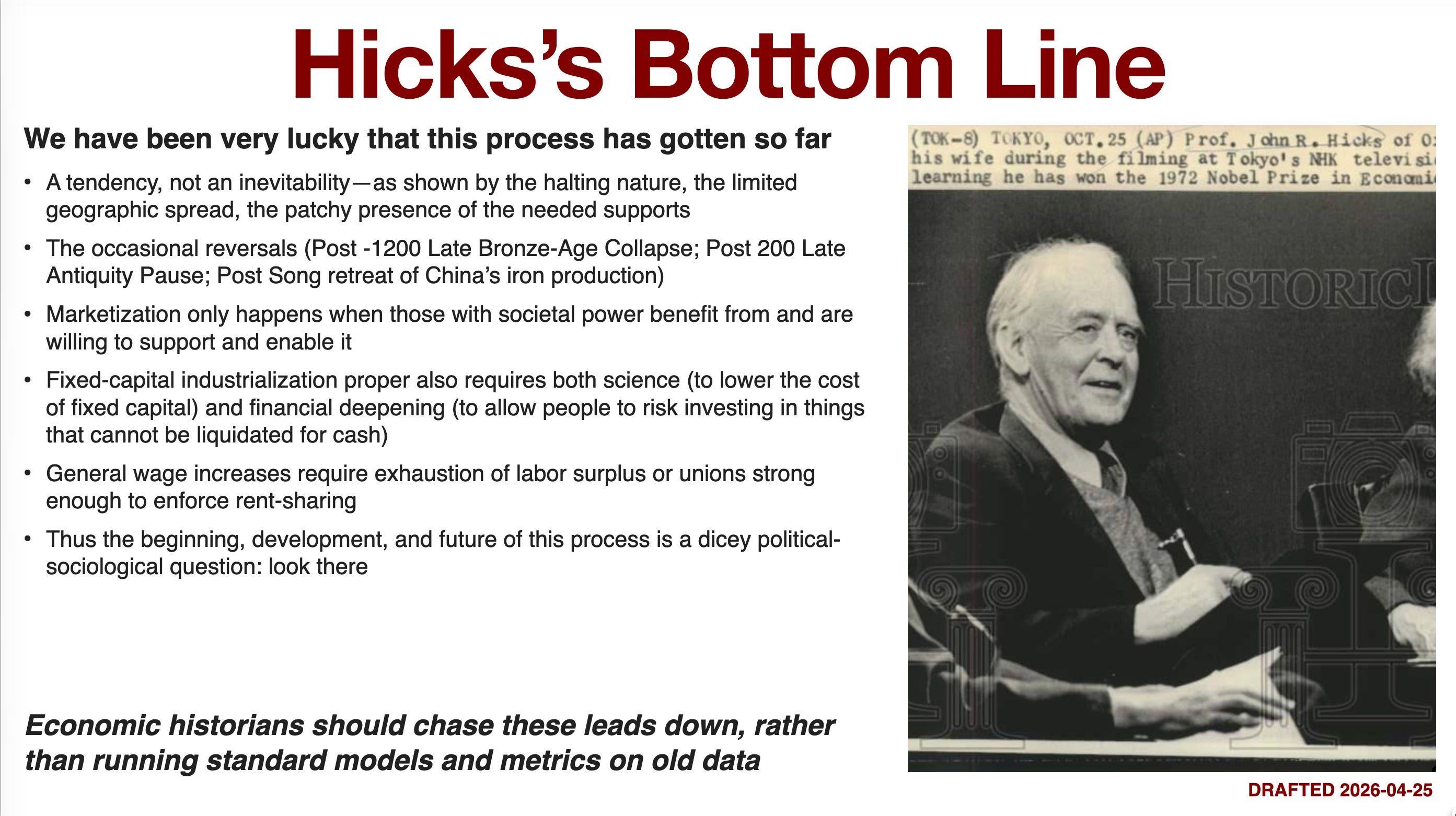
We are interested in history for its own sake, as a source of intellectual and aesthetic stimulation—for knowledge, romance, and entertainment. We are interested in histry because we want some knowledge about our current state as it informs our estimates of likely future—humans being much the same, an exact and true knowledge of the kinds of things that have happened in the past is the best possible guide to what is likely to happen in the future, things, as they do, not repeating but rhyming.
From his stage theory Hicks drew a bottom-line conclusion: When we consider the process that has generated our economic growth and current prosperity, we should note first that we have been very lucky. This process has gotten farther than it had any right to. The market system spread, expanded the potential for the specialized division of labor, created the opportunity for high-scale investment and accumulation. But it was always a tendency. It was never an inevitability. It had a halting nature. It had a limited geographic spread. They needed necessary supports were only found in patches.
Plus there were the occasional reversals. We know more than Hicks did now about the post year -1200 late Bronze Age collapse, during which the Greeks forget how to write. We know more about the post-Song retreat of China’s iron production. We know more of what caused the D—I understand we are not supposed to call it that: call it the post-200 Late-Antiquity Pause, the thing that led to a world in which, somehow, by the year 750, in both Europe and in China, people were looking around and marveling at the accomplishments of the earlier Hellenistic and Roman and Han civilizations at their height, and mourning their situation as unworthy descendants of mightier men.
Hicks also concluded that fixed-capital industrialization—the key source of prosperity—required both science coming in from left field, and also the development of unusual institutions of financial deepening to make people willing to invest in things that coud not be liquidated for cash whenever events went rapidly south and the panic spread. Hicks also concluded that the system was very unlikely to deliver general wage increases, at least not until it had spread enough to a large enough scale to get you exhaustion of the W. Arthur Lewis labor surplus in the countryside; or until you got unions strong enough to enforce rent-sharing for a labor aristocracy. Hicks also concluded that the beginning, the development, and the future of the future of this process always was and is a dicey political-sociological question.
And Hicks concluded that economists should look to history and political economy to understand it, rather than to Y= ƒ(K.L) and (K/Y)* = s/(n+g+δ).
Let us not try to strip off some of the teleology. Let us now try to use the fact that we were not born in 1904, and have seen a lot more of the world and a lot more of history than Hicks did—and it has been a very different history since 1969 than he wouldk have expected.. Let us ask: what would a better, more useful stage theory look like? And let us answer this by taking some snapshots, seeing whether we can be properly inductive, seeing whether we can do better than falling into yet another verison of some teleological end-state trap.
And at the end I will offer some conclusions, or at least hints, or at least guesses.
Part 3: Prehistory

Start, perhaps, in the year -700,000 on what is now a road from Gaza to Damascus.
Ever since at least the year -1500 or so, there have always been two roads from Gaza to Damascus. There has been the inland road, the Via Regia, the Road of the Kings, crossing to and then following along on the Jordan Plateau. And then there’s the Road of the Sea, the Via Maris, which starts at Gaza, heads north along the coast, and then turns inland in Galilee. It crosses the Upper Jordan River at the first convenient crossing point north of the Sea of Galilee, a place now called, in Hebrew, Gesher Benot Yaakov: the Bridge of the Daughters of Jacob.
That name was not originally Hebrew. That name was originally Norman French. In the 1100s the kings of the Latin Kingdom of Jerusalem gave toll-right over that crossing to the nearby Nunnery of St. Jacques. And so it became Jacob’s Ford. After the fall of the Latin Kingdom the name, translated to Arab, largely stuck. St. Jacques is, of course, Jacob—Yaakov. Gesher is Bidge. And Benot? that is “Daughters”—the memory of the nuns, as the only daughter of Jacob named in the stories is the singular Dinah.
The anthropologist-archaeologists have been digging there. They have found that 700,000 years ago we—for some value of “we”—camped there repeatedly.
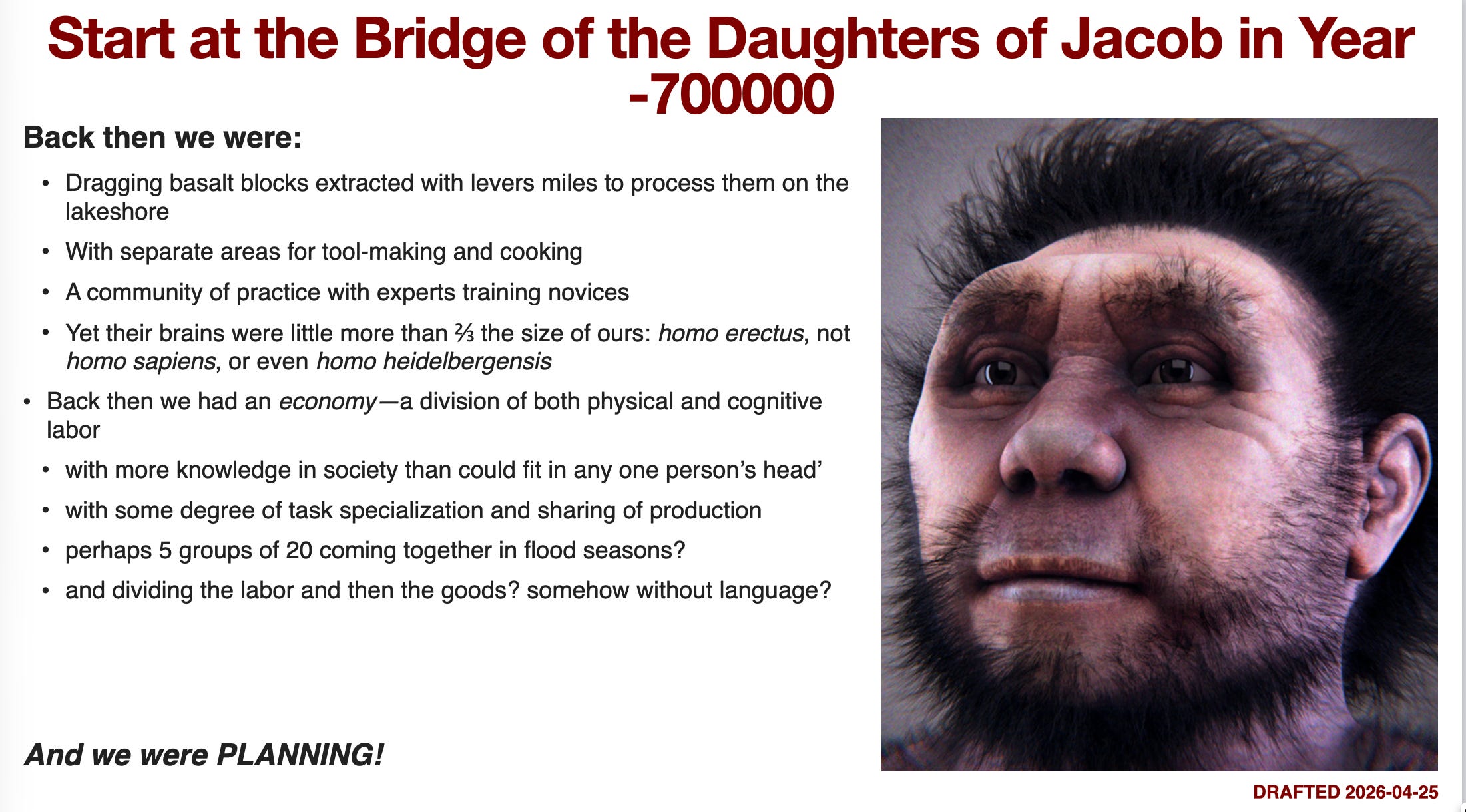
Now, we were not Homo sapiens sapiens back then.
We were not even Homo heidelbergensis. We were late Homo erectus. Our brains then, those of our ancestors then, were maybe two-thirds the size of ours now.
The fact that evolutionary pressures have expended our brains so much since then—in a relatively short time for a monkey with a 25-year reproductive cycle, less than 30,000 generations—strongly suggests that these things that sit in their box at the top of our neck are actually useful at their current size, even though they we do burn an astonishing 500 of our 2,500 or so calories a day to fuel them.
What were they doing with their brains, with these very expensive brains for a monkey, back then in the year -700,000?
We had, by then, already long been a cultural, technological species. We East African Plains Apes—those people at the Bridge of the Daughters of Jacob who were our ancestors—were then extracting basalt blocks with levers from sites miles away. dragging them to the shore of the lake, and there making stone tools with sharp-edges with which to cut and pound in separate tool-making workshop areas. They had other, separate, areas for keeping their fire going—for warmth and to drive off predators for the night, and for the great predigestion of food, which is cooking. It is cooking which allows us to do infinitely better than our great ape cousins, in terms of actually getting nutrition in, and using it, and so being energetically able to have our big brains. When we chow down, we manage to do it quickly and intensively. Gorillas have to pick and chew leaves eight hours a day.
Look at what anthropologist-archaeologists have found. We see things that look very much like communities of practice: experts training novices. We see an enormous sheer variety of foodstuffs—Joseph Henrichs stresses prickly water lilies found growing underwater far offshore—including large numbers of species of fish, all the nuts and berries, plus the animals. There is a division of labor there. It is not just: all of us in one particular age and gender class go do something. It looks like a division of physical labor. And it is definitely a division of cognitive labor: more knowledge about the natural environment and in how to manipulate it used on the lakeshore than could possibly fit into the head of any single homo erectus.
And more than wouild fit in any of our heads, bigger-brained though we are. We are not that smart. Fitting things into our heads is now easy. We are animals that can barely remember where we left our keys last night. And I don’t know about your household, but in my household, at least six times a day there will be a wailing from one of us about: “Where is my phone? Where have I left my phone?”
How many people do we find living by the then-lakeshore at the Bridge of the Daughters of Jacob? Perhaps five groups of 20 or so? Coming together in flood seasons to make a remarkably peaceful—for monkeys, who are pretty aggressive—division-of-labor society. Somehow managing to do that without having what we would call language. having culture, having experts in pieces of technology, having and doing different tasks, splitting up and coming back together. Sharing the results of what they make and do.
It is recognizable as an economy.
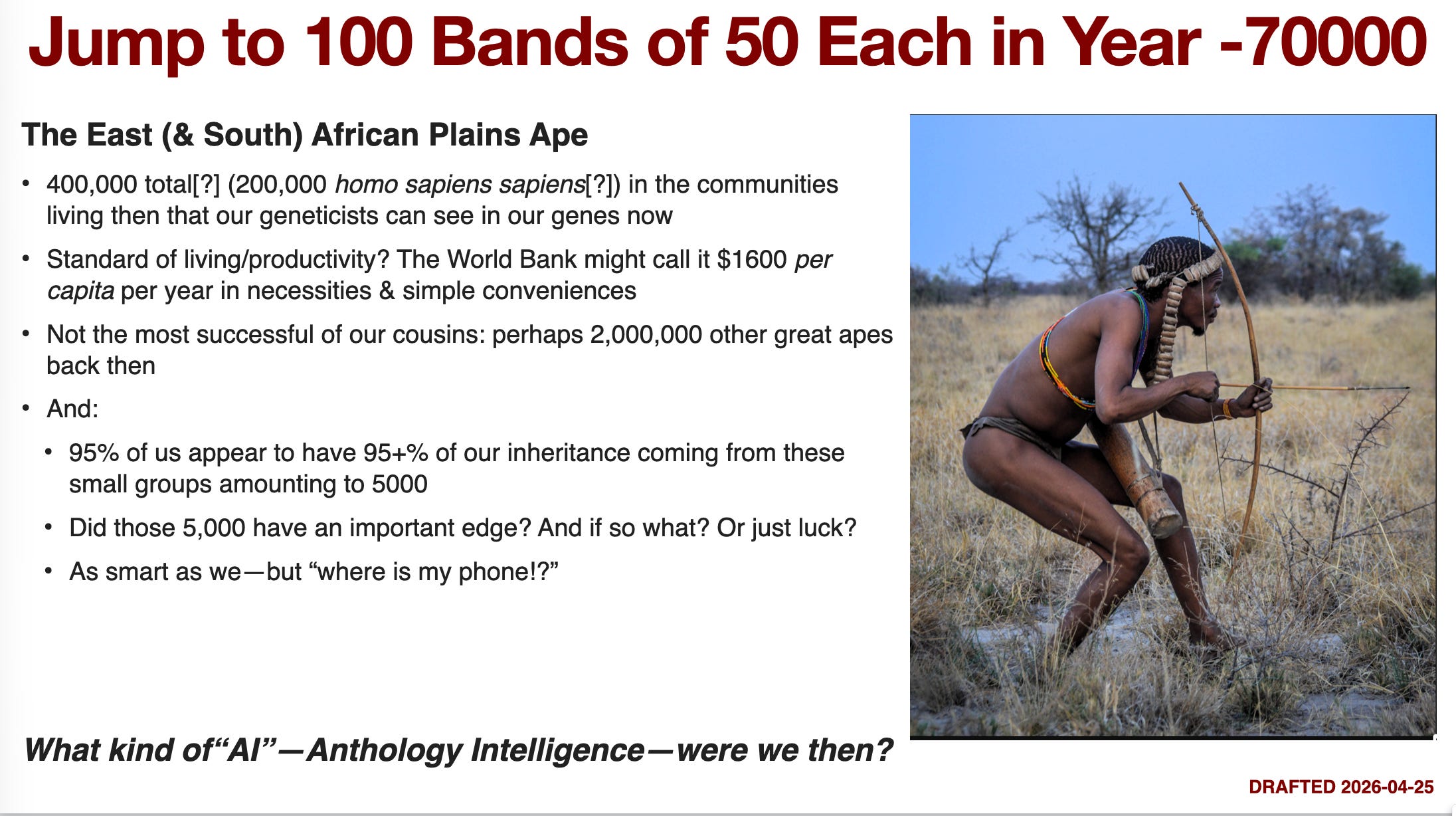
Now jump forward 630,000 years, to the year -70,000.
Here we have a modern Khoesan hunter in Southern Africa. I think the bow is significantly better than we had in the year -70,000. And the brightly colored textiles are are the product of late-1800s German chemical engineering. But, otherwise, this is a reasonable image of the kind of gatherer-hunter life we homo sapiens sapiens were living back then.
Back then in the year -70,000 there were maybe 200,000 of us proper, of our subspecies? But there were perhaps 400,000 total in the communities that have left us the present of useful things in our genes—not just from homo sapiens sapiens, but from homo sapiens neandertalensis, homo sapiens denisovensis, and still other “ghost populations” which the geneticists can see but which we have not found any fosils from.
How well did we live, in the year -70,000? Perhaps the World Bank might call their standard of living $1600 per capita per year, in produced necessities and simple conveniences. Take that guess as our anchor.
Back then we were fully, completely, us. Yet back then we were not the most successful of the Great Apes. While there were perhaps 400,000 of us East African Plains Apes, there were maybe 2 million other Great Apes around the world, orangutans, gorillas, chimpanzees, with much smaller brains. No one back then—and no alien, sympathetic or unsympathetic looking at us—would have looked on these interesting big-brain tool-using monkeys and with their technology and their culture and said: “these are it!”
400,000 in the communities that have left us their genes which are now ours. But there is an oddity here. The gene people tell us that 95%+ of us appear to have 95%+ of our heredity coming from a very subset of these 400,000, from perhaps 100 bands of 50 or so wandering around Eastern and Southern Africa back then.
Did these 5,000 have an important edge? And if so, what was it? Or was it just luck?
The obvious thing to guess at and grasp at is the possession of what we would see as full linguistic facility. More than just culture and technology passed down through observation and imitation, but the ability to fully describe not just what is going on now but things happending that are not there: to speak of things past, or future, or that never were, and be fully understood.
We do not know. We will probably never know. But I am confident that they then—and possibly many many more than this Gideon’s Band of 5000—were fully what we ought to call an AI: an Anthology Intelligence. Moving beyond simple planning. Moving beyond having the people who are best at some tasks taking the lead. Having things that welded them together into a band thinking things through—making use of the principal that with enough eyes on the problem, all bugs are shallow.
I am struck in my confidence in this guess by our unbelievable propensity to gossip. The saying is: three people can keep a secret, if two of them are dead. That is simply not true. All of them have to be dead for the secret to be kept. One person alone can rarely keep a secret, even if it is powerfully in their interest to do so. We have a nearly irresistible propensity to gossip. All the time. About everyone.
The result of this is that what one person knows, pretty soon almost everyone they talk to or anyone whom the people they talk to talk to will know it. Even if it is not particularly juicy.
The advantage of gossiping about whatever came into to your mind must have been so great.
It is that information-sharing that makes even a relatively small band of us an AI, an Anthology Intelligence.
When you look for an AI, do not look at things like the thing at the podium—crunching numbers as it is in the neural engines of each of its 40 GPU cores. Do what they advised you to do in the story of Christopher Wren: circumspice. Look around. But lnot at the dome of St. Paul’s, look at your fellow East African Plains Apes here, all of us here in the College of the Souls of All the Faithfully Departed, thinking togethr, each of u taking part in a cognitive division of labor. And standing, intellectually, if not on the shoulders of giants, at least on the shoulders of a very large pyramid of fellow dwarfs—at least as long as memories are transmitted down the chain from generation to generation.
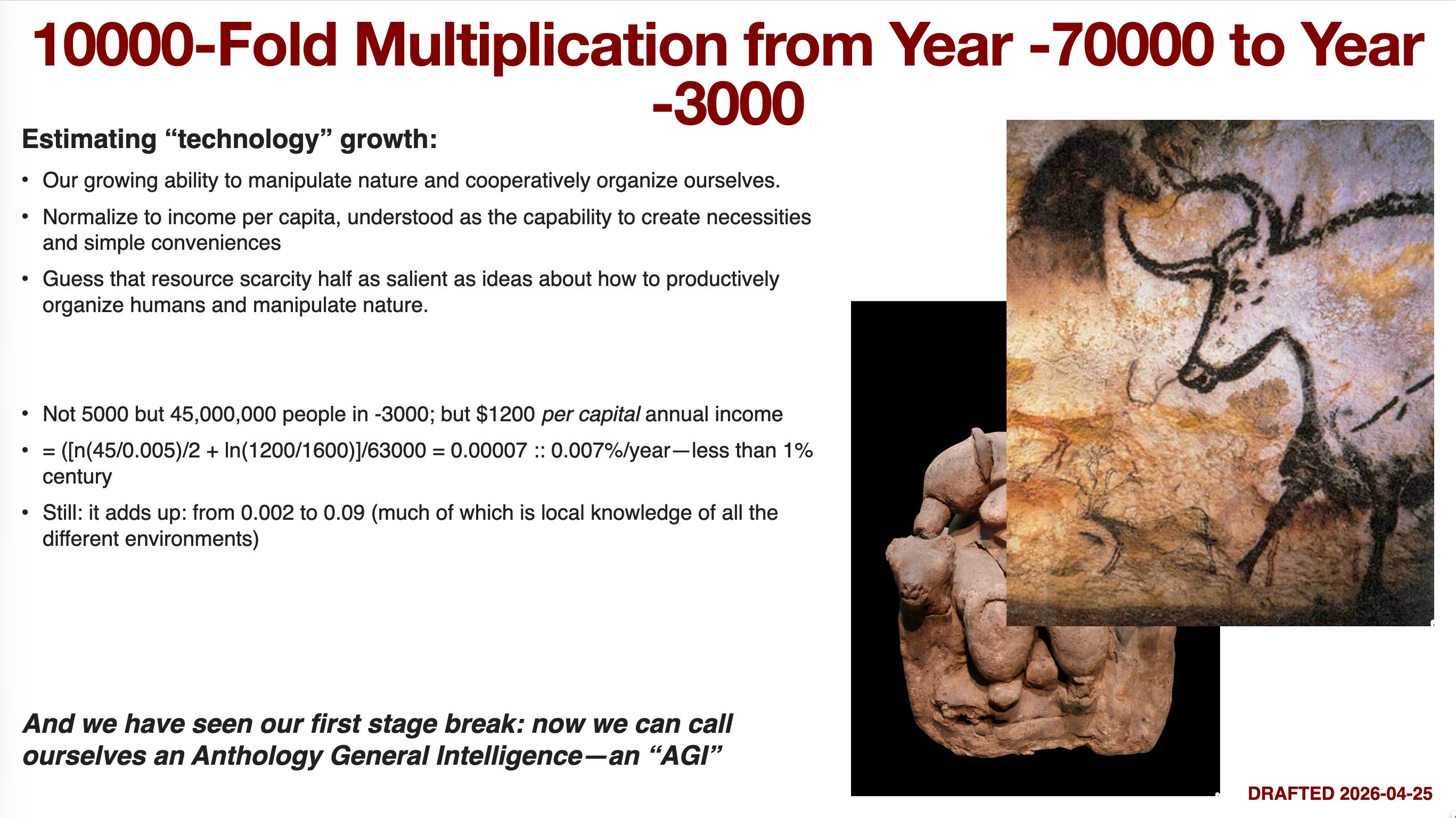
Now jump forward from the year -70,000 to the year -3,000. By -15,000, we now think, we had spread all over world. And by -7000 we were settling down to farm. The standard of living once we settled down to farm? We had $1,600 a year per capita as our anchoring guess number for hunter-gatherer. On that basis, it would have to be something like $1,200 for farmers. Farmers are shorter. Farmers are less well nourished. Farmers are much less buff. Farmers have more nutritional deficiencies. Farmers’ lives are more boring, Life is easier as a farmer: you don’t have to cover 12 miles a day, and you do not have to be as buff to catch your food. Carrying infants around 10 miles a day is a hard thing to do—hard for you, and hard on them.
An easier life means more surviving babies. So the population of farmers rises. And as population rises, resource scarcity in the form of farmland availability starts to bite. And then increasing poverty takes away the more surviving babies that an easier life had given.
Malthusian equipoise, with a much larger but substantially poorer population once you settle down to farm.
Hence we have Jared Diamond’s declaration that this was by far the worst mistake in the history of the human race. But I do notice that Jared is a professor in Los Angeles, and not a hunter-gatherer in New Guinea or, God knows, out in the Mojave, which is a truly unforgiving environment.
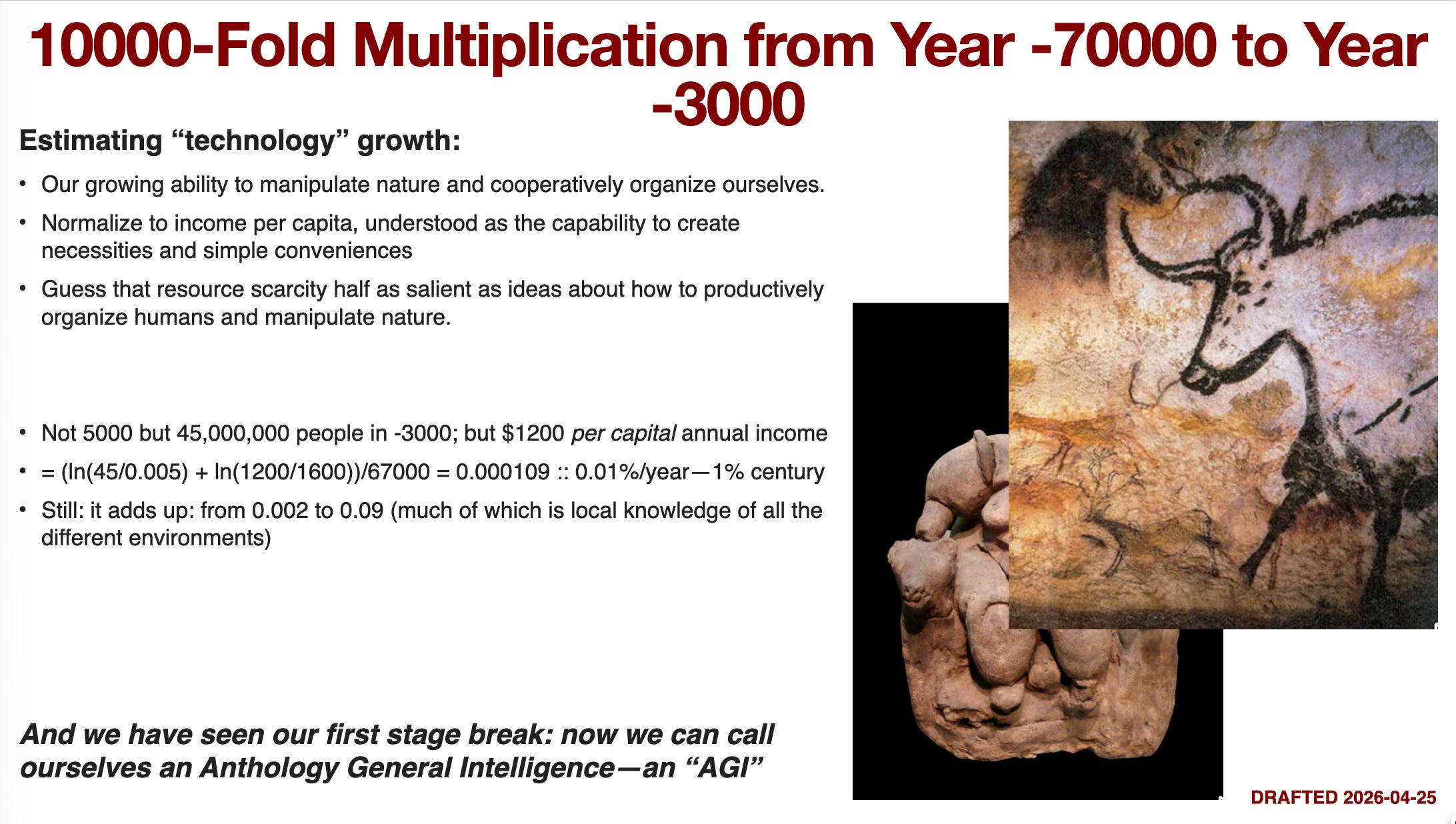
Settling down to farm also brings with it a change in the character of our AI, of humans in groups considered as an Anthology Intelligence. Once we are settled, we can have many more tools than what we can carry or cache. Once we are settled, we can and do construct in our environment ways of reminding us what we ought to be thinking about, and what are conclusions might be. Memory no longer has to carry such a big load. And reminders in the environment we build gives us an extra edge, and so there is less possibility of loss as generation succeeds generation. Our intelligence thus becomes more general: an Anthology General Intelligence, an AGI.
What can we say about what the pace was of our growing ability to manipulate nature and to coöperatively organize ourselves was as of the year -3000? Inasmuch as we are economists, when we tell stories we very much want to have numbers attached. Numbers are the best way to figure out whether the stories we are telling are in fact representative of anything important. So what numbers can we attach to the change in our “technology”—in the collective ability we have to manipulate nature and cooöperatively organize ourselves—from minus 70,000 to minus 3,000?
We would like to normalize the number to income per capita: a good notional index of technology would say that, other things equal, a population twice as rich has twice the level of technological competence. I guess that resource abundance is perhaps half as salient as ideas in terms of generating productivity. It is not that resources are unimportant: it makes no sense to say that a given level of technology enables a given level of productivity and living standards no matter how many people have to divided the resources. It makes no sense to say that resources are as important as ideas either. That would imply that the right index of technology would simply be income per capita times the number of heads, total societal income. And that would in turn imply that individual humans are not of themselves productive—that we gain nothing from having more eyes and hands and brains conditional on the overall level of knowledge contained in the AGI. That, however, is simply wrong. More hands, and eyes, and brains do make lighter work.
Half is a reasonable middle point, I think. If anyone has a better idea, I would love to adopt it.
Where am I going with this? Here: You can calculate the growth rate of “technology” between benchmark years from only two numbers. If you are willing to boldly guess at populations and living standards, simply take the growth rate of living standards and add to it half the growth rate of popuation.
By the year -3000, we have not the 5,000 people of the core population group of the year -70,000 but, we think, something like 45 million people. It might have been half that. It might have been more than that. It probably was not as low as a quarter. And we have not our $1,600 guess at annual per capita income, but $1,200. And so we calculate:
[ln(45/0.005)/2 + ln(1200/1600)]/67000 = 0.00007 = 0.007%
Less than 1/100 of 1%/year. The technological knowledge of the human mind considered as an anthology general intelligence was advancing between the year -70000 and the year -3000 at a pace of less than 1% per century. Moreover, much of that was local knowledge: figuring out how to live in the different environments we were moving into, acquiring knowledge about adapting to particular environments.
An AGI is supposed to be capable of recursive self-improvement. One percent per century does not look like we were then very good at it. It does not look like a great deal of societal effort was devoted to advancing our technology. Or, if it was, it was not terribly productive at doing so.
Part 4: Agrarian-Age Societies-of-Domination
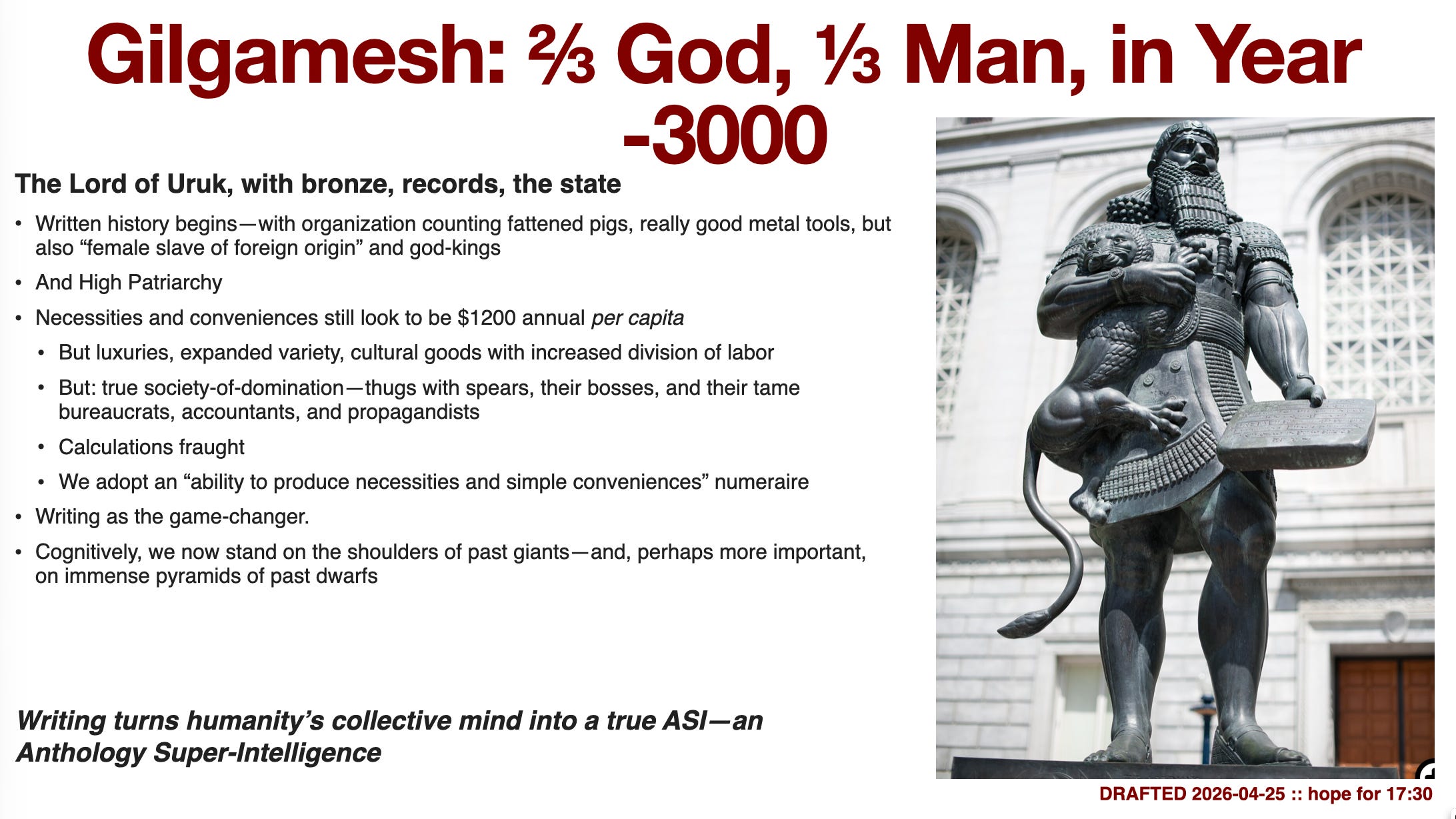
The year -3000 is a moment that sees a lot of key technological advances happen. We get bronze: combining copper with tin to produce something hard and malleable and extremely easy to make with weak, cool fires. A bronze-tipped hoe is ten times better than a digging stick if you’re a farmer. We get the state. We get records. get the state. Even if all that human civilization does is allow the organization of a tin trade and thus of bronze production, that in itself is an enormous gift from ourselves to each of us. We get writing.
With writing, we no longer a general intelligence: we are a true superintelligence. We now bind our ideas, what we think and know, not just to the local band and not just to what one person in the band learns and remembers. We speak across space, across the whole world, and across time. Now we have 5,000 years of human history compiled, assembled, compressed—highly compressed, it is true, .but those things thought worth remembering from those past 5,000 years, we do indeed remember.
One thing that the human collective mind ASI—Anthology Super-Intelligence—remembers from 5000 years ago is Gilgamesh, the mythical King of Uruk. The year -3000 was also Gilgamesh’s moment. He searched for eternal life, failed, but returned to Uruk as a wiser and juster king. Did you know that he was 2/3 god and 1/3 man? The human mind ASI does. Or, at least, it remembers that it was what his tame and hired propagandists said.
And that is one reason that we were not terribly good at and not terribly focused on the recursive self-improvement process. That is one reason that the boosting of the level of technological competence and knowledge of the human ASI proceeded very slowly. Gilgamesh was, his propagandists said, King of Uruk by divine sanction. Do not rebel! Pay your taxes! Or else the gods will be angry at you.
The societies of the year -3000 were, perhaps it was then when they became, societies of domination. Much of the energy of the people who have the power to deploy society’s energy is spent figuring out how to become and how to organize a gang. Thugs with spears; their bosses; their tame accountants, propagandists, and bureaucrats—they take a third of the crop and a third of the crafts for themselves. Why bother? Why not just work and make your own stuff? Because in a Malthusian world of poverty and scarcity, joining the gang is pretty much the only way you can try to ensure that you have enough for yourself and your family.
What happens if you try the other path, try to become more productive? First of all, you then make yourself a very soft and attractive target for the gang to prey upon.
Yet there are upsides to “civilization”. Bronze tools are wonderful. Records and writing too. They genuinely add another, valuable dimension to human experience.
That does, however, make calculation of standards of living very fraught. We seed the level of production of necessities and conveniences. We see that people are, by and large, close to the bare-bones subsistence edge. We see exploitation. We see inequality. But we also see luxuries—commodities that do not contribute to reproductive fitness, but that people find useful and enjoyable. Civilization can and does produce luxuries and so improve the standard of living without summoning and triggering its further ensorcellment by the Devil of Malthus.
Moreover, even where just conveniences are concerned, the ability to produce a greater variety of conveniences is an unambiguous benefit. Avinash Dixit wrote down the simplest possible tractable model to think about markets that were not perfectly competitive. He came up with the following story: your wealth is the quantity of basic necessities you could produce, multiplied by the variety of the commodities you know how to produce. We should also multiply by lifespan. So while the $1200 necessities-and-simple-conveniences annual living standard of agrarian civilization that we guess at is only ¾ of what we guess to be the typical gatherer-hunter living standard, agrarian-age civilization was not really 25% poorer.
Plus there is another very important complication. Civilization greatly amplifies and multiplies that entire bundle of ideas, orientations, beliefs, stories, and stances toward the world that are the cultural commodities that we consume. They are truly, truly valuable to us. They are an important part of our lives. They shape how we regard ourselves, how we regard the world, and what we regard as a life well lived.
Consider, once again, the alien—sympathetic or unsympathetic—looking down at us, at this College of the Souls of All the Faithfully Departed. It would see us roaming around. It would see us assembling in places, and then dispersing again. It would see us staring at things like our phones and other screens, making repeated small motions with our hands. It would hear us making an awful lot of noises. It would see us hurridly eating things, and after chowing down dispersing again. And so we maintain homeostasis: nutrition in, energy used for motion and cognition— the 25% or so of calories burned that are our brains firing—out.
But there is a supervening layer: What we are doing here is that we are building our belief and knowledge system, enlarging and adjusting our cognitive powers to understand, manipulate, and organize nature and ourselves. Learning to be good front-end nodes in the great neural network that is the human collective mind ASI. Drawing on it to properly calibrate our actions. And—occasionally—contributing something worthwile to its data stores and firing patterns.
And there is still another supervening layer: My personal experience of Oxford is not unmediated experience coming in through my eyes and my ears. My sense experiences are mixed with and transformed by memories, and memories of things that never happened and never existed. I cannot react to Oxford without interpreting it through the lenses given to me by my past reading of David Lodge’s novel Small World (and Changing Places, and Nice Work), and of Dorothy L. Sayers’s Gaudy Night. Those novels structure and deepen my experience of the place and so make that experience profoundly different from what it would otherwise have been—even though there never was a Lord Peter Wimsey, a shell-shocked veteran of the Great War, who was a Balliol man, and not only was there never a Harriet Vane but there was never a Shrewsbury College either. acquiring and then utilizing our great powers to manipulate nature and also to organize ourselves into a cooperative and productive division of labor.
What place does all of this have in human wealth? The mind is its own place, and each of us lives inside their individual mind. But none of us is sovereign over it. Not even Marcus Aurelius could be a full stoic: his Meditations are in large part a record of his unconvincing attempts to convince himself that he could be one. And while Milton’s Satan certainly made a hell of heaven, he lied when he claimed to have a mind that could make a heaven of hell.
Calculations are fraught, and fragile.
I am going to adopt an “ability to produce necessities and simple conveniences” as my yardstick for wealth, as numeraire. But that is not a solution to the problem.
I am also going to ignore the fact that an awful lot of the knowledge we have is in fact composed of ideologies that the society of domination is using to keep the rest of us quiet—or, if we think we’re part of the gang, that we’re using to keep them quiet.
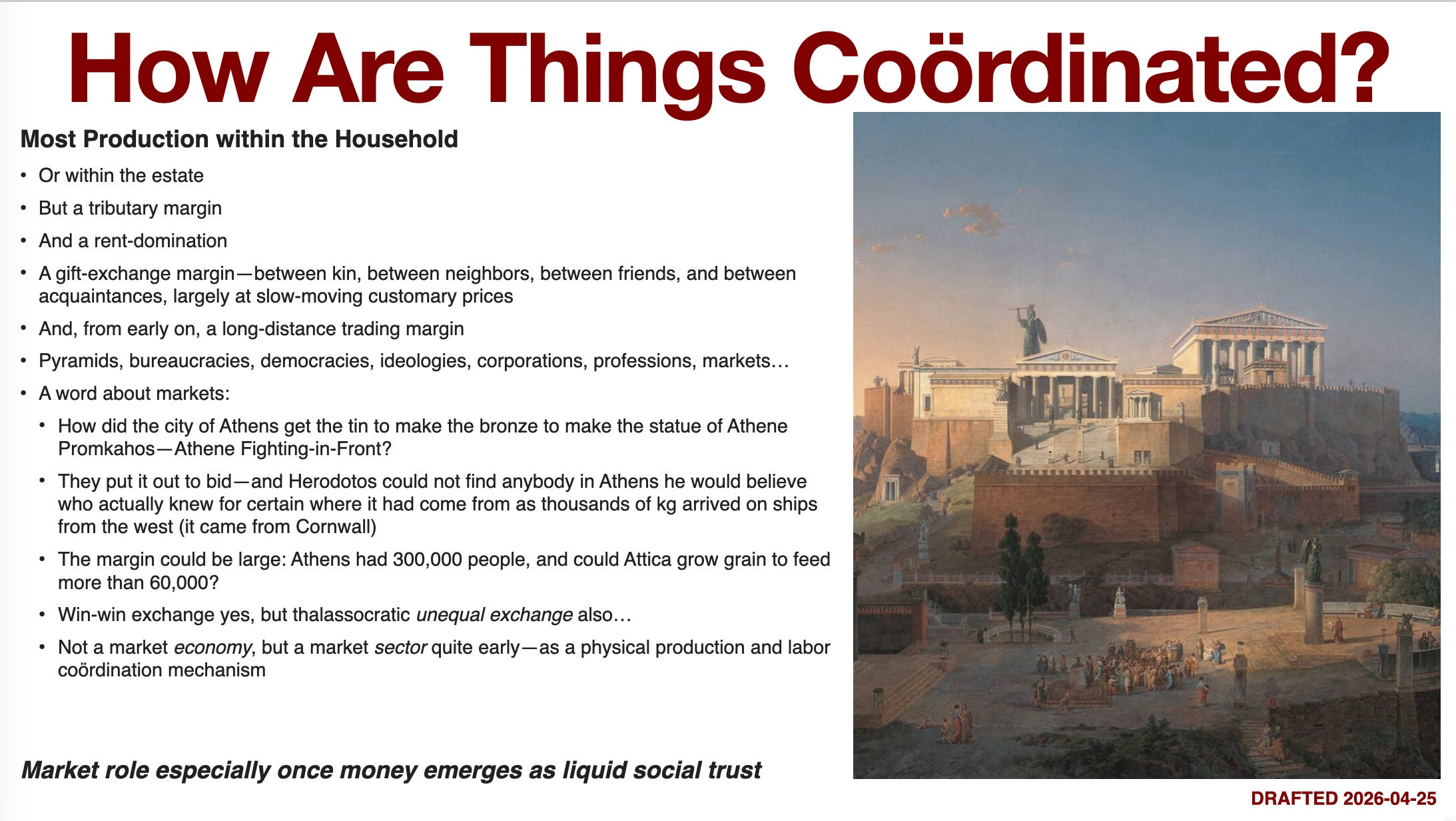
Writing really is one of the game changers. Successful maintenance of a fine and hence productive physical division of labor is a great deal of our wealth. Thus we need to focus not just on our very large cognitive division of labor—so much cultural-technological knowledge that each of us has only a teeny-weeny part of it—but also on the successful coordination of an increasingly finely divided and hence productive physical division of labor. Consider the modes, cultures, and institutions we have for organizing ourselves, with writing a key part of many such.
It is true that most production is within the household (or within the kind of estate, if you have a large estate with lots of slavery). Yes, it is true that there is rent. And it is true that there is domination. But a lot of the productive division of labor is mediated by gift-exchange, originally between kin, between neighbors, between friends, between acquaintances—maybe moving at slow-moving customary prices. Moreover, long-distance trade of preciosities has are very long history. All these are mediated by a bunch of different institutions: pyramids of feudal pyramids of loyalty, bureaucracies, democracies, ideologies, corporations, professions, markets. Plus there is a difference between formal institutions and on the ground functioning: even the most effective organization that is the arena of command in theory is, in reality, a mixture of market, barter, blat, and plan, with this last understood as the organization’s primary purposes and people’s allegiance to it.
A word about markets: On the alide behind my right shoulder, we have an idealized depiction of what the Akropolis, the high city, of Athens looked like in its prime, in its glory. One thing that is there in the picture but of which there is no trace today in our reality is the giant statue of Athene Promakhos, Athene fighting in front. It appears to have been taken off to Constantinople, and then destroyed by Latin crusaders in 1204 when they sacked the city. The statue stood at the top there. The sun glittered off her spear, and was the first thing you saw as you approached Athens by sea.
The stutude was paid for by money embezzled,—there is no other word—by Perikles from the treasury of the Delian League. The Delian League was formed to mobilize a navy to push the Persian navy out of the Aegean. City-states were supposed to contribute ships. Over time, a great number of city-states decided that they would rather contribute money, and let Athens worry about the logistics of turning money into ships. And then Perikles began taking the money. City-states complained. Perikles said: shut up. As long as the fleet protects you from the Persians, it is not your business what we do with the money. Thus the Delian League became the Athenian Imperial Thalassocracy, a maritime seaborne empire of domination, using unequal exchange to make sure terms of trade between Athens’s pottery and wine and other commodities remained favorable.
So Athens acquired the money. But how do you actually build a bronze statue? You need a lot of tin. How did the city of Athens get the tin to make the bronze to make the statue? There is no tin in Attica.
Well, they simply put it out to bid: we will pay a good price for tin that lands at the Peiraieus. Herodotus, who was wandering around then, could not find anyone in Athens he trusted and would believe when they told their stories about where the tin actually came from. (We are now confident it came from Cornwall. Clearly the market as an institution knew that, and knew how to get the tin from Cornwall to Athens, even though that piece of knowledge was not contained in any single human brain.)
The market could work wonders. Athens had 300,000 or so people, and yet Attica at that time could not grow enough grain for more than 60,000 or so.
The lesson? Very early we have, not a market economy as a whole, but at least some economies that have very powerful market sectors quite early on.
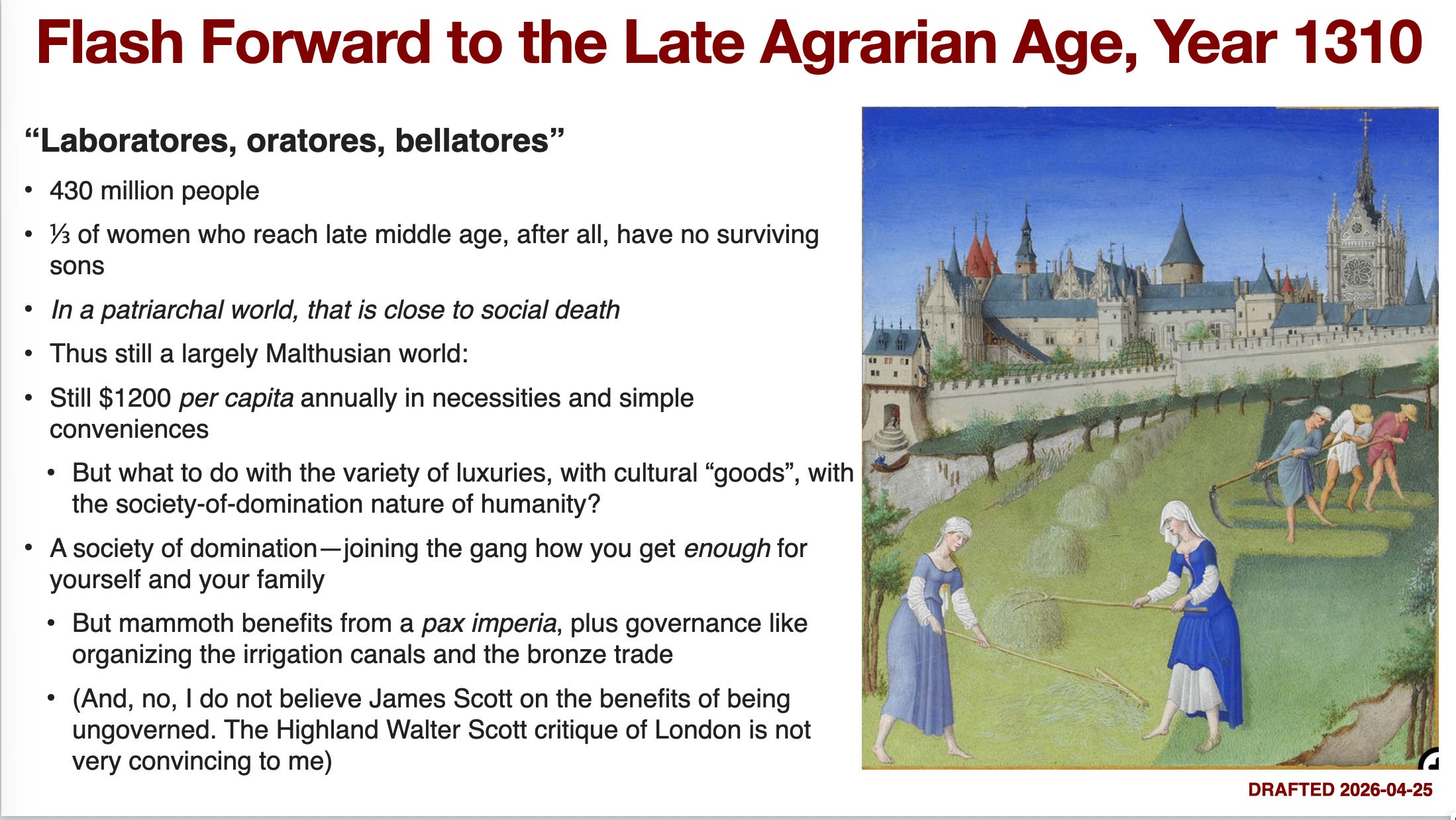
Now flash forward another 4,500 years or so to the late agrarian age. Stop in the year 1310: a world of workers, pray-ers, and warriors. By now there are 430 million people around the world. We still, though, are ensorcelled by the Devil of Malthus. Population is still growing very, very slowly on average. That means that those women who live long enough to reach late middle age—with something like a 1‑in‑7 total lifetime childbed risk plus more from adult diseases and accidents—will find that 1/3 of them have then no surviving son. In a patriarchal world, that situation is closely akin to one of social death.
Malthusian pressures do not just arise from the joy of making love and the inadequacy of pre-industrial modes of contraception. There is also the fact of this one-in-three widow-social-powerlessness risk. Thus whenever a couple has resources, one important thing they can do with them is try to have another kid to diminish this risk.
Thus in 1310 we are still ensorcelled by the Devil of Malthus. Thus we are still at close to $1,200 per capita annually in necessities and simple conveniences. There will be somewhat of a local escape in the post-Black Death period when first the depopulation of the plague and then the coming of the western European marriage pattern have their effects. There will be more of an escape in the 1700s, when decreasing patriarchy in the form of changing French property division customs makes it not such a resource disaster for the family to have only daughters. But in 1310 the ensorcellment is still unweakened.
Plus we still have the society‑of‑domination elements to make human flourishing lower than one would think from the $1,200 benchmark. On the ohter hand, wealth is boosted by increasing variety, increasing luxuries, and increasing cultural goods. And the power to actually apply organizational knowledge is boosted by public order and good government. (And, no, I do not believe James Scott on the benefits of being ungoverned. His critique of the state is the critique always made by the Scots, whether they are named James or Walter. it is the Highland Legend, the Highland critique of London society. It is not very convincing to me. I think Thomas Hobbes had it more right.)
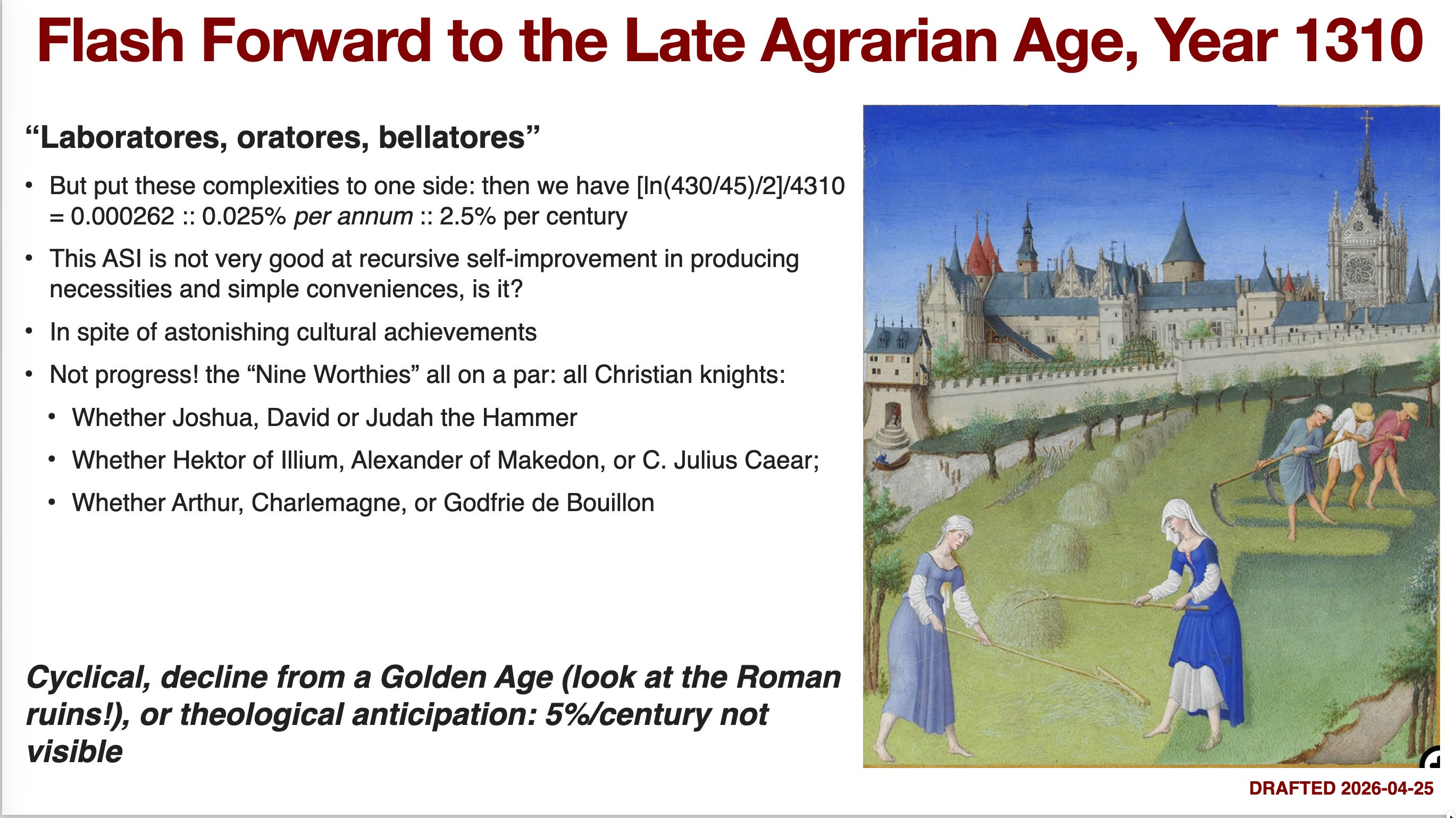
From -3000 to 1310 was the long Agrarian Age. How was the recursive self‑improvement of the human collective mind’s ASI doing over these four-plus millennia? By 1310 the human population was, perhaps, at 430 million, up from 45 million in -3000—a tenfold increase. Productivity levels were still, perhaps, at their farmer-Malthusian $1200 per capita per year. Modulus the disutility of being under the thumb of a more sophisticated society of domination. Modulus the extra utility of luxuries and of all the cultural flourishings since -3000 that had been added to the then-current collective human patrimony. And so we have:
[ln(430/45)/2]/4310 = 0.000262 = 0.026%/year
2.6% per century.
It is not progress at recursive self-improvement that strikes me here.
Such a slow average pace of technological improvement went along with a general belief, even among relatively careful observers, that society was, in the main, static. Consider the Nine Worthies of medieval Europe: the nine most admired chivalric heroes in the stories told to the warrior upper class. Traditionally they came in three groups of three:
The three Jews: Joshua, David, Judah “the Hammer” Maccabee.
The three pagans: Hektor of Troy; Alexander the Great of Makedon; Julius Caesar
The three christians: King Arthur of Britain; Emperor Charlemagne of Frankish Rome; and King Godfrey of Bouillon and of the Latin Kingdom of Jerusalem.
All nine of these are portrayed as Christian knights of medieval western Europe. This is part of viewing history as cyclical, or perhaps as a decline from a Golden Age—look at the Roman ruins—with any possibility of a better future confined to the expectation of some theological rescue. A better world will come from heaven, not be made here on earth by any idea of progress,
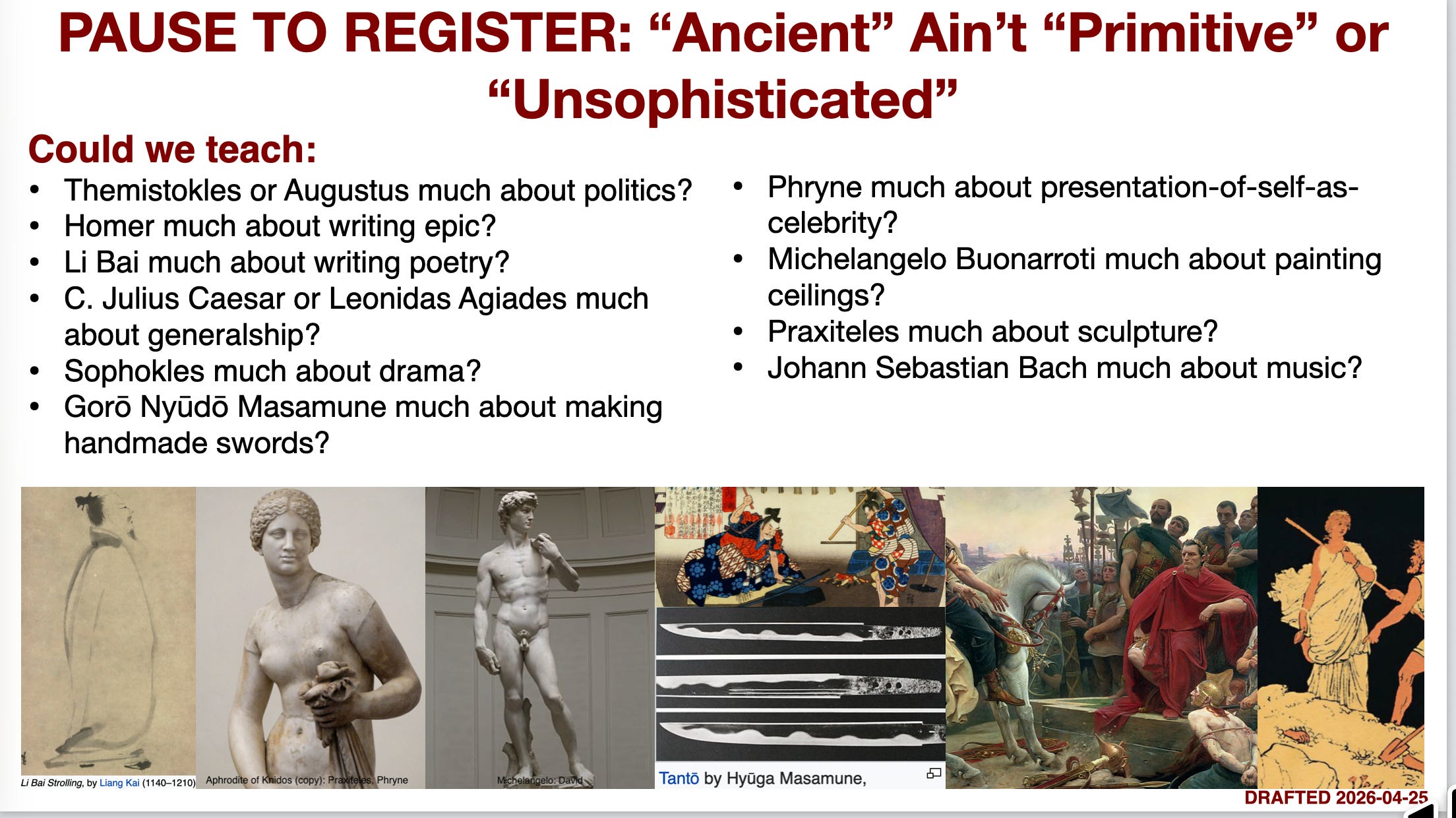
Here pause for a moment, and pause again. Here register that ancient and medieval agrarian age ancient ain’t primitive, ain’t unsophisticated, ain’t unaccomplished. Everything else in terms of civilization that people are doing—everything that is artistic, that is cultural, that is artisanal, that is organizational—reaches heights of accomplishment that are equal to what we can match. Lots and lots of people who are right now engaged in the bizarre and appalling human social practice of war might be doing much, much better, for their side at least, were they to match the excellences in that human social practice displayed by C. Julius Caesar: how in a decade you can conquer ancient Gaul from the Pyrenees and the Atlantic up to the Rhine, a land with perhaps 15 million people in it; do it with 40,000 guys; hold them in submission; and by the end of the process have more than half of the ruling classes of those you have conquered more eager to help you suppress revolts than to revolt. Mnesarete of Thespiai—nicknamed Phryne, “Toad” (perhaps from her attractive yellow-brown skin, much more beautiful than the pasty white of northerners whose speech sounded like bar-bar-bar)—could have learned nothing from anyone today about deploying the social power of charm, beauty, and sex appeal. She was, we are told, the favorite model of the sculptor Praxiteles, who again may be matched but not surpassed by such as Rodin.
And yet they were inept, by our standards at least, in the pace at which they pushed forward the value of the stock of ideas that makes up the technological heritage and toolkit of the human race.
Part 5: Commerce & Industry & Empire
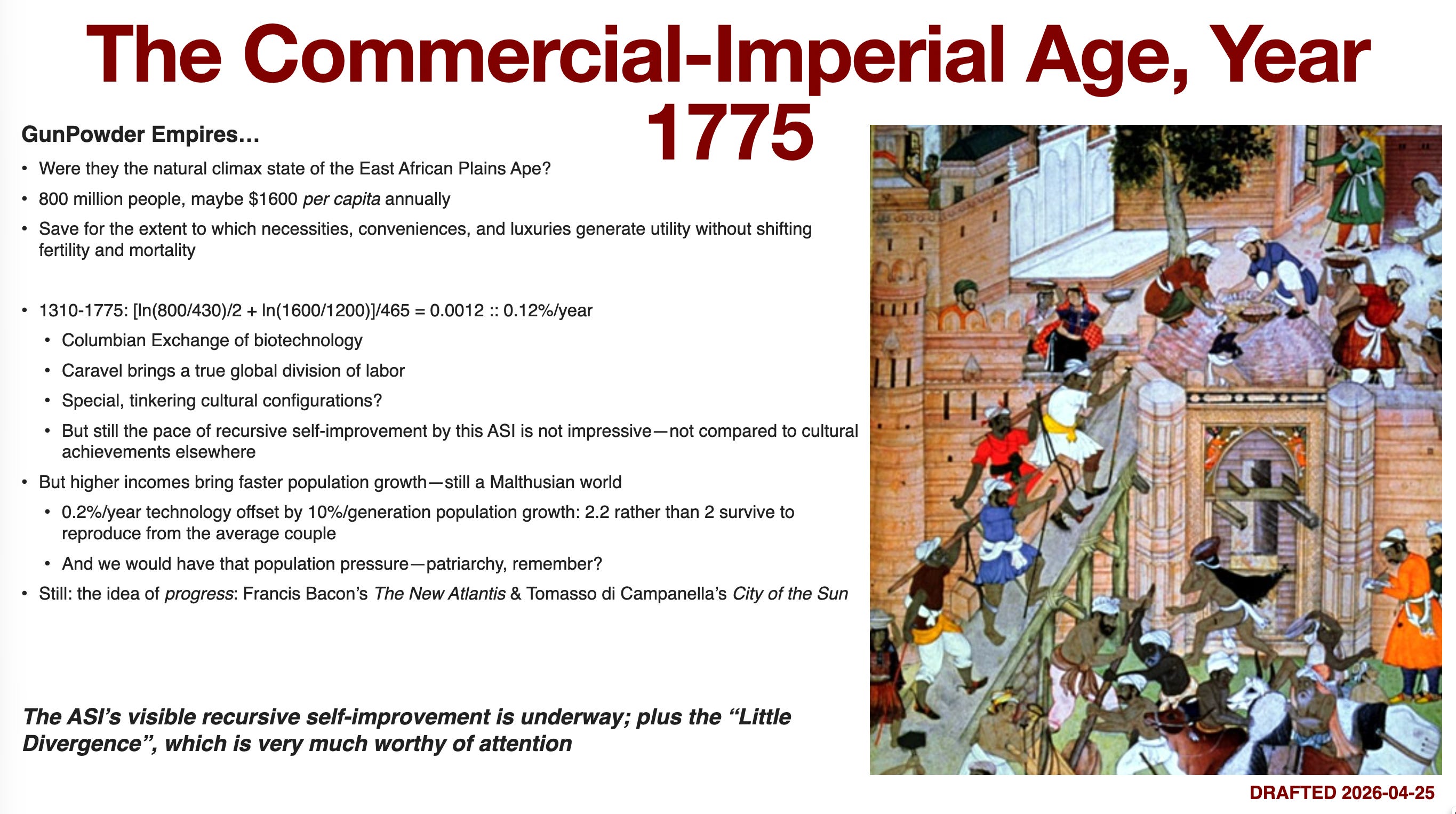
However, go forward another 465 years, and things appear then to have been different. We no onger had our agrarian-age societies. Instead, we appear to have had what we might as well call a commercia-imperial age. We had our gunpowder empires.
With certainty, the Black Death administered a huge Europe-wide shock. With high probability, the shock extended far beyond. And there was the two centuries-later Iberian conquest plagues larger demographic shock in the Americas. In some parts of greater Eurasia it looks like the Devil of Malthus had nearly completed the reworking of his spell, and humanity was back to close to near bare-bones living standards. In other parts of the world, even th working classes were not.
As of 1775, therefore, the world average standard of living, considered as the capability given available resources per capita to produce necessities and simple conveniences, may have been back to its pre-agriculture gatherer-hunter age norm: what we have guessed and anchored at $1,600 per capita per year. And as of 1775 we believe we had 800 million people on the globe.
Do the arithmetic:
[ln(800/430)/2 + ln(1600/1200)]/465 = 0.0012
0.012%/year. Five times as rapid in terms of the pace of technological improvement as the average pace of the long agrarian age. Nearly seventeen times as rapid as the march from the Gideon’s Band of 5000 or so in the year -70000 to the year -3000 invention of bronze tools and writing.
A five-times faster rate of growth of technology means that global society can support a five-times faster rate of population increase as well before it gets into the zone in which women become so skinny that ovulation becomes hit-or-miss, and children become so malnourished that their compromised immune systems mean that they get carried off by the common cold, in which people cannot work hard for more than an hour or two a day without their energy balance entering the red zone in which they are slowly starving to death. Instead of the average reproducing couple leaving 2.01 or 2.03 similar descendants reproducing in the next generation, the numvber was up to 2.07.
Something is going righter in terms of the pace of recursive self-improvement.
What?
One strong possibility is simply that “two heads are better than one”. With from 430 to 800 million heads over 1310 to 1775, there was much more thinking being done than with the from 45 to 430 million heads over -3000 to 1310, let alone the 5 thousand to 43 million heads of -70000 to -3000. And the later heads and much better information and communications technologies: paper, printing, and algebra. Whatever fraction of resources were mobilized by society’s élite and others to solve problems and bottlenecks in nature manipulation and build positive-sum organization for production (rather than the negative-sum institutions of domination), that fraction would have been vastly greatly by 1775 than it had been in -3000. Allow by 1775 for a multiple of four in the effectiveness of information and communication in 1775 relative to cuneiform and basic arithmetic in -3000, and we had by 1775 nearly 100 times the useful thinking for recursive self-improvement. It is true that the really low-hanging fruit had been picked. But, at one level, I am not surprised at a five-times more rapid growth rate for “technology”.
There are other, special factors in play as well. Certainly a large chunk of post-1500 technological improvement comes from the great Colombian Exchange of biotechnology between continents. Almost surely the coming of reliable transoceanic rather than Silk Road or Indian Ocean cost-hugging trade made a difference.
And so while the pace of recursive self-improvement by the collective human mind ASI was still not impressive by our standards, it was very impressive by the standards of earlier agrarian-age and before human history.
Plus we have the idea of progress showing up in the culture. Tomasso di Campanella’s The City of the Sun. (.) Francis Bacon’s The New Atlantis, in which the warden of Salomon’s House directs his fellows to investigations of secular technological learning, for “the enlargement of the scope of human empire, and the effecting of all things possible”.
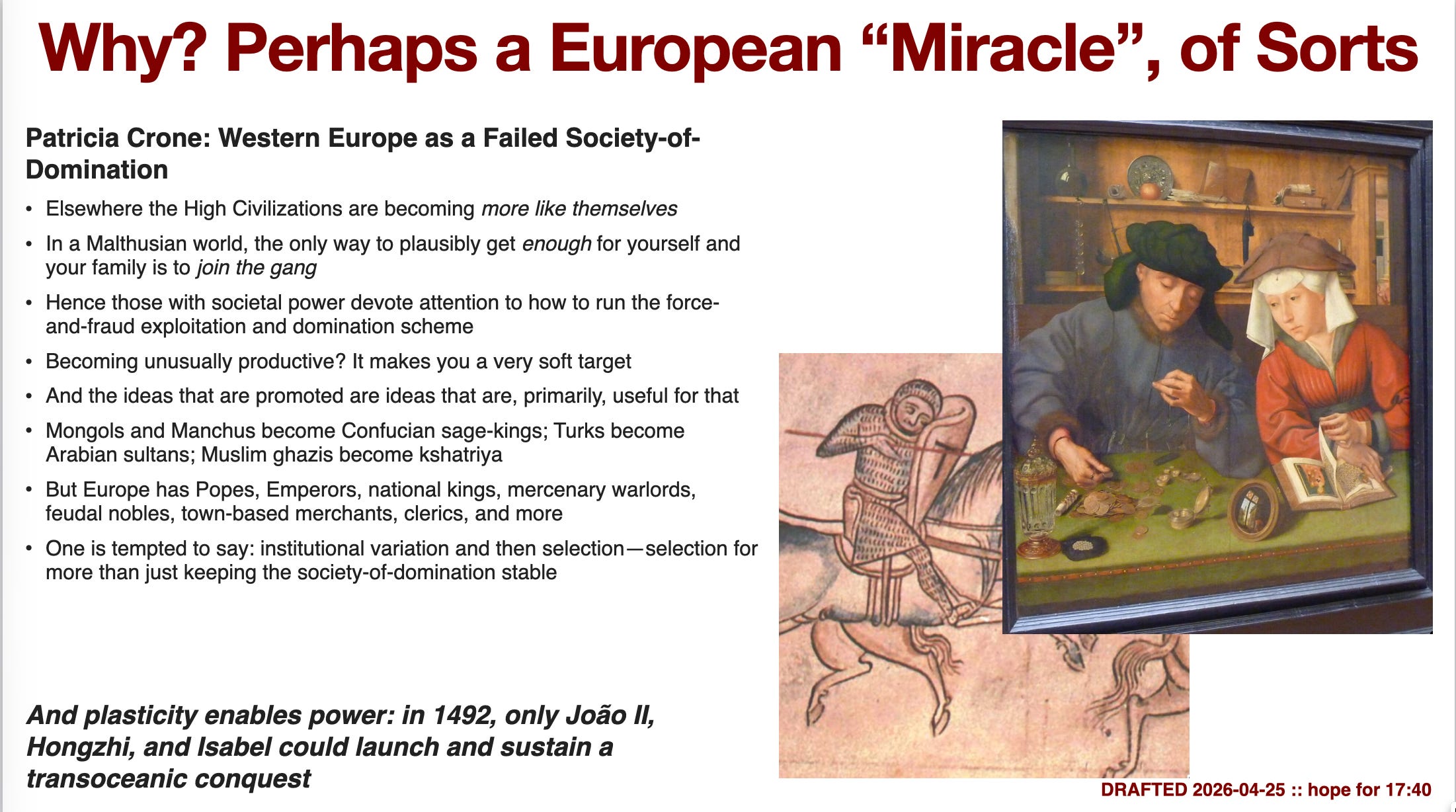
There is another possible answer for why the phase change, and particularly for the apparent concentration of the location of technological innovations at the far western edge of Eurasia.
I have long been struck by an observation made by the late Patricia Crone. In her view, in essence, western Europe as of 1500 is best seen as an unsuccessful and failed society of domination. Elsewhere, the High Civilizations of Eurasia, Africa, and the Americas each had their own playbook about how the élite that was the gang could maintain their place at the top of the society-of-domination so that its members and their families could have enough. Elsewhere, each was more and more becoming more like itself, perfecting its playbook. On the Indian subcontinent, there was a strengthening of the way in which the karmic order told you that your current low place in the division of labor and status expiation for your sins in past lives and the building-up of merit for better future ones, with alien military conquest élites being rapidly incorporated as variants of the kshatriya varna. In China, successive dynasties were becoming better and better at the smooth functioning of lineages’ operation of the bureaucrat-landlord-scholar-exam taker-degree holder-bureaucrat cycle. In Islam, there was increasingly effective hiving-off of the military institutions supporting the dynasty—janissaries, mamluks, ghazis, and so forth—from clan institutions with the potential to push back against exploitation and extraction.
In each case, individual members of the élite would contest for places in it. And coalitions would contest for places at the very top. But while the name of the boss could change, the strategies that successive bosses followed stayed largely the same.
But Europe had no playbook. Europe had no coherent élite. Europe had people fighting not just over what slots in the society of domination they would occupy, but even over what kind of society of domination it was going to be. Pope-ruled theocracy? Hohenstaufen-ruled empire with the sacred status of the dynasty head trumping the authority of the pope? Continent-wide empire, or individual national states? Feudal coalitions, or mercenary armies funded by royal taxation? Agricultural tax- or commerce-based régimes exercising political dominance?
I am very tempted to say that this failure of the gang to get its act together was a long-run strength. It produced a lot of institutional variation. And that was then followed by selection. Plus institutional plasticity—people knew that they could choose not just which but which kind of social coalition they could choose to belong to.
One more observation: It 1492, the Ming Emperor Hongzhi of China had the power to command, had he wished, a transoceanic campaign of imperial conquest with a wave of his hand. In 1492, Queen Isabel the Catholic of Castile did not. And yet it was she that did it. She bargained. She assembled a coalition: German financiers, Castilian crusader-conquistadores, Portuguese sailors, Catholic priests, and a Genoese navigator. And because it is a bargained-for coalition, the returns from the expedition are divided rather than all flowing into the state treasury, and so there are powerful bottom-up incentives to do it again, and expand it. Enterprise, rather than command.
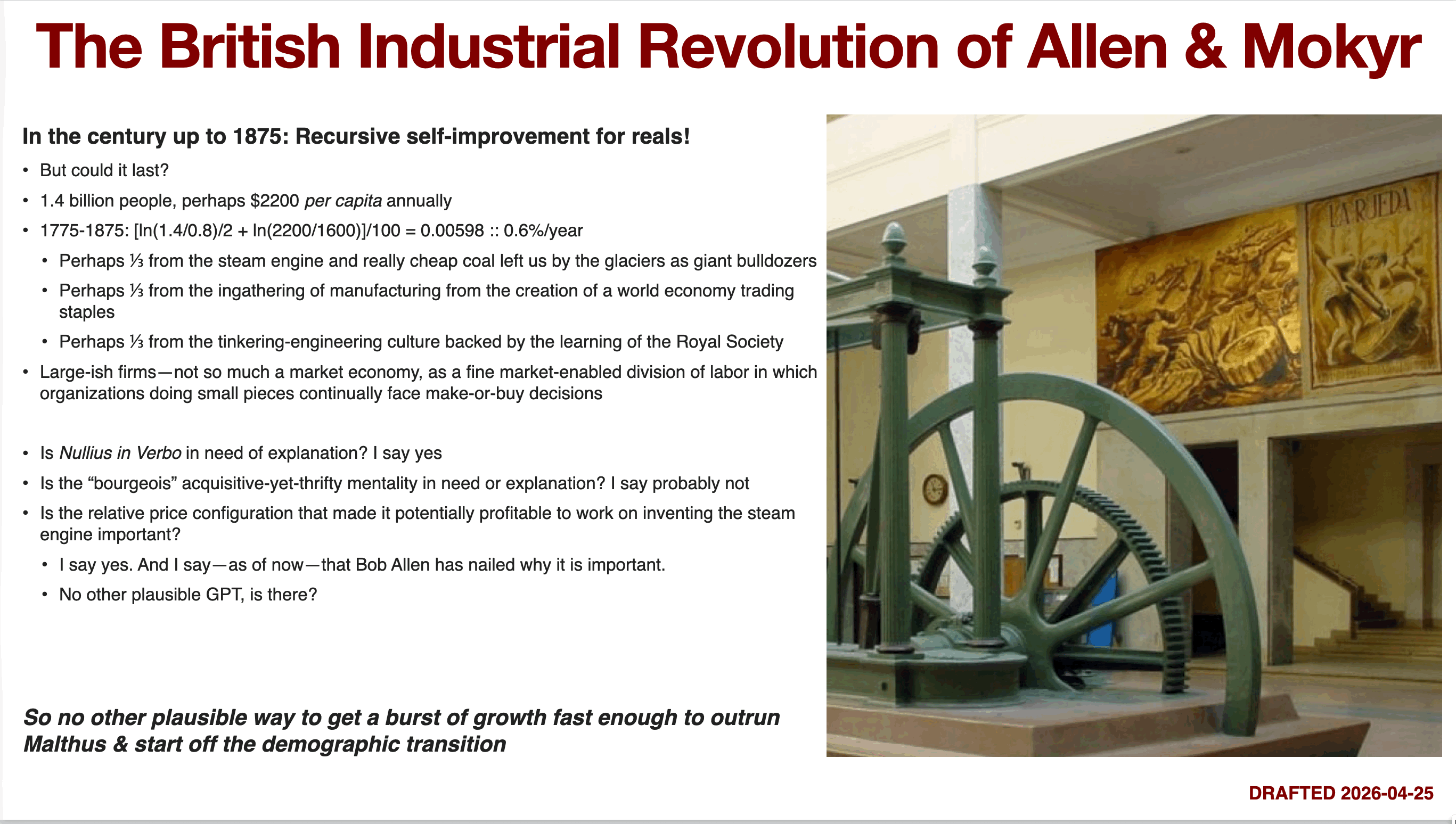
Move forward another century, and by then we had recursive self-improvement for real. We had sustained rates of technological growth worldwide—this isn’t just Western Europe, but worldwide—on the order of 0.6% per year in measured labor productivity and perhaps 0.4–0.5% per year in total factor productivity. Before 1500, even the optimists like Angus Maddison would be hard-pressed to claim more than 0.05% per year on average. That is, for thousands of years human societies had lived under an effective stagnation regime in which it took something like 1,500 years for average material living standards to double. After 1800, in the industrial core, living standards doubled in 50 to 70 years instead.
There was an awful lot of benefit from participating in the division of labor produced by the coming of the steam engine and its associated technologies. Think of the canonical pictures: James Watt and Matthew Boulton at Soho in the 1770s; Richard Arkwright’s water frames and then steam-powered mills at Cromford; the coal mines of Newcastle and South Wales; and then, by the mid-19th century, railways tying together Lancashire cotton, Yorkshire woolens, Ruhr coal and steel, and Belgian machinery. By 1860, perhaps 5–7% of the British labor force was directly or indirectly engaged in coal mining, yet that 5–7% was delivering an energy flow equivalent to something like 200–300 million adult male laborers working at the pre-industrial norm. Gregory Clark has calculated that a single coal miner in 19th-century Britain could bring to the surface enough coal in a day to do the work of perhaps 50 to 100 human laborers, once translated through steam technology into mechanical power. That is the scale of the discontinuity.
But maybe this was not sustainable. Perhaps one third of this increase in technological prowess came from the fact that early steam engines were possible because, among all the other reasons, the glaciers of natural history had scraped off all the rock above the coal in Britain, in the Ruhr, in Belgium, and in almost no place else. In those lucky basins, you could just pick it up off the ground, or sink shallow bell pits, and then ship it cheaply by water. The North Sea coast, the Thames and Severn river systems, and the Rhine-Ruhr axis offered extraordinarily low-cost transport. In the 18th century, moving a ton of coal 30 miles by wagon overland could cost as much as mining the coal itself; moving that same ton by coastal barge from Newcastle to London cost a fraction of that. Joel Mokyr and E.A. Wrigley have stressed that this cheap coal-energy-plus-water-transport bundle was not a general human endowment. It was a weird, contingent, geo-ecological lottery win.
Lots of technologies would be profitable for individuals to develop if coal was effectively free and so high-density stored sunlight could be easily accessed for power if you had a steam engine. But even though inventing the steam engine would be a marvelous boon for humanity—a once-in-a-millennium shift in the production possibility frontier—the engineering sweat to do so would, ex ante, be a money-loser for the individual entrepreneurs and engineers if energy were costly everywhere and coal deposits were deep and inaccessible. Thomas Newcomen’s early atmospheric engines, for example, were horribly inefficient: they converted something like 0.5–1% of the heat energy in coal into mechanical work. They made sense only when the coal was right there at the pithead and essentially priced near zero at the margin. Wrigley calls this the shift from an “organic economy,” bound by current photosynthesis, to a fossil-fuel economy in which past photosynthesis is drawn down. That shift depends on almost comically specific geological facts.
And the boon that was nearly-free coal was gone by 1875, as we had to dig deeper and deeper to find the stuff. By then, average pit depths in Britain had increased dramatically; pumping costs, ventilation, and safety expenditures all rose. The easy seams near the surface, accessible with limited capital and little engineering expertise, were increasingly exhausted. This is one reason why late-19th-century Britain, although still rich and industrial, begins to lose its hyper-growth edge to places like the United States and Germany, which, as Robert Allen points out, had their own combinations of high wages, abundant resources, and latecomer advantages.
Maybe another third of 1775–1875 productivity improvement came from the in-gathering of global manufacturing to where the engineers were. You drew spinning, weaving, iron-making, and machine-building away from Italy, India, and China, and re-centered them within that 300-mile Dover Circle. Already by 1850, Britain was producing something like half of the world’s cotton textiles, a staggering share given that its population was perhaps 2–3% of the world total. This dramatic reallocation—the “great divergence” in its most concrete manufacturing-trade form—generated immense agglomeration economies: engineers talking to mechanics; mechanics talking to inventors; inventors imitating, stealing, and improving on each other’s designs. This is the sort of thing that economic historians from Nicholas Crafts to Kevin O’Rourke and Jeffrey Williamson have pointed to as key to understanding both Britain’s lead and the costs imposed on deindustrializing regions elsewhere.
That too, however, was a process that had largely run its course as of 1875. Once you have re-centered the world’s high-value manufacturing in your industrial districts, you can only do that reallocation once. After that, your growth depends increasingly on genuine technological deepening and the continual discovery and exploitation of new general purpose technologies—railways, electricity, internal combustion, chemicals, telegraphy, telephony, and so on—as David Landes and, more recently, Joel Mokyr and Alexander Field have emphasized.
And there was more: there was—perhaps this is the final third, driving all by itself—the recursive self-improvement of the ASI at a pace perhaps twelve times that of the agrarian age, and nearly three times that of the Columbian Exchange- and caravel trade-driven imperial-commercial era. By “ASI” here, think of the entire complex of institutions that generate, store, and recombine useful knowledge: universities, learned societies, patent offices, engineering firms, military arsenals, and even the more capable parts of state bureaucracies. This is the tinkering-engineering culture that emerged after 1600 in northwest Europe, in that Dover Circle with a 300-mile or so radius around the white cliffs. It manifests in the Dutch Republic’s early-modern engineering for land reclamation; in British naval dockyards; in the French École Polytechnique; in the Prussian technical universities; in the proliferation, by 1900, of engineering degrees across the United States.
That culture needed to be backed by the learning of the Royal Society and of all the other colleges, visible and invisible. It needed to be backed by the rather strange belief that the ideas that should be promoted are not the ideas that make the ruling class’s extraction machine more comfortable, but instead the ideas that are actually true about the world. Nullius in verba—“on nobody’s word”—as the Royal Society motto had it. Defer, if at all, to experimental evidence, replicable procedures, and mathematical consistency, not to the preferences of your patron or the needs of your landlord’s rent-extraction scheme.
And here we economic historians do not agree and never agree. With respect to every aspect of this jump-up in the pace of recursive self-improvement, some see it as natural and inevitable and others as bizarre and badly in need of explanation. For example, nullius in verba—we take nothing for granted because some earlier authority has said it. Is that in need of explanation? I say yes. This is one of the central divisions between those, like Joel Mokyr in “The Enlightened Economy,” who see the rise of a culture of systematic inquiry, open debate, and scientific societies as the key driver, and those more inclined toward materialist or demographic stories, whether drawn from Jan de Vries’s industrious revolution or from unified-growth-theory versions of Oded Galor’s work.
Is the bourgeois acquisitively thrifty mentality in need of explanation? I say probably not. I say such people with backing ideologies pretty much emerge everywhere. You can find merchant elites and proto-bourgeois behavior in Song China, among the merchants of Venice and Genoa, in the trading communities of the Indian Ocean described by K.N. Chaudhuri, and in the mercantile diasporas of the Mediterranean. Ernst Gellner had a crack about how if it wasn’t the Protestant ethic, it would have been the Karajite ethic, had the Battle of Tours gone wrong and the emirs of Al-Andalus had routed Charles Martel in the 700s. Max Weber wanted to tie the “spirit of capitalism” to a very specific Confessional culture. Gellner, and many who followed him, would say: no, the world is full of potential bourgeois mentalities waiting for the right institutional and technological environment to flourish. The constraint, they argue, is less the supply of acquisitively thrifty people and more the structure of political and property-rights institutions.
Is the relative-price configuration that made it potentially profitable to work on inventing the steam engine important? Well, I think that Bob Allen probably has that nailed: that it is very important. In his “The British Industrial Revolution in Global Perspective,” Allen makes the now-famous argument that Britain’s peculiar combination of cheap coal and expensive labor—high wages relative to energy prices—created a unique incentive to substitute capital and energy for human labor. Under those conditions, a machine that could save workers at the cost of burning huge amounts of cheap coal would be profitable for the individual firm, not just for society at large. Others disagree, emphasizing instead the role of science (Mokyr), institutions (Douglass North and his followers), or luck and path dependence (a broad reading of Pomeranz). But, at least as I see it, there is no other plausible GPT—General Purpose Technology—to drive astonishingly rapid leading-sector growth out there in that first industrial century. Nothing else with the reach and versatility of heat engines harnessing coal.
What else was there that could get your rate of technological progress high enough, for a while, to get your society prosperous enough to get infant mortality low enough in some portion of the world so that the Malthusian imperative—“we’ve gotta have another kid to diminish the one-third chance that my widow will be accused of being a witch”—fades away? Economic demographers like Livi-Bacci and economic historians like Richard Easterlin have pointed out that pre-industrial infant and child mortality rates in many societies ran at 200–300 deaths per 1,000 live births, with life expectancy at birth hovering in the low 30s. Under such conditions, reproductive behavior is dominated by replacement: have many children because many will die. Only when incomes rise and public health measures, clean water, and basic medical knowledge bring infant mortality down toward 50 per 1,000 and then 20 per 1,000 can you get a sustained demographic transition.
And it needed to fade away. Without a demographic transition, all the surplus generated by any given productivity improvement is eventually eaten up by population growth—a point hammered home since Malthus and revisited in every serious growth-and-history framework from Wrigley’s “dual economy” model to Galor’s unified growth theory. There was recursive self-improvement of the ASI at a pace perhaps twelve times that of the technology growth at the speed of the imperial-commercial age: if the earlier mercantile and Columbian-Exchange-driven era could manage perhaps 0.1–0.2% per year in productivity growth through better ships, better trade routes, and better commercial institutions, the industrial era’s 0.6–1.0% per year was a break in the historical series.
Only growth at that higher clip—or something like it—would ever have gotten you to the demographic transition: to France’s drop in fertility beginning in the late 18th century; to Britain’s in the later 19th; to Sweden’s in the late 19th and early 20th; and then, via diffusion and state-led modernization, to the broader world after 1950. That is why the precise and somewhat odd configuration of coal deposits, relative prices, engineering cultures, and institutional arrangements in the long 18th century matters so much for the entire subsequent history of humanity. Change any of those parameters too far—no cheap coal near navigable water, no Royal Society, no cluster of high wages and secure property rights in that small North Atlantic corner—and you plausibly do not get the same recursive self-improvement process in time to pull large populations out of the Malthusian trap before the 20th century.
At least, that is how I read the current balance of the economic-historical literature.
Moreover, note the importance here of Jevons’s paradox, as Jeffrey Williamson and Greg Clark taught me, earlier true technological breakthroughs—movable-type printing, the caravel, wet multi-annual staple-crop rice cultivation—had limited impact on rates of aggregate growth because the price elasticity of demand there was less than one. Thus the more technologically capable the sector began, the smaller was its weight in total production.
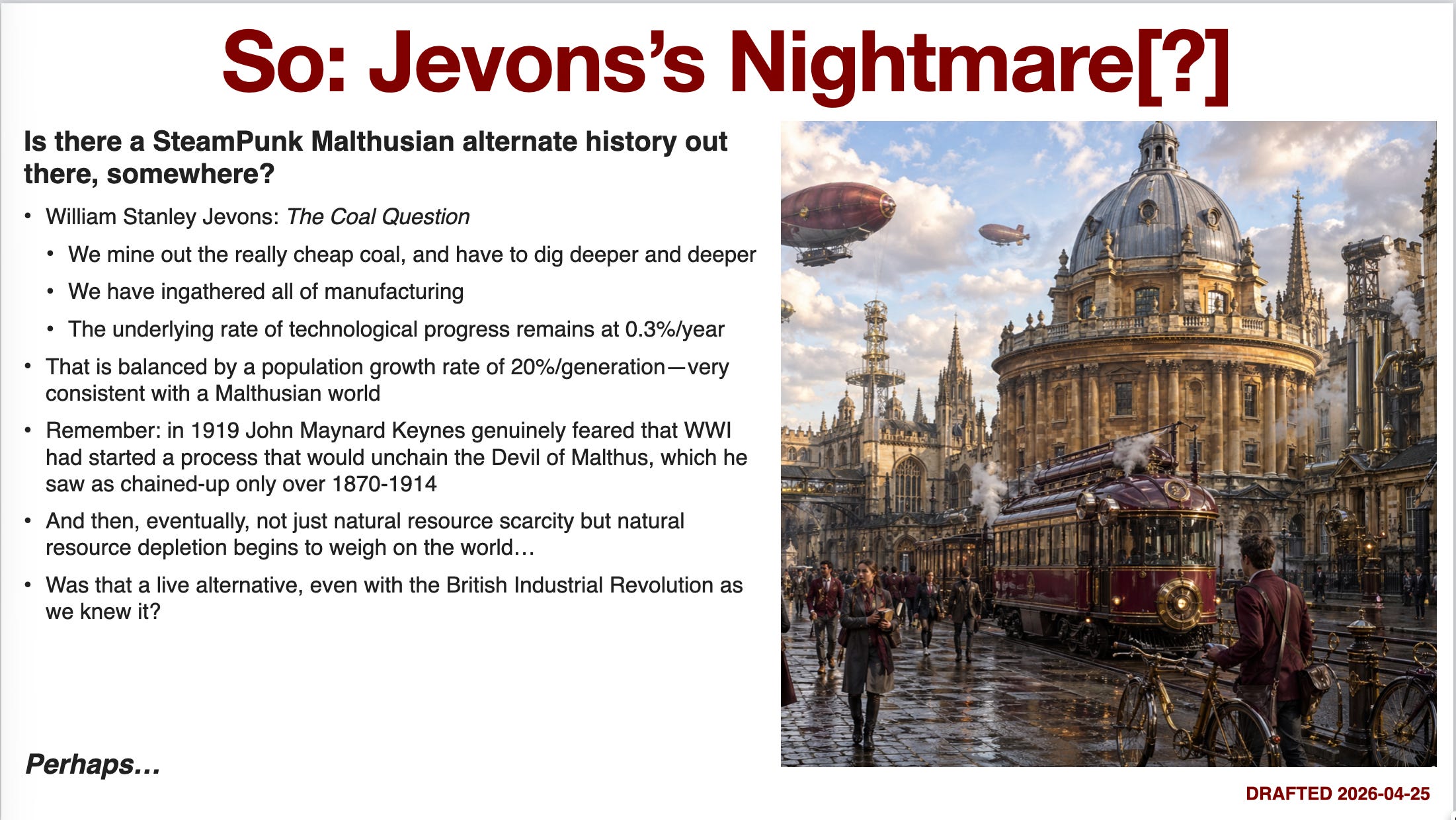
But in addition to Jevons’s Paradox there is Jevons’s Nightmare.
When W. Stanley Jevons wrote The Coal Question in 1865, warning that Britain had already mined out the really cheap coal, was having to dig deeper and deeper, and that put the comfort of the British working class, the power of the British state, and the British Empire itself at hazard, he was not just indulging in Victorian melancholy. According to Jevons’s own then-estimates, British coal output had risen from roughly 10 million tons a year in 1800 to around 80 million tons by mid-century and would pass 100 million tons not long after. Yet the quality of easily accessible seams was already falling. By the 1860s, average shaft depths had lengthened dramatically, pumping costs had risen, and mine-owners were confronting a future in which each additional ton required more capital, more engineering ingenuity, and more labor.
E.A. Wrigley would later look at this and say: this is what it looks like when an economy has shifted from an organic energy regime to a fossil one, and is now starting to encounter the constraints of that fossil regime as well.
By that point, we had already in-gathered a very large share of the world’s manufacturing into the North Atlantic industrial core. By 1870, Britain alone was producing perhaps a quarter of world industrial output with less than 3 percent of world population, and together with the United States, France, and Germany it dominated the export of textiles, metal goods, and machinery. Robert Allen, Nicholas Crafts, and others have stressed how this geographic reallocation of manufacturing and know-how had, by the late 19th century, largely run its course. You could not “in-gather” Manchester’s textile production or the Ruhr’s ironworks twice.
Suppose, then, that you simply had the underlying rate of technological progress—the “residual” in the Solow sense—after 1875 at something like 0.3 percent per year worldwide, which is in the ballpark of what many economic historians think characterized the early Victorian era if you strip out one-off gains from cheap coal and manufacturing reallocation. And which is not that much less than the post 1870 pace in Britain as it went through its pre-1914 Edwardian allowdown. A 0.3 percent annual growth rate in productivity implies a doubling time of roughly 230 years. That is a far cry from the 2–3 percent per year experienced by the 20th-century rich countries: at 2 percent a year, you double living standards in about 35 years; at 3 percent, in about 23.
Well, 0.3 percent per year can be balanced—indeed overwhelmed—by population growth of, say, 20 percent per generation, something like 0.6 percent per year. That is very consistent with a Malthusian or quasi-Malthusian world, in which improvements in productivity show up mostly as more people rather than richer people. Before the demographic transition, many societies did see population growth on that order or higher in “good” centuries: think of Europe’s population rising from roughly 100 million in 1500 to around 190 million by 1800, or of Qing China’s population perhaps doubling between 1700 and 1800. If productivity crawls while population sprints, the average human does not get much richer for long.
Even in 1919 John Maynard Keynes genuinely feared that World War I had broken things permanently. He feared that the Devil of Malthus was coming back. In The Economic Consequences of the Peace, Keynes warned that the pre-1914 “economic Eldorado” might well. have been a one-off, dependent on an unusually benign configuration of trade, capital flows, and political stability. His nightmare scenario was that the postwar settlement would snuff out growth, while population pressures—still pushing upward in much of Europe and beyond—would reassert themselves. He knew the arithmetic: if Europe’s prewar growth of perhaps 1.5–2 percent a year in income per head collapsed toward zero while populations continued to expand, the 19th century’s escape from the Malthusian trap might prove a brief holiday rather than a new epoch.
Think of that world Jevons and Keynes were worrying about. And note that it gets worse. It is not just that population draws even in its race with technology’s ability to make use of a fixed stock of natural resources. Eventually, not just natural resource scarcity but natural resource depletion would begin to weigh hard on the human economy. Too much irrigation in arid lands leads to salinization. Too much depletion of acquifers is driven by evaporation from poorly managed canals and reservoirs. Too much plowing of marginal land accelerates erosion.
The Fertile Crescent has become, as many environmental historians like John McNeill have noted, the infertile crescent.
You start to see deteriorating farmland, falling yields per acre, and the need to throw ever more labor and capital into the land merely to stand still. At the same time, the quality of the minerals you can mine declines: copper ore grades fall from 5–10 percent in easily worked deposits to 1 percent or less in deeper, more dispersed ones; iron ore of 60 percent purity gives way to leaner deposits requiring more processing. B
y the late 19th and early 20th centuries, geologists and economists alike were already debating whether such trends were compatible with sustained growth at anything like the pace that Britain and the United States had tasted during the industrial revolution century.
Now embed all this in a mental picture, the picture on the slide. It is a picture of Oxford. It is a picture of Oxford in a world that has our 8 billion plus population. It is a picture of Oxford in the year 2026. But it is a picture of a Malthusian Oxford, a SteamPunk Oxford, a world of 8 billion people but with technologies of industry and agriculture that has merely crawled forward from their level of 1875. It is a world in which heavier-than-air flight is not yet really a thing, in which internal combustion engines are a curiosity, in which there are not yet electric trains, and certainly no mass electrification of households—so no refrigerators, no air conditioning, no cheap artificial light beyond gas and a few arc lamps? SteamPunk world looks cool”: enormously attractive visually, as gleaming brass-and-iron contraptions—locomotives, steam carriages, pumping engines—still rattle down High Street on their rails with big clouds of steam billowing out of them. The engineering is gorgeous, the brass is polished, the valves hiss in a most satisfying way.
But it is a tremendously idealized picture.
For one thing, in that world everything is absolutely black with coal smoke, rather than gleaming brass. Environmental historians remind us what real coal-burning cities looked and smelled like: London’s infamous pea-soup fogs, which killed thousands in the 19th and early 20th centuries; Pittsburgh’s daytime darkness; Manchester’s grime; the thick soot that coated every horizontal surface. Respirable particulates, sulfur dioxide, and unfiltered coal smoke gave you bronchitis, emphysema, and a life expectancy in industrial cities that, until the late 19th century, could lag rural areas by a decade or more. A SteamPunk Oxford scaled up to an 8 billion-person planet, with everyone aspiring to 19th-century British coal consumption levels—on the order of a few tons per head per year—would mean tens of billions of tons of coal burned annually. The air would be unbreathable, and the carbon load on the atmosphere would dwarf even our current climate mess.
Moreover, with only that 0.3 percent per year of underlying technological progress and no further great general-purpose technologies beyond coal-fired steam and some rudimentary electricity, the capacity of the economy to compensate for environmental degradation and resource depletion would be sharply constrained. Wrigley’s “organic versus mineral-based energy regime” framework tells us why: once you have shifted to fossil fuels, your escape from land-based constraints depends on continuously improving your ability to find, extract, and use those fuels, or to substitute new energy sources altogether. If that improvement stalls early, and if population nevertheless climbs into the billions, you are pushed back toward a world in which the binding constraints are calories, water, and the carrying capacity of soil and ecosystems.
Are we ourselves an unlikely escape from a multiverse in which, in most of the Oxfords, Jevons’s nightmare plays out?
In some of those other possible timelines, things are worse than in the one I have shown of SteamPunk Oxford. One might imagine 2 or 3 billion people—perhaps fewer—very jealously guarding the small amount of coal and residual forest they still have available in order to keep themselves from being desperately and bitterly cold. In those branches, perhaps railways exist, but they are thin, elite infrastructures; perhaps there are some experimental airplanes, but they never become cheap enough for mass travel; perhaps electrification is partial and unreliable, confined to cores of empires that continually struggle with resource limits and political breakdowns. The wave of 20th-century general-purpose technologies that we got—electrification at scale, internal combustion, chemicals, modern agriculture, information and communications technologies—does not fully arrive, or arrives too slowly to outrun the Malthusian arithmetic.
Economic historians who work at the intersection of environment and growth—people like Wrigley, McNeill, and more recently those in the “energy-GDP nexus” literature—rarely are explicit but often implicitly flirt with such counterfactuals. They ask: how robust was the 19th- and 20th-century escape route? Was it overdetermined, with many possible technologies and institutional configurations leading us away from scarcity-and-stagnation equilibria? Or was it, as some readings of Robert Allen, Kenneth Pomeranz, and Joel Mokyr suggest, the product of a highly contingent bundle of resource endowments, relative prices, institutional quirks, and intellectual cultures that might very easily have failed to align?
You know, perhaps this is in part a question of taste and interest among historians: some are temperamentally drawn to stories of inevitability—of deep forces, Smithian specialization and Schumpeterian innovation grinding forward—while others are fascinated by just how knife-edge and precarious our particular historical path looks once you write down the numbers. But, either way, that SteamPunk, coal-blackened Oxford of 8 billion souls is not the world we got. Instead, we got a 20th century in which global GDP per capita rose from perhaps 2,000–3,000 dollars (in today’s prices) in 1900 to more than 15,000 today, and in which the share of the world population living in extreme poverty fell from over 70 percent to under 10 percent—even as we set ourselves up for a different set of nightmares in the form of climate change and ecological overshoot. Jevons’s nightmare did not materialize quite as he feared; we have, so far, chosen a different branch of the multiverse, one whose dangers are less about running out of coal than about burning far too much of it.
2026-04-28 17:00-18:30 BST (Tue): <https://zoom.us/j/8458651578?omn=95983788025>
Meeting ID: 845 865 1578
Passcode: 764724
If reading this gets you Value Above Replacement, then become a free subscriber to this newsletter. And forward it! And if your VAR from this newsletter is in the three digits or more each year, please become a paid subscriber! I am trying to make you readers—and myself—smarter. Please tell me if I succeed, or how I fail…
##fyi-theories-of-eeconomic-history
##lecture-notes
##enlarging-the-scope-of-human-empire
#2026-hicks-lecture
#economic-history
#grand-narrative
#stage-theory
#john-hicks
#oxford-lecture
#institutional-change
#technological-change
#macro-history
#global-economy
#theories-of-economic-history
<https://braddelong.substack.com/t/theories-of-economic-history>