
DRAFT: Social Theory for the Mid-21st Century
2024 Philosophy, Politics, & Economics Society Keynote Lecture :: Westin New Orleans Hotel, New Orleans, LA :: J. Bradford DeLong :: U.C. Berkeley :: brad.delong@gmail.com :: as prepared for delivery [I LIED: I don’t like the pre-delivery text enough to let it out into the wild, so I am revising the most egregious of the mind-os I find as I go back through it. I am dancing as fast as I can!] as revised :: 2024-11-14 Th : but it really needs more revision…
I. What Do I Ask My Students to Read so That They Will Understand the World of 2055?
1. The Utility? of History
Thank you very, very much for that introduction, for this crowded room, and for the opportunity to take a trip to New Orleans in the fall.
I apologize that I am here a year late. And I apologize that the talk I have this year has many fewer answers than the talk I had ready to givelast year. It has very many fewer answers, largely, because I concluded that the answers I had last year were not right.
Thus, this is going to be a talk that ends up with questions, not answers. It will end with a frantic attempt to pass the baton to all of you—especially the younger ones among you who still have time to think new thoughts and to change their minds—and demand that you come up with the answers. All of you together are certainly wiser than me alone.
Our students are human beings who will spend their lives engaging in human affairs. We should try to teach them how to do this well. In order to gain insight into “human affairs” in general we are led to study history. And from history we are then led to think about and study and create this thing that we call theory: philosophical theory, political theory, economic theory, social theory, and so forth.
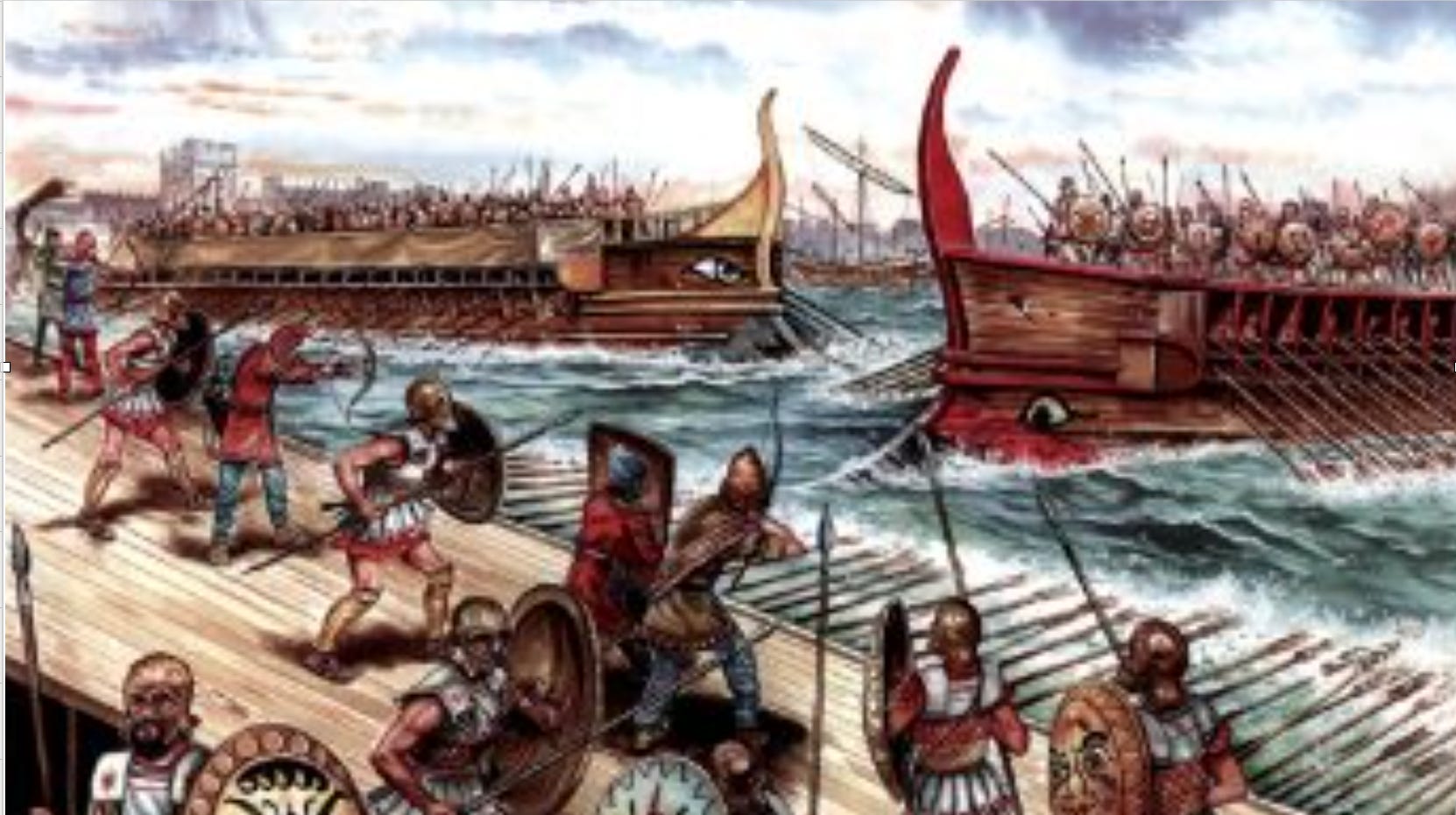
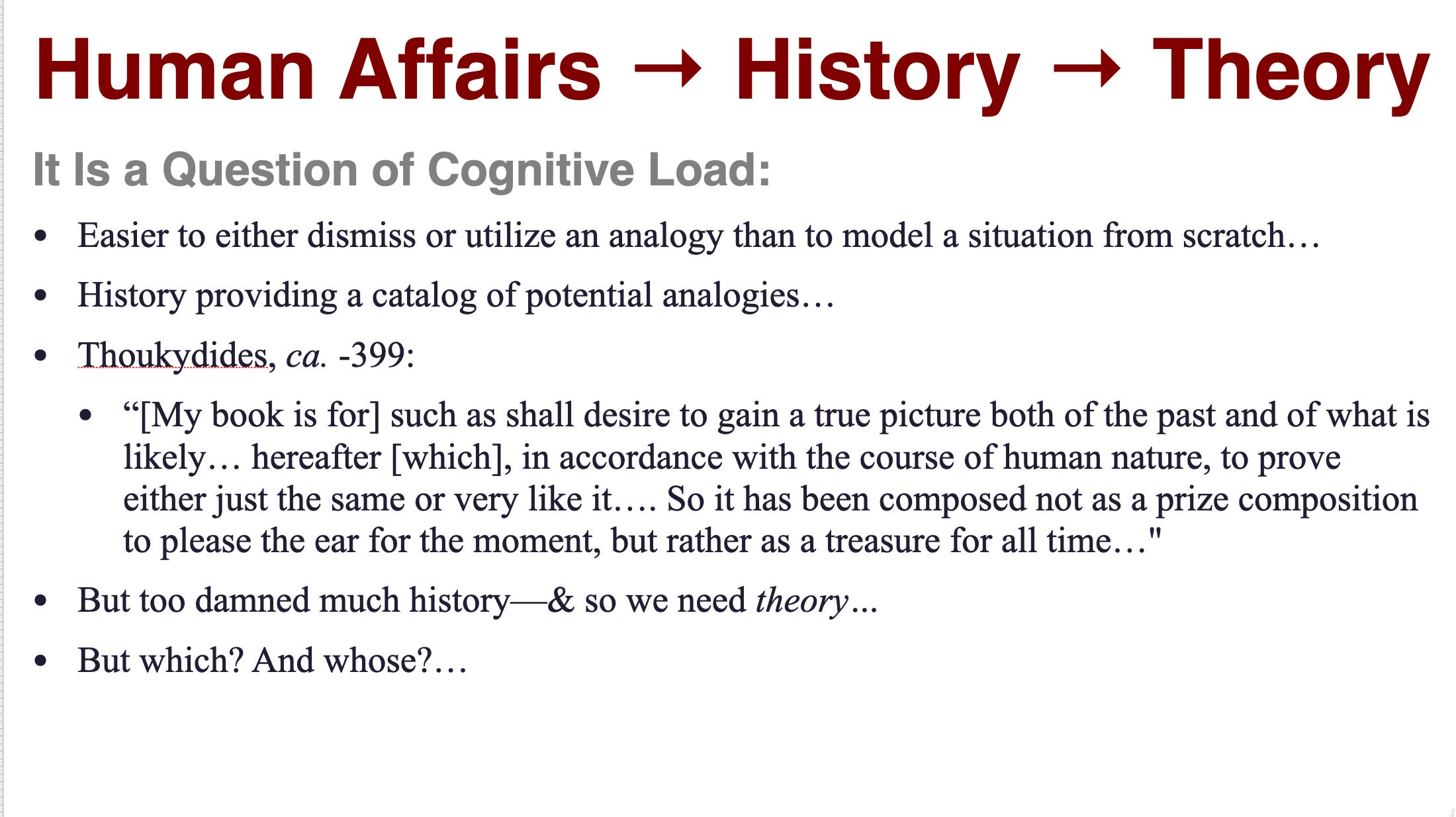
I think, at bottom, that it is a question of cognitive load. In this I agree with Dan Davies: is much easier to either dismiss or utilize an analogy than to model a situation from scratch. Our history is great at providing us with a very large library of potential analogies and analogues. We can then run through them, thinking: “no, no, no, no, no, no, no, no, no, maybe, maybe, no, no, no, no, maybe, yes.” That this is an important use of history has long been known. In the introduction to his The History of the Peloponnesian War, Thoukydides of the Athenai set it forth as the reason that people should study his book, for he had written his book for:
such as shall desire to gain a true picture, both of the past and of what is likely hereafter, which in accordance with the course of human nature, to prove either just the same or very like it…
Then comes the single most arrogant statement I have ever read from any author anywhere anywhen. He writes that he has succeeded in writing something that is:
not written for a prize composition to please the ear for a moment, but rather is a treasure for all time…
Thrown out of Athens by the twists and turns of Athenian politics, hanging out in exile in weird barbarian places as an ex-Athenian aristocrat, too close to various Spartan sources for the liking of many people in his home city—not a guy doing conspicuously well as an Athenian aristocrat. And yet the guy still is, or at least presenting himself as, the most self-confident individual alive.
2. The Necessity of Theory
Back in the early -300s we had two works of what we call history: Herodotos and Thoukydides. But he started a fad, and the result was a flood of Hellenistic-era histories—nearly all of which are not lost to us, alas!, save as they were compressed into and show up summarized in the biographies of Plutarkhos of Khaeroneia. And people kept writing, and many of what they wrote has survived. So by now we have far too damned much history.
Thus we need theory. We need theory to direct us where to look in the histories in our attempts to find analogies. We need theory because we have no choice but to try to take all the various analogies and to distill them down. I know that this is a very dangerous thing to do. Distilling down all the potential lessons of history into theoretical propositions may wind up giving you something both flat and hallucinatory like Chat-GPT. Worse, perhaps, you wind up taking a fine Bordeaux and turning it into white lightning. It is certainly true that when you imbibe too much theory too quickly, you wind up the following morning with a huge headache, and greatly regretting what you said and did while under its influence.
Nevertheless, we must have theory. We cannot do without it. We are, after all, East African Plains Apes of very little brain, and there is so much that we might choose to try to learn and know.
So: which history, and whose? The answer to that is theory. But at that level thje problem repeats itself: which theories, and whose?
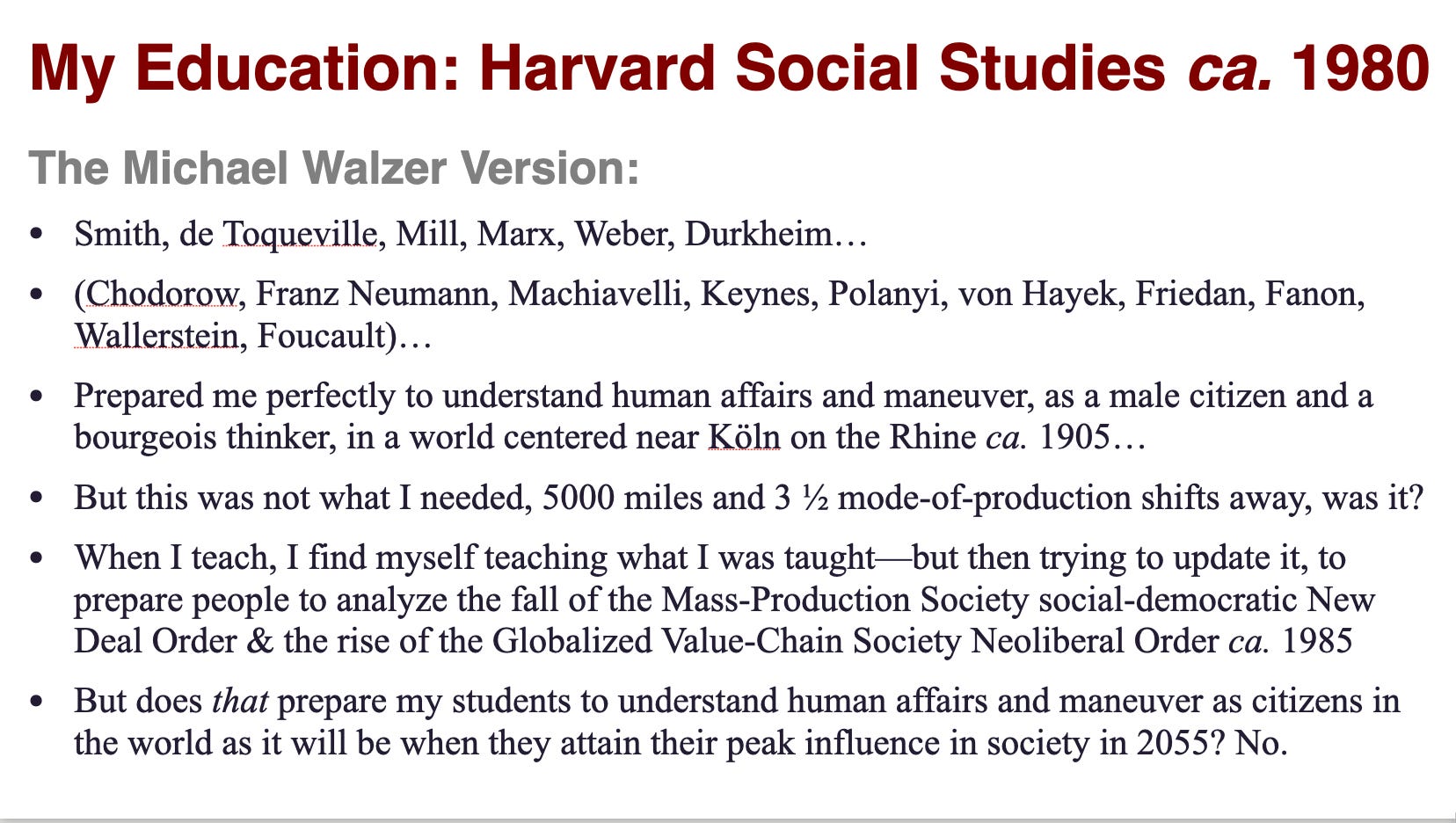
My theoretical education came from the Harvard Social Studies undergraduate concentration circa 1980. Even today, there is a core of me that still is the Michael Walzer version of the Harvard Social Studies interdisciplinary curriculum circa 1980: Smith, de Tocqueville, Mill, Marx, Weber, Durkheim. In junior tutorials and elsewhere people tried to force-feed me more theory: Nancy Chodorow, Franz Neumann, Machiavelli, Keynes, Polanyi, Frieden, Fanon, Wallerstein, Foucault—a whole bunch of others, some of which took and some of which didn’t.
The net effect of all of this? It was to prepare me perfectly to understand human affairs, and to maneuver as a male citizen and as a bourgeois thinker, in an area centered around Köln on the Rhine in the years around 1905. I would have been so damned effective as a bureaucrat, as a political actor, as an intellectual back then. I could have absolutely wowed the world.
3. Our Current Problem: Drowning in too Much Theory
But in the 1990s I was 5,000 miles and perhaps three and a half mode of production shifts away. And so my theoretical education was not all that relevant. That problem is constant. Today when I teach, I find myself drifting back to teaching largely what I was taught. And then I find myself frantically trying to update it. And when I come to the end of the course, I look back and find I have prepared people to analyze the 1980s, the fall of the Mass-Production Society social-democratic New Deal Order and the rise of the Globalized Value-Chain Society Neoliberal Order. That is a very important topic. (I think it has been best covered by Gary Gerstle).
But is my preparing people to analyze that really me serving my students? Does that prepare my students to understand human affairs and maneuver as citizens in the world as it is likely to be for them? They are going to attain their peak influence on society and take actions that have consequences in 2055? No, it does not. I am making them skate to where the puck was 40 years ago, not to where the puck will be thirty years hence.
We need to do better. I need now to be teaching my students theoretical perspectives that will enable them to understand what is going to be going on in 2055.
I warn you now that that point—I need a reading list to assign my students if I am to do my job—is where I am going to stop this talk. I do not have a reading list. I have ideas, but I do not trust them. So I am passing the baton to you. I charge you, each of you, to come up with a reading list, and to email it to me.
II. From -73000 to 2055: Malthusian Poverty to Modern Economic Growth
Imagine standing in 1905, looking back at ancient agrarian poverty in the year -3095 at the start of the Bronze Age, then peering ahead to 2055—and recognizing that the rough proportional difference in human technological mastery across the first 5000 years is the same as over the next 150. To call technoeconomic change in the past 150 years truly seismic is to massively undersell it. It is very likely that the magnitude of that shift is the most important thing from which to start deriving lessons from and of history.
How, then, are we today to think about the world as it will be 2055?
2055 is far from today, and is much farther from the 1905 that I think is still the focal point of what American academia teaches and thinks about. How far is it? I am going to claim that 2055 is as far from 1905 as 1905 is from the year -3000.
Let me now try to justify this very large and unsettling claim.
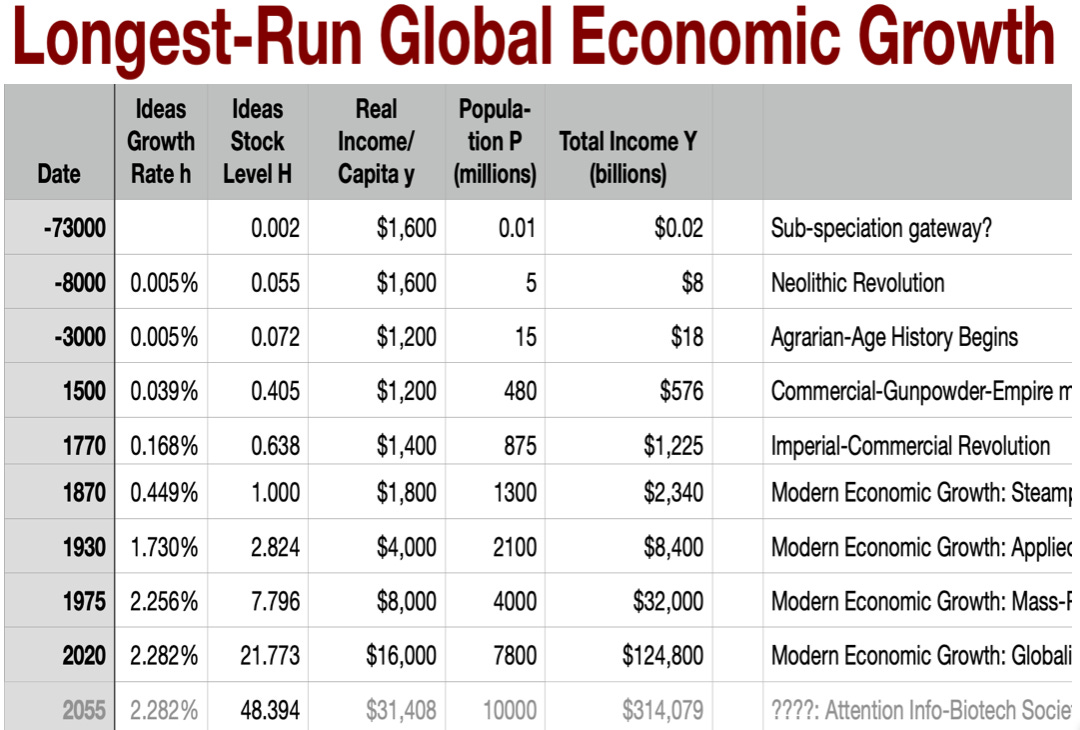
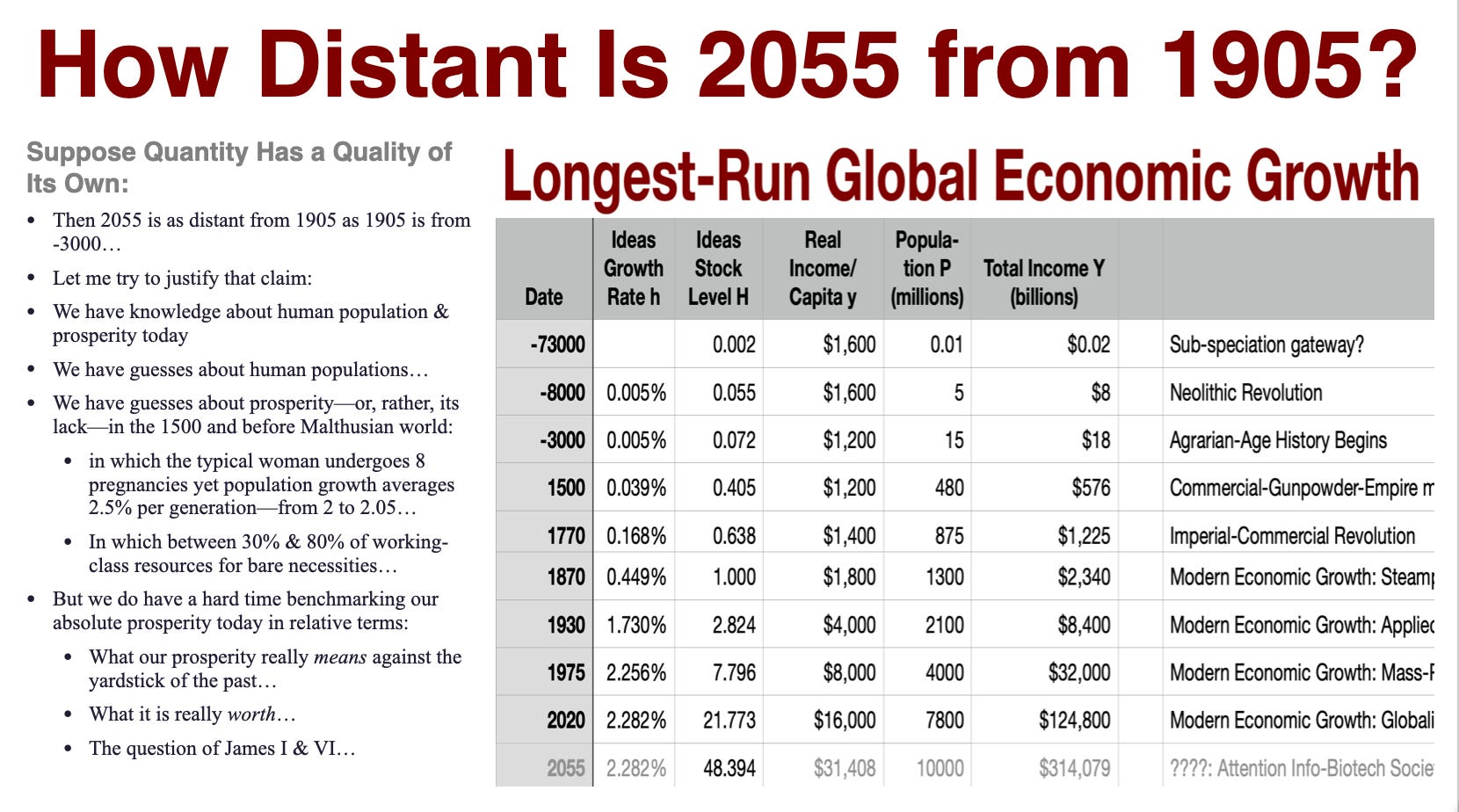
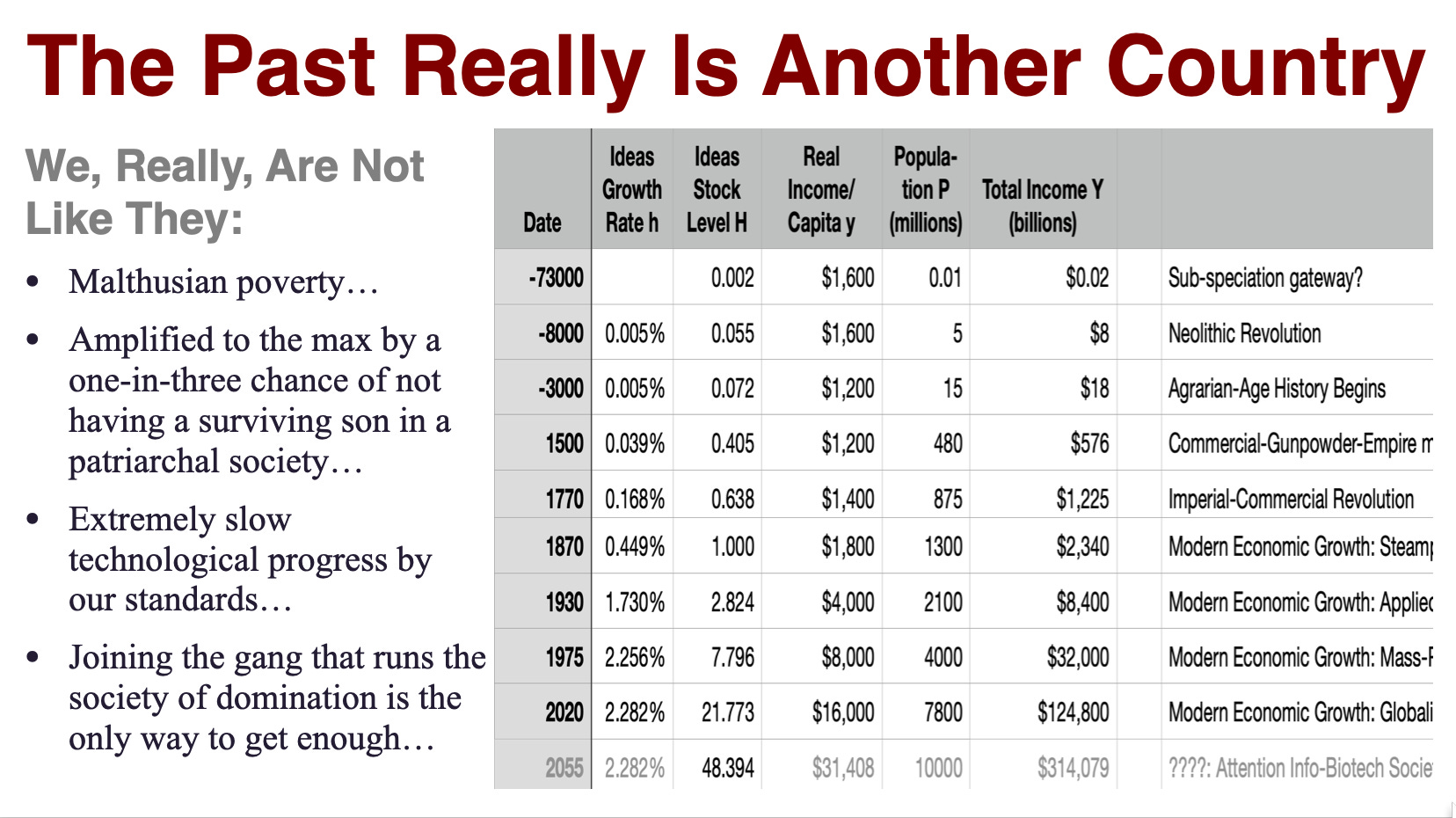
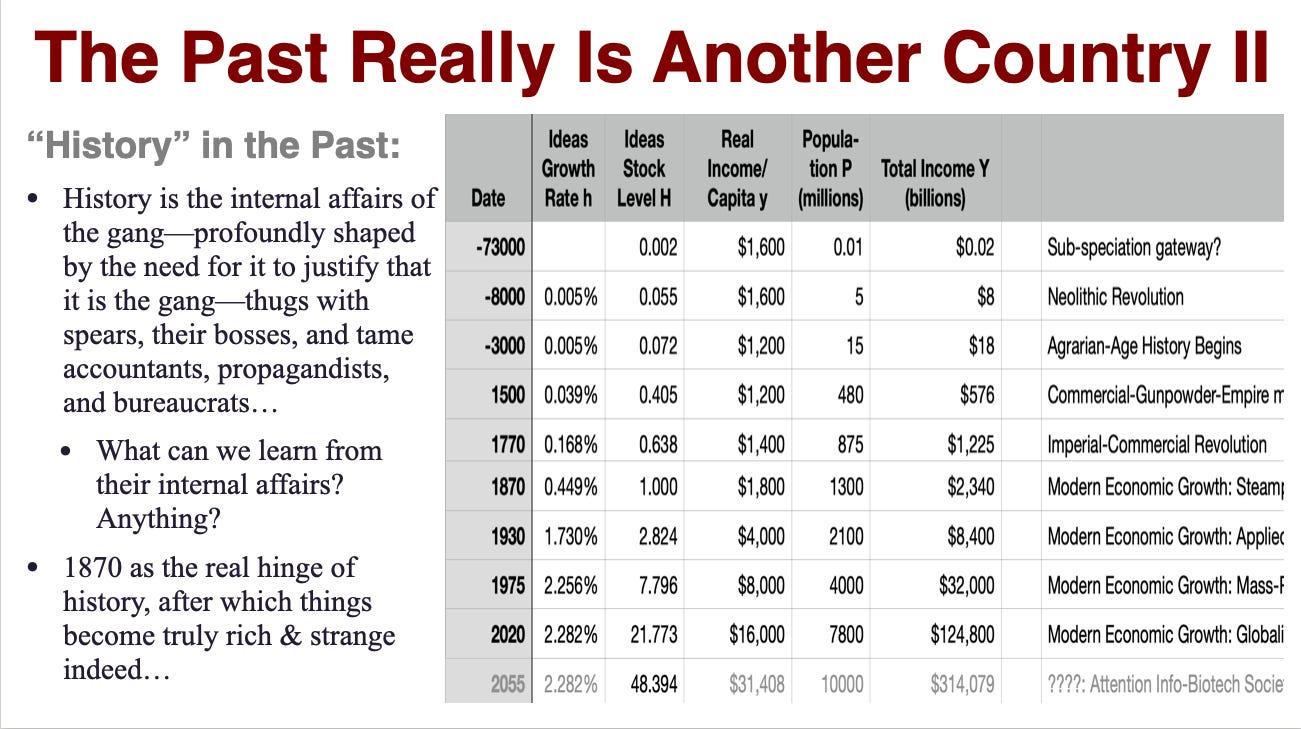
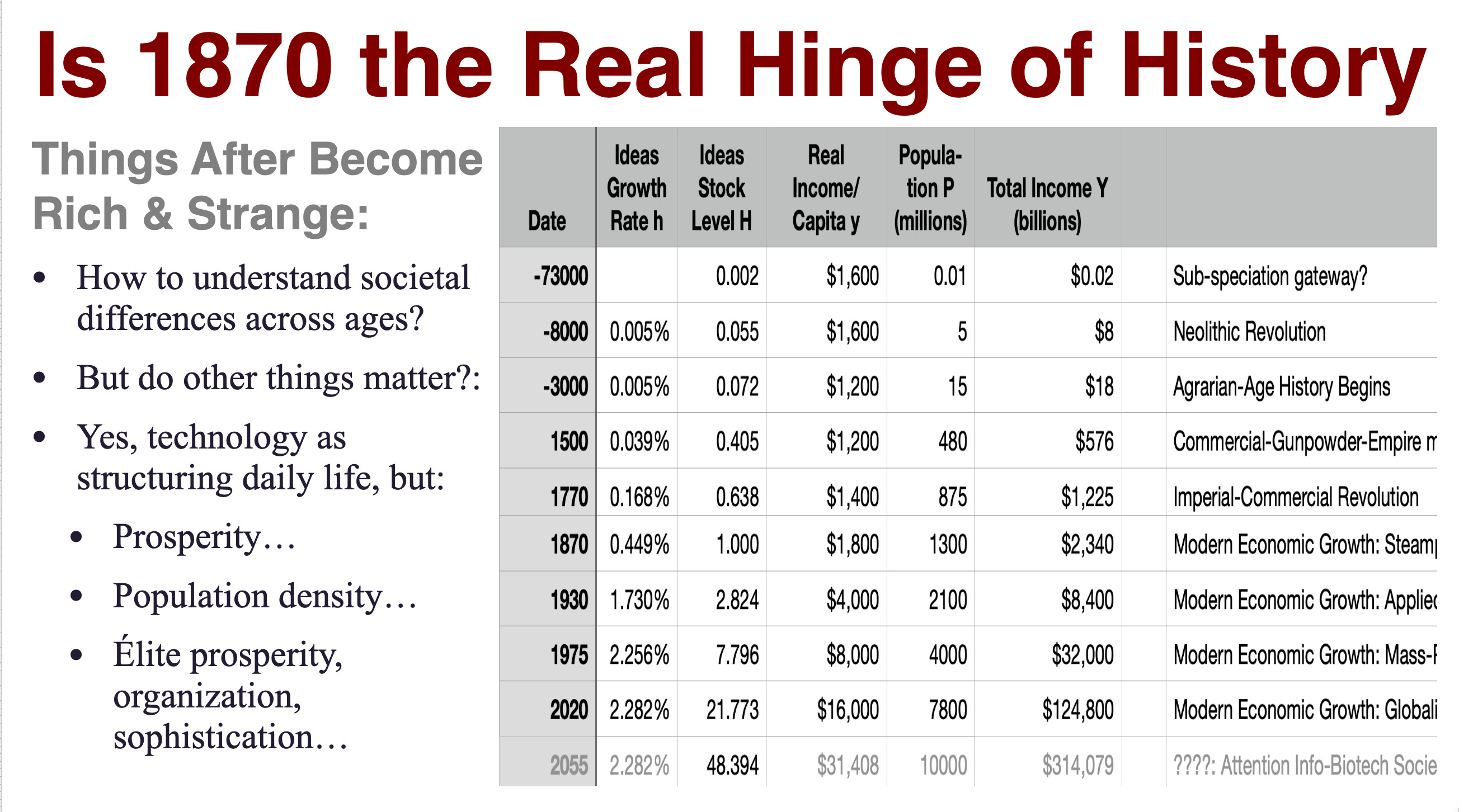
We have knowledge about human population and prosperity today: total world gross product of $130 trillion a year, a human population of 8 billion, and thus an average—but extraordinarily unequally distributed—income per capita of $16,000 per year.
We have guesses about human populations earlier, informed guesses but guesses. And we have guesses about prosperity—or rather its lack—in the pre-1500 and before world, largely Malthusian as it was, back in the days when the overwhelming bulk of the people were working class between 30 and 80% of working class resources had to be spent for bare necessities. By “bare necessities” I mean enough shelter that you don’t spend two hours a day worrying about how wet you are, enough clothing you don’t spend three hours a day worrying about how cold you are, plus your 2000 calories a day so you don’t spend four hours a day unable to think about anything other than how hungry you are; the world in which the typical woman undergoes eight pregnancies, yet population growth averages 2.5% per generation—so that those eight pregnancies yield only 2.05 people who themselves survive to reproduce, weith rates of pre-birth, stillbirth, miscarriage, and then infant and child that horrify us.
The world as a whole is much, much better off today than it was back in the day, in terms of our ability to command nature and to coöperatively and productively organize ourselves. Less than 5% of us today who have a standard of living within shouting distance of what was the typical working class standard of living back before 1500. Even those 400 million have access to modern public health, which has driven infant mortality down to what earlier societies would have regarded as absolutely god-blessed levels. Those 400 million also have access to the village cell phone and the knowledge it can transmit.
We are today so much richer than people were in 1500 and before. But how much? What happens when we quantify this?
It turns out that it is surprisingly difficult to make solid the quantification of how much richer we are than people were in the past. I like to think of this in the context of James I and VI and The Scottish Play—Macbeth—that he semi-commissioned.
Suppose you want to watch MacBeth in your own house, or in your hotel room, tonight. No problem. You have a choice of 20 versions. You might get dinged for $3.99, the same share of average income today $0.20 back then would have been. You might not—it might only cost you pennies for electricity.
Suppose you want to watch MacBeth in your own house in the year 1606. Well, you had better:
be named James Stuart.
be the principal occupant of Whitehall Palace.
have $5,000 of today’s values of loose coin to finance it, even given the very low real wage levels back then.
have Shakespeare’s Company of Actors on retainer
have thought of it a month ago so that The Kings’ Men Players would have time to put it in repertory.
In either case you have the experience of watching MacBeth—of having the experience that evokes pity and terror and that both entertains and informs, in a way that rich people in earlier civilizations were willing to pay a fortune for. But for us it costs 1/40000 as much. And there is an enormous gain in flexibility because you did not have to plan to do this a month beforehand.
On the other hand, if I wanted to watch a professional live theatrical performance of MacBeth, it would cost me $100. You can bet that there were 50 or so people crowding into Whitehall Palace when Shakespeare’s company put on MacBeth, even in a private show for King James I and VI of England and Scotland. From that perspective, the real price of watching Macbeth live has not in fact declined. Besides, they got to see Shakespeare in person.
The first of these points suggests that standard calculations are a massive understatement. They say that we today are, maybe,13 times as rich as humanity was on average back before 1500. But buy there has since 1606 a 40,000-fold fall in the real price of getting all pity and terror and catharsis and entertainment and insight into the human condition you get from MacBeth, and you have to conclude that any accurate quantitative metric would show a difference much more than 13-fold.
But the second suggests, to the extent that it leads to the conclusion that things are less important while relationships between people are key, that the differences between us and them are not, in fact, worth so much.
I am on the side of the first. But I see these as knotty problems with no good and solid resolutions. Personally, I think this Gordian Knot can be cut only if I make precise distinctions between wealth, utility, and eudaimonia that economists are the most ill-equipped people in the world to ever possibly make. So what I really want to do is to throw questions of the proper measurement of economic growth questions over the wall for you to deal with.
However, for the purpose of this talk, I take the economists’ numbers seriously. And I also take seriously the idea that perhaps a sufficient difference in quantity has a difference of quality of its own.
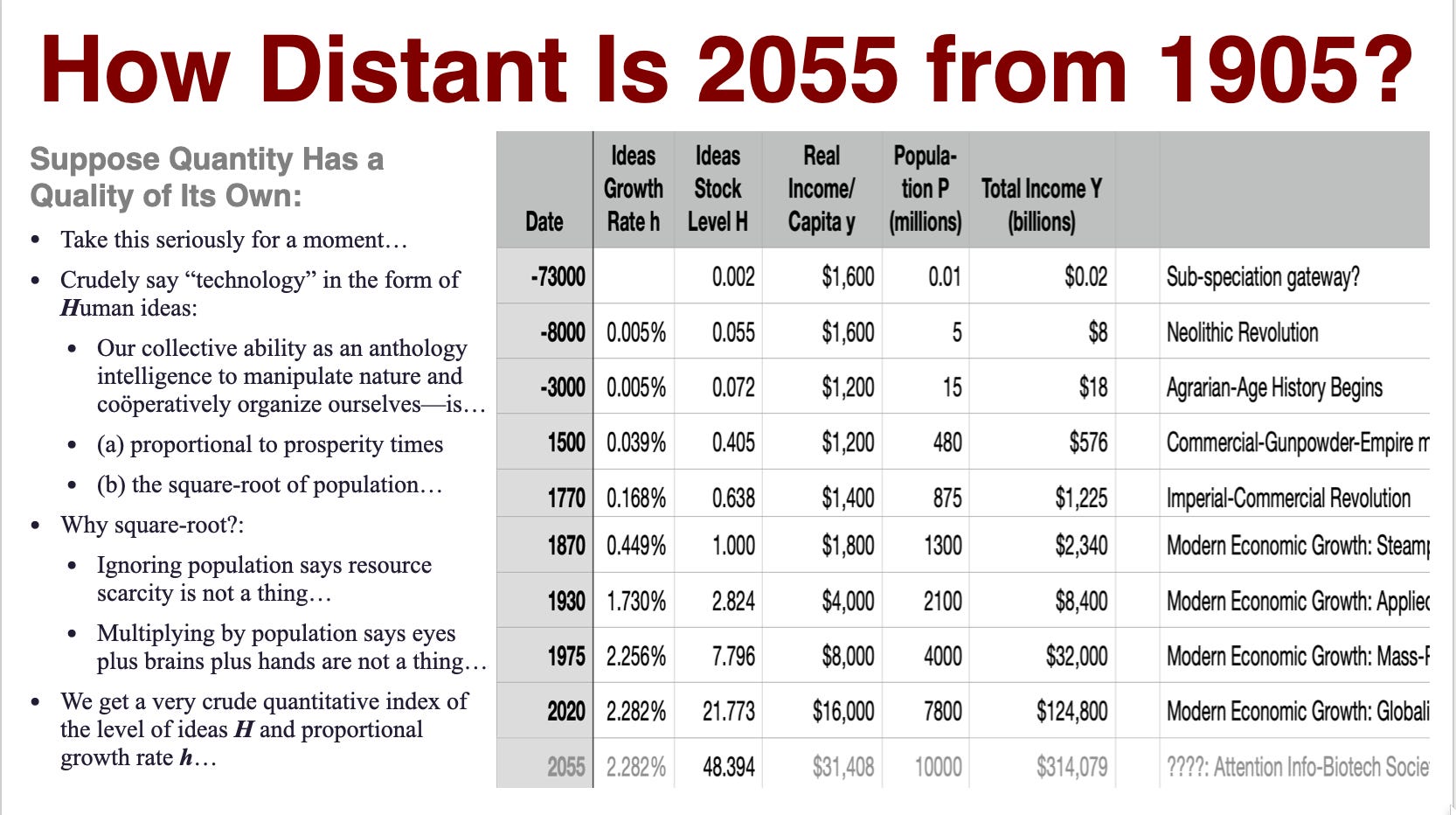
So take our numbers on human population and human prosperity. Use them to construct a crude quantitative index of human technology—the value of the stock of ideas deployed across the human race with respect to our ability as an anthology intelligence to manipulate nature to our purposes and productively and coöperatively organize ourselves to pursue our goals.
Let me assert, uncontroversially, that this quantitative index should be proportional to our prosperity in terms of valuable things we can create and utilize: that is just a normalization.
Let me assert, more controversially, that this quantitative index should be prosperity multiplied by the the square root of the human population. Why the square root? If we ignore population entirely and just say technology is proportional to prosperity, we are saying that resource scarcity is not a thing—that it requires no greater level of human competence and command over nature and ability to organize to support our 8 billion people at our current level of prosperity than it would to support 400 million people. That cannot be right. Resource scarcity is a thing.
On the other hand, taking technology to be equal to multiplying prosperity by population implicitly says that eyes plus brains plus hands are not a thing, that the only thing that is valuable is the ideas and the brains of humanity as an anthology intelligence and not individual workers. That also cannot be right. Individual human productivity is a thing.
Square root is a compromise in the middle. And if you have a better idea I would love to adopt it as an alternative to what we have.
So we get a very crude quantitative index, which I call big H, of the level of the value of the stock of Human ideas deployed across the world. And we also get this proportional growth rate, little h, of our technology. I propose to take this seriously.
When we take this seriously, we see the past really is another country, and a very different country. It is so much more another country that the differences between then and now are ones so great that Silicon Valley TechBros currently raving about forthcoming “singularities” when they will have succeeded in building and then worshipping machines made of stone that think with AGI would have a difficult time wrapping their heads around their magnitude.
We see a past of everywhere before 1500—and note, in many parts of the world long after that—characterized by three salient features:
Malthusian dire poverty.
Extremely low technology relative to us.
Exceedingly slow rates of growth of technology relative to us.
We see Malthusian dire poverty. Our guesses set typical world incomes before 1500 during the long Agrarian Age at around $1200 per capita per year. At that level of poverty the risks, unless you are part of an élite, that you will go very hungry sometime next week and die of famine sometime in the next decade are not things you dare ignore. You see the typical woman among you having eight pregnancies, yet raising only 2.05 children on average to survive to reproduce in the next generation. You see the typical woman who happens to survive to late middle age as having one chance in three of not having a surviving son—which means that, in heavily patriarchal societies, she needs a son-in-law who really likes her to an unusual degree, or she may well face very significant sociological trouble. Hence where there are extra resources families are pushed to try to have more children, to try to buy more insurance against her being left alone in a patriarchal society.
We see extraordinarily low levels of technology compared to our standards. Compared to our H(today) = 23 and H(1870) = 1, we have H(1500) = 0.4 and H(-3000) = 0.07. The powers of the anthology intelligence that is humanity are, in comparison, truly godlike. Óðinn had a spear, Gungnir, unstoppable, fatal, and inerrant; and had two ravens, Huginn and Muninn, who whispered in his ear the news from places far out of his sight. Þórr had a magic hammer, Mjǫllnir, that struck anywhere within his eyesight with the force of a lightning bolt, and then returned to his hand so he could strike with it again. (He also had a two-wheeled cart drawn by two magic self-reviving goats, Tanngnjóstr and Tanngrisnir, who could provide a feast one night and yet be ready to pull the cart the following morning; but the cart was so underlubricated that the noises it made as it bumped along the skyways were the thunder.) Compared to what we can and do accomplish for good and for ill, they were helpless and hapless.
We also see extremely slow technological progress by our standards. From the invention of writing and bronze around -3000 to the 1500 start of the transition from the Agrarian Age to Commercial-Imperial Society, the average annual proportional rate of increase h of the technology of humanity as an anthology intelligence was only 0.04% per year: 50% per millennium. We see more proportional technological change than that each and every generation, and have since 1870 or so. That is also an extraordinary difference.
III. How Can the Experiences of Past Societies of Domination Be Relevant for Us?
From spears to steam engines: what in the experience of a society based on exploitation can illuminate the workings of a society based on technology? The interplay of power, technology, & ideology in shaping the past makes using pre-steam engine history as a potential source of illumination particularly hazardous.
The past was very different from us in another dimension as well.
Suppose under conditions of dire Malthusian poverty you wanted to have enough for yourself and your family. You could try to invent a better mousetrap, make it, sell it, become a very productive person, and become a rich possessor of great resources as the world beat a path to your door. That was very hard back then. And what happened if you succeeded? Well, then you found yourself a very soft and attractive target for those who had chosen a different strategy.
What was that different strategy? Who were those people?
The different strategy was to focus not on becoming skilled producers of commodities but skilled practitioners of coërcive violence. Then they would say to you: give us a third of your crops, a third of your craftwork, or else. And be grateful that we leave you two-thirds if you keep your head down because you are our sheep and we want to shear you again in a year. Be grateful we do not take it all now, and that we leave you and your family alive.
These people were the gang: thugs-with-spears (and later thugs-with-gunpowder-weapons), their bosses, plus their tame accountants, propagandists, and bureaucrats, and exceptionally skilled artisans of items of war and peace who caught their eye. Looking out at you, audience, I think that had you lived in that age you, like, me would be frantically trying to sign up as one of those tame accountants, propagandists, or bureaucrats, for few among us are sufficiently gym rat-like to have done well marching the Spanish Road in the Tercio de Flandes to join the army of Alessandro di Parma. Joining that gang that runs the society of domination taking one-third of the crop and one-third of the crafts by force and fraud is about the only way to get enough.
My guess is that the relative contrast in benefits between joining the élite gang on the one hand and becoming more productive on the other is one of the things at the root of the discrepancy between the rate of technological growth now and that of previous civilizations. In all other civilizational accomplishments besides the growth of technological knowledge productive for the making of necessities and conveniences they are our equals: their art, their literature, their politics, and even their rate of advance of technologies of domination and war. But not the rate of growth of technologies of win-win productivity and coöperation.
There are, however, I guess, other reasons for why we are so blessed in terms of our rate of advance of technology.
One that I guess is absolutely key is this: The members of the élite gang neither toiled nor span, they reaped where they did not so, and they gathered where they did not scatter. But they then had to live with themselves.
We all are, as East African Plains Apes (or perhaps as cultural descendants of the Yamnaya), very sociable creatures who create and maintain our networks of solidarity via practicing gift-exchange. We want all such relationships to wind up with each of us feeling profoundly indebted to the other for all we have received. We profoundly dislike feeling that the relationship is unbalanced—that someone who should be our gift-friend has always taken, or that we have always taken from someone who should be our gift-friend. Hence ideology is needed as a psychological support—both for the victims and perpetrators of the force-and-fraud exploitation schemes of the élite gangs that run societies of domination. Sheep who are in some way soothed are easier to shear. Bandits—mobile or stationary, foreigners or local notables, individuals or state functionaries—sleep easier when they can reassure themselves at night that their victims had it coming.
Hence Aristotélēs’s declaration that while a more detailed and minute examination of the various forms of “acquisition”:
might be useful for practical purposes… to dwell long on them would be in poor taste…
Hence Seneca’s declaration, contra Posidonios of Rhodios, that:
Mechanical inventions were [not] the invention of wise men… [but] by some man whose mind was nimble and keen, but not great or exalted… [with] a bent body and… a mind whose gaze is upon the ground…
Systematic focus by those who could direct civilizational energies on technological advance was thus heavily discouraged by the psychological need for the élite to sharply degrade those from whom it took. Productive activities that did not involve the creation of necessities and conveniences that made up the plunder of the gang—painting, sculpture, architecture, literature, fine dining—these were proper ornaments for a civilization, and acceptable occupations and concerns. Public works of peace, administration, and war—these were also great. And this discouragement did not mean that commerce and industry could not flourish to some degree. Especially under the ægis of a pax imperia, commerce and the division of labor with their additions to productivity could indeed advance, in what John A. Goldstone calls an “efflorescence”, as you could produce and trade without worrying about disorganized roving and stationary bandits, but only had to keep the Big Bandit viewing you as a valuable sheep.
But there was a definite limit to how much such a civilization could progress in the way of advancing technology if it spent much energy degrading the idea that the pieces of the productive and distributive economy other than how to boss your slaves were proper concerns for a gentleman.
This character of past civilizations raises substantial problems if we attempt to appropriate their history and use it as a source of useful analogies for us and for our successors, living as we do not in societies of domination with near-static technology under conditions of dire Malthusian poverty, but rather under conditions of modern rapid technological and economic growth. The gulf between us and them is thus made remarkably large by three factors. The first is that they were societies of domination. The second is that because their technology was near-stagnant their institutions were near-static. The third is that their level of technology—of arranging things to make nature dance and humans pull together coöperatively—was so much lower than ours. All of these are stumbling blocks.
First, their status as societies of domination ruled by an élite gang. What useful analogies for 2055 can we draw from historical episodes springing from a culture where it is assumed without question that somebody with a bent back and their gaze on the ground might be clever—and probably in a cheating, dishonest, ridiculous way—but cannot be great, exalted, or indeed have any rights at all that an aristocrat need respect? What useful analogies can come from a culture where the belief that slaves should be grateful to be slaves—for, except for the accidents and injustices of history and fortune, slaves are slaves by nature—goes without question? For that was, overwhelmingly, the attitude of the élite gang.
This aspect of the gulf does indeed make it difficult and hazardous. But it does not make it impossible. The total membership of the gang of the upper class and the prosperous middle class can be large. It thus has its own internal arrangements for how it organizes itself and does its business. Yes, its business is primarily that of taking from others and then dividing the spoils. But taking is a form of “production” from the standpoint of the élite gang. Distribution is distribution. And arranging coöperation is arranging coöperation.
I think we can learn a lot in terms of useful analogies from the history of what went on within past élites. And, indeed, that is nearly all of past history that we have, at least of past written as opposed to past archeological history.
Within the élite, the ways they run their internal affairs are either better or worse, easier or harder, more vicious or less vicious.
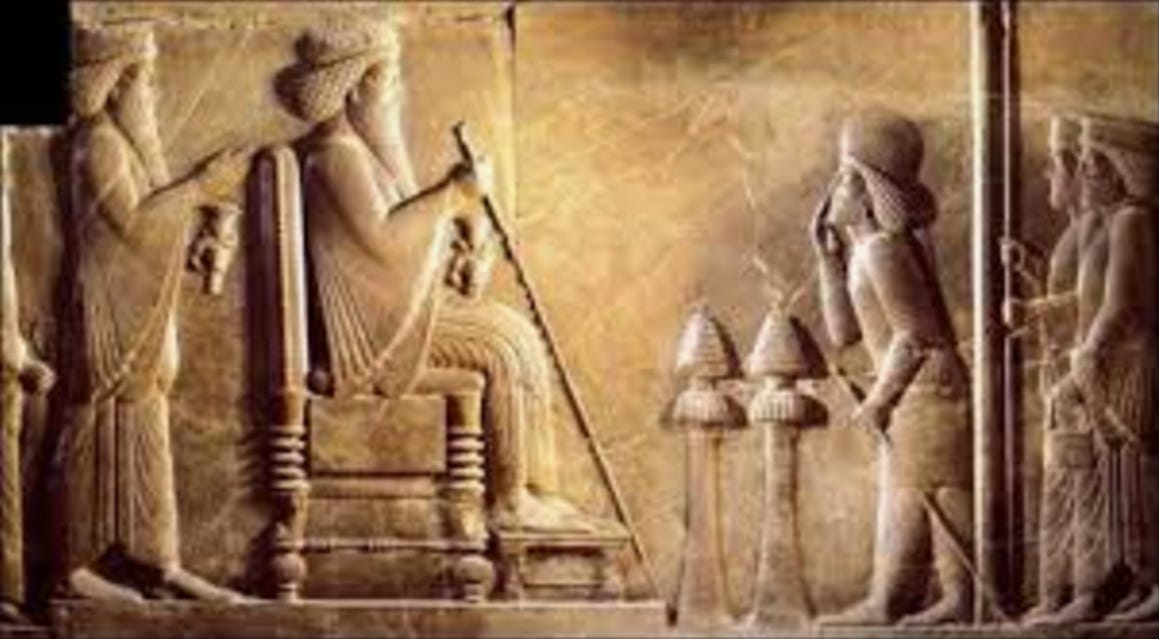
Suppose, in one ancient society, you cross Shahanshah Khashayarsha of the Hakhamanishiya, of the Parsa—Basileus Basileōn Xerxes the Achæmenid, of the Persians—the King of Kings “Ruler of Heroes” of the Loyal-Spirit clan, of the Righteous People—by requesting that he exempt not your youngest but your eldest from the army levy. You might then find that your eldest son has been cut in two. You might find then that half of him has been placed on the left and half of them placed on the right side of the road. And Shahanshah Khashayarsha then further accomplished his purposes by making Putiya of Sfarda then watch the army march between the two halves of his dead son.
Alternatively, in another ancient society, you might have in some way crossed the politician-boss Anytos. He might then have thought to intimidate you by having Meilētos and Lykon prosecute you for impiety. You might then have expressed your contempt for the jury that found you guilty and the prosecution that has asked for the death penalty for your “crime”. You might have proposed, as an alternative punishment, that you be given the high honor free meals for life in the Prytaneîon, sitting alongside all of the city’s olympic-game champions. The jury, choosing between the two proposed punishments, might then have said “death”. But even after that you would have been allowed and strongly encouraged to flee to Thessaly before they come around with the deadly hemlock for you to drink. And they might then be taken somewhat aback at your actions: that Sokrates chose to die at the age of 70 in order to make points about justice and fairness and reason.
The land empire run by the Parsa Hakhsamanishya clan and the seaborne empire run as the demokratia of the Athenai handled their dissenters in very different ways. Comparing and contrasting their intra-élite human affairs with each other and with ours could be a very fruitful source of historical examples and social theories relevant to us and to 2055. But always remember that the élite society’s internal workings cannot but be profoundly affected by the fact that it is, at bottom, an extortion gang ruling over a mass population of slaves or near-slaves. Aristoteles thought that it would always be such—that civilization was only possible when there was a class that had enough, and thus had enough leisure to think, but that was impossible unless in some way we could have the miracles in which:
every instrument, at command, or from a preconception of its master’s will, could accomplish its work (as the story goes of the [robot blacksmith] statues of Daeidalos; or what the poet tells us of the [self-propelled catering-cart] tripods of Hephaistos, “that they moved of their own accord into the assembly of the gods”), the shuttle would then weave, and the lyre play of itself; nor [then] would the architect want servants, or the master slaves…
But we do have such miracles. And our possibilities for the self organization of humanity as an anthology intelligence in our day should profit thereby.
The second stumbling block to using theory based on analogies from the distant past is that back in their day because their technology was near-stagnant their institutions were near-static.
For us, Schumpeterian creative destruction is a thing: every generation since 1870 human technological competence has more than doubled. And the “destruction” aspect is very real: every generation tasks, jobs, occupations and professions, livelihoods, industries, sectors, communities, and regions have found themselves in its bullseye. This has been the case since late-1700s England. There and then the “poor stockingers” found that their skilled profession was no longer needed because of improvements in knitting technology, and that even though they had Acts of Parliament setting out for them and their employers their standard conditions of work and pay, those Acts could and would be repealed or ignored because there was enough money to be made by allowing the forward march of knitting technology. The march of technology had given to them 200 years ago, creating the stocking-frame that allowed for a large enough fall in the price of stockings for there to be a mammoth boost in demand as they became middle-class conveniences rather than pure upper-class luxuries. But in the late 1700s the march of technology taketh away. And General Ned Ludd could not help them.
This type of technocrisis was not something any society before ours ever had to deal with. And even where Schumpeterian creative-destruction is overwhelmingly creative, it is still change. And change has to be managed—again, something with no close analogue before. No history of any time before the invention lf the steam engine can help us here: no useful analogies can be found. As the underlying techno-economic foundational hardware of their societies changed, they did indeed have to rewrite the socio-econo-political-cultural societal software of human interaction patterns that runs on top of the hardware so that things would not crash, or at least not crash often. But this was a process of slow, if bumpy, adjustment. Our quantitative index H of technological prowess is indeed 2.5 times as large in the year -500 of Classical Antiquity as it had been in the year -3000 at the dawn of the Bronze-and-Writing Age, and still 2.5 times higher in the year 1500 at the dawn of the Imperial-Commercial Age. But the first took 2500 years and the second 2000. We cover the same amount of apparent transformation in 40 years. and then we do it again. General Ned Ludd could not help the poor stockinger. And no past historical examples can help us deal with the types of problems that brought him to the forefront.
The third stumbling block is that the pre-Modern Economic Growth level of technology—of arranging things to make nature dance and humans pull together coöperatively—was so absurdly much lower than ours. Most of what we call “work” would be close to incomprehensible to people in previous centuries. And many of the institutional pattern of exchange and direction would leave them similarly flummoxed.
As for myself, I am flummoxed by the extraordinary differences in prosperity and in the pace of technological progress. I am thus truly convinced that 1870 is the real hinge of history. After it, from the perspective of all previous history, things become truly rich and strange.
History offers useful analogies, and theory distills their lessons, but are today’s classrooms addressing tomorrow’s realities? It is a great challenge to try to teach students how to understand and maneuver in what will be their world in the future. So please tell me what in the way of theory I should assign to deal with what they will face in the human societal world in 2055
References:
Aristoteles. 1946 [-86]. Politics. Ed. Andronicos of Rhodios. Trans. Ernest Barker. Oxford: Clarendon Press. <https://archive.org/details/in.ernet.dli.2015.50166/>.
Bacon, Francis. [1627]. The New Atlantis. New York: W.J. Black. <https://archive.org/details/essaysnewatlanti00baco>.
Davies, Dan. 2023. “The Valve Amplifier of History”. Back of Mind (blog), May 3. <https://backofmind.substack.com/p/the-valve-amplifier-of-history>.
DeLong, J. Bradford. 2024. “The Poor Stockinger”. In What Rough Beast?: The 21st-Century World in Political-Economy Polycrisis. Brad DeLong’s Grasping Reality. July 17. <https://braddelong.substack.com/p/21-the-poor-stockinger-what-rough>.
Gerstle, Gary. 2022. The Rise and Fall of the Neoliberal Order: America and the World in the Free Market Era. New York: Oxford University Press. <https://archive.org/details/rise-fall-neoliberal-order>.
Herodotos. 1858 [-420]. The History of Herodotus. Trans. George Rawlinson. London: John Murray. <https://archive.org/details/historiesofherod00hero>.
Mauss, Marcel. 1954. The Gift: Forms & Functions of Exchange in Archaic Societies. Trans. Ian Cunnison. London: Cohen & West. <https://archive.org/details/giftformsfunctio00maus>.
Platon. 1897. Apology, Crito, & Phaedo of Sokrates. Trans. Henry Cary. Philadelphia: David McKay. <https://archive.org/details/platosapologycr00broogoog>.
Seneca Minor, L. Annæus. 1917 [64]. “On the Part Played by Philosophy in the Progress of Man”. Moral Letters to Lucilius,. Trans. Richard Gummere. London: William Heinemann. 90. <https://archive.org/details/adluciliumepistu01seneuoft>.
Thoukydides. -431 [1910]. The History of the Peloponnesian War. Trans. Richard Crawley. London: J.M. Dent & Sons, 1910. <https://archive.org/details/thucydidestrans00thucgoog>.
If reading this gets you Value Above Replacement, then become a free subscriber to this newsletter. And forward it! And if your VAR from this newsletter is in the three digits or more each year, please become a paid subscriber! I am trying to make you readers—and myself—smarter. Please tell me if I succeed, or how I fail…