
Theories of Economic History IV: Agrarian-Age Societies-of-Domination :: Roughly-Edited Transcript:
J. Bradford DeLong brad.delong@gmail.com :: 2026-04-28 :: All Souls’ College, Oxford :: The 2026 Sir John Hicks Memorial Lecture in Economic History…
Link to Video:
<https://braddelong.substack.com/p/theories-of-economic-history-zoom>
And let me start going through, making the transcript less incoherent, less cryptic and compressed, and more sensible…
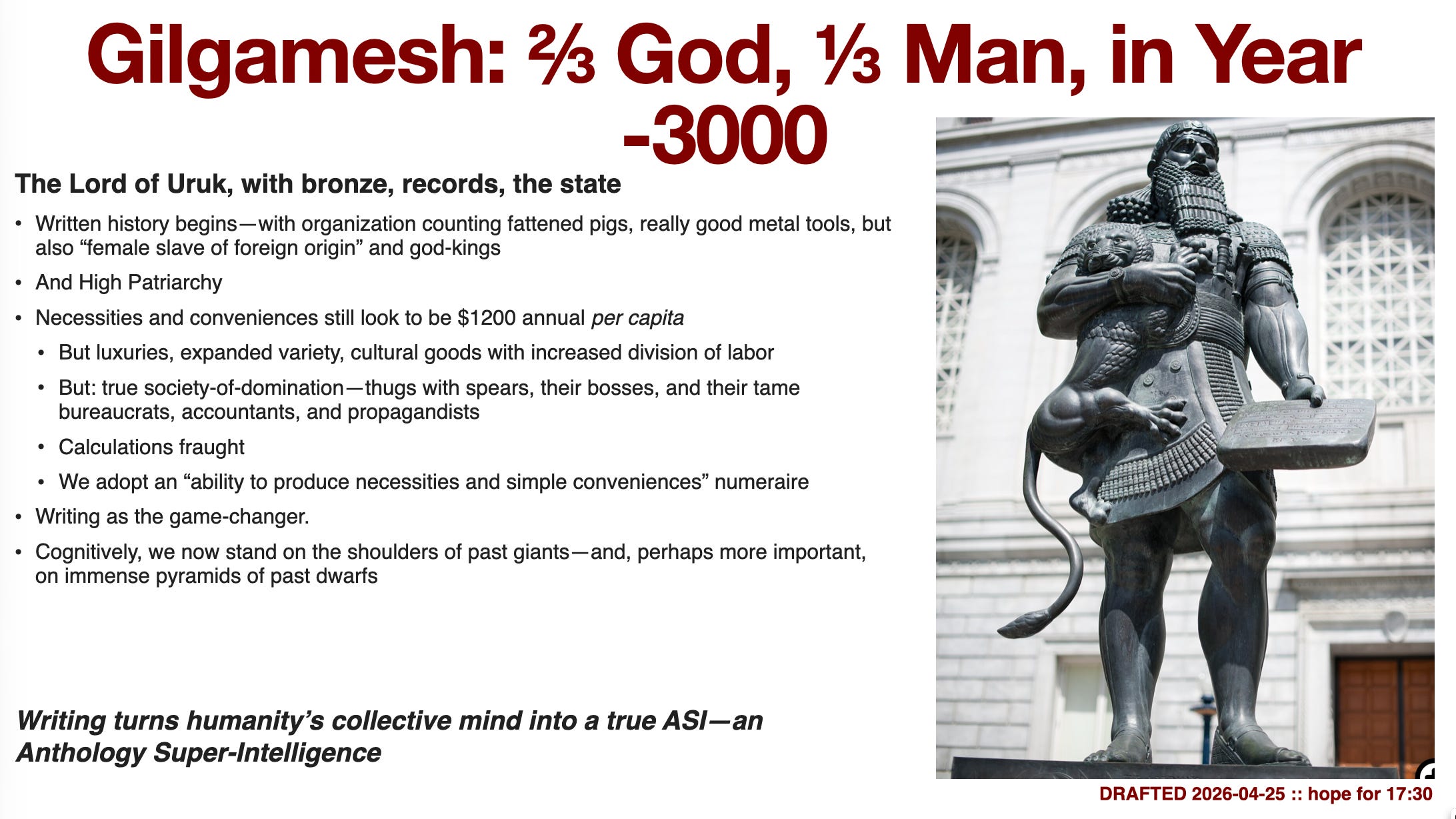
The year -3000 is a moment that sees a lot of key technological advances happen. We get bronze: combining copper with tin to produce something hard and malleable and extremely easy to make with weak, cool fires. A bronze-tipped hoe is ten times better than a digging stick if you’re a farmer. We get the state. We get records. get the state. Even if all that human civilization does is allow the organization of a tin trade and thus of bronze production, that in itself is an enormous gift from ourselves to each of us. We get writing.
With writing, we no longer a general intelligence: we are a true superintelligence. We now bind our ideas, what we think and know, not just to the local band and not just to what one person in the band learns and remembers. We speak across space, across the whole world, and across time. Now we have 5,000 years of human history compiled, assembled, compressed—highly compressed, it is true, .but those things thought worth remembering from those past 5,000 years, we do indeed remember.
One thing that the human collective mind ASI—Anthology Super-Intelligence—remembers from 5000 years ago is Gilgamesh, the mythical King of Uruk. The year -3000 was also Gilgamesh’s moment. He searched for eternal life, failed, but returned to Uruk as a wiser and juster king. Did you know that he was 2/3 god and 1/3 man? The human mind ASI does. Or, at least, it remembers that it was what his tame and hired propagandists said.
And that is one reason that we were not terribly good at and not terribly focused on the recursive self-improvement process. That is one reason that the boosting of the level of technological competence and knowledge of the human ASI proceeded very slowly. Gilgamesh was, his propagandists said, King of Uruk by divine sanction. Do not rebel! Pay your taxes! Or else the gods will be angry at you.
The societies of the year -3000 were, perhaps it was then when they became, societies of domination. Much of the energy of the people who have the power to deploy society’s energy is spent figuring out how to become and how to organize a gang. Thugs with spears; their bosses; their tame accountants, propagandists, and bureaucrats—they take a third of the crop and a third of the crafts for themselves. Why bother? Why not just work and make your own stuff? Because in a Malthusian world of poverty and scarcity, joining the gang is pretty much the only way you can try to ensure that you have enough for yourself and your family.
What happens if you try the other path, try to become more productive? First of all, you then make yourself a very soft and attractive target for the gang to prey upon.
Yet there are upsides to “civilization”. Bronze tools are wonderful. Records and writing too. They genuinely add another, valuable dimension to human experience.
That does, however, make calculation of standards of living very fraught. We seed the level of production of necessities and conveniences. We see that people are, by and large, close to the bare-bones subsistence edge. We see exploitation. We see inequality. But we also see luxuries—commodities that do not contribute to reproductive fitness, but that people find useful and enjoyable. Civilization can and does produce luxuries and so improve the standard of living without summoning and triggering its further ensorcellment by the Devil of Malthus.
Moreover, even where just conveniences are concerned, the ability to produce a greater variety of conveniences is an unambiguous benefit. Avinash Dixit wrote down the simplest possible tractable model to think about markets that were not perfectly competitive. He came up with the following story: your wealth is the quantity of basic necessities you could produce, multiplied by the variety of the commodities you know how to produce. We should also multiply by lifespan. So while the $1200 necessities-and-simple-conveniences annual living standard of agrarian civilization that we guess at is only ¾ of what we guess to be the typical gatherer-hunter living standard, agrarian-age civilization was not really 25% poorer.
Plus there is another very important complication. Civilization greatly amplifies and multiplies that entire bundle of ideas, orientations, beliefs, stories, and stances toward the world that are the cultural commodities that we consume. They are truly, truly valuable to us. They are an important part of our lives. They shape how we regard ourselves, how we regard the world, and what we regard as a life well lived.
Consider, once again, the alien—sympathetic or unsympathetic—looking down at us, at this College of the Souls of All the Faithfully Departed. It would see us roaming around. It would see us assembling in places, and then dispersing again. It would see us staring at things like our phones and other screens, making repeated small motions with our hands. It would hear us making an awful lot of noises. It would see us hurridly eating things, and after chowing down dispersing again. And so we maintain homeostasis: nutrition in, energy used for motion and cognition— the 25% or so of calories burned that are our brains firing—out.
But there is a supervening layer: What we are doing here is that we are building our belief and knowledge system, enlarging and adjusting our cognitive powers to understand, manipulate, and organize nature and ourselves. Learning to be good front-end nodes in the great neural network that is the human collective mind ASI. Drawing on it to properly calibrate our actions. And—occasionally—contributing something worthwile to its data stores and firing patterns.
And there is still another supervening layer: My personal experience of Oxford is not unmediated experience coming in through my eyes and my ears. My sense experiences are mixed with and transformed by memories, and memories of things that never happened and never existed. I cannot react to Oxford without interpreting it through the lenses given to me by my past reading of David Lodge’s novel Small World (and Changing Places, and Nice Work), and of Dorothy L. Sayers’s Gaudy Night. Those novels structure and deepen my experience of the place and so make that experience profoundly different from what it would otherwise have been—even though there never was a Lord Peter Wimsey, a shell-shocked veteran of the Great War, who was a Balliol man, and not only was there never a Harriet Vane but there was never a Shrewsbury College either. acquiring and then utilizing our great powers to manipulate nature and also to organize ourselves into a cooperative and productive division of labor.
What place does all of this have in human wealth? The mind is its own place, and each of us lives inside their individual mind. But none of us is sovereign over it. Not even Marcus Aurelius could be a full stoic: his Meditations are in large part a record of his unconvincing attempts to convince himself that he could be one. And while Milton’s Satan certainly made a hell of heaven, he lied when he claimed to have a mind that could make a heaven of hell.
Calculations are fraught, and fragile.
I am going to adopt an “ability to produce necessities and simple conveniences” as my yardstick for wealth, as numeraire. But that is not a solution to the problem.
I am also going to ignore the fact that an awful lot of the knowledge we have is in fact composed of ideologies that the society of domination is using to keep the rest of us quiet—or, if we think we’re part of the gang, that we’re using to keep them quiet.
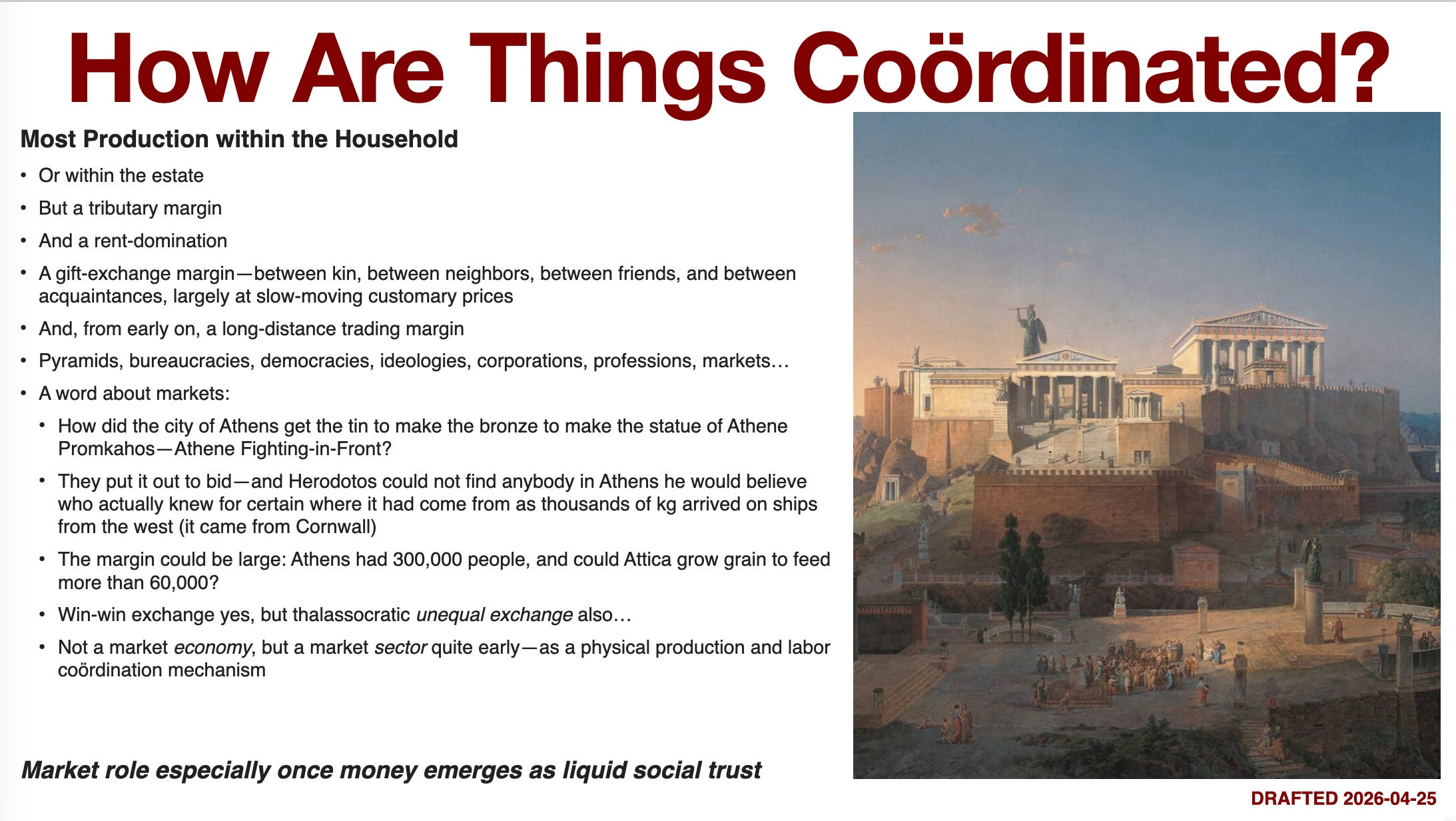
Writing really is one of the game changers. Successful maintenance of a fine and hence productive physical division of labor is a great deal of our wealth. Thus we need to focus not just on our very large cognitive division of labor—so much cultural-technological knowledge that each of us has only a teeny-weeny part of it—but also on the successful coordination of an increasingly finely divided and hence productive physical division of labor. Consider the modes, cultures, and institutions we have for organizing ourselves, with writing a key part of many such.
It is true that most production is within the household (or within the kind of estate, if you have a large estate with lots of slavery). Yes, it is true that there is rent. And it is true that there is domination. But a lot of the productive division of labor is mediated by gift-exchange, originally between kin, between neighbors, between friends, between acquaintances—maybe moving at slow-moving customary prices. Moreover, long-distance trade of preciosities has are very long history. All these are mediated by a bunch of different institutions: pyramids of feudal pyramids of loyalty, bureaucracies, democracies, ideologies, corporations, professions, markets. Plus there is a difference between formal institutions and on the ground functioning: even the most effective organization that is the arena of command in theory is, in reality, a mixture of market, barter, blat, and plan, with this last understood as the organization’s primary purposes and people’s allegiance to it.
A word about markets: On the alide behind my right shoulder, we have an idealized depiction of what the Akropolis, the high city, of Athens looked like in its prime, in its glory. One thing that is there in the picture but of which there is no trace today in our reality is the giant statue of Athene Promakhos, Athene fighting in front. It appears to have been taken off to Constantinople, and then destroyed by Latin crusaders in 1204 when they sacked the city. The statue stood at the top there. The sun glittered off her spear, and was the first thing you saw as you approached Athens by sea.
The stutude was paid for by money embezzled,—there is no other word—by Perikles from the treasury of the Delian League. The Delian League was formed to mobilize a navy to push the Persian navy out of the Aegean. City-states were supposed to contribute ships. Over time, a great number of city-states decided that they would rather contribute money, and let Athens worry about the logistics of turning money into ships. And then Perikles began taking the money. City-states complained. Perikles said: shut up. As long as the fleet protects you from the Persians, it is not your business what we do with the money. Thus the Delian League became the Athenian Imperial Thalassocracy, a maritime seaborne empire of domination, using unequal exchange to make sure terms of trade between Athens’s pottery and wine and other commodities remained favorable.
So Athens acquired the money. But how do you actually build a bronze statue? You need a lot of tin. How did the city of Athens get the tin to make the bronze to make the statue? There is no tin in Attica.
Well, they simply put it out to bid: we will pay a good price for tin that lands at the Peiraieus. Herodotus, who was wandering around then, could not find anyone in Athens he trusted and would believe when they told their stories about where the tin actually came from. (We are now confident it came from Cornwall. Clearly the market as an institution knew that, and knew how to get the tin from Cornwall to Athens, even though that piece of knowledge was not contained in any single human brain.)
The market could work wonders. Athens had 300,000 or so people, and yet Attica at that time could not grow enough grain for more than 60,000 or so.
The lesson? Very early we have, not a market economy as a whole, but at least some economies that have very powerful market sectors quite early on.
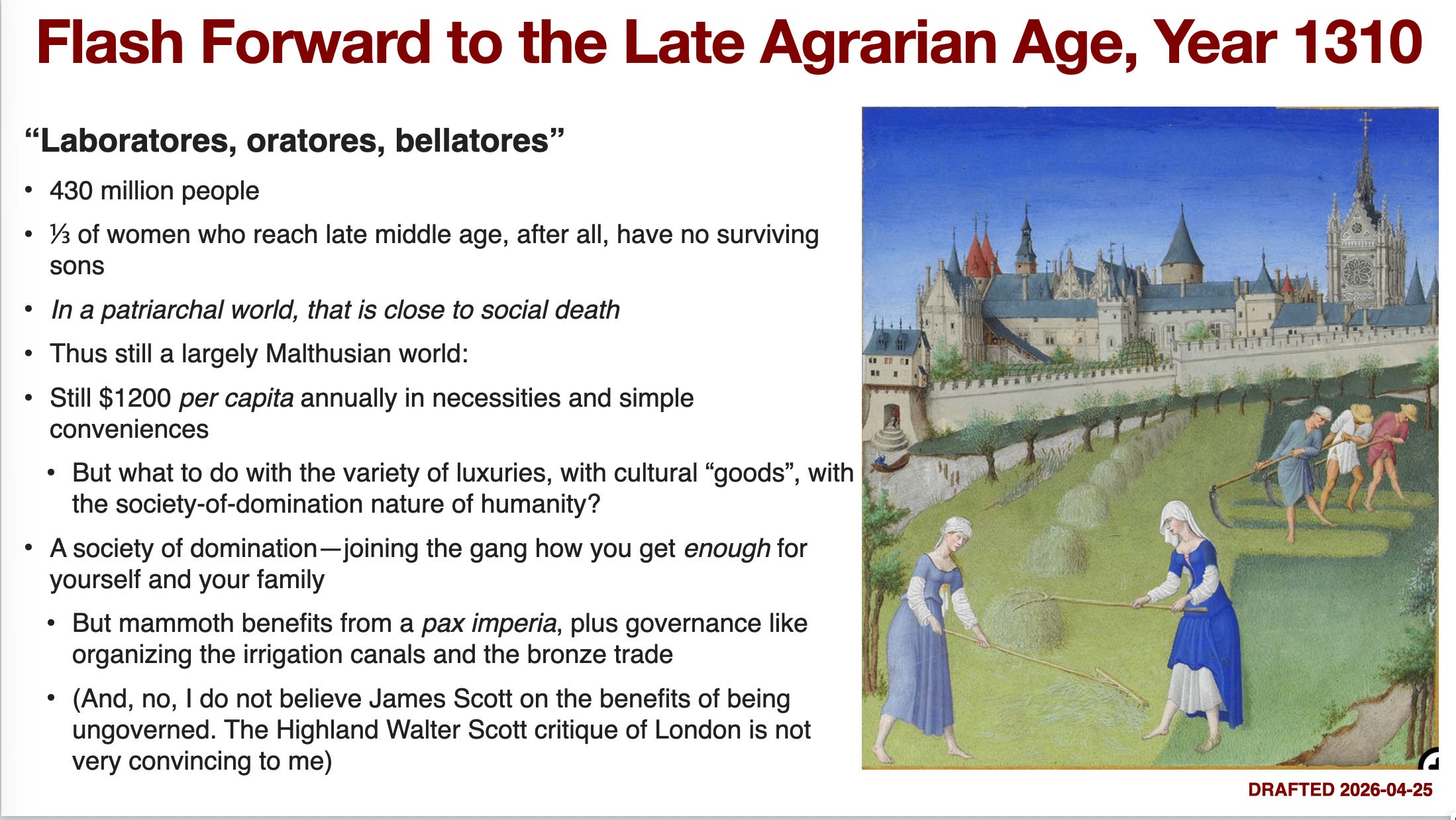
Now flash forward another 4,500 years or so to the late agrarian age. Stop in the year 1310: a world of workers, pray-ers, and warriors. By now there are 430 million people around the world. We still, though, are ensorcelled by the Devil of Malthus. Population is still growing very, very slowly on average. That means that those women who live long enough to reach late middle age—with something like a 1‑in‑7 total lifetime childbed risk plus more from adult diseases and accidents—will find that 1/3 of them have then no surviving son. In a patriarchal world, that situation is closely akin to one of social death.
Malthusian pressures do not just arise from the joy of making love and the inadequacy of pre-industrial modes of contraception. There is also the fact of this one-in-three widow-social-powerlessness risk. Thus whenever a couple has resources, one important thing they can do with them is try to have another kid to diminish this risk.
Thus in 1310 we are still ensorcelled by the Devil of Malthus. Thus we are still at close to $1,200 per capita annually in necessities and simple conveniences. There will be somewhat of a local escape in the post-Black Death period when first the depopulation of the plague and then the coming of the western European marriage pattern have their effects. There will be more of an escape in the 1700s, when decreasing patriarchy in the form of changing French property division customs makes it not such a resource disaster for the family to have only daughters. But in 1310 the ensorcellment is still unweakened.
Plus we still have the society‑of‑domination elements to make human flourishing lower than one would think from the $1,200 benchmark. On the ohter hand, wealth is boosted by increasing variety, increasing luxuries, and increasing cultural goods. And the power to actually apply organizational knowledge is boosted by public order and good government. (And, no, I do not believe James Scott on the benefits of being ungoverned. His critique of the state is the critique always made by the Scots, whether they are named James or Walter. it is the Highland Legend, the Highland critique of London society. It is not very convincing to me. I think Thomas Hobbes had it more right.)
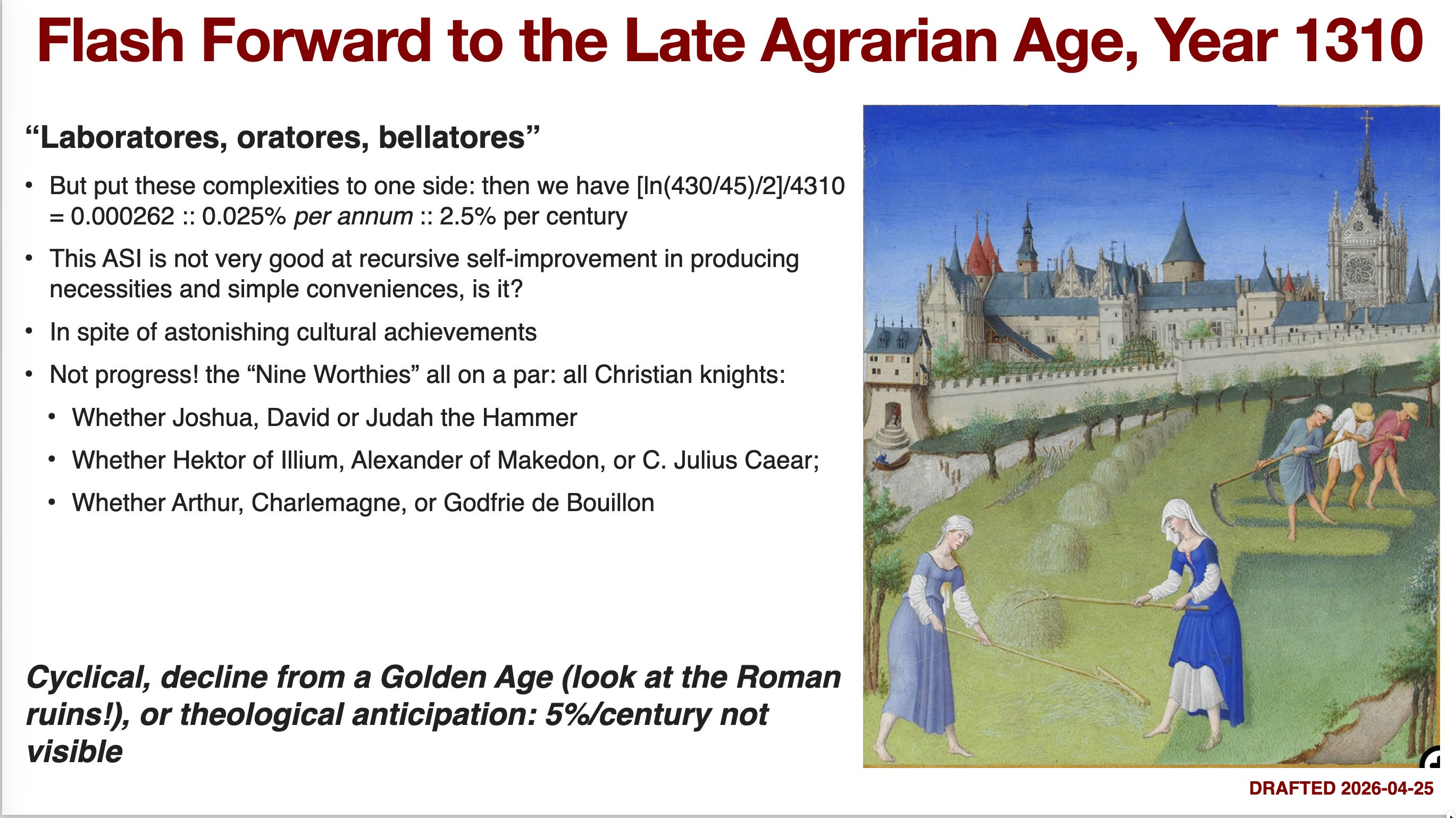
From -3000 to 1310 was the long Agrarian Age. How was the recursive self‑improvement of the human collective mind’s ASI doing over these four-plus millennia? By 1310 the human population was, perhaps, at 430 million, up from 45 million in -3000—a tenfold increase. Productivity levels were still, perhaps, at their farmer-Malthusian $1200 per capita per year. Modulus the disutility of being under the thumb of a more sophisticated society of domination. Modulus the extra utility of luxuries and of all the cultural flourishings since -3000 that had been added to the then-current collective human patrimony. And so we have:
[ln(430/45)/2]/4310 = 0.000262 = 0.026%/year
2.6% per century.
It is not progress at recursive self-improvement that strikes me here.
Such a slow average pace of technological improvement went along with a general belief, even among relatively careful observers, that society was, in the main, static. Consider the Nine Worthies of medieval Europe: the nine most admired chivalric heroes in the stories told to the warrior upper class. Traditionally they came in three groups of three:
The three Jews: Joshua, David, Judah “the Hammer” Maccabee.
The three pagans: Hektor of Troy; Alexander the Great of Makedon; Julius Caesar
The three christians: King Arthur of Britain; Emperor Charlemagne of Frankish Rome; and King Godfrey of Bouillon and of the Latin Kingdom of Jerusalem.
All nine of these are portrayed as Christian knights of medieval western Europe. This is part of viewing history as cyclical, or perhaps as a decline from a Golden Age—look at the Roman ruins—with any possibility of a better future confined to the expectation of some theological rescue. A better world will come from heaven, not be made here on earth by any idea of progress,
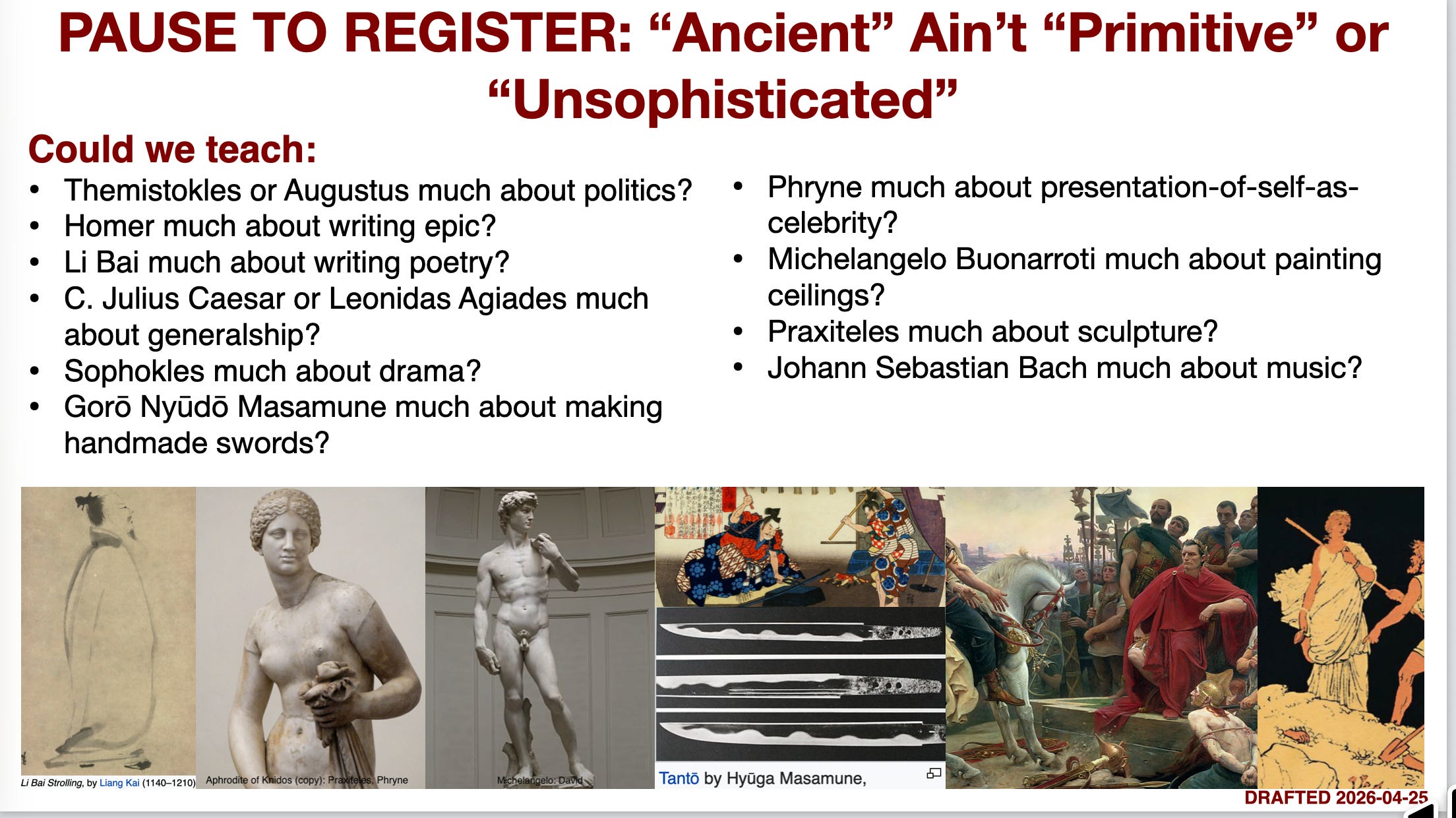
Here pause for a moment, and pause again. Here register that ancient and medieval agrarian age ancient ain’t primitive, ain’t unsophisticated, ain’t unaccomplished. Everything else in terms of civilization that people are doing—everything that is artistic, that is cultural, that is artisanal, that is organizational—reaches heights of accomplishment that are equal to what we can match. Lots and lots of people who are right now engaged in the bizarre and appalling human social practice of war might be doing much, much better, for their side at least, were they to match the excellences in that human social practice displayed by C. Julius Caesar: how in a decade you can conquer ancient Gaul from the Pyrenees and the Atlantic up to the Rhine, a land with perhaps 15 million people in it; do it with 40,000 guys; hold them in submission; and by the end of the process have more than half of the ruling classes of those you have conquered more eager to help you suppress revolts than to revolt. Mnesarete of Thespiai—nicknamed Phryne, “Toad” (perhaps from her attractive yellow-brown skin, much more beautiful than the pasty white of northerners whose speech sounded like bar-bar-bar)—could have learned nothing from anyone today about deploying the social power of charm, beauty, and sex appeal. She was, we are told, the favorite model of the sculptor Praxiteles, who again may be matched but not surpassed by such as Rodin.
And yet they were inept, by our standards at least, in the pace at which they pushed forward the value of the stock of ideas that makes up the technological heritage and toolkit of the human race.
2026-04-28 17:00-18:30 BST (Tue): <https://zoom.us/j/8458651578?omn=95983788025>
Meeting ID: 845 865 1578
Passcode: 764724
If reading this gets you Value Above Replacement, then become a free subscriber to this newsletter. And forward it! And if your VAR from this newsletter is in the three digits or more each year, please become a paid subscriber! I am trying to make you readers—and myself—smarter. Please tell me if I succeed, or how I fail…
##fyi-theories-of-eeconomic-history
##lecture-notes
##enlarging-the-scope-of-human-empire
#2026-hicks-lecture
#economic-history
#grand-narrative
#stage-theory
#john-hicks
#oxford-lecture
#institutional-change
#technological-change
#macro-history
#global-economy
#theories-of-economic-history
<https://braddelong.substack.com/t/theories-of-economic-history>