
Theories of Economic History III: Prehistory :: Roughly-Edited Transcript:
J. Bradford DeLong brad.delong@gmail.com :: 2026-04-28 :: All Souls’ College, Oxford :: The 2026 Sir John Hicks Memorial Lecture in Economic History…
Link to Video:
<https://braddelong.substack.com/p/theories-of-economic-history-zoom>
And let me start going through, making the transcript less incoherent, less cryptic and compressed, and more sensible…
Part 3: Prehistory
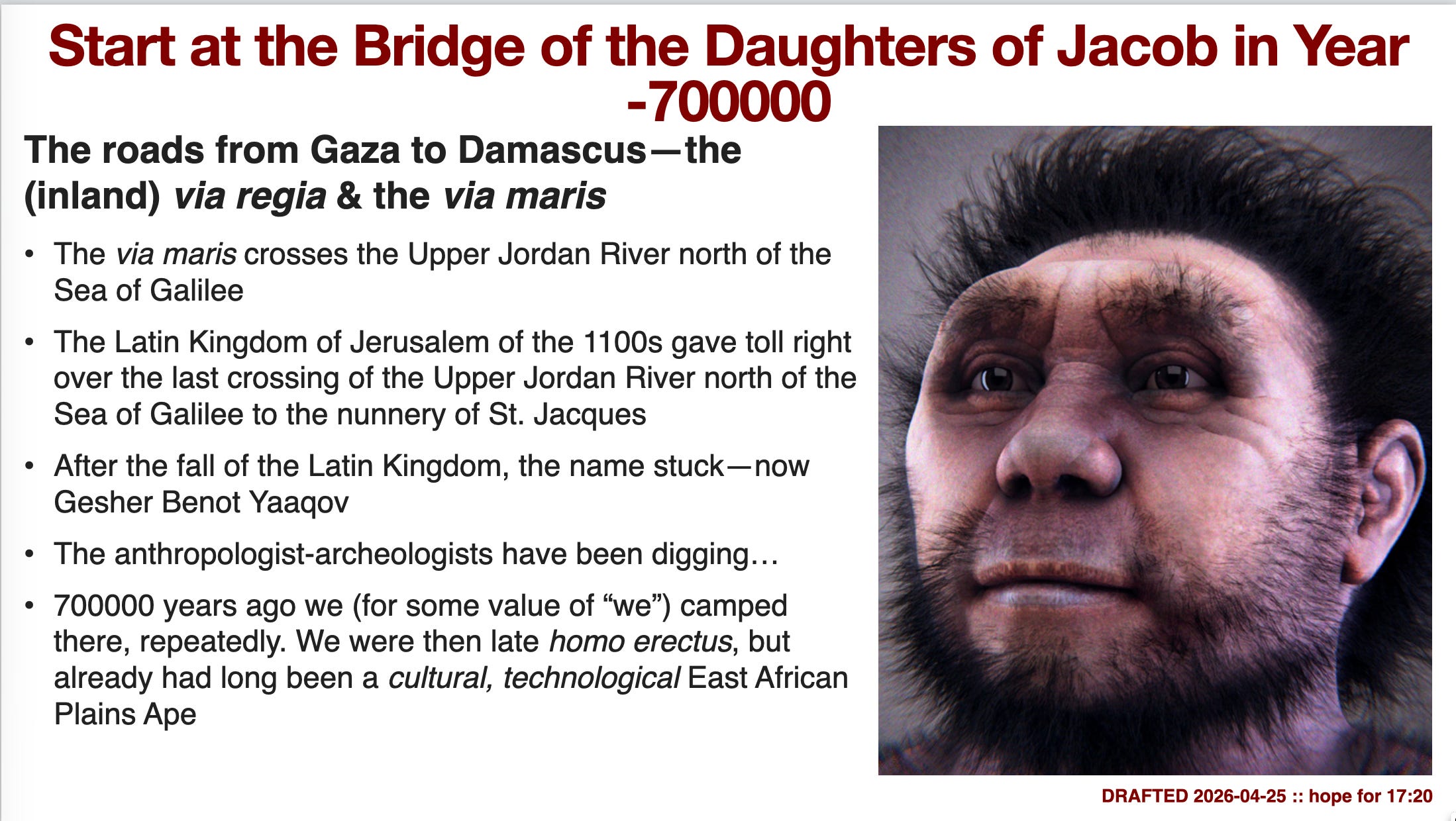
Start, perhaps, in the year -700,000 on what is now a road from Gaza to Damascus.
Ever since at least the year -1500 or so, there have always been two roads from Gaza to Damascus. There has been the inland road, the Via Regia, the Road of the Kings, crossing to and then following along on the Jordan Plateau. And then there’s the Road of the Sea, the Via Maris, which starts at Gaza, heads north along the coast, and then turns inland in Galilee. It crosses the Upper Jordan River at the first convenient crossing point north of the Sea of Galilee, a place now called, in Hebrew, Gesher Benot Yaakov: the Bridge of the Daughters of Jacob.
That name was not originally Hebrew. That name was originally Norman French. In the 1100s the kings of the Latin Kingdom of Jerusalem gave toll-right over that crossing to the nearby Nunnery of St. Jacques. And so it became Jacob’s Ford. After the fall of the Latin Kingdom the name, translated to Arab, largely stuck. St. Jacques is, of course, Jacob—Yaakov. Gesher is Bidge. And Benot? that is “Daughters”—the memory of the nuns, as the only daughter of Jacob named in the stories is the singular Dinah.
The anthropologist-archaeologists have been digging there. They have found that 700,000 years ago we—for some value of “we”—camped there repeatedly.
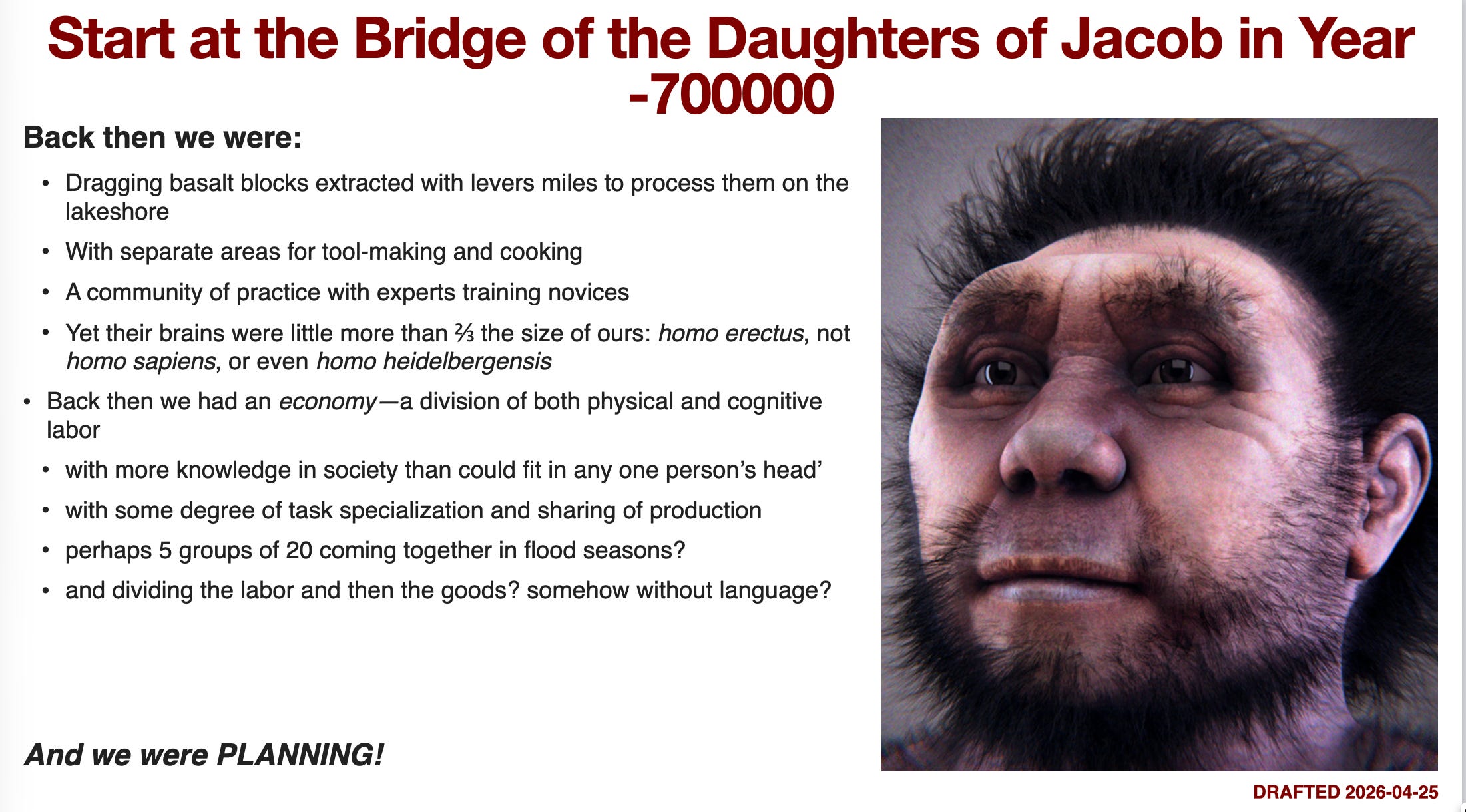
Now, we were not Homo sapiens sapiens back then.
We were not even Homo heidelbergensis. We were late Homo erectus. Our brains then, those of our ancestors then, were maybe two-thirds the size of ours now.
The fact that evolutionary pressures have expended our brains so much since then—in a relatively short time for a monkey with a 25-year reproductive cycle, less than 30,000 generations—strongly suggests that these things that sit in their box at the top of our neck are actually useful at their current size, even though they we do burn an astonishing 500 of our 2,500 or so calories a day to fuel them.
What were they doing with their brains, with these very expensive brains for a monkey, back then in the year -700,000?
We had, by then, already long been a cultural, technological species. We East African Plains Apes—those people at the Bridge of the Daughters of Jacob who were our ancestors—were then extracting basalt blocks with levers from sites miles away. dragging them to the shore of the lake, and there making stone tools with sharp-edges with which to cut and pound in separate tool-making workshop areas. They had other, separate, areas for keeping their fire going—for warmth and to drive off predators for the night, and for the great predigestion of food, which is cooking. It is cooking which allows us to do infinitely better than our great ape cousins, in terms of actually getting nutrition in, and using it, and so being energetically able to have our big brains. When we chow down, we manage to do it quickly and intensively. Gorillas have to pick and chew leaves eight hours a day.
Look at what anthropologist-archaeologists have found. We see things that look very much like communities of practice: experts training novices. We see an enormous sheer variety of foodstuffs—Joseph Henrichs stresses prickly water lilies found growing underwater far offshore—including large numbers of species of fish, all the nuts and berries, plus the animals. There is a division of labor there. It is not just: all of us in one particular age and gender class go do something. It looks like a division of physical labor. And it is definitely a division of cognitive labor: more knowledge about the natural environment and in how to manipulate it used on the lakeshore than could possibly fit into the head of any single homo erectus.
And more than wouild fit in any of our heads, bigger-brained though we are. We are not that smart. Fitting things into our heads is now easy. We are animals that can barely remember where we left our keys last night. And I don’t know about your household, but in my household, at least six times a day there will be a wailing from one of us about: “Where is my phone? Where have I left my phone?”
How many people do we find living by the then-lakeshore at the Bridge of the Daughters of Jacob? Perhaps five groups of 20 or so? Coming together in flood seasons to make a remarkably peaceful—for monkeys, who are pretty aggressive—division-of-labor society. Somehow managing to do that without having what we would call language. having culture, having experts in pieces of technology, having and doing different tasks, splitting up and coming back together. Sharing the results of what they make and do.
It is recognizable as an economy.
Now jump forward 630,000 years, to the year -70,000.
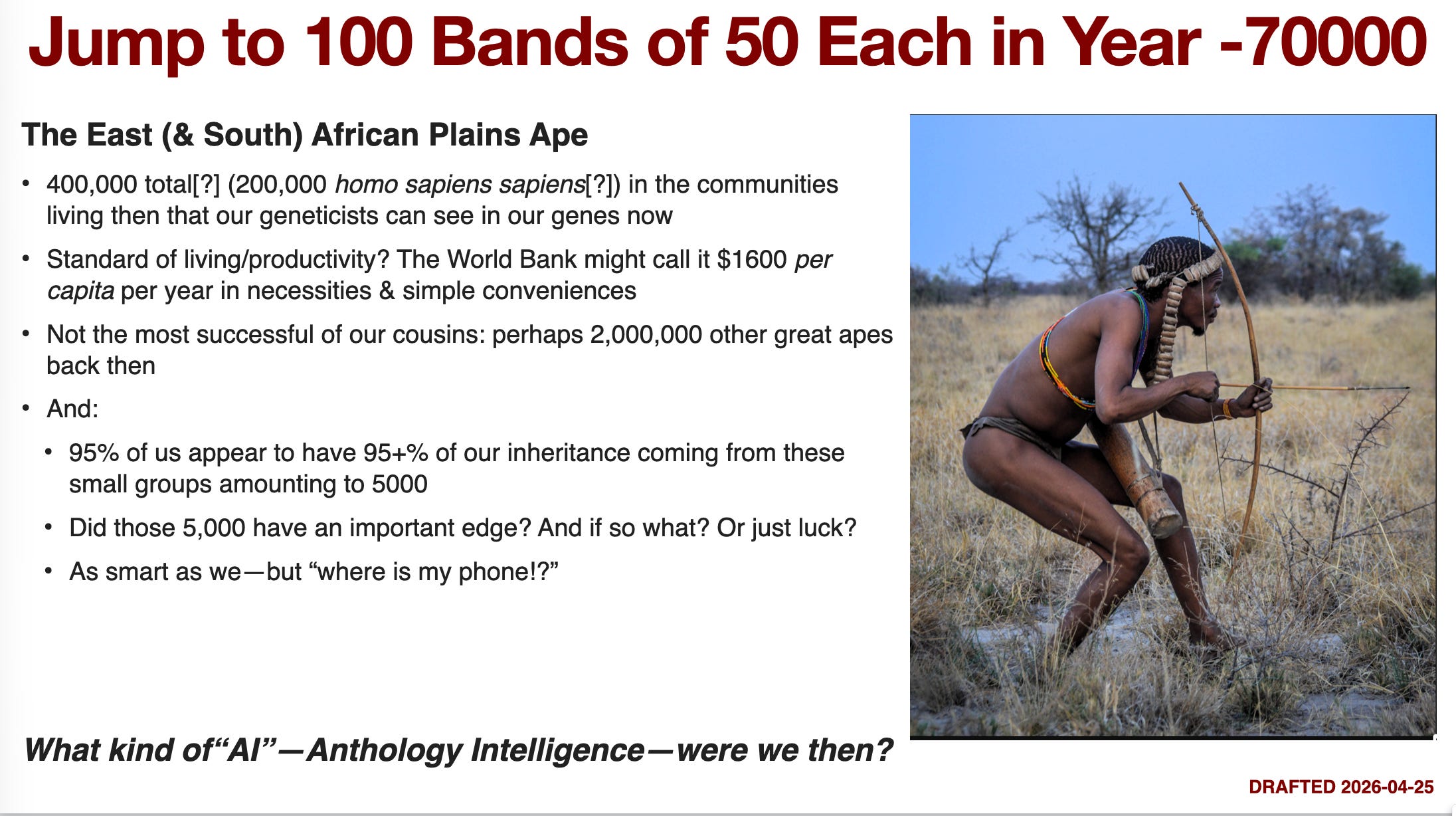
Here we have a modern Khoesan hunter in Southern Africa. I think the bow is significantly better than we had in the year -70,000. And the brightly colored textiles are are the product of late-1800s German chemical engineering. But, otherwise, this is a reasonable image of the kind of gatherer-hunter life we homo sapiens sapiens were living back then.
Back then in the year -70,000 there were maybe 200,000 of us proper, of our subspecies? But there were perhaps 400,000 total in the communities that have left us the present of useful things in our genes—not just from homo sapiens sapiens, but from homo sapiens neandertalensis, homo sapiens denisovensis, and still other “ghost populations” which the geneticists can see but which we have not found any fosils from.
How well did we live, in the year -70,000? Perhaps the World Bank might call their standard of living $1600 per capita per year, in produced necessities and simple conveniences. Take that guess as our anchor.
Back then we were fully, completely, us. Yet back then we were not the most successful of the Great Apes. While there were perhaps 400,000 of us East African Plains Apes, there were maybe 2 million other Great Apes around the world, orangutans, gorillas, chimpanzees, with much smaller brains. No one back then—and no alien, sympathetic or unsympathetic looking at us—would have looked on these interesting big-brain tool-using monkeys and with their technology and their culture and said: “these are it!”
400,000 in the communities that have left us their genes which are now ours. But there is an oddity here. The gene people tell us that 95%+ of us appear to have 95%+ of our heredity coming from a very subset of these 400,000, from perhaps 100 bands of 50 or so wandering around Eastern and Southern Africa back then.
Did these 5,000 have an important edge? And if so, what was it? Or was it just luck?
The obvious thing to guess at and grasp at is the possession of what we would see as full linguistic facility. More than just culture and technology passed down through observation and imitation, but the ability to fully describe not just what is going on now but things happending that are not there: to speak of things past, or future, or that never were, and be fully understood.
We do not know. We will probably never know. But I am confident that they then—and possibly many many more than this Gideon’s Band of 5000—were fully what we ought to call an AI: an Anthology Intelligence. Moving beyond simple planning. Moving beyond having the people who are best at some tasks taking the lead. Having things that welded them together into a band thinking things through—making use of the principal that with enough eyes on the problem, all bugs are shallow.
I am struck in my confidence in this guess by our unbelievable propensity to gossip. The saying is: three people can keep a secret, if two of them are dead. That is simply not true. All of them have to be dead for the secret to be kept. One person alone can rarely keep a secret, even if it is powerfully in their interest to do so. We have a nearly irresistible propensity to gossip. All the time. About everyone.
The result of this is that what one person knows, pretty soon almost everyone they talk to or anyone whom the people they talk to talk to will know it. Even if it is not particularly juicy.
The advantage of gossiping about whatever came into to your mind must have been so great.
It is that information-sharing that makes even a relatively small band of us an AI, an Anthology Intelligence.
When you look for an AI, do not look at things like the thing at the podium—crunching numbers as it is in the neural engines of each of its 40 GPU cores. Do what they advised you to do in the story of Christopher Wren: circumspice. Look around. But lnot at the dome of St. Paul’s, look at your fellow East African Plains Apes here, all of us here in the College of the Souls of All the Faithfully Departed, thinking togethr, each of u taking part in a cognitive division of labor. And standing, intellectually, if not on the shoulders of giants, at least on the shoulders of a very large pyramid of fellow dwarfs—at least as long as memories are transmitted down the chain from generation to generation.
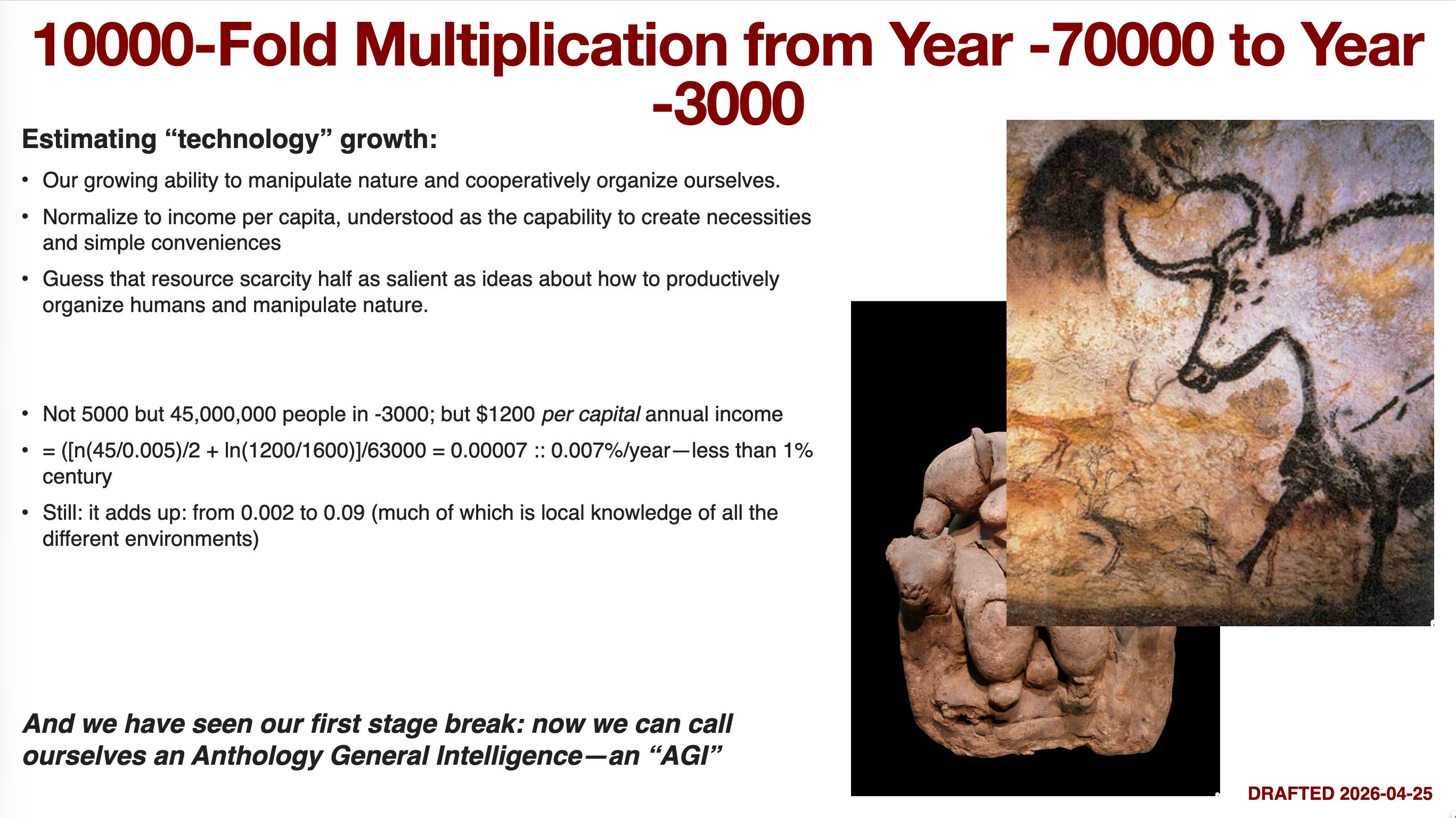
Now jump forward from the year -70,000 to the year -3,000. By -15,000, we now think, we had spread all over world. And by -7000 we were settling down to farm. The standard of living once we settled down to farm? We had $1,600 a year per capita as our anchoring guess number for hunter-gatherer. On that basis, it would have to be something like $1,200 for farmers. Farmers are shorter. Farmers are less well nourished. Farmers are much less buff. Farmers have more nutritional deficiencies. Farmers’ lives are more boring, Life is easier as a farmer: you don’t have to cover 12 miles a day, and you do not have to be as buff to catch your food. Carrying infants around 10 miles a day is a hard thing to do—hard for you, and hard on them.
An easier life means more surviving babies. So the population of farmers rises. And as population rises, resource scarcity in the form of farmland availability starts to bite. And then increasing poverty takes away the more surviving babies that an easier life had given.
Malthusian equipoise, with a much larger but substantially poorer population once you settle down to farm.
Hence we have Jared Diamond’s declaration that this was by far the worst mistake in the history of the human race. But I do notice that Jared is a professor in Los Angeles, and not a hunter-gatherer in New Guinea or, God knows, out in the Mojave, which is a truly unforgiving environment.
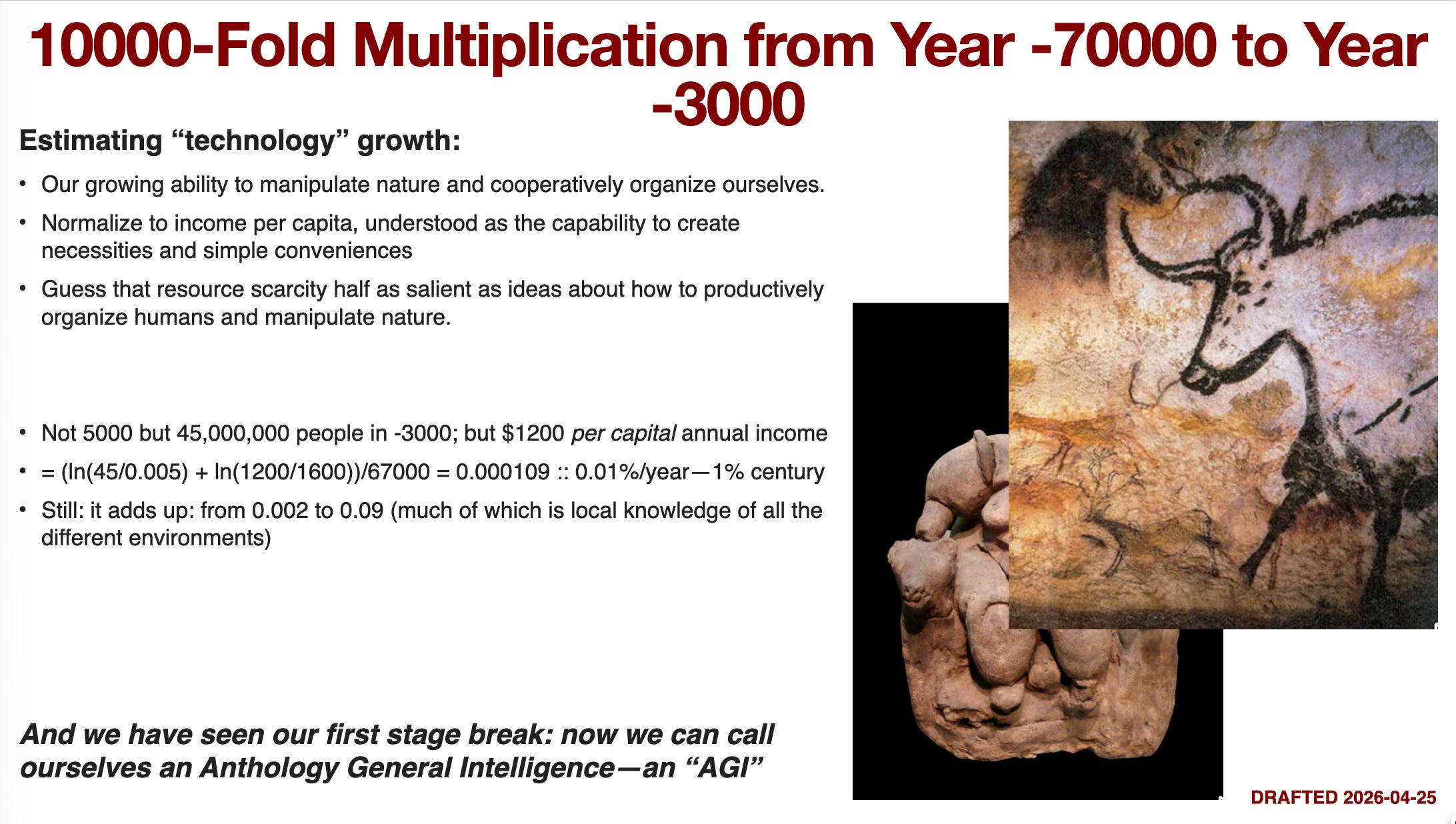
Settling down to farm also brings with it a change in the character of our AI, of humans in groups considered as an Anthology Intelligence. Once we are settled, we can have many more tools than what we can carry or cache. Once we are settled, we can and do construct in our environment ways of reminding us what we ought to be thinking about, and what are conclusions might be. Memory no longer has to carry such a big load. And reminders in the environment we build gives us an extra edge, and so there is less possibility of loss as generation succeeds generation. Our intelligence thus becomes more general: an Anthology General Intelligence, an AGI.
What can we say about what the pace was of our growing ability to manipulate nature and to coöperatively organize ourselves was as of the year -3000? Inasmuch as we are economists, when we tell stories we very much want to have numbers attached. Numbers are the best way to figure out whether the stories we are telling are in fact representative of anything important. So what numbers can we attach to the change in our “technology”—in the collective ability we have to manipulate nature and cooöperatively organize ourselves—from minus 70,000 to minus 3,000?
We would like to normalize the number to income per capita: a good notional index of technology would say that, other things equal, a population twice as rich has twice the level of technological competence. I guess that resource abundance is perhaps half as salient as ideas in terms of generating productivity. It is not that resources are unimportant: it makes no sense to say that a given level of technology enables a given level of productivity and living standards no matter how many people have to divided the resources. It makes no sense to say that resources are as important as ideas either. That would imply that the right index of technology would simply be income per capita times the number of heads, total societal income. And that would in turn imply that individual humans are not of themselves productive—that we gain nothing from having more eyes and hands and brains conditional on the overall level of knowledge contained in the AGI. That, however, is simply wrong. More hands, and eyes, and brains do make lighter work.
Half is a reasonable middle point, I think. If anyone has a better idea, I would love to adopt it.
Where am I going with this? Here: You can calculate the growth rate of “technology” between benchmark years from only two numbers. If you are willing to boldly guess at populations and living standards, simply take the growth rate of living standards and add to it half the growth rate of popuation.
By the year -3000, we have not the 5,000 people of the core population group of the year -70,000 but, we think, something like 45 million people. It might have been half that. It might have been more than that. It probably was not as low as a quarter. And we have not our $1,600 guess at annual per capita income, but $1,200. And so we calculate:
[ln(45/0.005)/2 + ln(1200/1600)]/67000 = 0.00007 = 0.007%
Less than 1/100 of 1%/year. The technological knowledge of the human mind considered as an anthology general intelligence was advancing between the year -70000 and the year -3000 at a pace of less than 1% per century. Moreover, much of that was local knowledge: figuring out how to live in the different environments we were moving into, acquiring knowledge about adapting to particular environments.
An AGI is supposed to be capable of recursive self-improvement. One percent per century does not look like we were then very good at it. It does not look like a great deal of societal effort was devoted to advancing our technology. Or, if it was, it was not terribly productive at doing so.
2026-04-28 17:00-18:30 BST (Tue): <https://zoom.us/j/8458651578?omn=95983788025>
Meeting ID: 845 865 1578
Passcode: 764724
If reading this gets you Value Above Replacement, then become a free subscriber to this newsletter. And forward it! And if your VAR from this newsletter is in the three digits or more each year, please become a paid subscriber! I am trying to make you readers—and myself—smarter. Please tell me if I succeed, or how I fail…
##fyi-theories-of-eeconomic-history
##lecture-notes
##enlarging-the-scope-of-human-empire
#2026-hicks-lecture
#economic-history
#grand-narrative
#stage-theory
#john-hicks
#oxford-lecture
#institutional-change
#technological-change
#macro-history
#global-economy
#theories-of-economic-history
<https://braddelong.substack.com/t/theories-of-economic-history>