
Theories of Economic History II: Stage Theories :: Roughly-Edited Transcript:
J. Bradford DeLong brad.delong@gmail.com :: 2026-04-28 :: All Souls’ College, Oxford :: The 2026 Sir John Hicks Memorial Lecture in Economic History…
Link to Video:
<https://braddelong.substack.com/p/theories-of-economic-history-zoom>
And let me start going through, making the transcript less incoherent, less cryptic and compressed, and more sensible…
This is part 2 of the Hicks Memorial Lecture I gave at Oxford All Souls’ last Tuesday eve. This is about Stage Theories of big-picture economic history—how they are necessary, how they are inevitable, how they are inadequate, and how we owe our students and readers to come up with the best ones we can. It is also, I think, about how if Hayek & Polanyi have the best keys to understanding the long 20th century, Malthus & Schumpeter have the best keys to understanding the very long arc from gatherer-hunters to AI.
Hicks wrote his Theory of Economic History as his own attempt to provide some guidance for what economic historians should be doing and studying. And in writing that guide, Hicks wound up with a stage theory.
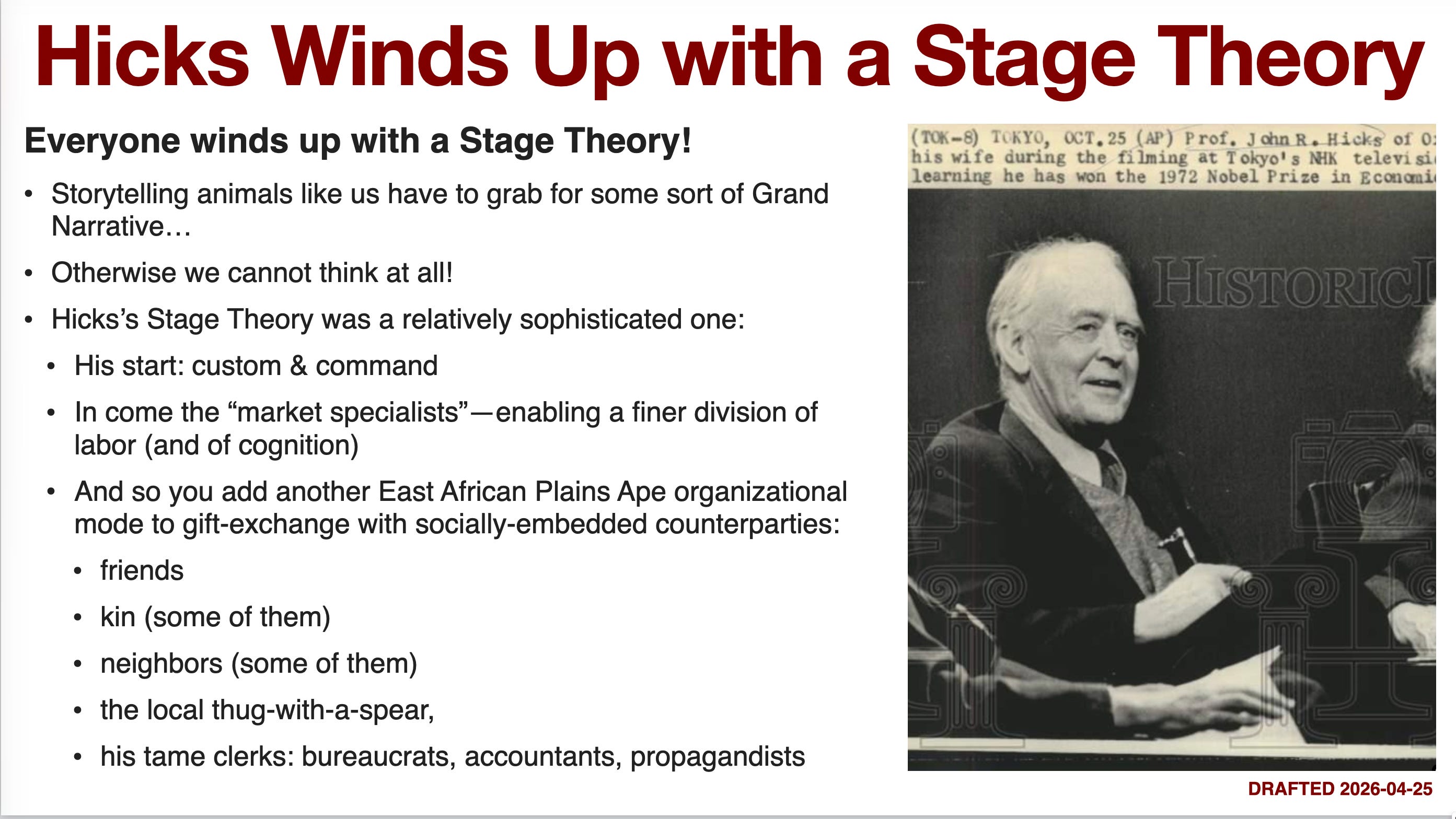
Now that is not surprising. Everyone winds up with a stage theory!
You cannot not wind up with a stage theory.
We are storytelling animals. We cannot think without grasping forms of narrative through-line. We do not react well to tables and charts of statistics about the likelihood of leopard encounters at the waterhole, as a function of time of day on the one hand and size of the band that actually goes down to the water hole on the other. But “Ogg went down to the water hole at 6 p.m. alone, and the leopard got him!”—that gets our attention, and gets engraved on our brains,
One of the assets of Hicks’s stage theory is that it was a relatively sophisticated one> He starts from an ideal type of an economy governed by custom and command. He asks how we then got to, or in some logical sense should have gotten to, the modern prosperous fixed-capital industrial exchange-based market economy.
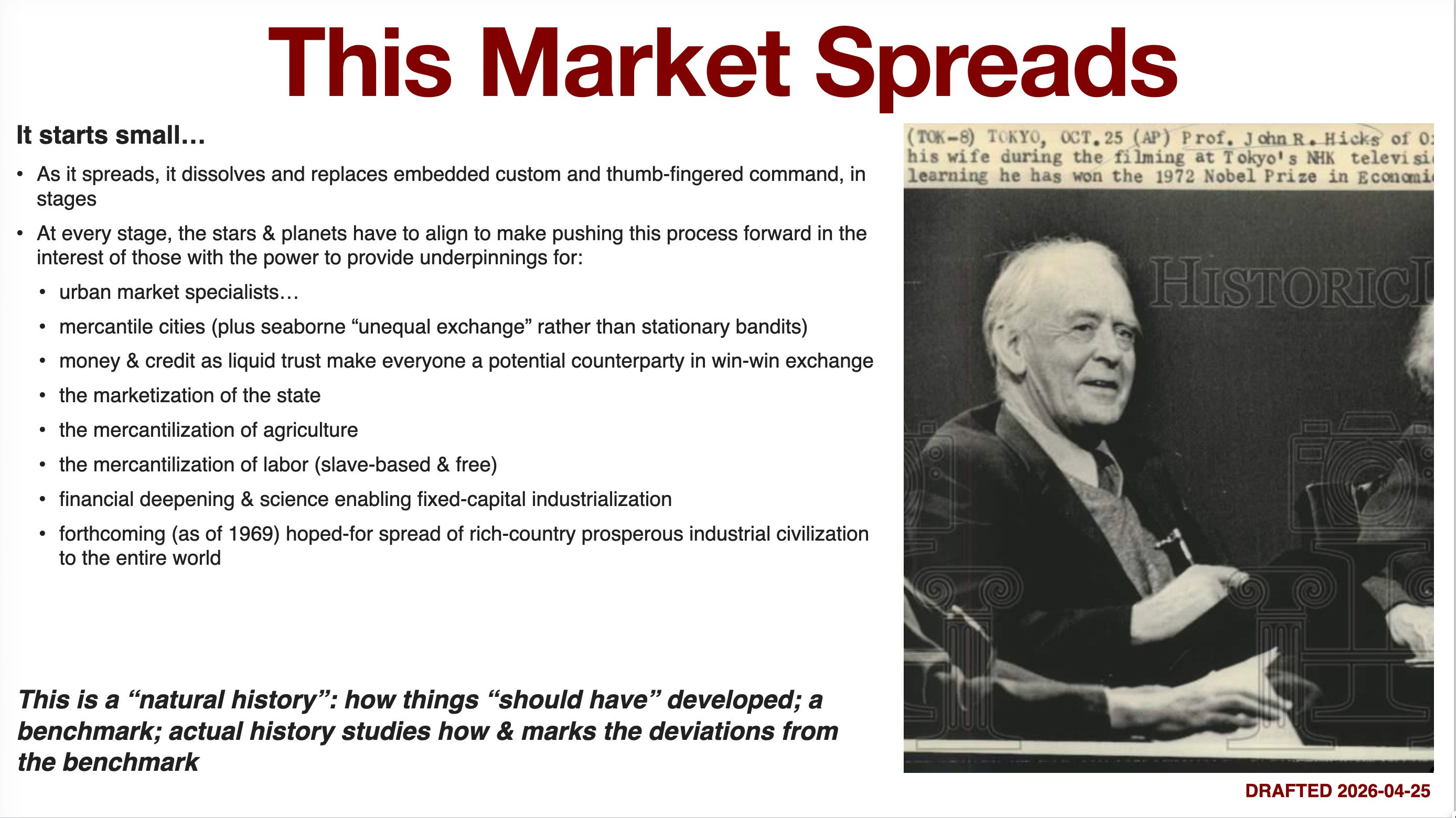
I do not have enough time now to even summarize the book. But do note that it is a stage theory with a lot of stages. In each of those the market slowly encroaches on and dissolves other, less flexible, less adaptable, less scalable forms of human social, economic, and cultural organization. Note that Hiks ends with the hoped-for forthcoming, as of 1969, hoped-for spread of rich-country prosperous industrial civilization to the entire world.
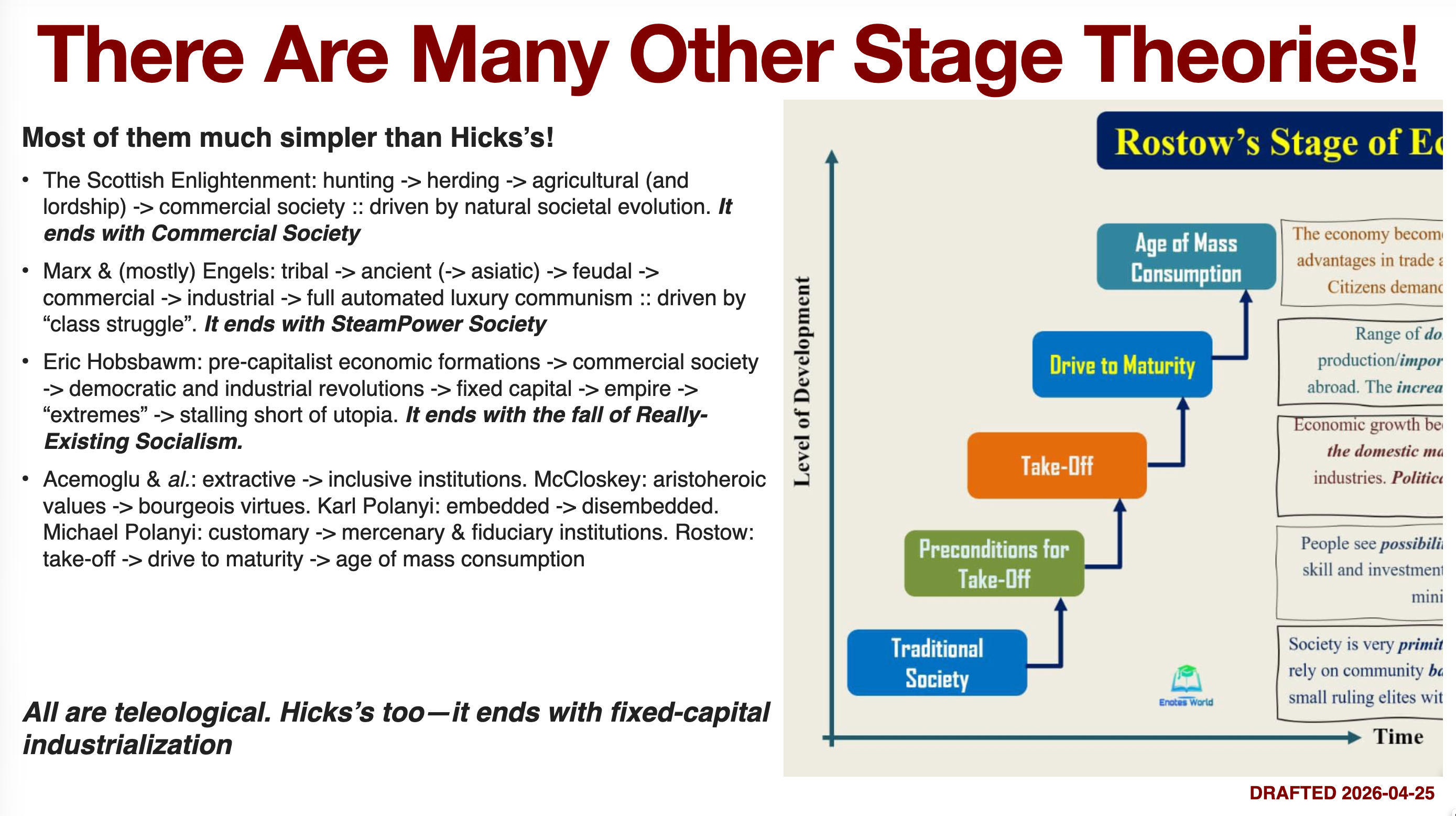
There are all the people whose stage theories shrink until there are only two stages.
We have my friend Daron Ashimoglu: two stages: extractive → inclusive institutions.
We have my friend Deirdre McCloskey: aristo-heroic → bourgeois virtues.
Karl Polanyi: embedded → disembedded, with big pluses and minuses from the “disembedding”, as you wind up with an inhuman society in which the only rights that are vindicated are property rights, and the only property rights that are vindicated are those that give you control of things that are valuable. People believe and demand that they have lots of other rights, and that society should vindicate those rights in addition or instead.
We have Carl’s brother Michael: customary → mercenary + fiduciary institutions.
We have Walt Rostow’s non-communist manifesto: takeoff → drive to maturity → age of mass consumption.
All of these strongly teleological. All of these end with the belief that we, whoever “we” are, are in fact the end-state and the process has been building toward us. Which makes for a lot of bad history. We are not the end point. Even though it is certainly the case that
we have gotten here,
given that we have gotten here, which is an unlikely thing,
we probably got to this unlikely endpoint outcome by processes that are the most likely processes that could have led to this unlikely outcome.
but still it could have gone lots of other ways.
We are interested in history for its own sake, as a source of intellectual and aesthetic stimulation—for knowledge, romance, and entertainment. We are interested in histry because we want some knowledge about our current state as it informs our estimates of likely future—humans being much the same, an exact and true knowledge of the kinds of things that have happened in the past is the best possible guide to what is likely to happen in the future, things, as they do, not repeating but rhyming.
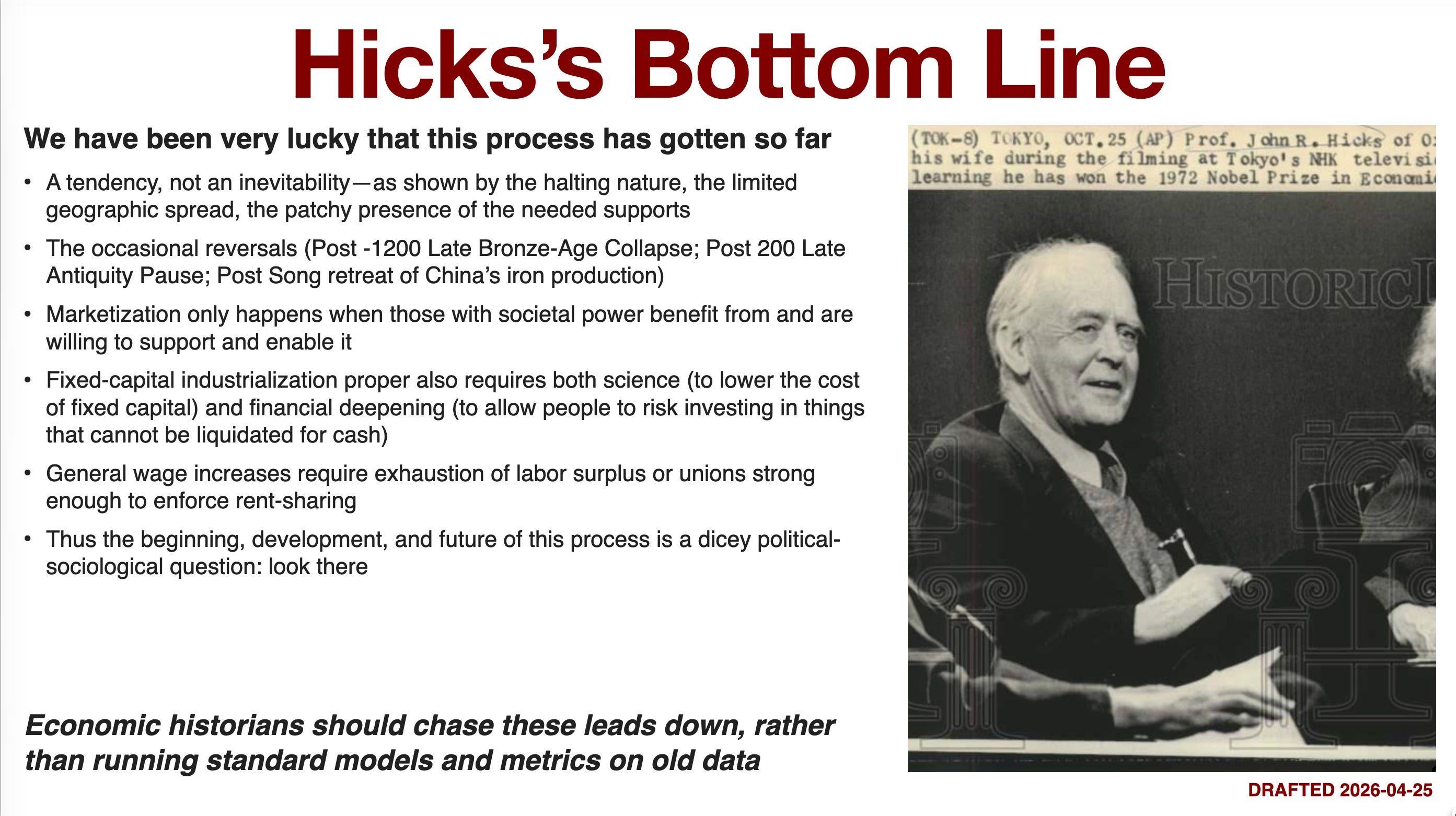
From his stage theory Hicks drew a bottom-line conclusion: When we consider the process that has generated our economic growth and current prosperity, we should note first that we have been very lucky. This process has gotten farther than it had any right to. The market system spread, expanded the potential for the specialized division of labor, created the opportunity for high-scale investment and accumulation. But it was always a tendency. It was never an inevitability. It had a halting nature. It had a limited geographic spread. They needed necessary supports were only found in patches.
Plus there were the occasional reversals. We know more than Hicks did now about the post year -1200 late Bronze Age collapse, during which the Greeks forget how to write. We know more about the post-Song retreat of China’s iron production. We know more of what caused the D—I understand we are not supposed to call it that: call it the post-200 Late-Antiquity Pause, the thing that led to a world in which, somehow, by the year 750, in both Europe and in China, people were looking around and marveling at the accomplishments of the earlier Hellenistic and Roman and Han civilizations at their height, and mourning their situation as unworthy descendants of mightier men.
Hicks also concluded that fixed-capital industrialization—the key source of prosperity—required both science coming in from left field, and also the development of unusual institutions of financial deepening to make people willing to invest in things that coud not be liquidated for cash whenever events went rapidly south and the panic spread. Hicks also concluded that the system was very unlikely to deliver general wage increases, at least not until it had spread enough to a large enough scale to get you exhaustion of the W. Arthur Lewis labor surplus in the countryside; or until you got unions strong enough to enforce rent-sharing for a labor aristocracy. Hicks also concluded that the beginning, the development, and the future of the future of this process always was and is a dicey political-sociological question.
And Hicks concluded that economists should look to history and political economy to understand it, rather than to Y= ƒ(K.L) and (K/Y)* = s/(n+g+δ).
Let us not try to strip off some of the teleology. Let us now try to use the fact that we were not born in 1904, and have seen a lot more of the world and a lot more of history than Hicks did—and it has been a very different history since 1969 than he wouldk have expected.. Let us ask: what would a better, more useful stage theory look like? And let us answer this by taking some snapshots, seeing whether we can be properly inductive, seeing whether we can do better than falling into yet another verison of some teleological end-state trap.
And at the end I will offer some conclusions, or at least hints, or at least guesses.
2026-04-28 17:00-18:30 BST (Tue): <https://zoom.us/j/8458651578?omn=95983788025>
Meeting ID: 845 865 1578
Passcode: 764724
If reading this gets you Value Above Replacement, then become a free subscriber to this newsletter. And forward it! And if your VAR from this newsletter is in the three digits or more each year, please become a paid subscriber! I am trying to make you readers—and myself—smarter. Please tell me if I succeed, or how I fail…
##fyi-theories-of-eeconomic-history
##lecture-notes
##enlarging-the-scope-of-human-empire
#2026-hicks-lecture
#economic-history
#grand-narrative
#stage-theory
#john-hicks
#oxford-lecture
#institutional-change
#technological-change
#macro-history
#global-economy
#theories-of-economic-history
<https://braddelong.substack.com/t/theories-of-economic-history>