
Not My John Hicks Lecture: "John (Hicks) the Apostate"
I am going to be talking about something other than this Tuesday at Oxford:
A master technician of neoclassical economics spent his last decades explaining why his own framework misled us. From IS‑LM to Kaldor‑Hicks to ‘temporary equilibrium,’ Hicks ended his career trying to undo much of what he had helped build, and in the process suppressing Keynes’s tragic uncertainty, welfare’s forgotten losers, and the optionality-uncertainty of historical time…
Julian the Apostate, that last pagan emperor of Rome, understood that Constantine’s Christian Empire revolution had made a certain kind of civilization impossible — understood it, tried to reverse it, and failed.
We remember him for the failure: “Nenikēkas me, Galilaie”—thou hast conquered, Galilean! But we also remember the clarity and the accuracy of his vision.
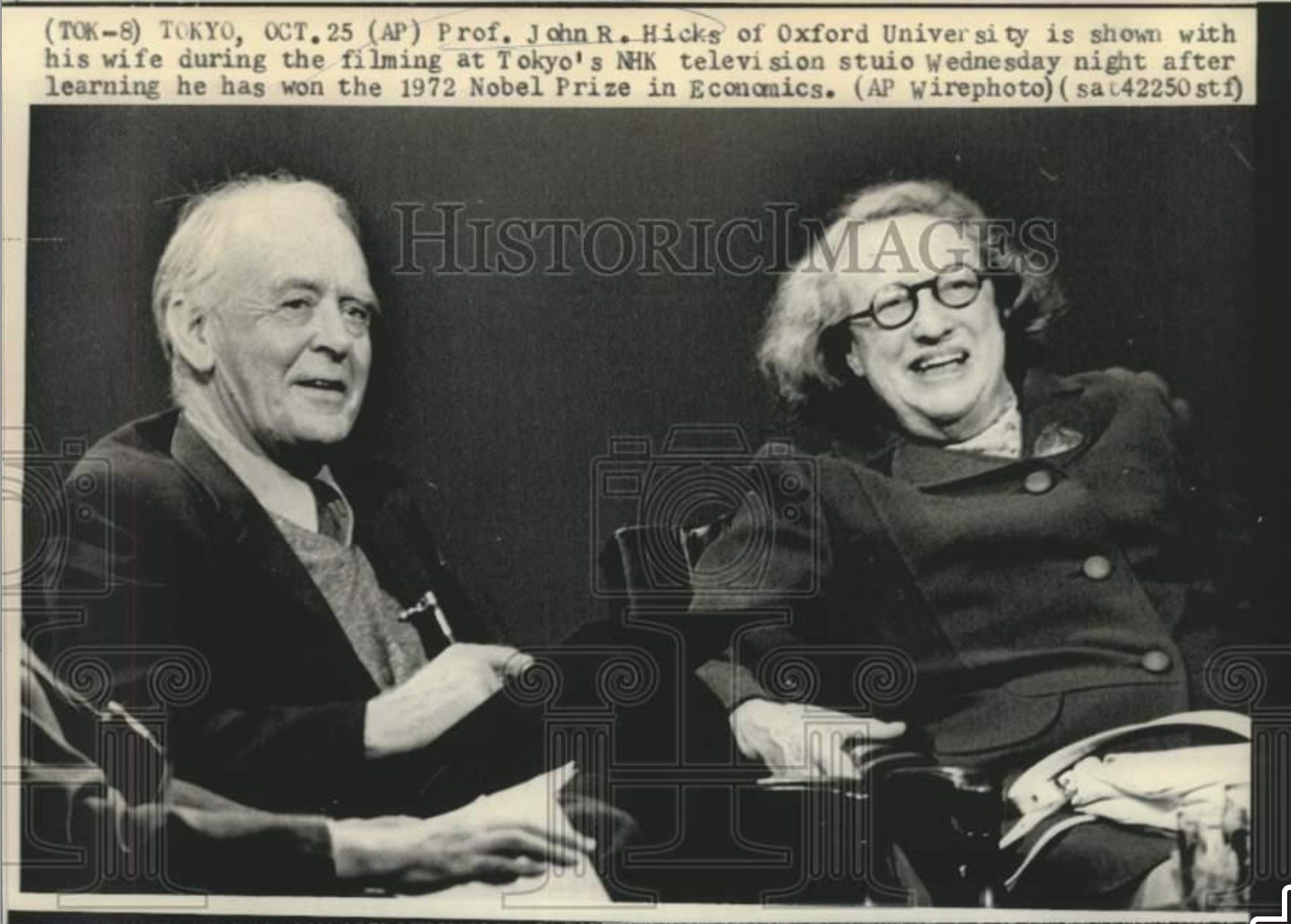
John Richard Hicks (1904–1989) was, in the history of twentieth-century economic thought, a figure of similar stature. He is one of the principal architects and builders of what became the cathedral of the neoclassical synthesis. And he spent the last quarter of his life trying to explain to people why the cathedral was, at its foundations, not very helpful.
Hicks was the most technically accomplished British economist of the twentieth century. Not the most famous — that was that Cambridge prophet-visionary Keynes. Not the most politically consequential — that was also Keynes. But the most technically accomplished: the one who took the raw materials left by Marshall, Walras, Pareto, the early pre-epistemological break Keynes, and company, and then forged them into the coherent analytical framework that generations of economists would inhabit as though it were simply the way things must be.
Hicks accomplished:
Value & Capital (1939): still, eighty-five years on, an intellectually demanding and very rewarding book, a deserved part of the economics canon (to the extent that it consists of read books, rather than article abstracts read, problem sets attempted, and seminar oral traditions). It built a rigorous general equilibrium theory in which economic agents made plans — for production, consumption, investment — and markets did their job and cleared by coordinating those plans, in actual cash-and-goods-on-the-barrelhead fact in the present and in expectation in the future. It was a magnificent technical achievement.
The IS-LM model: sketched in a 1937 Econometrica paper intended to interpret the General Theory to the profession, became the backbone of macroeconomics teaching for fifty years, and arguably still is. Indeed, every macro model that has financial assets that are property’s claims on future profits and also has assets that serves as liquid trust to grease transactions has an LM curve, where demand for changing one into the other meets supply. And it has one whether it knows it or not. Indeed, every macro model that has a flow of currently produced goods and services bought and sold for those liquid trust assets has an IS curve. And it has one whether it knows it or not.
The Kaldor-Hicks welfare criterion: which gave cost-benefit analysis its foundations. It thereby shaped the way governments all over the world thought about economic policy from the 1940s forward.
Plus there was more. A lot more.
And then, in the last twenty years of his long life, he recanted.
Not everything, not all at once, not with the dramatic public theater that the word “recantation” implies. The late Hicks issued his apostasies in the patient, qualified, professorial register that was his natural mode — in the 1974 Arne Ryde lectures published as The Crisis in Keynesian Economics, in a 1980 paper in the Journal of Post-Keynesian Economics titled “IS-LM: An Explanation,” in Causality in Economics (1979), in some of the pieces in Collected Essays (1981–83).
The tone was never self-flagellating. Hicks was too “English” for that, too careful, too proud.
But the substance was devastating: he had been wrong, the profession had been wrong, and the framework he had done as much as anyone else to construct had, in crucial ways, obscured rather than illuminated the phenomena it purported to explain.
Take the IS-LM model first, because it is the most famous of the apostasies and the most consequential. The story of what happened to Keynes in the hands of Hicks, Hansen, and Samuelson is one of the central intellectual dramas of the twentieth century.
Keynes in 1936 was writing about a world of radical, non-insurable uncertainty — a world in which investment decisions are irreversible bets on a future that cannot be known, in which “animal spirits” are not an irrational departure from rational calculation but the only possible response to genuine ignorance, in which money is held not because of some friction in the adjustment of portfolios but because it is the one asset that preserves optionality in the face of an unknowable future. This is a vision of capitalism as inherently unstable, as resting on foundations of shifting expectation and herd psychology that no amount of fine-tuning can fully stabilize. It is, in the deepest sense, a tragic vision.
What Hicks did to this vision — what he meant to do, what he thought he was doing — was to translate it into the language that the economics profession could use. The IS curve, the LM curve, equilibrium at their intersection: this is not a caricature. It is a sophisticated and genuinely illuminating formal apparatus that captures something real about the Keynesian mechanisms.
The trouble is what it loses.
It loses time, sequence, optionality, revision, inconsistencies between the beliefs and plans of different economy participants that do not show up in demand and supply right now. It loses uncertainty. It loses the essential Keynesian insight that the problem is not that wages are sticky or that the economy has moved to a bad equilibrium but that in a world of genuine uncertainty, coordinating expectations is genuinely hard and may be genuinely impossible without external intervention.
The IS-LM model is a comparative statics exercise. It compares two equilibria. It has nothing to say about the process by which, or the conditions under which, the economy might move from one to the other.
The Hicks of 1980 understood this. “The IS-LM diagram,” he wrote:
which is widely, and rightly, seen as a convenient synopsis of what I had to say, is not meant to be a synopsis of the General Theory…
He said it had been “a classroom gadget” that had been “read back” into Keynes’s text in ways Keynes would not have recognized. He said, with characteristic understatement, that he was “not altogether happy” about what IS-LM had done to the discipline.
What he meant — and what the late Hicks allows himself to say more directly in other places — was that the profession had used the IS-LM framework to domesticate Keynes, to transform a radical argument about the structural instability of capitalist investment into a manageable problem of aggregate demand management, to convert a visionary prophet who understood that capitalism’s essential problem was uncertainty into merely another identifier of discrete and correctable market failures.
Keynes had argued that the economic problem was fundamentally political, that it could not be resolved by technique alone.
The IS-LM Keynesians had made it technical, and thereby made it safe.
The apostasy over the Kaldor-Hicks welfare criterion cuts differently — less about what was done to Keynes and more about what Hicks did, with Kaldor, to the foundations of post-WWII cost-benefit analysis and welfare economics. The criterion is elegant: a policy change is a social improvement if those who gain could, in principle, fully compensate those who lose and still be better off. This is the “potential Pareto improvement” standard, and it became the basis of policy analysis as practiced in governments, regulatory agencies, and international organizations throughout the postwar world.
The intellectual problem with it is that the compensation is almost never actually paid.
The criterion says: the change is an improvement if compensation could occur. But once you have driven the change through — the trade liberalization, the infrastructure project, the regulatory reform — the people who gained are not going to turn around and compensate the people who lost. The criterion licenses the economist to say “this is efficient” while remaining silent about the redistribution from losers to winners that actually occurs. In practice, it became the philosopher’s stone of a particular kind of economic liberalism: the intellectual warrant for policies that have profound wealth distribution-changing and lifeways-upsetting consequences as long as the money-metric gains to the winners outweigh the money-metric losses to the losers.
Hicks came to understand this as a kind of monstrous parody of what welfare economics should be. Real welfare economics asks: is this society better, taking account of everyone who lives in it? The Kaldor-Hicks criterion answers a different question: could the winners, if they chose to, arrange things so that no one was worse off?
The gap between “could” and “did” is the gap between theory and the world in which human beings actually live, and in that gap live the actual losers of every trade liberalization, every factory closure, every “efficiency-enhancing” reform that left specific people, in specific places, with their lives materially worse.
Hicks, in his late career, was clear that he bore some responsibility for having provided the formal apparatus that allowed economists and policymakers to look away from those people.
But there is another perhaps deeper apostasy.
It is the one about time. It is about what Value & Capital had done, and what should have been done instead, and why the difference matters.
Value & Capital set out to build a rigorous general equilibrium theory in which economic agents made plans — for production, consumption, investment — and markets cleared by coordinating those plans. It was a magnificent technical achievement. It was also, Hicks came to believe, built on a fiction.
The fiction is that plans are made and revised smoothly, that expectations adjust and markets clear in a way that can be modeled as optimization over a space of possible states. The reality is that economic decisions happen in historical time, which is to say: they are irreversible. You cannot uninvest. You cannot un-hire. You cannot un-commit. Once a decision is made, the future it presupposes either arrives or does not, but the decision cannot be recalled. This means that what matters, at every moment of decision, is not the rational expectation of future states but the option value of keeping options open — the value of not foreclosing futures before you have to.
Hicks had actually glimpsed this in Value & Capital itself, in the concept of “temporary equilibrium”: markets clear in the present, but economic actors hold different expectations about what will happen next, and those different expectations are themselves part of what is being equilibrated.
This was a genuine insight, and subsequent theorists — including a certain strand of Post-Keynesian economics — have tried to build on it, albeit without any notable success.
What Hicks came to feel, in his late career, was that temporary equilibrium was not enough — that the really important thing about a monetary economy was precisely the irreversibility of time and the impossibility of insuring against all possible futures, and that a framework built on optimization and plan-coordination could not capture this because it was, at its core, a framework that treated uncertainty as manageable, as resolvable into probability distributions over known outcomes.
In Causality in Economics, written when he was seventy-five years old, Hicks tried to think about what a properly temporal economics would look like. He distinguished between what he called “static” analysis (logical time, reversible, path-independent) and “sequential” analysis (historical time, irreversible, path-dependent), and he argued that the really interesting economic questions were all sequential. The General Theory, properly read, was a work of sequential economics. The IS-LM model was a work of static economics that had been misread as a sequential one. The entire apparatus of neoclassical general equilibrium, including Value & Capital, was built for a world without real time — which is to say, a world that does not exist.
Was he right to apostasize? Perhaps. Perhaps not. It is conventional in many circles to blame everything that has gone wrong since 2007 on “neoclassical economics” itself. The financial crisis of 2008, the inadequacy of the policy response to it, the long stagnation that followed, the blowback of the neofascist political turn— all these are, it is claimed in many circles, consequences of bad economic theory, specifically of the theory that said markets are equilibrating toward full employment, that uncertainty is manageable, that the Kaldor-Hicks gainers-and-losers calculus adequately captures what matters about distributional outcomes. But the doctrines that blocked proper financial-regulation safeguards before and proper policy responses after 2008 were not those of Hicks’s version of the neoclassical synthesis. Blame Milton Friedman. Blame the American Enterprise Institute, the Cato Institute, and the Heritage Foundation. Blame the Republian Party and the Tory Party. But not Hicks.
Hicks’s apostasy, in my view, sprung not from the fact that the policy questions and options that grew out of his version of the neoclassical synthesis were destructive, but out of the fact that it offered little purchase against the obstacles that needed to be overcome to make further progress.
It was in the hope of opening a way forward to intellectual progress that Hicks spent his last twenty years trying to tell his profession that it had gone wrong, in the patient prose of a very old man who knew he probably would not live to see the correction. He was right. He was too late. The cathedral he had helped build was too large, too useful, too deeply embedded in the training and practice of too many economists to be dismantled by the second thoughts of on of its own architects.
But we neoclassicals teach our students that Hicks gave us the tools: IS‑LM for macro, Kaldor‑Hicks for policy, Value & Capital for general equilibrium. We rarely teach that Hicks himself spent twenty years explaining why those tools obscured as much as they revealed—about uncertainty, about distribution, about the irreversibility of decisions in historical time. Keynes’s tragic, political vision of capitalism became a set of comparative statics diagrams; “potential Pareto improvements” became a philosopher’s stone for disruptive liberalization. This piece traces Hicks’s late‑life recantation and asks what it means to keep using a cathedral its builder came to doubt.