
DRAFT: Origins of a “Human” Economy
A hornfels quarry in KwaZulu‑Natal and a basalt workshop in the Jordan Valley show that spatial division of labor, long‑term planning, and cumulative culture are not modern inventions but Pleistocene facts long predating our evolution as Homo sapiens sapiens…
In my email inbox this morning, the highly-estimable Johan Fourie makes me aware of a brilliant Nature Communications archeology piece by Will & al. <https://www.nature.com/articles/s41467-026-70783-8>, setting a stake in the ground marking the remarkable complexity of the human division of labor extending far across space more than 200 millennia ago:
Johan Fourie: The Oldest Tool in the Book <https://www.ourlongwalk.com/p/the-oldest-tool-in-the-book?>: ‘Imagine… people walking across a grassland in… 220,000 BCE… not hunting… not gathering food. They are heading, with intent, to a particular outcrop of dark grey rock above the Jojosi River. They have walked this route before. So did their parents, and their parents’ parents, probably for 5000 generations or more. The stone they want is hornfels – a hard, fine-grained rock baked by ancient magma into something that flakes beautifully. They will arrive, knock large blocks into long blades, and carry the blades away to use somewhere else. And then, over the next hundred thousand years, others will keep coming back to do the same thing. That picture comes from a paper just published in Nature Communications by Manuel Will and an interdisciplinary team working at the Jojosi Dongas, an eroded landscape in the grasslands east of the Drakensberg….
Making a special trip to a particular place to get a particular rock was thought to be rare, and late…. Pleistocene hunter-gatherers, the textbook said, did not really do this. Jojosi shows that they did. And much earlier than anyone thought…. Rough flakes, partly worked cores, and tiny chips of debris… [from] shaping blocks of stone into portable blanks….. The blades are missing because the people who made them carried them away. The site is not a camp. It is a workshop. A quarry. A place you go only to get stone. And the visitors were choosy. Dolerite was right next to the site. Quartz and quartzite pebbles sat in the riverbed below. The knappers ignored all of them. They wanted hornfels, and only hornfels….
Blombos Cave… overlooking the Indian Ocean about 300 kilometres east of Cape Town… where archaeologists found… a cross-hatched pattern drawn… in red ochre, about 73,000 years old… push[ing] back the timeline of symbolic thought by more than 30,000 years and helped overturn… [the] idea: that the cognitive package… was acquired in Eurasia…. Jojosi extends the same argument by another 150,000 years – and shifts it from art to economics. Long-term planning is not only about drawing a pattern on a rock. It is also about deciding, in advance, where you will be, what you will need, and how to make sure you have it. The Jojosi knappers were not opportunists but managers of a supply chain…. We make tools. We plan their use. We invest effort today for a payoff tomorrow. We build supply chains and pass knowledge across generations. We are different because of our economic function, and that function is older than almost anything else we can name about ourselves…

You probably know that I have two ongoing active book projects right now: What Rough Beast?: The Economic History of the World 1980-2040, and Enlarging the Bounds of Human Empire to the Effecting of All Things Possible: The Human Economy since the Dawn of Time. I think it is time to start seriously pushing out draft chapters, which are only DRAFTS at this stage, at least to paid subscribers. Will & al. (and Fourie) impelled me to rewrite one of the early sections of Enlarging the Scope of Human Empire. I did this because I have been wondering if that is where to start my Hicks Lecture, that I am going to be giving at Oxford All Souls’ in a week and a half.
So here it is in its current state:
Origins of a “Human” Economy
About five miles north of the Sea of Galilee and the town of Capernaum, at the foot of the Golan Heights, Route 91 crosses a bridge at what is the last natural ford of the upper Jordan River. In that place, in the northern sector of the Dead Sea transform fault, the river narrows enough that you can easily wade across.
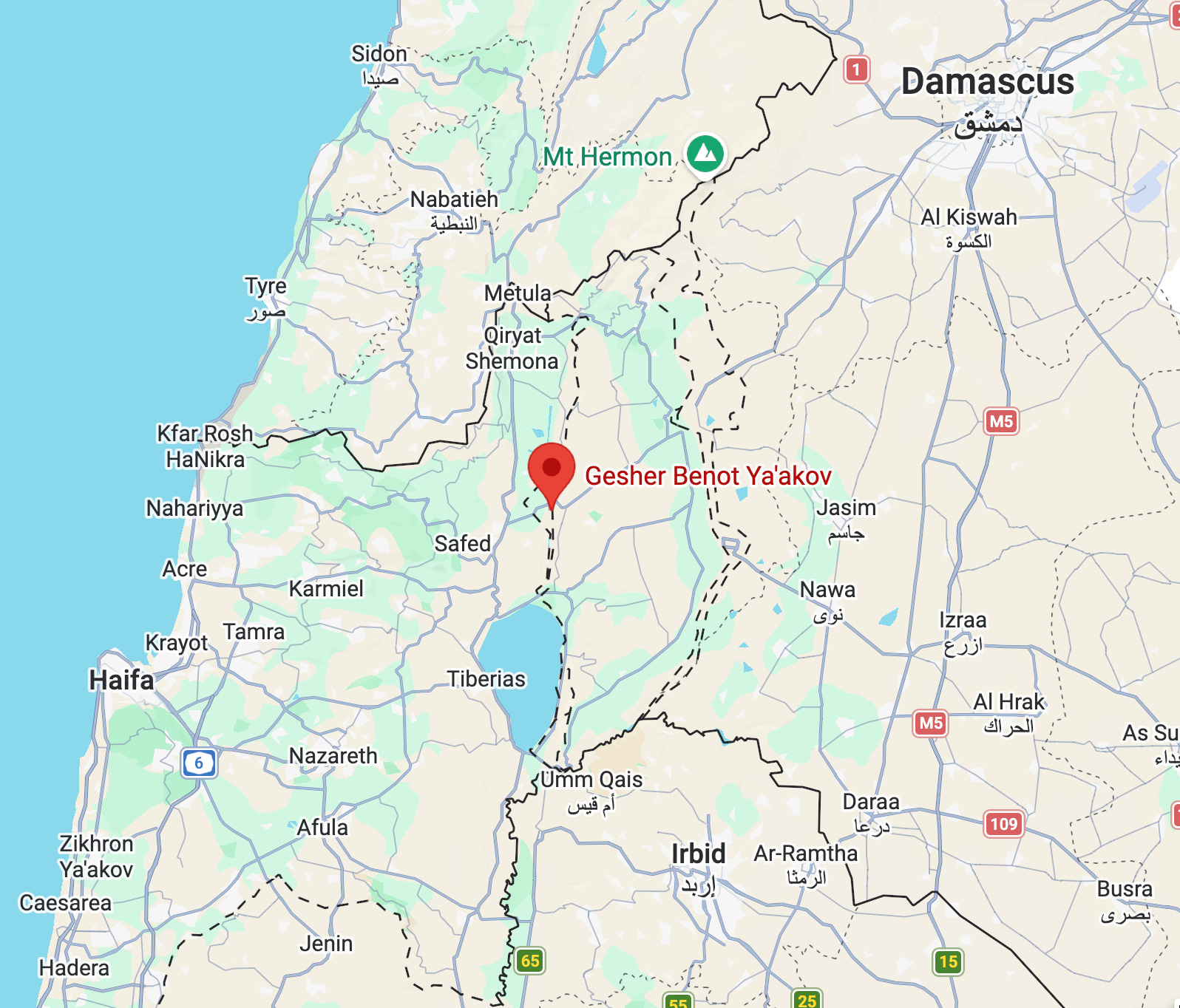
The Crusader kings of the Latin Kingdom of Jerusalem assigned some of the tolls from the ford to the nearby Latin Nunnery of St. James. The Crusader military élites then named the strategically important ford le Gué Saint-Jacques, Latinized into charters and such as Vadum Jacob: Jacob’s Ford.
Paid subscribers get the full arguments/unfounded speculations below: