
The Vibe-Horsing Coal-&-Steam Revolution of the 1700s
It was steam-engine pioneer James Watt coined and quantified “horsepower” as a sales gimmick to sell steam engines. The point was that steam engines could replace your power-horses, not multiply their productivity. But for coal barons and coal miners each upward leap in steam-engine productivity saw the value of their businesses and their work rise, until the technological shift when coal gave way to oil…
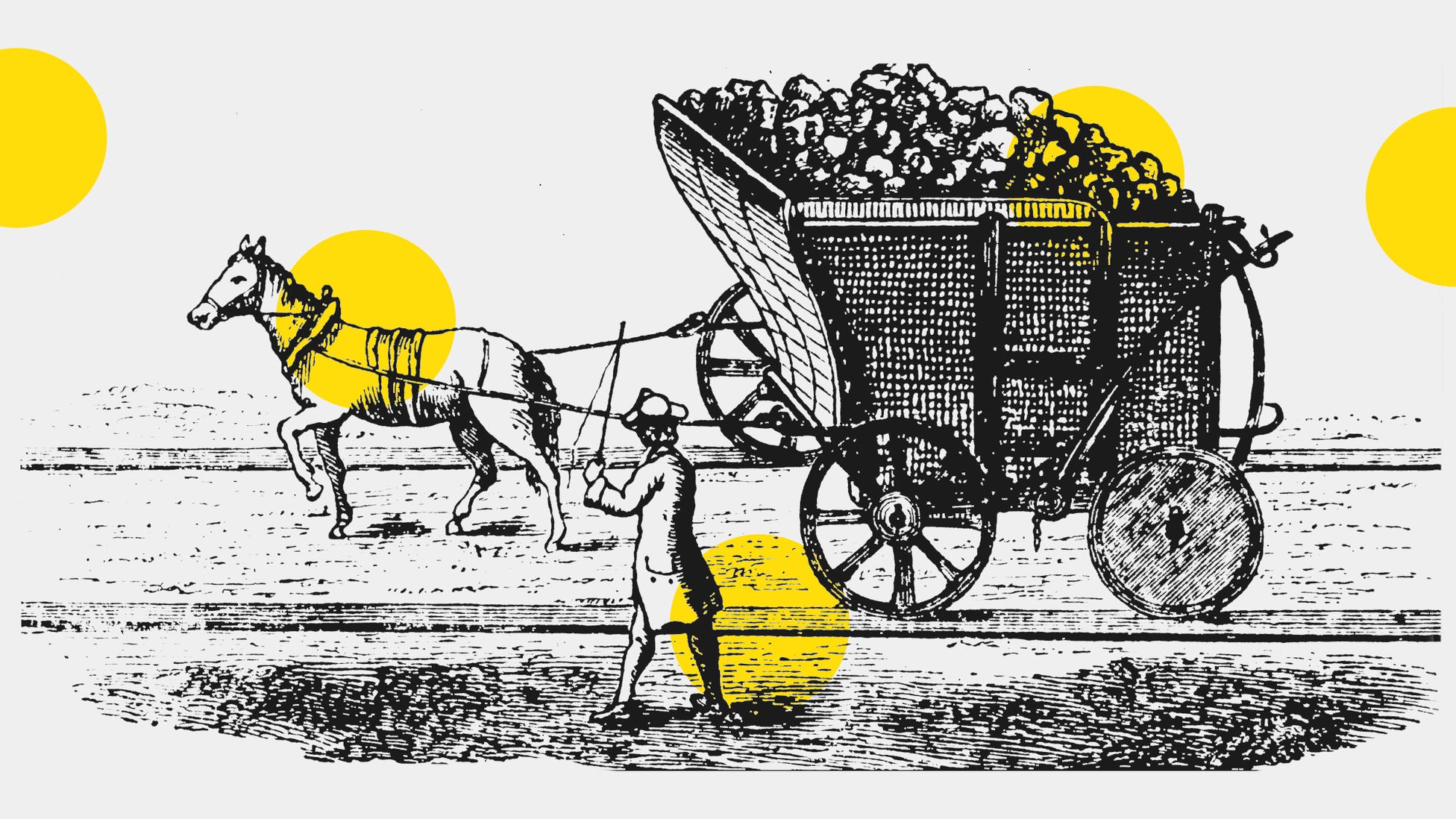
What happened then as steam engines moved from horribly inefficient to not? Newcomen’s ca. 1750 engines were 0.5% in terms of thermal efficiency. Watt’s engines as of 1800 were 2% efficient. According to Vaclav Smill, Corliss had gotten this up to 10% by 1850. Cleveland says the 20% for steam was reached by 1900, and today’s typical U.S. fossil-fuel power plant is at 40%.
More efficient steam engines made coal cheaper per unit of work, which in turn made coal-powered activities more attractive, which in turn greatly expanded coal consumption. Whether the market price of the resource rises or falls with increasing efficiency of utilization depends on the elasticity of demand, which depends on the shape of the set of potential uses that are currently unprofitable.
But which side of Jevons’s Paradox—making a resource more efficient and cheaper to use can end up increasing, not decreasing, demand for it—are human workers on these days? The steam engine would make you rich if you were a coal baron; the steam engine would make you poor if you were a horse breeder:
Annie Lowrey: How to Guess If Your Job Will Exist in Five Years <https://www.theatlantic.com/ideas/2026/03/ai-job-loss-jevons-paradox/686520/>: ‘Ask yourself: Are you coal, or are you a horse?…
American farms employed 26,493,000 equines in 1915. One hundred years later, the number of such animals on the payroll had collapsed to 700,000…. Horses… stubborn as mules… did not see the writing on the barn wall and start applying for factory jobs. They didn’t learn to code or attend community college. They stood there and ate carrots…. Searches for the phrase Jevons paradox are looking a lot like searches for the phrase job apocalypse…. Broadband, mobile data, and semiconductors are Jevons-paradoxical…. Faster networks have led to people watching short-form videos every waking moment, meaning we need more bandwidth. Advanced chips that turn everything into a tiny computer means that someone can hack your coffee maker and demand a ransom, meaning we need more chips….
People can be horses and coal and a thousand other things, because AI will have different effects on different workers in different industries in different places and in different times…. The most common job in the Bay Area isn’t AI-systems architect. It’s home health aide…
It was steam-engine pioneer James Watt coined and quantified “horsepower” as a sales gimmick to sell steam engines. Watt needed a unit that mine owners and millers could grasp. His customers knew what a team of horses could do; they did not know what “foot‑pounds per second” were. So he went to where the horses were working—mills and mines—and watched a horse walking in circles turning a mill wheel: about 2.4 revolutions per minute on a wheel with a 12‑foot radius—.4 × 2π × 12 feet, pulled with what he judged to be around 180 pounds-force. Force times distance divided by time is the power rate. Standardized at 550 foot‑pounds per second tha becomes “horsepower.” But the point was not science but rather marketing: this machine will do the work of N horses but is fueled not by oats but by coal.
Computer programming, so far, is a Jevons’s Paradox story. Each wave of tooling makes the marginal unit of “useful software” cheaper to produce. But instead of eliminating programmers, it widens the range of things we can feasibly build and deploy. Demand for software, and for people who can wrangle it, keeps going up—at least so far. AI is not replacing the human; it is shifting what the valuable human knows and does.
Here’s one thing to focus on: It is all called “programming”. And in a sense, it is. But the earliest “computer people” were literally humans flipping switches and setting dials. Then they were Fortran programmers. Then they were people who knew C, then JavaScript and its proliferating frameworks. Now we see the coming “vibe coders”: people who can tell an AI coding assistant what to build in reasonably precise language, and who know enough about what’s happening one, two, or three abstraction layers below to fix things when the AI’s output is garbage, as it always is.
But Jevons’s paradox is not a universal law of nature. It is a tendency that operates under particular conditions: when demand is elastic, when regulation does not slam on the brakes, and when the new technology opens up new, valuable uses rather than exhausting them. And it cannot operate unchecked forever. If you keep spending more of your income on a single thing as its price falls, arithmetic eventually bites: you’d devote essentially all of your budget to that one thing.
At the broadest level, there is one sense in which we have done the Jevons’s Paradox thing to the maxx over the past five-thousand years. What is the category we became more efficient at producing? Not-Raw-Food. We spent only 20% of our collective human budget on Not-Raw-Food in the year -3000. We spend only 5% on it today. Enormous efficiencies in making Not-Raw-Food. Enormous increases in demand for everything we make and do that is not raw food. And so we have had no trouble finding “something else to do” for the 20% of the workforce that were not farmers back in the year -3000. We have, in fact, found so much to do that their relative numbers have nearly quintupled.
We have, however, had trouble ensuring that all of those “something elses” pay decently and come bundled with status and security. And so the big question is: what is the income distribution in the resulting “attention–bio–infotech” economy? Does it look more like Kodak in mid-20th-century Rochester, producing broad middle-class prosperity for engineers and skilled workers? Or does it look more like Apple, producing a handful of multi-billionaires in Cupertino and a long tail of precarious gig work elsewhere
That is less a technological question than a political-economic one.
So, coal or horse?
Put all this together, and what I wish I had given as a short summary answer when Annie Lowrey called me is roughly this:
In the short- to medium-run, the occupations that can use AI as a complement—software engineering, many kinds of analysis, some forms of medicine and design—look more like coal. AI raises their productivity and expands the range of tasks they can tackle, which can increase demand for their services.
Over longer horizons, any given bundle of tasks is at risk of becoming horse-like as basic needs saturate and as capital-intensive substitutes mature. This has happened to agriculture, to many forms of manufacturing, and to clerical work. There is no reason knowledge work is magically exempt.
The binding constraints are likely to be distributional and institutional, not technological. The anthology superintelligence we already have—our accumulated knowledge of humanity, plus our tools to access it—can sustain extraordinarily rich, varied lives. The hard question is who gets how much of which kind of life, under what rules.
That is where the issue truly bites: technology keeps expanding the feasible set of things we can do with our time and income, but without deliberate institutional design, it does not guarantee that those things will be fairly shared, or that the people whose “coal” has just become vastly more productive will actually see their share of the gains.
References (by AI):
CLEVELAND, CUTLER. 2023. “Maximum efficiencies of engines and turbines, 1700–2000.” Visualizing Energy. June 26. <https://visualizingenergy.org/maximum-efficiencies-of-engines-and-turbines-1700-2000/>.
JEVONS, W. STANLEY. 1865. The Coal Question: An Inquiry Concerning the Progress of the Nation, & the Probable Exhaustion of Our Coal-Mines. London: Macmillan & Co.<https://archive.org/details/in.ernet.dli.2015.224624>.
LOWRIE, ANNIE. 2026. “How to Guess If Your Job Will Exist in Five Years.” The Atlantic. March 25. <https://www.theatlantic.com/ideas/2026/03/ai-job-loss-jevons-paradox/686520/>.
PETZOLD, CHARLES. 2000. Code: The Hidden Language of Computer Hardware & Software. Redmond, WA: Microsoft Press. <https://archive.org/details/CharlesPetzoldCodeTheHiddenLanguageOfComputerHardwareAndSoftwareMicrosoftPress2000>.