
CROSSPOST: Paul Ford: The A.I. Disruption We’ve Been Waiting for Has Arrived
The New York Times’s subhead: “We’re entering a new renaissance of software development. We should all be excited, despite the uncertainties that lie ahead.” It took a century starting back in 1875 for 20% of the jobs in the economy to be destroyed or completely upended by the technological kernel of the classic industrial revolution: coal-steam-textile-machinery-iron-railroad. Ever since 1875 it has taken not a century but a generation: about four-fifths of the economy sees incremental growth at about one-percent per year while the structures and organizations remain much the same, while one-fifth of the economy gets fully destructed and leveled to rubble and then rebuilt and created in previously unimagined futuristic mode to do five times as much, or more.
This generation it is knowledge workers who are in the bullseye of this Schumpeterian creative destruction process…
The first foreshock in this category came with radio and its impact on the vaudeville performers of a century ago as communications and computers began to do what computers and communications would do.
Since then, the computer-and-communications-and-internet leading sector kernel has gotten rid of rooms-full of of people punching keys on adding machines and typewriters, inserting plugs into switchboards, producing and filing documents—the few secretaries, AAs, and EAs left are now “admins” coordinating and gatekeeping—sorting mail, consulting actuarial tables, calculating ballistics and stresses, hand-tabulating records, manually keeping books and ledgers, calculating payrolls, back-office transaction reconciliation, operating telegraphs, setting and compositing type, pasting-uo pages, operating linotype machines, cutting and splicing films with razor blades, developing images in darkrooms, routine travel bookings, punching keys on cash registers, hand-keying and processing orders, manually counting inventories, controlling transportation signals, writing up index cards, taking dictation, sampling and cross-checking from large paper datasets, manually configuring networks and devices, operating keypunch msachines, coding surveys, answering directory assistance calls, routine translation.
Jobs whose core was symbol manipulation, creation, and transformation in physical form or abstract representation under a short set of fixed rules—typing, sorting, adding, routing, filing, simple querying—are the ones computers and networks take first. The work did not disappear; the job structures did. Some share of tasks migrateed “up” into fewer, more highly skilled roles; much migrated “out” to self‑service by end users; some migrated “down” into algorithms and ‘bots.
And jobs with a major task component consisting of symbol manipulation under fixed rules were transformed, sometimes utterly.
All that happened.
But what is happening now is that, as we move into the attention info-bio tech economy proper, the skilled white-collar information-processing jobs move under the bullseye. A surprisingly large number of them now appear to involve lots of tasks that are not manipulating under a short set of fixed rules but rather manipulating in ways that turn out to have surprisingly low Kolmogorov complexity. Those are being utterly transformed even without the coming of anything that anyone other than a grifting hypester would label “Artificial General Intelligence”. And, as those who know how to do them well become 10x as productive and those who can learn barely enough how to do them at all become good enough to cobble along, some of these job categories greatly shrink and those in or planning to be in them need to find other things to do, while others substantially expand in number and create potential gold rushes—all depending on which side of the demand-elasticity Jevons’s-Paradox canyon-gulf they land on.
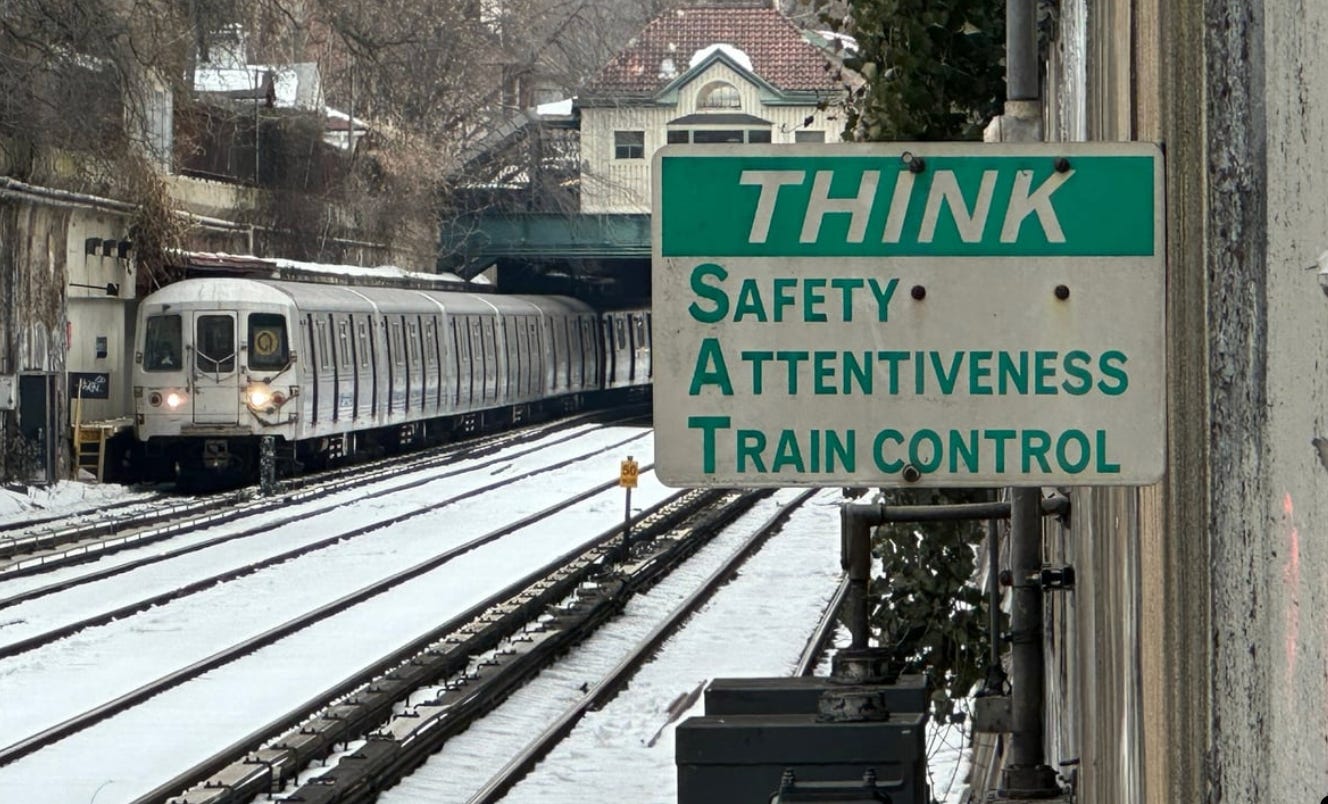
Now comes the OG blogger Paul Ford <http://ftrain.com> to blog his reactions to being at the center of this:
Paul Ford: The A.I. Disruption We’ve Been Waiting for Has Arrived <https://www.nytimes.com/2026/02/18/opinion/ai-software.html>: ‘“Vibe coding” [is] a term coined a year ago by the artificial intelligence expert Andrej Karpathy. To vibe code is to make software with prompts sent to a specialized chatbot… and letting the bot work out the bugs…. Claude Code from Anthropic… in November it suddenly got much better, and ever since I’ve been knocking off side projects that had sat in folders for a decade or longer. It’s fun to see old ideas come to life, so I keep a steady flow. Maybe it adds up to a half-hour a day of my time, and an hour of Claude’s…. The bot can run for a full hour and make whole, designed websites and apps that may be flawed, but credible…. The tech industry is a global culture — an identity based on craft and skill. Software development has been a solid middle-class job for a long time. But that may be slipping away. What might the future look like if 100 million, or a billion, people can make any software they desire?…
When you watch a large language model slice through some horrible, expensive problem — like migrating data from an old platform to a modern one — you feel the earth shifting…. I rebooted my messy personal website a few weeks ago… I would have paid $25,000 for someone else to do this. When a friend asked me to convert a large, thorny data set, I downloaded it, cleaned it up and made it pretty and easy to explore. In the past I would have charged $350,000. That last price is full 2021 retail — it implies a product manager, a designer, two engineers (one senior) and four to six months of design, coding and testing. Plus maintenance…. Today… when the stars align and my prompts work out, I can do hundreds of thousands of dollars worth of work… for the price of the Claude $200-a-month plan. That’s not an altogether pleasant feeling…. Former employees… designers and JavaScript coders. I could not hire the majority of them now, because I would have no idea how to bill for their time…. [Perhaps] A.I. will create tons of new jobs. But no one thinks they’ll be the same as the old jobs. Is the software I’m making for myself on my phone as good as handcrafted, bespoke code? No. But it’s immediate and cheap. And the quantities, measured in lines of text, are large….
For lots of users, that’s going to be fine…. They’re looking to achieve a goal. Code just has to work…. No matter where you work, my hunch is this is coming for you…. I’ve spent my last few years working with a team to build an A.I. software platform, trying to help clients and customers navigate…. Sounds like the perfect job for the moment, right? It’s not. Every six months, some new A.I. bomb goes off in our industry, and we have to metabolize the change, reset our product, change our strategy and marketing and adapt, at great expense…. Everyone is fried….
I collect stories of software woe. I think of the friend at an immigration nonprofit who needs to click countless times, in mounting frustration, to generate critical reports. Or the small-business owners trying to operate everything with email and losing orders as a result. Or my doctor, whose time with patients is eaten up by having to tap furiously into the hospital’s electronic health record system. After decades of stories like those, I believe there are millions, maybe billions, of software products that don’t exist but should: dashboards, reports, apps, project trackers and countless others. People want these things to do their jobs, or to help others, but they can’t find the budget. They make do with spreadsheets and to-do lists….
I’m writing all kinds of code I never could before — but you can, too. If we can’t stop the freight train, we can at least hop on for a ride. The simple truth is that I am less valuable than I used to be. It stings to be made obsolete, but it’s fun to code on the train, too. And if this technology keeps improving, then all of the people who tell me how hard it is to make a report, place an order, upgrade an app or update a record — they could get the software they deserve…