
Econ 196 :: Societies of Domination :: Pre-Class Assignment—do before 2026-02-15 23:59 PST
What I am teaching in my seminar these days: predatory thugs with spears and transitory economic booms with limits—agrarian-age antiquity as both domination and efflorescence…
READINGS: Mandatory:
DeLong J. Bradford. 2023. “Viewing Sparta, & Ancient Society More Generally”. DeLong’s Grasping Reality. August 10. <[braddelong.substack.com/p/viewing...](https://braddelong.substack.com/p/viewing-sparta-and-ancient-societyLinks) to an external site.>.
DeLong J. Bradford. 2023. “Grokking the History of Antiquity: Ancient Stories of Élites Already More than Half-Transformed into Myth”. DeLong’s Grasping Reality. July 26. <[braddelong.substack.com/p/should-...](https://braddelong.substack.com/p/should-we-read-steven-pressfieldsLinks) to an external site.>.
Jongman, Willem. “Gibbon Was Right: The Decline & Fall of the Roman Economy”. In Crise et transformation des sociétés archaïques de l’Italie antique au Ve siècle av. J.-C.: Actes de la table ronde en l’honneur de Raymond Bloch, edited by John H. D’Arms and E. Christian Kopff, 183–199. Rome: École Française de Rome <[bcourses.berkeley.edu/files/938...](https://bcourses.berkeley.edu/files/93874526/download?download_frd=1)>
Temin, Peter. 2013. “Economic Growth in a Malthusian Empire”.
Chapter 10 in Peter Temin, The Roman Market Economy. Princeton, NJ: Princeton University Press. <[bcourses.berkeley.edu/files/938...](https://bcourses.berkeley.edu/files/93874581/download?download_frd=1)>.
The pairing of these four readings is designed to force students to hold two seemingly contradictory ideas in their heads at once: that the long agrarian age was structurally a set of societies of domination in which a small and largely predatory élite took one-third or so of the crops and the crafts by force and fraud, and that within that structure there were real, if temporary, efflorescences in which material life genuinely improved for many people we would call “middle class”, and not just for the largely predatory élite.
The two DeLong weblog posts are doing conceptual and moral groundwork:
“Viewing Sparta, & Ancient Society More Generally” tries to strip away the heroic glaze from classical antiquity.
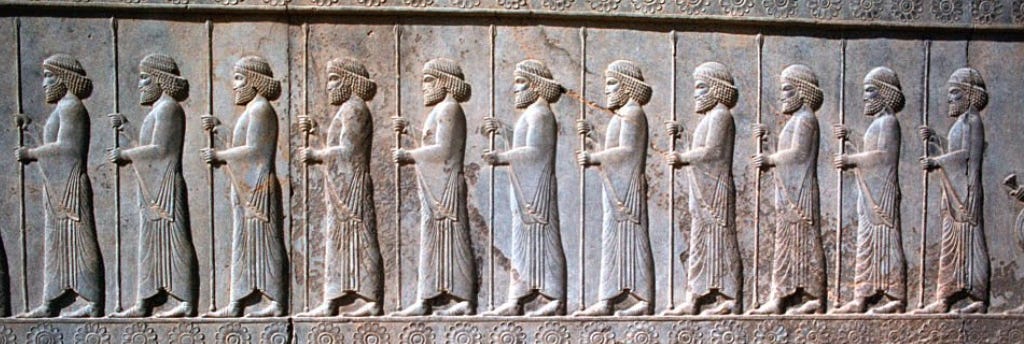
Elites are recast as gangs of “thugs with spears” and their retinues, extracting as much as they can from peasants and craftsmen subject to a Malthusian resource constraint. The point is not just to debunk Sparta, but to reframe almost all pre‑industrial élites—Greek, Persian, Davidic, Roman—as variants on the same extraction game, constrained only by the need not to kill the host society on which they depend.
“Grokking the History of Antiquity” then turns to how those same elites narrate themselves.