
A Brief Note on the Near-Absence of Pre-1500 "Economic Growth"
& some of my musings on how to teach it. The long agrarian-age Malthusian night of the trap, of the ensorcellment: thugs, patriarchs, & standard-of-living stagnation, that is. For 5,000 years, from Gilgamesh to imperial-commercial age Britain, echnology advanced, empires rose, and elites feasted—while the median human stayed stuck at “barely enough”, as population growth, patriarchy, and predation turned every gain in know‑how into more bodies alarmingly close to the edge of subsistence…
I continue to grope my way forward with my experimental “Econ 196” attempt to take a much more data‑sciency approach to economic history than is usual in the field. The aim is to use the modern “data science” toolkit—sampling, estimation, simulation, and counterfactual modeling, mostly via Python and Jupyter—not as an add‑on but as a central way of thinking through the long‑run trajectory of the world economy, from agrarian Malthusian regimes to industrial and post‑industrial growth. My hope is that this will give both humanists and quants a shared Royal Road into global economic history: accessible enough for students who have never coded before, but with enough analytical bite that numerate students will not be bored.
Will it succeed? I do not know.
Now I have reached the “Long Agrarian Age Malthusian Stagnation” section of the course, and so I am musing—much to myself—as to what I should do with it:
Pre-Industrial Economic Growth
At one level, the history of pre-industrial economic growth is relatively easy to summarize: Up until at least 1500, there was essentially none—if “economic growth” is taken to be a significant sustained improvement in the material living standards of a typical human.
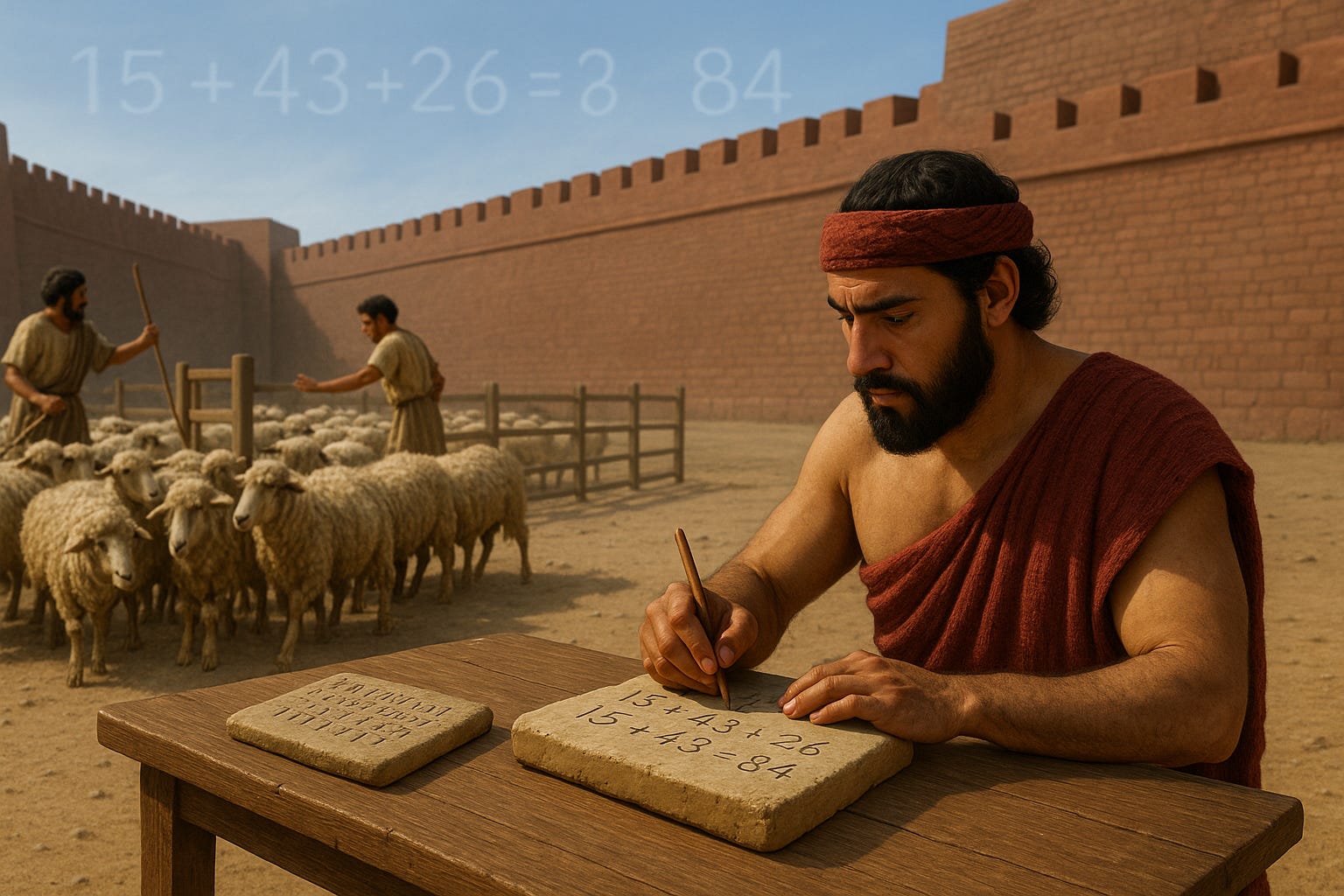
“WAIT!!!! WHAT?!?!” Explaining What I Mean by This
Before 1500, there was technological growth. There was artistic growth. There was intellectual and conceptual growth. There was imperial growth. There was organizational growth. There was political growth—although that was not necessarily a good thing, if you understand “politics” to be mostly a matter of domination and redistribution.
But there was not, or at least there was very little, economic growth as we would term it. A typical human in 1500—hell, 1875—had a material standard of living not that much different from that of the typical human back in –3000. As far as necessities and simple conveniences are concerned, typical peasant and craftsman living standards in the age of Gilgamesh of Uruk in Mesopotamia and Narmer of Inebu‑hedj (the city that was later to be called Men-Nefer, which the Hellenes heard as “Memphis”), the probable first king of Kemet (which the Hellenes, for no comprehensible reason, called “Aígyptos”).
(For the élite, by contrast, the life-styles of the rich and famous did get and kept getting much more convenient and luxurious. over time)
What kept there from being “economic growth” before 1500?
My tentative answer is that, back before 1500, the world economy was under Malthusian pressure that kept humanity desperately poor. Agrarian-Age technological progress was slow: on the order of 5% per century before 1500. That meant, before 1500, that a 10% percent per century rate of growth in the human population would reinforce resource scarcity enough to offset the benefits that better technology would otherwise have yielded in higher material living standards.
Such 10% per century increases in human population were almost inescapable.
Why was sufficient population growth to offset the slow progress of technology, in terms of its effect on typical living standards, near-inevitable back then?
That was itself an indirect consequence of the slowness pre–1500 of technological advance.
People really like to make love. People really, really like to make love. Patriarchy prioritizes surviving sons. In the dire poverty of pre-modern patriarchal societies, it is nearly social death for women—and, substantially, for men—to reach late middle-age with no surviving sons. Reflect that under conditions of slow technological development, and thus slow population growth, one-third of humans will wind up without surviving sons.
Hence, whenever there were extra resources to support raising more children, people were under enormous pressure to use them to do so. This was Thomas Robert Malthus’s key insight: population expands until it reaches the limits of subsistence. Slow technological progress means that that “until” arrives in, at most, a few generations.
The only potentially bright spot in the picture is that “subsistence” is as much a sociological as a biomedical and nutritional concept. Malthus strongly believed that the right sociological institutions were patriarchy, monarchy, and orthodoxy. Patriarchy was to delay, the age of female marriage, and so reduce female, fertility without requiring women to be so skinny that ovulation was hit or miss. Monarchy was to reinforce patriarchy, as the king as father of the country figured the father as king of the household. Orthodoxy to threaten women who engaged in premarital sex with hell.
This dire poverty meant that pre-modern politics and governance were a poisonous weed. In a world in which there cannot be enough for all, at the foundation politics and governance can be little more than an élite elbowing competitors out of the way, and running a force-and-fraud exploitation game on the rest of humanity.
This élite of thugs-with-spears (and later thugs-with-gunpowder-weapons), along with their tame accountants, bureaucrats, and propagandists—they could have enough. And with their enough they could build and enjoy their high culture. But those who controlled the commons, and had enough so that they could have the leisure to write the literatures that have come down to us—those were hard men, who reaped where they did not sow, and gathered where they did not scatter. They made typical human life fairly dystopian back in the long Agrarian age, even after taking account of the general poverty.
But why was technological progress slow back then?
A good deal of the answer is that they simply were not enough people and not enough sufficiently educated people to have the energy and time to think about solving the problems of advancing technology. Two heads are not twice as good as one, quite. But two heads are considerably better than one. And heads that are not exhausted by the combination of hard work and a scant diet have more energy to think, plan, experiment, and evaluate.
Plus we humans are much smarter when we think together. Thinking together requires that we be able to communicate not just within our own little band or village, but communicate across space and across time. To the extent that humanity is more numerous, richer, better educated, and better able to communicate across space and time, we can become a truly remarkably intelligent anthology intelligence.
In the years since 1875, that ability to transform ourselves into such an anthology intelligence has allowed us to power technological progress forward at 2% per year on average, even though the low-hanging technological fruit has long been harvested, and even though a great deal of the technological fruit we are now harvesting is a very, very high indeed.
But there is more than a lack of numbers, lack of education, lack of energy and leisure, and lack of the means of communication and memory behind the slow rate of technological progress back before modern economic growth. In a society where the typical activity of those who deploy resources is to use them to grab enough for themselves from everybody else, the ideas that will be promoted will not be ideas that are true, but rather ideas that are useful for that grabbing process. The consequences of general poverty for inequality, and the consequences of inequality for ideas and for the direction of societal effort are major drags on even the possibility of technological development.
Now What to Give Students to Read?
But what should I give modern students to read that they will read to drive these points home?
And by now I find I have made a great many—too many—attempts at laying all of this out. Plus there are the other takes at it that I regard as standard workhorses. Everything I think is good. Everything I think is valuable. But the overlap is much too large. And students’ attention-spans are not what I would wish.
Here is my current list, ranked by my guesses of a combination of approachability by students and usefulness to them.
Start with a relatively “humanistic” summary:
DeLong J. Bradford. 2024. “The Great Agrarian-Age Vine-&-Fig Tree Shortage”. June 18. <https://braddelong.substack.com/p/hoisted-from-the-archives-ensorcelled.>
Then go into the numbers and the models:
Clark, Gregory. 2007. “Living Standards”. Chapter 3 in: Clark, Gregory. 2007. A Farewell to Alms: A Brief Economic History of the World. Princeton: Princeton University Press. <https://bcourses.berkeley.edu/files/93800462/>
DeLong J. Bradford. 2023. “Ensorcelled by the Devil of Malthus”. DeLong’s Grasping Reality. July 2. <https://braddelong.substack.com/p/ensorcelled-by-e-devil-of-malthus.>
DeLong, J. Bradford. 2023. “DAY 3: LECTURE NOTES: 2. Ensorcelled by þe Devil of Malthus: 2.1. The Logic of the Malthusian Economy.” DeLong’s Grasping Reality. January. <https://braddelong.substack.com/p/day-3-lecture-notes-the-logic-of>.
DeLong, J. Bradford. 2023. “LECTURE NOTES: Lessons from Simulating a Malthusian Economy.” DeLong’s Grasping Reality. <https://braddelong.substack.com/p/lecture-notes-lessons-from-simulating>.
DeLong J. Bradford. 2023. “1. Guesstimating Typical Living Standards in the Agrarian Age”. DeLong’s Grasping Reality. September 28. <https://braddelong.substack.com/p/1-guesstimating-typical-living-standards>.
Plus I want to note that there is a debate—one that I (naturally) think I won:
Guthmann, Rafael R. 2023. “The Great Waves in Economic History.” Rafael’s Commentary. February 20. <https://rafaelrguthmann.substack.com/p/the-great-waves-in-economic-history>
DeLong, J. Bradford. 2025. “Yes: Pre‑Modern Economies Were Meaningfully ‘Malthusian’ (Which Does Not Mean Incomes Were Stable).” DeLong’s Grasping Reality. February 4. <https://braddelong.substack.com/p/hoisted-from-the-archives-yes-pre>.
And add a relatively recent update on whether or not there is still anyplace in the world where the Malthusian model is now relevant:
Chatterjee, Shoumitro & Tom Vogl. 2018. “Escaping Malthus: Economic Growth and Fertility Change in the Developing World”. American Economic Review. 108:6 (June), pp. 1440–67. <https://www.aeaweb.org/articles?id=10.1257/aer.20170748>.
Then reserve other workhorse works for background, and for going deeper:
Clark, Gregory. 2007. “The Logic of the Malthusian Economy”. Chapter 2 in: Clark, Gregory. 2007. A Farewell to Alms: A Brief Economic History of the World. Princeton: Princeton University Press. <https://bcourses.berkeley.edu/files/93800463/>.
Clark, Gregory. 2007. “Fertility”. Chapter 4 in: Clark, Gregory. 2007. A Farewell to Alms: A Brief Economic History of the World. Princeton: Princeton University Press. <[bcourses.berkeley.edu/files/938...](https://bcourses.berkeley.edu/files/93800461/>).
Clark, Gregory. 2007. “Life Expectancy”. Chapter 5 in: Clark, Gregory. 2007. A Farewell to Alms: A Brief Economic History of the World. Princeton: Princeton University Press. <[bcourses.berkeley.edu/files/938...](https://bcourses.berkeley.edu/files/93800460/>).
Max Roser. 2020. “Breaking out of the Malthusian trap: How pandemics allow us to understand why our ancestors were stuck in poverty”, Our World in Data. <https://ourworldindata.org/breaking-the-malthusian-trap>.
Wikipedia. 2025. “Malthusianism”. <https://en.wikipedia.org/wiki/Malthusianism>
CORE. 2018. “Econ Handout: The Economics of the Malthusian Trap”. <https://www.core-econ.org/wp-content/uploads/asgarosforum/27/MALTHUS-Reading.pdf>.
Is this the right order to rank these? And how many of them can I assign? I mean, I am now up to nine required pieces, even though all except the Clark chapter are very short.
And then there are the questions to ask them to think about before class:
Land and diminishing returns: Why is a fixed factor like land central to Malthusian dynamics, and how does that assumption generate the wage‑population feedback highlighted in the readings?
Demographic response: Describe the mechanisms by which fertility and mortality respond to changes in real income in the pre‑modern settings discussed. Which margin (fertility vs mortality) seems more important in the examples you read?
Luxuries and norms: How can rising demand for “luxuries” or shifts in social norms (e.g., later age at marriage) raise average living standards in a Malthusian world without implying an escape from the Malthusian regime?
Inequality within Malthusian systems: How do the readings suggest elite living standards and mass living standards can move differently under Malthusian constraints, and what implications does that have for interpreting archaeological or literary evidence?
Consider Guthmann and DeLong. In what senses do you think DeLong is too full of himself, and needs to rethink his position and move closer to Guthmann’s non-Malthusian take on global economic history in the long -3000 to 1500 agrarian age?
Consider Chatterjee and Vogl: what do you think could go wrong with how the world works over the next twenty-five years that could restore the relevance of Malthusian models and thinking to understanding significant parts of our world?
Are these the right questions to ask them to think about before next Tuesday’s class?