
The Spearpoint Right Now of Human Technological Engineering
From Veldhoven, in the Brainport Eindhoven region of the Netherlands, comes the bleeding-edge point of the spear of human technological capabilities: the manipulation of nature and the organization of the human economic division of labor at a truly insane and unbelievable—and that is not hyperbole: I simply do not believe that Naked East African Plains Apes with brains of only 1400 cc each and neuronal processing clock speeds only one-ten-millionth as fast as NVIDIA Blackwells in our data centers actually manage to do this…
The stack is vertical and unforgiving. Cymer → Zeiss → ASML → TSMC (right now using CoWoS) → Shin-Etsu Chemical → NVIDIA chip-design → CUDA (NVIDIA’s software stack): Cymer makes the light. Zeiss makes the mirrors. ASML assembles the machines to make the EUV photolithography carve the right circuit paths. Shin-Etsu Chemical makes and slices the pure silicon crystal wafers for TSMC to imprint with the chips NVIDIA designs that then run CUDA. And it is, right now, the single most pricey economic value chain in the world today. And all parts of it are essential. (OK: Shin-Etsu faces competition, and you could with perhaps a 30% penalty replace TSMC with Samsung or Intel, and you could with perhaps a 75% penaltry replace NVIDIA’s chips-plus-CUDA with an alternative).
And yet, somehow, right now, rather than being divided up, NEARLY ALL THE MONIES FLOW TO NVIDIA.
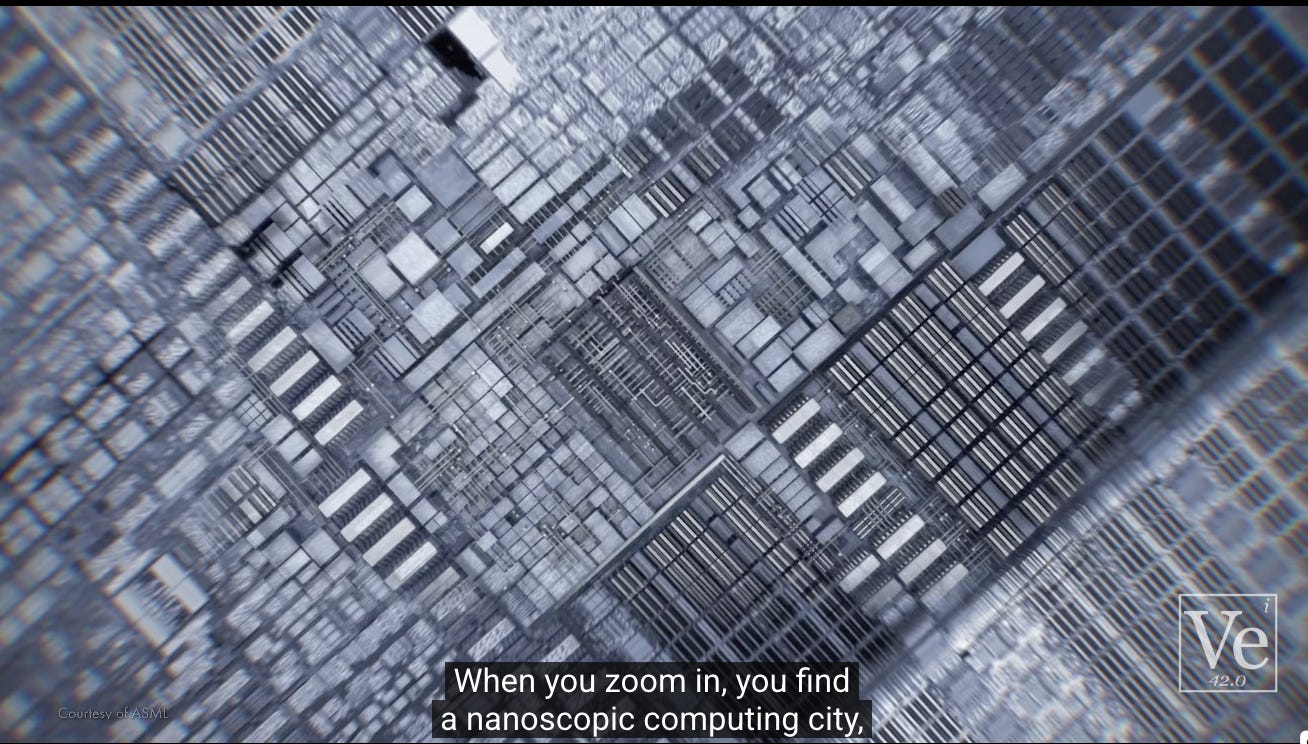
Rightly recommended by the Accidental Tech Podcast <https://www.youtube.com/channel/UC0QTVSHTjBKExtdExrBca5w> of John Siracusa, Casey Liss, and Marco Arment: the most mind-blowing hour you can spend learning about engineering today. It is all about the Twinscan NXE and EXE EUV (Extreme Ultra-Violet) photolithography silicon chip-making machines manufactured by ASML at its factories in Veldhoven in the Brainport Eindhoven region of the Netherlands, and elsewhere:
<https://www.youtube.com/watch?v=MiUHjLxm3V0>
Yes, “Brainport” is a Dutch term for regions built around dense collaboration between industry, universities, and government to create knowledge‑intensive growth.
ASML has no competitors in the making of EUV photolithgraphy. It and its partners own the business in a way that nobody else—not Applied Materials, even—can match.
It seems to be a matter of: