
Six Analytical Threads in Search of Useful Empirical Traction: On Karl Marx's 1859 "Preface"
Josef Schumpeterian creative-destruction vs. Karl Marxian base-superstructure: What history actually looks like as Marx’s 1859 vision promised imminent revolution followed by utopia, sketching six bold claims about how technologies drive economies drive societies. The evidence since 1870 points to rotating, sectoral upheavals—not synchronized social revolutions: sectoral churn and institutional lag. Historical materialism, soft-true; stage theory and millenarianism, not so much. Even stripped of millenarian theology of utopia, the Marxist apparatus explains far less than it promises…
Columbia’s Adam Tooze says this AM that he is thinking a lot about the 1859 Preface to Karl Marx’s abysmal A Contribution to the Critique of Political Economy.
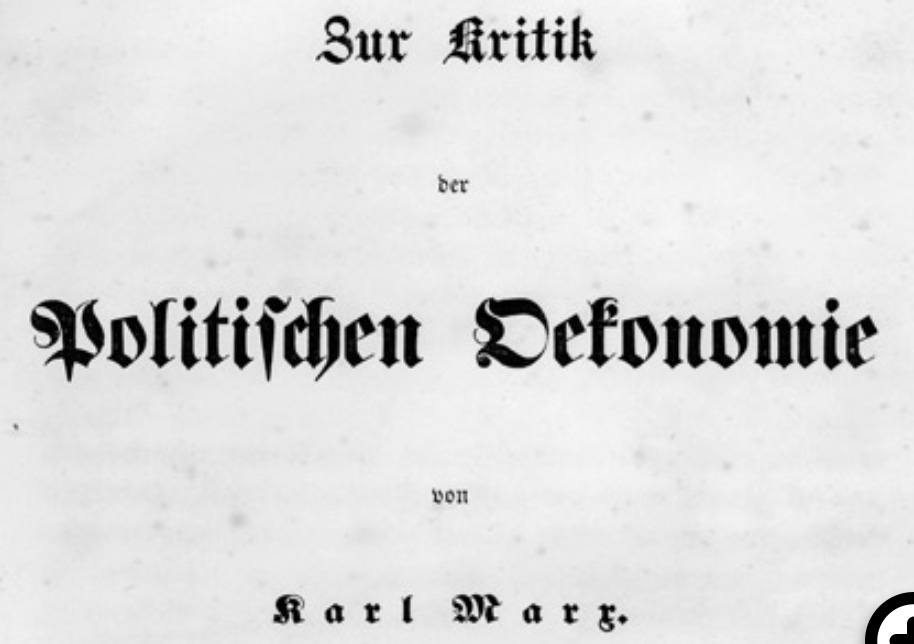
He does not say why:
Adam Tooze: Top Links 976 <https://adamtooze.substack.com/p/top-links-976-ai-investment-surges>: ‘[I] keep thinking of this passage right now: Karl Marx 1859, Preface to A Contribution to the Critique of Political Economy: “In… existence, men… enter into definite relations… independent of their will… appropriate to… their material forces of production. The totality of these relations of production constitutes the economic structure of society… on which arises a legal and political superstructure and… forms of social consciousness.... It is not the consciousness of men that determines their existence, but their social existence that determines their consciousness.
At a certain stage of development, the material productive forces… come into conflict with… relations of production or… the property relations… framework…. From forms of development… these relations turn into their fetters. Then begins an era of social revolution. The changes in the economic foundation lead sooner or later to the transformation of the whole immense superstructure….
It is always necessary to distinguish between the material transformation of the economic conditions of production… and the legal, political, religious, artistic or philosophic—in short, ideological forms in which men become conscious of this conflict and fight it out…. This consciousness must be explained from the contradictions of material life….
No social order is ever destroyed before all the productive forces for which it is sufficient have been developed, and new superior relations of production never replace older ones before the material conditions for their existence have matured within the framework of the old society. Mankind thus inevitably sets itself only such tasks as it is able to solve, since closer examination will always show that the problem itself arises only when the material conditions for its solution are already present or at least in the course of formation.
In broad outline, the Asiatic, ancient, feudal and modern bourgeois modes of production may be designated as epochs marking progress in the economic development of society.
The bourgeois mode of production is the last… form… antagonistic… in the sense… of an antagonism that emanates from the individuals’ social conditions of existence—but the productive forces developing within bourgeois society create also the material conditions for a solution of this antagonism. The prehistory of human society accordingly closes with this social formation…
But I can say why.
Let us look at the passage. (I have reparagraphed the passage to make the separate thoughts clearer.) Here we have, working backward:
Theology: a millenarian claim (made in 1859!) that the era in which human societies were societies of domination—ones profoundly shaped by the presence in them of an élite that successfully runs an exploitation-and-domination scheme on the rest, taking one third of the crops and one-third of the crafts for itself—is now about to end. Why? Marx himself never set out a rational argument—he pretty much limited himself to CAPITALISM BAD. (But Engels, two decades later, did make one in his Socialism: Utopian & Scientific.)
Stage Theory of History: The five pre-socialist modes of production—tribal was later added by Engels to Asiatic, ancient, feudal, and bourgeois—as the successive stages of human history before the socialist mode of production brings an end to the societies of domination, with history’s ages of social revolution driving the transitions between them.
Theology: In this case, refracted through Hegel’s thesis-antithesis-synthesis: the claim that history has an arrow, in that when a society’s relations of production become fetters constraining its economic development there has already been sufficient technological development to drive a social revolution which will produce new and progressive different relations of production.
Sociology & Ideology: The conflicts generated by the rupture between old relations of production and the requirements of the new, growing forces of production play themselves out in ideological forms—men “become conscious of this conflict and fight it out” in ways substantially removed from the actual material basis of the rupture.
Political Economy: As advancing technology and investment transforms the forces of production, the previous existing relations of production—the “property” order of society—no longer fits them. The relations of production constrain technological development and investment for a while, and then the pressure of constraining development breaks society’s property order via an era of social revolution.
Historical Materialism: The relations of production have to be fitted to the technology of society and thus to the way people experience their worklife. And then everything else—“legal and political superstructure and… forms of social consciousness”—has to be fitted to the combination of technology and the property order, to the forces and relations of production.
I would argue strongly—this is, in fact, an intellectual hill I would die on—that to pick up one (or more) of these six claims and then to try to develop it and demonstrate its truth and draw forth its implications for human knowledge, human society, human political action, and the human future is what it is to be a “Marxist” in any sense meaningful, other than grabbing that term as a positive or negative marker of tribal allegiance. If someone shows up calling themself a “Marxist”, and cannot demonstrate which of the threads from at least one of these six claims they are pursuing in their thinking—well, they should find something else to call themself.
Conversely, looking at the development of social science since 1870 or so, it is a fact that nearly everybody else doing historical social science worth reading who is not picking up and developing one of these six claims is spending a lot of their time trying to disprove and dispel one or more of them.
I would also argue strongly that (6) Historical Materialism is, in a soft sense, true: to be stable, human relations of production have to be fitted to the technology of society and thus to the way people experience their worklife; and the rest of society is not determined by the forces and relations of production, but is constrained by the necessity that it fit with them.
Moreover, I would also argue that (5) Political Economy is equally true, except for the “social revolution” part—changing technology does cause immense trouble for societal order as the rest of society finds itself no longer properly fitted to it. Then follows a reworking. But the reworking does not have to be driven by anything one would call “social revolution”.
As for (2) Stage Theory—well, setting up ideal-types of forms of techno-economic-societal orders that are in some sort of rough homeostasis, and thinking of history as the transitions from one to another, can be very useful. Indeed, it is next to impossible for us East African Plains Apes of very little brain to think at all coherently without it. But are “[tribal,] Asiatic, ancient, feudal, and bourgeois” the right stages? My rough guesstimations as to how different the techno-economic underpinnings are at a global scale gets us something more like:
Attention info-bio tech: 2040 (human technological capability index H = 35)
Globalized value-chain: 2000 (H = 15)
Mass-production: 1960 (7)
Applied science: 1920 (3)
Steampower: 1870 (1)
That’s an almost 2.5-fold shift for what seem to me to be meaningful differences at a global scale in the modern age.
But then, if we cast back looking for roughly equally large quantitative shifts in the deeper past, we get to:
H = 0.4 in 1400—I guess I am happy calling that “Mediæval”.
H = 0.15 in -1000—I guess I am happy calling that “Ancient”.
H = 0.06 in -5000—I guess I am happy calling that “tribal”.
But I do have a strong sense that we need to set up our ideal-type stage benchmarks differently before the modern age—that it is not just modes of production, but of distribution, communication, domination, and legitimation that matter. Hence I would be happier with:
1700: Commercial-imperial (H = 0.65)
1200: Feudal (H = 0.35)
-500: Ancient (H = 0.2)
-3000: Early bronze (H = 0.8)
-7000: Tribal (H = 0.065)
-48000: Gatherer-hunter (H = 0.03)
The shifts in society are profound, yet they come accompanied by changes in the value of known and applied technologies that seem to me, quantitatively, less than those seen between what I regard as the natural ideal-type benchmarks to set up in understanding history since 1870.
With (4), I think Marx has left reality behind: History and its conflicts are sometimes about forces and relations of production and the relationships of those to the “superstructure” that is the rest of society. History and its conflicts are sometimes really conflicts over forces and relations of production but are masked by ideologies so that they seem to be about something else. And history and its conflicts are sometimes not about forces and relations of production at all, but are really about other things—that when people fight over whether God is three-personned with the Father almighty, the Son giving us mercy, and the Holy Spirit bringing compassion, or whether al-‘Azīz, al‑Raḥmān, al‑Raḥīm are three principal attributes of divine unity, that is, usually, really what they are primarily fighting about. And (3) as well is nonsense on stilts: the arc of history does not bend toward justice, or even prosperity.
And (1), of course, was Millenarian theological fantasy.
Yet, as I said, a huge amount of effort over what is now one and a half centuries has gone into either trying to develop and prove these six threads or demolish and disprove them. Plus there is the historical fact that the writings of Karl Marx became the sacred texts of one of the most destructive world religions ever.
What else do I have to say about this? Three things—but let me delay those, because this has grown long enough as it is.
Note: The full quoted Marx passage as Tooze gives it:
Karl Marx (1859): Preface to “A Contribution to the CI am running a few minutes late; my previous meeting is running overitique of Political Economy”: ‘In the social production of their existence, men inevitably enter into definite relations, which are independent of their will, namely relations of production appropriate to a given stage in the development of their material forces of production. The totality of these relations of production constitutes the economic structure of society, the real foundation, on which arises a legal and political superstructure and to which correspond definite forms of social consciousness. The mode of production of material life conditions the general process of social, political and intellectual life. It is not the consciousness of men that determines their existence, but their social existence that determines their consciousness. At a certain stage of development, the material productive forces of society come into conflict with the existing relations of production or – this merely expresses the same thing in legal terms – with the property relations within the framework of which they have operated hitherto. From forms of development of the productive forces these relations turn into their fetters. Then begins an era of social revolution. The changes in the economic foundation lead sooner or later to the transformation of the whole immense superstructure.
In studying such transformations it is always necessary to distinguish between the material transformation of the economic conditions of production, which can be determined with the precision of natural science, and the legal, political, religious, artistic or philosophic – in short, ideological forms in which men become conscious of this conflict and fight it out. Just as one does not judge an individual by what he thinks about himself, so one cannot judge such a period of transformation by its consciousness, but, on the contrary, this consciousness must be explained from the contradictions of material life, from the conflict existing between the social forces of production and the relations of production. No social order is ever destroyed before all the productive forces for which it is sufficient have been developed, and new superior relations of production never replace older ones before the material conditions for their existence have matured within the framework of the old society.
Mankind thus inevitably sets itself only such tasks as it is able to solve, since closer examination will always show that the problem itself arises only when the material conditions for its solution are already present or at least in the course of formation. In broad outline, the Asiatic, ancient, feudal and modern bourgeois modes of production may be designated as epochs marking progress in the economic development of society. The bourgeois mode of production is the last antagonistic form of the social process of production – antagonistic not in the sense of individual antagonism but of an antagonism that emanates from the individuals’ social conditions of existence – but the productive forces developing within bourgeois society create also the material conditions for a solution of this antagonism. The prehistory of human society accordingly closes with this social formation.…
References:
Anderson, Perry. 1976. Considerations on Western Marxism. London: New Left Books. <https://archive.org/details/considerationson0000ande>.
Engels, Friedrich. 1880. Socialism: Utopian & Scientific. Bonn, Germany: Marxists Internet Archive. <https://www.marxists.org/archive/marx/works/1880/soc-utop/index.htm>.
Gilman, Nils. 2025. “How Did Academia Not See It Coming.” Small Precautions. March 7. <https://nilsgilman.substack.com/p/how-did-academia-not-see-it-coming>.
Marx, Karl. 1859. “Preface” to A Contribution to the Critique of Political Economy. Bonn, Germany: Marxists Internet Archive. <[www.marxists.org/archive/m...](https://www.marxists.org/archive/marx/works/1859/critique-pol-economy/preface.htm)>.
Tooze, Adam. “Top Links 976”. Chartbook. January 8. <https://adamtooze.substack.com/p/top-links-976-ai-investment-surges>.