
(Largely) HOISTED FROM THE ARCHIVES: “West”, “North Atlantic”, or “Dover Circle”?
Hoisted so I can find this easily in the future: From January 2023. With a little bit of reëditing:
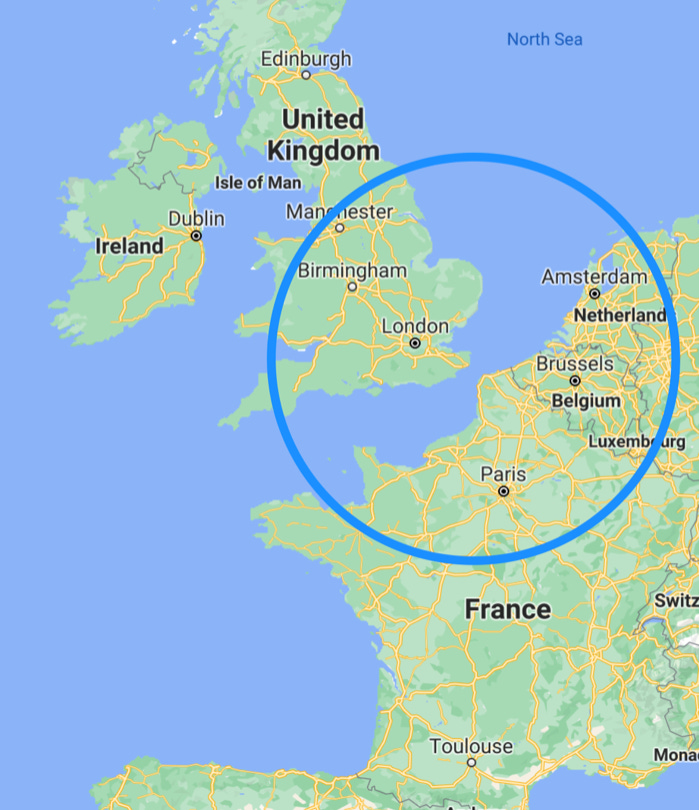
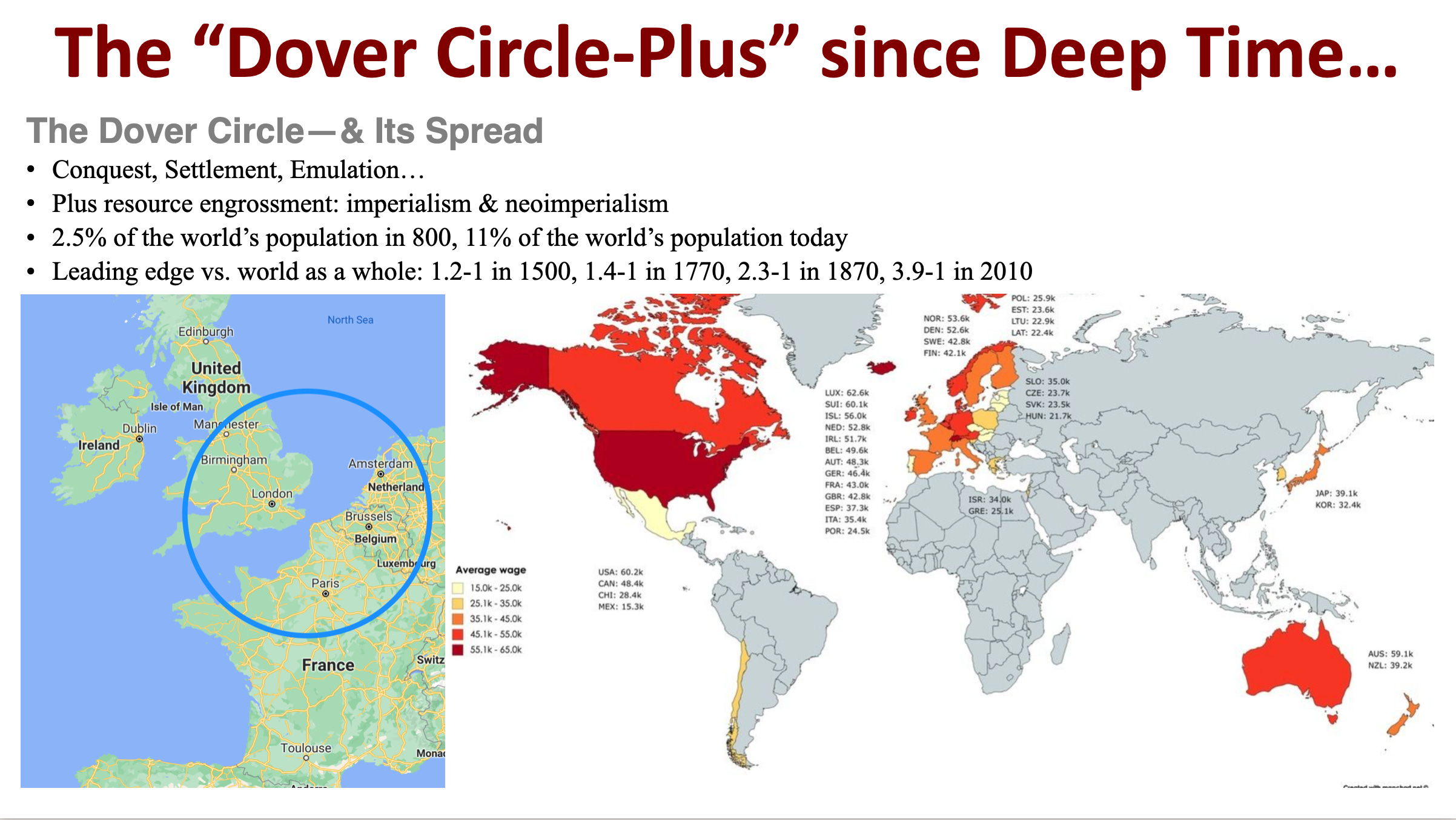
“West” or “Dover Circle”? A student asked me why, in my lectures earlier this week, I kept on referring to the “North Atlantic” rather than the “Western” economies. Why did I use the first to refer to those that have become vastly richer than the world average over the past 200 years? Even as of the early 1800s, “North Atlantic” made more sense than did “West”. By 1960, “North Atlantic” itself became less apposite. Would “Global North” be a good replacement? And in the 2000s things have changed still further: I have swung around to think that a more useful and informative label would be “Dover Circle-Plus”: those economies and societies that are, that have received very large settler inflows from, or that have strained every nerve to emulate the particular economic structures and patterns and practices that developed in the years after 1500 in a 300-mile radius circle centered on the port of Dover at the southeast corner of England:
When asked why I kept on referring to the “North Atlantic” rather than the “Western” economies, I responded: I was not aware that I had settled on “North Atlantic”— I had thought that I found myself bouncing around when I am not focusing on what descriptor to use.
I do, however, try to avoid “West”. Part it is that “West” is out-of-date. “West” comes from a time and a place now long ago: a time and a place when it was assumed that pretty much everything of interest was in Eurasia, and that the most important thing was the contrast between the western edge of Eurasia and everything else that was east—that was the “Orient”, from the Latin word for the direction from which the sun rose.
But even then, “West” as in “Western edge of Eurasia” did not really cut it.
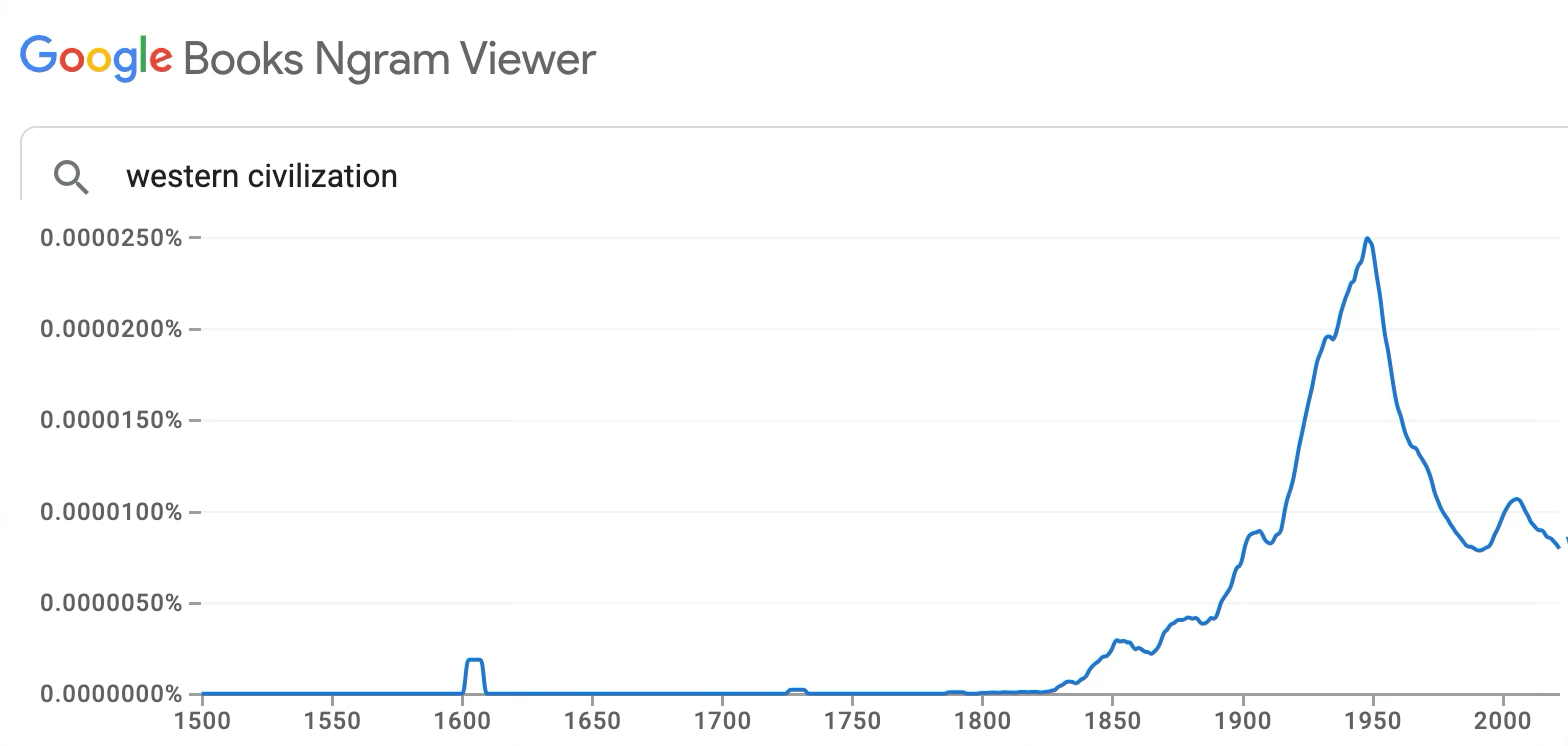
The phrase does not even begin to take off until after 1840 or so. And by then, there was no sense in which Portugal, Spain, Italy, and southern France were no longer securely among the relatively rich. The United States, and Canada too, were very rich indeed, and the United States’s population was growing rapidly. Even as of the early 1800s, “North Atlantic” made more sense than did “West”.
And today? “Global North”? “Global North” is not quite right either: New Zealand, Australia, Singapore, Hong Kong, and soon—we hope—Chile?
Here is a hill to defend: A more useful and informative label would be “Dover Circle-Plus”: those economies and societies that are, that have received very large settler inflows from, or that have strained every nerve to emulate the particular economic structures and patterns and practices that developed in the years after 1500 in a 300-mile or so radius circle centered on the port of Dover at the southeast corner of England.
But there is another reason to avoid much talk of the “West” and the “East”.
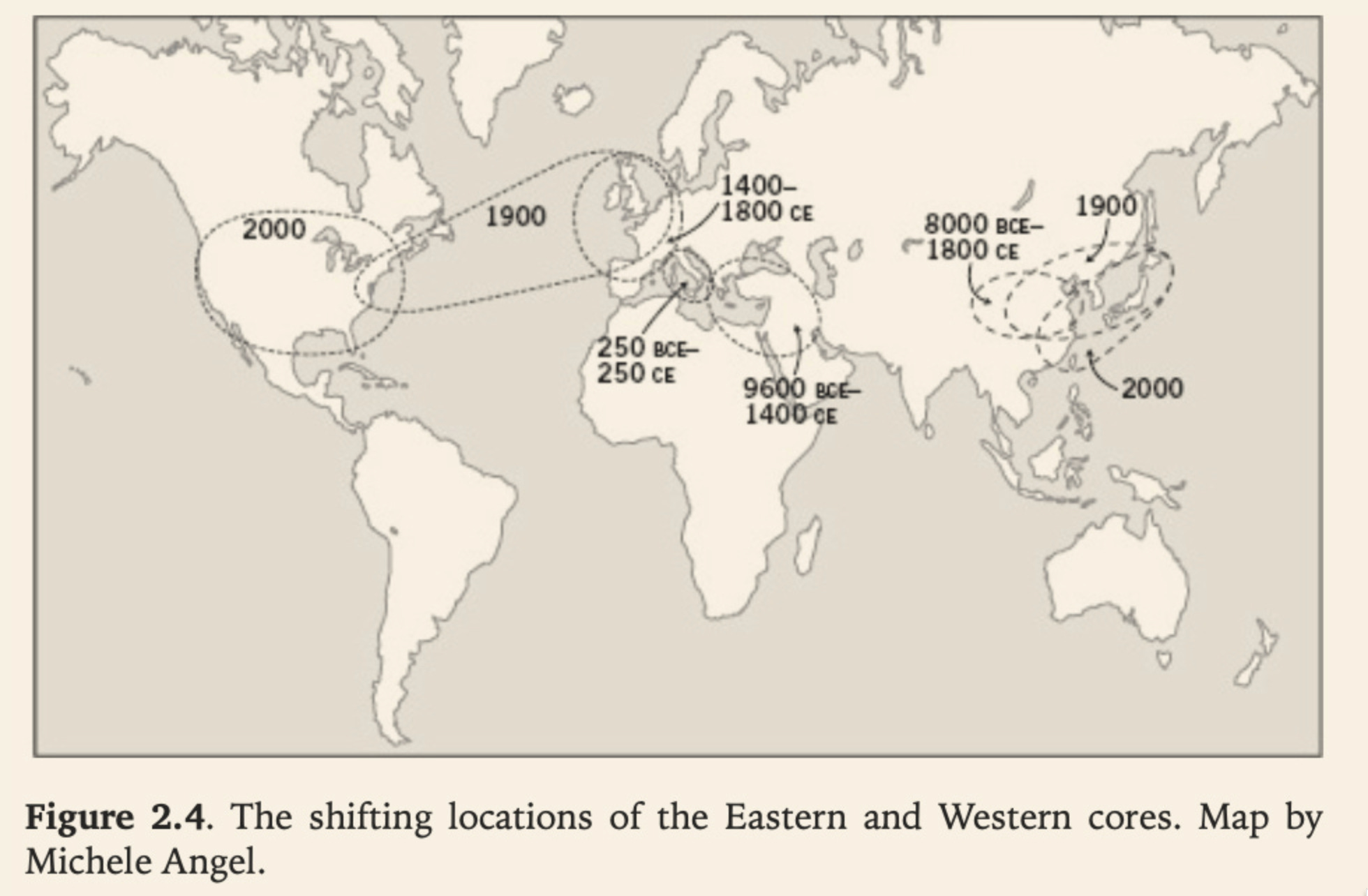
Above is a map showing what Stanford’s Ian Morris <https://archive.org/details/whywestrulesforn00morr_1/mode/1up> thinks are the economic and civilizational "core areas" of “Western” and “Eastern” civilization since the year -9600.
For nearly all the time since the invention of agriculture, the Eastern core is the Yellow River and Yangtze Valleys, according to Morris. He sees it as, by 1900, moving a little further east: gaining Manchuria and Japan, while losing Sichuan and the upper Yellow River Valley. By 2000 the core has further gained Taiwan island and the Pearl River Delta, but lost has non-coastal China (including Manchuria).
There is continuity here: political continuity, cultural continuity, unbroken chains of influence, even substantial continuity of genetic descent.
This is in great contrast to the “Western core”. Morris claims that from -9600 to 1400 it extended from Basra on the Persian Gulf to Tbilisi in the Caucasus to Ithaka off the northwest corner of Greece to Thebes in Egypt. Then, from -250 to 250 it…moved? …had added on? … comprised Italy, Sicily, and Sardinia. Yet after 250 it reverted back to the original Basra-Tbilisi-Ithaka-Thebes quadrangle.
In 1400, however, that then pops like a bubble. For the period 1400 to 1800, according to Morris, the “Western core” picked up stakes and moved to Western Europe. And by 1900 the Western “core area” has extended a pseudopod across the Atlantic to the American northeast and contracted in Eurasia, where it is: Ireland and Britain, the Low Countries, northern and western France, and northwest Germany.
Come 2000, Morris’s “Western core” is the continental United States plus the more-settled parts of Canada.
Truly a moveable feast.
I feel a great lack of continuity here. What has the civilization of Uruk in -3000 have to do with the civilization of Silicon Valley today? In what sense are they both “the West”, save that there are some people at Stanford who read The Story of the Man Who Saw the Deep, the Epic of Gilgamesh <https://archive.org/details/gilgameshnewrend00ferr>?
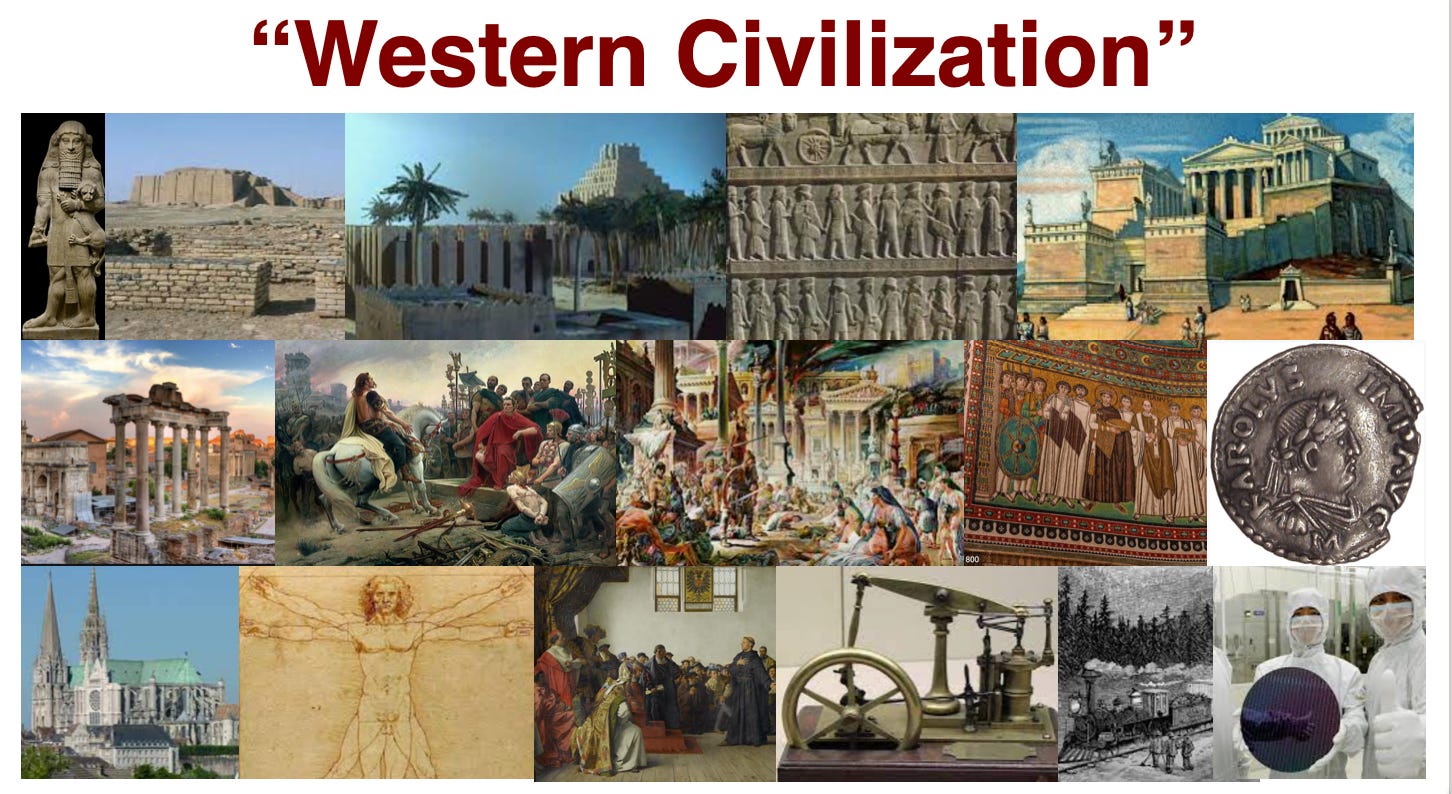
Certainly there was a time in the 1800s when people wanted to tell the Story of Civilization as something like an Olympic-torch relay race:
The flint is struck and the torch lit in the Uruk of Gilgamesh and in Ur of the Chaldees.
It is then passed down to the Pharaohs of Egypt and to the Babylon of Hammurabi.
It winds up in Jerusalem, in the hands of Kings Dovid Melech Yisrawel and his son Salomo.
The torch is then passed—perhaps through Kurush and the other Loyal-Spirit Great Kings of the Persian Empire—to Athens!
And then on to Rome!
And conquering Rome is then conquered by Jerusalem and Galilee, as the torch is carried forward!
And so on. In the aftermath of the fall of Rome, barbarian invasions and western Christendom then meld themselves into European feudal civilization, which picks up the torch. The torch is handed off to the Renaissance. The Reformation, The Enlightenment rise of representative government and common-law systems: governments that exist to secure people’s natural rights and that derive their just powers from the consent of the governed. Then the British Industrial Revolution. And on to modern democratic capitalism, or capitalist democracy.
But this is like picking out pictures of things you like in a photograph and claiming that they are “yours”.
Moreover, the phrase rocketed up in prominence just in those early-1900s years in which anything that might be called “civilization” in Europe was catastrophically falling apart. Europe in those years was indeed becoming, as Mark Mazower calls it, the “Dark Continent”. And at its apogee at the start of the 1950s—I think that my long-ago teacher the brilliant Judith Shklar put it very well in her assessment of why it was that in the post-WWII United States, “Western Civilization” had a moment:
Judith Shklar: A Life of Learning <https://www3.nd.edu/~pweithma/Shklar/Haskins%20Lecture.pdf>: The real ideal of many teachers at Harvard in the 1950s was the gentleman C-er. He would, we were told, govern us and feed us, and we ought to cherish him, rather than the studious youth who would never amount to anything socially significant. There was, of course, a great deal of self-hatred in all this…. Harvard in the 1950s was full of people who were ashamed of their parents’ social standing, as well as of their own condition… closet Jews and closet gays and provincials… obsessed with their inferiority… [to] some mythical Harvard aristocracy….
[There] was also a bizarre refusal to think through the real meaning of the Second World War…. I found Harvard conversations unreal. I knew what had happened in Europe between 1940 and 1945, and I assumed that most people at Harvard also were aware of the physical, political, and moral calamity that had occurred, but it was never to be discussed…. If these matters came up in class, it was only as part of the study of totalitarianism, and then it was pretty sanitized and integrated into the Cold War context….
A look at the famous “Redbook,” which was the plan for the general education program at Harvard, is very revealing:
Its authors were determined to immunize the young against fascism and its temptations so that “it” would never happen again.
There was to be a reinforcement of The Western Tradition, and it was to be presented in such a way as to show up fascism as an aberration, never to be repeated.
I would guess that in the pre-war Depression years some of the young men who devised this pedagogic ideology may have been tempted by attitudes that eventually coalesced into fascism, and now recoiled at what they knew it had wrought. They wanted a different past, a “good” West, a “real” West, not the actual one that had marched into the First World War and onward. They wanted a past fit for a better denouement.
I found most of this unconvincing…
“Western Civilization”, the Harvard Redbook, Humanities 1 and Social Sciences 2, the through-line of cultural, political, historical, and logical development from Gilgamesh to FDR—an ideological project principally aimed, whether consciously or unconsciously, at constructing a fake but usable past for a post-World War II New Deal Order of social democracy in a free, capitalist, and above all anti-Leninist anti-Stalinist anti-Hitlerian society.
In fact, there was no single torch. There were no hand-offs. And if there had been a single torch, it would come with all kinds of things that we do not like at all.
However, do not get me wrong: There is a great deal of value in teaching:
Matthew Yglesias: Thankful mailbag <https://www.slowboring.com/p/thankful-mailbag>: ‘There’s just a big divergence between what most people see as potentially valuable in the liberal arts and what most humanities faculty think is valuable and important…. Educated professionals… it’s good for them to be inculcated with… values… the history of proto-constitutionalism in England and the classical republics… religious freedom… [which] develop[ed] out of the specific circumstances of the Protestant Reformation….
Historical events… Greece to Rome to “the Dark Ages” and the Renaissance and Reformation and the founding of America… philosophical lineage from Plato and Aristotle to Hobbes and Locke and Mill and Rawls… literary and artistic cultures… informed by these… and that also informed them…. That kind of traditional broad liberal education would of course involve some exposure to radical critics of Anglo-American liberal capitalism….
[But] current trends on campus are toward an atmosphere where the radical criticism predominates…. The critical theories themselves would tell you, there’s no way Anglo-American liberal capitalist society is going to sustain generous financial support for institutions whose self-ascribed mission is to undermine faith in the main underpinnings of society…
But I do substantially disagree with Matt here. For one thing, I do not think Matthew has Ground Truth as to what is going on in American universities. I have said this before, and I do believe I have receipts:
Thus it does annoy me when people speak of cultural-civilizational patterns rooted in the early-modern imperial-commercial age Dover Circle and then the Dover-Circle-Plus as “the West” and talk of and unreflective believe in some “it” that is “Western Civilization”, which the people living in the Thames Valley of the island of Great Britain in the 1800s possessed as rightful heirs.
Earlier peoples ascribed the rôles of torch-bearers in this relay would have been very surprised to learn that the inhabitants of the Thames Valley were in any way them or their heirs. In the -50s, Roman Senator and Proconsul Marcus Tullius Cicero snidely snarked argued that the Britons had no silver and were too stupid and uneducated to make good slaves—hence they were not worth imperializing. Athens had very little tolerance for Jerusalem. And Jerusalem had even less tolerance for Athens.
If you want continuity starting at the Western edge of Eurasia of the same kind as you see in the “Eastern Core”—political, cultural, linked chains of influence, some continuity of genetic descent—you certainly cannot start before 800, and almost surely not before 1500. And you have to start in the Dover Circle.
But do not carry this tradition-demolition project too far.
In 800 the Dover Circle a backwater, technologically behind—and hundreds of years technologically behind, much of the time—the world average. But around the year 800, in the Dover Circle, a local barbarian, a Frankish king, Charles, son of the usurper Pippin the Short, extended his military reach from his sometime capital city of Aachen or Aix-la-Chapelle in the Dover Circle to the Elbe River in Germany, the Tiber in Italy, the Ebro in Spain, and to the borders of Hungary. Pope Leo II then crowned “Charlemagne” Emperor, the first emperor dwelling west of Constantinople for three and a quarter centuries. And after that interesting things did begin to happen between Stockholm and Sevilla, ultimately concentrating in the Dover Circle.
But they did not happen rapidly. Even as of 1500 the Dover Circle held no place special in world civilization. Yes, the Dover Circle by 1500 was no longer a backwater. Yes, it ad from 800 to 1500 had a rapid creative run of growth and technological advance for a pre-Imperial-Commercial civilization in the Middle Ages. But much of that was simply a Viking-raided backwater’s catching up to world civilization. In 1500 it certainly had no “edge” in governance or culture, and in technology whatever edge it had was narrow—ships and gunpowder and cannon, and perhaps precision machinery like, clocks.
Maybe it has a small technological edge on average in 1500. Perhaps 1.1 over the other high civilizations of Eurasia? It did forge ahead after 1500 in technology faster than the world average, but not that much faster.
It certainly developed a politically and militarily important technological edge in ocean navigation and gunpowder weaponry. Caravels begin to dominate the world’s oceans from 1500 on—although the first great exploratory-imperialist wave comes from Portugal and Greater Castile. But do not overstate that edge. The Ottoman Empire was still besieging Vienna in 1688. It was only in ships that it dominated up until 1800. And its ships did not dominate always: the Omani from Muscat threw the Portuguese out of East Africa, and then ruled the coasts of the Indian Ocean from Zanzibar.
As of 1500 the Dover Circle had potential. And I see that potential as consisting of five important elements:
The Joseph Henrich point: the Mediaæval church’s war on cousin marriage and on relationship affinities—an attempt to make Jesus, and the Church, the place you went to for help—had created a diffuse sociability in which you could, within reason, trust almost everyone in society who you dealt with, rather than just your close kin. Diffuse sociability rather than clan-based was to be very important after 1500.
Harold J. Berman’s point, in his 1983 Law and Revolution: The Formation of the Western Legal Tradition, that the struggle over whether emperors bossed popes or popes bossed emperors had created for the first time ever Dover Circle civilizations were places in which the default assumption was that the law was not a mere tool of the most powerful, but that even the most powerful were bound by the law.
Durable proto-nation states rather than more or less evanescent continent-spanning empires amped up the pressures of military competition for governmental effectiveness.
The primarily rural-military basis of the Dover Circle aristocracies, which meant that cities were an anomaly in the major military-political power network, and so became self-governing, making merchants not the clear subordinates but the near-equals of warriors and bureaucrats among the society-of-domination élites.
The Patricia Crone point that Dover Circle societies were imperfect and rather unsuccessful society of domination. In the other high civilizations of Eurasia-Africa (and MesoAmerica), it was very clear how the society-of-domination élite ran its force-and-fraud game, it was very clear that it was a sweet deal, and it was very clear to all that big changes would turn many big power brokers into big losers; in the Dover Circle, by contrast, kings, aristocrats, merchants, priests, and more all had claims to various levers of society of domination power.
All these created a remarkable plasticity in social organization—a situation in which many things could be tried, some of which would turn out to be productive and effective. Society was not bound by kinship, not under the thumb of a ruler unbound by procedure and law, subject to fierce incentives to improve productivity and efficiency to mobilize for war, creating a place in which at least some societal power could be exercised by those—merchants—more interested in efficiency in productivity than in exploitation, and in which the possibility of change and revolution in favor of some élite faction was regarded by large segments of the élite with something other than horror and dismay.
Only place, and only time, all of these came together was in the post-1500 Dover Circle.
Even in the late 1700s it was touch-and-go. The British started to conquer India, but they could not maintain their hold on North America. What had been a perhaps 1.1-1 edge in technological prowess in 1500 was only perhaps 1.4-1 in 1770.
Even in the 1800s the French failed in their conquest of Mexico and had a devil of a time conquering and colonizing Algeria.
Not until 1880 and the machine gun did it become the case that Dover Circle-Plus armies could march anywhere and conquer anything (save, for the Italians, Ethiopia; and save, for the British and the Russians, Afghanistan). And in the end the durable expansion of the Dovber Circle to the Dover Circle-Plus of today was as much a soft- as a hard-power process.
& þe “‘West’ vs ‘Dover Circle-Plus’ Video:
References:
Shklar, Judith Nysse. 1989. “A Life of Learning.” Charles Homer Haskins Lecture, ACLS Occasional Paper No. 9. Washington, DC: American Council of Learned Societies. <https://www3.nd.edu/~kellogg/_files/pdf/old-documents/ACLS_Judith_Shklar_A_Life_of_Learning_1989.pdf>
Yglesias, Matthew. 2023. “Thankful Mailbag”. Slow Boring. November 24. <https://www.slowboring.com/p/thankful-mailbag>.