
HOISTED FROM THE ARCHIVES: John Holbo on the Horrible Atrocity of Defending Good Causes Badly!
From three years ago: 2022-10-27. Did I get this right back then?...
I find my friend John Holbo writing:
John Holbo: Russell Jacoby Against the Buzzwords: ‘Russell Jacoby… in “Tablet”… approvingly retweeted by Richard Dawkins, then by Elon Musk…. I’m sympathetic to Jacoby’s old line… ‘theory’ silliness… in the 80’s-90’s… perverse incentives… for doing ‘philosophy’ badly in various ways. This was not good…. But… as Jacoby himself used to acknowledge… pretend[ing] ‘ivory tower-types being eccentric’ = ‘barbarians at the gates of western civ’ is one more funny, bug-in-his-ear character in some David Lodge novel. But now Jacoby’s updated his script… these leftists don’t even have power in the Ivory Tower!—they don’t have jobs! they are bitter baristas! resentful HR drones!—that makes them so dangerous!… Their weakness is their terrible strength!… The black comedy quality of this twist—surely this is shaping up [as] a sad David Lodge novel...
And this is the illustration Russell Jacoby chooses to illustrate his article:
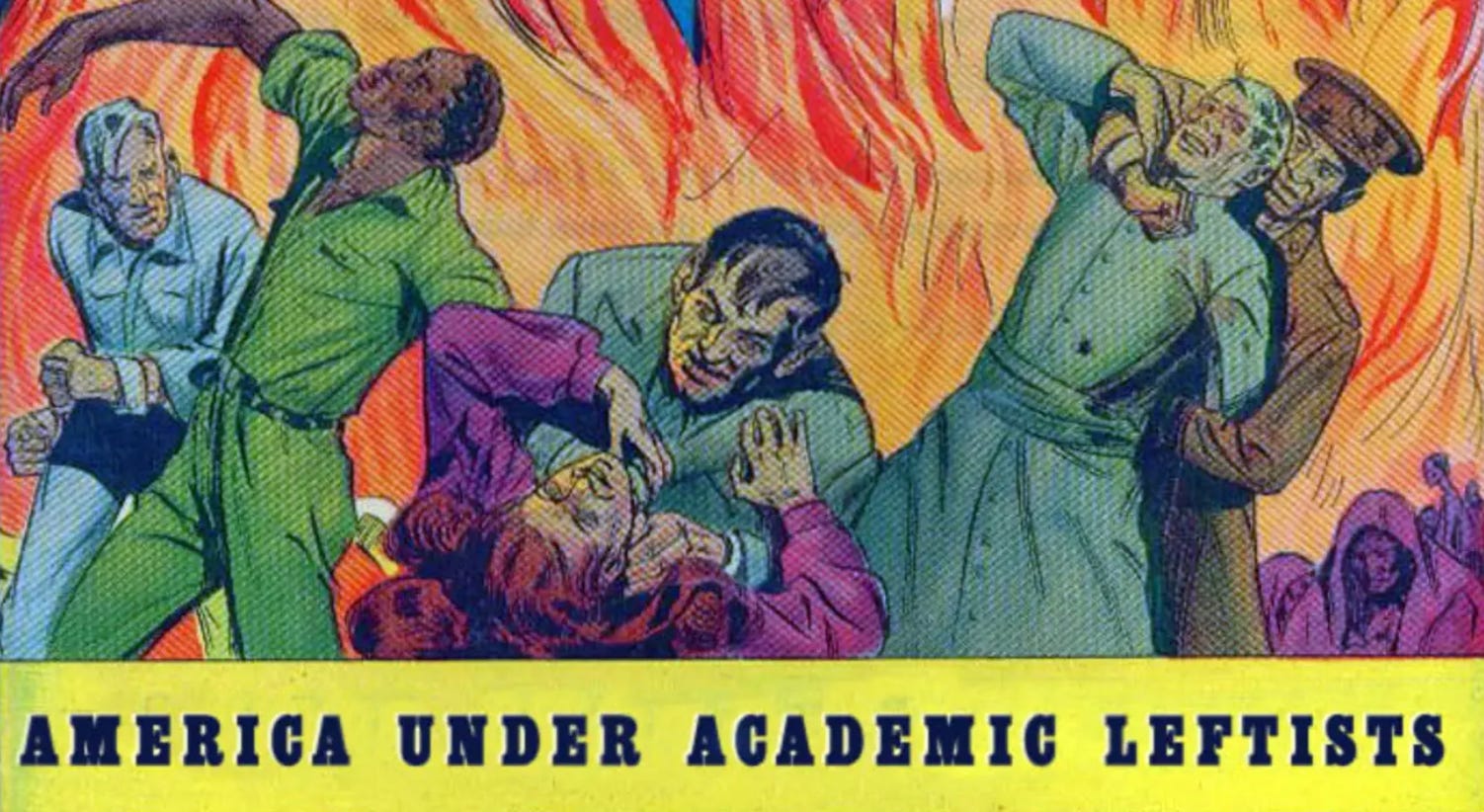
Oohhh… kaaaayyyy…
Who is this guy?
I did, long ago, read a very nice, book by Russell Jacoby called Dialectic of Defeat: Contours of Western Marxism. It was worthwhile, even if written in embarrassingly crude-and-creaky New Leftese.
Jacoby’s work did cast a long shadow not on my contribution but on some of the other contributions than mine to our 2016 conference volume Public Intellectuals in the Global Arena: Professors or Pundits?
I do remember Dan Drezner citing Jacoby’s The Last Intellectuals: American Culture in the Age of Academe in his 2017 The Ideas Industry.
Scanning my hard disk, I see his name come up in a few of my notes. So: someone who took the Long March from New Left (“I was part of a Boston bookstore ‘collective’ that interminably discussed everything from the titles the store should stock to the details of our lives…”) to, today, the Paleolithic Right:
Russell Jacoby: The Takeover: Self-righteous professors have spawned self-righteous students and unleashed them into the public square: ‘The leftists who would have vanished as assistant professors in conferences on narratology and gender fluidity or disappeared as law professors with unreadable essays on misogynist hegemony and intersectionality have been pushed out into the larger culture… staff the ballooning diversity and inclusion commissariats that assault us…. Buzz words of the campus—diversity, inclusion, microaggression, power differential, white privilege, group safety—have become the buzz words in public life. Already confusing on campus, they become noxious off campus…
Let me give the mic back to John Holbo:
What indefensible barbarism do these buzz words buzz on behalf of, sez Jacoby?: “Orwell targeted language that defended ‘the indefensible’... the British rule of India, Soviet purges and the bombing of Hiroshima.... But today, unlike in 1946, political language of Western progressives does not so much as defend the indefensible as defend the defendable.”
So they defend the… defendable.
That doesn’t sound SO indefensible...
And I gotta concur with John. Jacoby feels beseiged by noxious buzzwords:
Wonder about the significance of microaggression? You are a microaggressor. Have doubts about an eternal, all-inclusive white supremacy? You benefit from white privilege. Skeptical about new pronouns? You abet the suicide of fragile adolescents…
I am at U.C. Berkeley.
If the Woke Beast has a belly, the place where I am must be its Ground Zero.
Yet in my personal experience:
Microaggressions: I have come home to my house to find my house-sitter and two of her friends sitting on the floor drinking wine, unburdening themselves on the microaggressions of being a female economics graduate student here at Berkeley. These are powerful, brilliant, capable, accomplished women all—and it grinds them down. It is one of the reasons why Economics does so badly and our pipeline of women (and underrepresented minorities!) leaks so much. Economics’s Talmud-like culture of challenge and debate has many advantages, but it does make microaggression (and macroaggression) a privileged and honored lifestyle.
So my reaction is: Time spent reflecting upon how to make the social world less of a zero-sum dominance and more of a positive-sum cooperation game is rarely wasted.Pronouns: I had thought that the first principle of being a gentlemen is to treat people as they want to be treated, and, in polite society, at least, take their presentation-of-self at surface value: if a man is introducted to you as M. le Comte de St.-Germain, you refer to him as M. le Comte or St. Germain. There was such a man, who dazzled contemporaries in the 1700s with languages, music, chemistry, and gem‑polishing, claiming exotic pasts—sometimes Spanish, sometimes Portuguese or Transylvanian—and hinting at great age, moving among élites sometimes as a minor fixer or informal envoy, cultivating patronage, performing chemical demonstrations, keeping to a strict diet and nocturnal work habits, with strong relationships to figure like le Duc de Choiseul and Prinz Karl von Hesse. Perhaps the one thing certain about him was that he was not, in fact, M. le Comte de St.-Germain.
If Jacoby wants to write a brief for how impolite society is in fact superior, I might read it.
But he has not done so.
So my reaction is: Adolescence is a time in which everyone is fragile, and needs sympathy and compassion. Civilization is empathy and consideration. Barbarism is the reverse.White Privilege: If you are an elderly or middle-aged straight white male in America who does not know that you have been playing the videogame of life on the “easy” setting, I judge you to be a pathetic loser. And I cannot interpret Jacoby’s “have doubts about an eternal, all-inclusive white supremacy? You benefit from white privilege” as anything other than a denial that he has been playing on the “easy” setting.
So my reaction is: Knowing how much you are, as Milton and Rose Director Friedman liked to say, “supremely lucky people” is a very important part of self-knowledge.
Am I deluded?
Should I join those like Russell Jacoby who complain about snowflakes—women are snowflakes who are annoyed when told in class that “solving this will put hair on their chest”? Should I complain about those who want a different pronoun—they should just suck it up and recognize that they are “he” or “she”? Should I complain about those who tell me and others that something called “white privilege” has in fact played a substantial part in what success they have had?
Let’s think about that last: White privilege makes you a lucky person who has been, undeservedly, successful. Milton and Rose Friedman could recognize and stress that they had been supremely lucky people. But it is a macroaggression to tell Russell Jacoby, ex-New Leftist, that he is such?
I head over to the internet to look at Jacoby’s curriculum vitae.
I cannot find it anywhere.
The closest I can find is not a .pdf but, instead, an email link to request it.
Odd. I do so. Nothing comes back.
Googling around, I find:
He became professor emeritus at UCLA in 2020. The UCLA website says “education: Universities of Chicago, Wisconsin and Rochester. Ph.D. Rochester, 1974”.
I find little else until I follow a Google link over to a “World Biographical Encyclopedia”, of which I have never heard. Is it reliable?
In any event, Prabook says: ”Bachelor, University Wisconsin, 1967. Master of Arts, University Rochester, 1968. Student, Ecole Pratique Hautes Etudes, Paris, 1970. Doctor of Philosophy in History, University Rochester, 1974. Lecturer, Boston University, Boston, 1974-1975. Scholar in residence, Brandeis U., 1975-1976. Lecturer department History, University of California, Los Angeles, 1976-1979. Visiting assistant professor History, University of California, Irvine, 1979-1980. Visiting associate professor Humanities, Simon Fraser U., Vancouver, B.C., Canada, 1983-1984. Visiting scholar, associate professor, Lonergan U. College/Liberal Arts College Concordia U., Montreal, Canada, 1985-1986. Visiting senior lecturer, University of California, San Diego, 1986-1987. Visiting associate professor of history, University of California, Riverside, 1988-1991. Visiting associate professor of history, University of California at Los Angeles, 1992-1994. Adjunct professor of history, University of California at Los Angeles, 1995-…”
And I think:
Here is someone who bounced around for twenty years with no academic stability…
From short-term non-renewable three-year-or-less position to position—UCLA, UCI, SFU, Concordia, UCSD, UCR, UCLA…
Before finally landing a semi-permanent position at UCLA…
But one potentially insecure: it might well vanish the next time a budget crunch came around…
Or his slot might evaporate into smoke should someone powerful in the senior tenured faculty wants a teaching-heavy job slot for a protégé…
And, as an adjunct, a poition likely to carry a much higher teaching-load burden at UCLA than that of the other professors sitting in the front two rows at seminars…
And so I guess: He doesn’t see himself as lucky.
He didn’t go from Ph.D. to tenure in seven years. He always saw himself as failing to run the course in the expected time, as hanging onto his academic post by his fingernails, as not someone whom patriarchy and white privilege conspired to give him an easy-mode speed-run but as someone whom THE MAN kept down for his entire career. Max Weber would have understood. Weber strongly cautioned those seeking academic careers thus: ““Do you in all conscience believe that you can stand seeing mediocrity after mediocrity, year after year, climb beyond you, without becoming embittered and without coming to grief?” If you don’t believe that you can do that, he said, you should leave academia immediately.
I drop over to Amazon’s “Look Inside the Book” feature. I am struck by the beginning of the acknowledgements to his 2020 On Diversity:
In my previous books I have been chagrined by the brevity of my acknowledgments; no lengthy roster of esteemed colleagues and devoted friends or rollcall of foundations, institutiosn, and conferences that fêted the author. Alas, my short list has barely changed over the decades…
And I again guess: Another sign that he sees himself not as lucky but as unlucky—as lacking the devoted friends, esteemed colleagues, and, perhaps most important, the hard-working and tireless but interested adversaries to read his stuff and point him in a better direction.
Plus: I am struck by the beginning of Jacoby’s introduction to the 1996 reissue of his 1975 Social Amnesia:
Social Amnesia… written amid the dying embers of the New Left…. I was part of a Boston bookstore “collective” that interminably discussed everything from the titles the store should stock to the details of our lives. Anti-psychoanalytic sentiment…. Kate Millet’s Sexual Politics…. The bookstore carried Pavlov… billed as a materialist and revolutionary, not Freud who was attacked as an idealist and reactionary…. What bothered me was not a sheer ignorance of psychoanalytic thinking, but the cheap criticism that Freud was nineteenth century…. The criticism implied that those who come later are smarter: the critics and their friends. This outlook had a great future…
And I again guess: He sees himself not as lucky but as vastly unlucky: Even his friends were not his constructive adversaries but, rather, his enemies—in the sense that they made deliberate decisions to remain ignorant of what he saw as crucial.
So I think: Maybe what Jacoby is doing is crying out that he was not, personally, privileged?
Maybe what Jacoby really wants to say, but cannot quite bring himself to, is that his ancestors’ American white-ethnic experience was not all that easy, and he does not see his experience as all that easy?
That others had it easier?
That—let me list the surnames of all of my great-great-grandparents—the Wymans, Richardsons, Paysons, Ushers, Wards, Carters, Andersons, Lords, Slocums, Creases, Parkinsons, Bradfords, Whipples, DeLongs (solid WASPY Huguenots), Siglins (token Protestant Germans), Gallaghers (token Irish Catholics!), and such all had it easy, but the Jacobys did not? That the Jacobys should be numbered not among the goats but among the sheep, on the side of the strivers who deserve good things, on the side of those who never yachted off of Marblehead or Newport, as opposed to the entitled parasites who did?
But if that is what he really means to say, then he should say that!
I have constructed an image of Russell Jacoby in my mind’s eye. It may well be a false image. But it is a strong one.
In the image in my mind’s eye HE REALLY REALLY RESENTS being told that there was anything “easy” about his life and career: About being born in New York in 1945. About leaving New York for Chicago as a teenager and then dropping out of the University of Chicago (for academic? financial?) reasons. About finishing his B.A. at lower-status (and cheaper!) Wisconsin-Madison in 1967. About using graduate-school to avoid being drafted and sent to Vietnam. About finding his New-Left commitments blocking him from getting the tenure-track job he deserved while the universities were still fat and growing through the mid-1970s, even as he recognized that they were idiots. About having three years to prove that he deserved a tenure-track slot, and it not appearing, and getting bounced. About trying to do it again. And again. And so on.
In this image, he REALLY does not like being called THE MAN—someone who has an unearned position, who benefits from white privilege, who needs to recognize that he is one of the, as F. Scott Fitzgerald wrote of Tom and Daisy Buchanan, “careless people” who can and does unthinkingly break things with their actions, and even their words, and so must be careful.
This image I have constructed does explain to me how ex-New Leftist Jacoby can write:
The New York Times published an opinion piece by Sen. Tom Cotton that called for the national guard to stem looting in the wake of the George Floyd riots. Employees of the Times protested and charged that the piece put Black staffers “in danger.” Again, this was an article in the editorial section of the paper, page 14. In the American adaption of Stalinist show trials, the editor of the opinion section [James Bennet] confessed. He regretted “the pain” he caused. He resigned…
For, as John Holbo points out, that is not at all an adequate description of what went down:
Jacoby has his parade.... But in each case (and others) isn’t it more complicated?... I’ll only offer one example.... Tom Cotton.... A bunch of NYTimes staffers say Cotton’s op-ed made them feel ‘unsafe’, which does sound snowflake-y. But... Cotton explicitly called… for the extrajudicial execution of American citizens, en masse, by the US military....
Indeed. Would anyone sane and balanced not think that massively boosting Tom Cotton’s violent fantasies beyond their normal spread has the potential to make us all unsafe?
And James Bennet? The victim of the “American adaption of Stalinist show trials”? James Bennet is, right now, a senior editor at the Economist. He writes the Lexington column. He did not suffer the fate of a defendant at a Stalinist show trial: He was not shot dead with a bullet in the back of his skull in the basement of Lubyanka Prison on Dzerzhinsky Square in Moscow.
Do I have the gist of Russell Jacoby right here?
Or am I completely off base here?