
"Star Trek: The Wrath of Khan" as Franchise Hinge: Wednesday Comfort Watching
The Day Trek Changed: From “Where No Man” to Wrath— & a real franchise was born. Sixty years ago, production wrapped on the second “Star Trek” pilot: Where No Man Has Gone Before” Friday, December 24, 1965. That, I think, was the first true franchise-hinge moment. The second came seventeen years later, with Nicholas Meyer taking the quarterdeck of HMS Star Trek on the voyage of “The Wrath of Khan”…
Sixty years ago, Friday, December 24, 1965, production wrapped on the second “Star Trek” pilot: Where No Man Has Gone Before” . That, I think, was the first true franchise-hinge moment. It created “Star Trek”. But it did not make “Star Trek” a cultural phenomenon, or an economic IP franchise engine worth the attention of the princelings and princesslings of Hollywood. That came after.
I recall a friend whose daughter returned home from her first semester at an engineering college. She immediately said: This vacation we are going to watch all 80 episodes (including “The Cage”) of the three seasons of ST:TOS. And they did.
But that would not have happened without the second franchise hinge moment, the one that came second came 17 years later. What was that second moment? It was the launch and then the phenomenal launch of the movie: “Star Trek: The Wrath of Khan”.
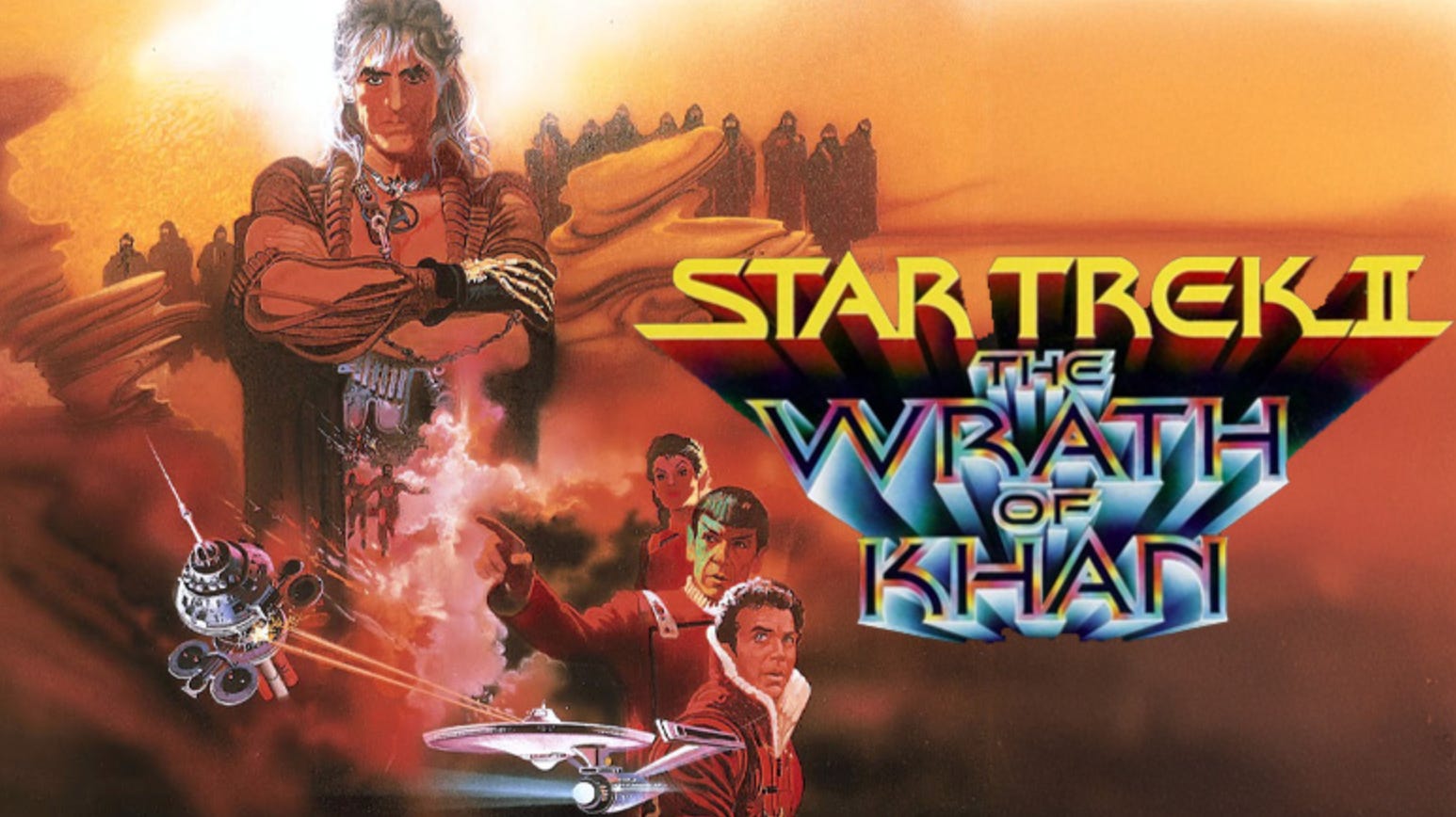
The way things had gone down between 1964 and 1982 was, roughly:
1964: Gene Roddenberry drafts his “wagon train to the stars” concept and pitches “Star Trek” at Desilu (Desi-Lucy, i.e, Desi Arnez’s and Lucille Ball’s studio); initial series bible takes shape.
1964–1965: Pilot “The Cage” is produced with Jeffrey Hunter as Captain Pike; NBC famously passes but asks for a second pilot.
1965–1966: Second pilot “Where No Man Has Gone Before” (Shatner as Kirk) convinces NBC to order the series.
September 1966: “Star Trek” premieres on NBC; Season 1 begins the Kirk–Spock–McCoy era.
1967: First-season episode “Space Seed” introduces Khan Noonien Singh, once and future super-villain.
1968: Season 2 airs; ratings struggles continue despite critical and fan support.
1969: Season 3 airs after a time-slot move; series is canceled after three seasons and 79 episodes (pilot “The Cage” still unaired).
1973-4: the animated series briefly revives the brand.
1979: “Star Trek: The Motion Picture” releases; financially strong but seen as ponderous, triggering a rethink of tone and budget.
1980: Rethink and budget finishes, with “Star Trek” getting one more swing at the ball.
1982: “Star Trek II: The Wrath of Khan”—Nicholas Meyer’s Hornblower-in-space reframe—restores energy, stakes, and audience enthusiasm.
Did ST:TMP actually make any money?
Hollywood accounting is notoriously the domain of thieves, but $139 million worldwide on a roughly $35–44 million budget. But expectations had been sky-high after Star Wars, and overruns plus marketing and distribution costs meant Paramount judged the return underwhelming.
There is a peculiar kind of mindwarp found in the big-budget-studio piece of Hollywood that is in sharp contrast to the Golden Age of pre-TV. Pre-TV, you needed a lot of movies to fill a lot of theatres owned by studios. So you made movies, rapidly. And a base hit was a base hit. But in the post-TV post-theater-chain-breakup world, simply saying “this will be a solid single” in terms of market no longer got the greenlight. For there were others out there pitching things they promised were guaranteed homers. And since you did not have to fill your theaters, committing studio and investor money to something that did not aim high tended not to get the enthusiasm: better to hold your financing for someone whose this-will-be-a-homer pitch was convincing. That almost always the people making that this-will-be-a-homer pitch were delusional, and that their sole superpower was one of hypnosis, was something that studio executives and investors rarely learned.
Thus never mind that ST:TNG almost surey was, ex post, a better financial use of Paramount’s own and investors’ money than the marginal other Paramount project. It wasn’t cloud-castle good and profitable. And so, if “Star Trek” were to have a future in the 1980s and beyond, the successor movie would have to show better performance-price ratios. Hence Paramount pushed for a cheaper, livelier sequel model. $12 million budget for ST:TWoK.
And here came the second franchise hinge: At least as Nicky Meyer recounts it (and I find him completely plausible), it turned out to be a very strange hinge of the franchise indeed as he carried: ST:TWoK on his back, from plot and script coherency through the final day of shooting and into post-production. The final script, and then on through direction and editing to produce Khan’s coiled rage, Spock’s earned death, Kirk shaved down from preening star to captain outmatched by foe and fate, and submarine-tight direction restored stakes and audience trust.:
No Nicholas Meyer taking control of the quarterdeck to produce a final script in twelve days, no “Wrath of Khan”. No “Wrath of Khan”, and “Star Trek” as a Hollywood, cultural, and economic phenomenon dies after ST:TMP. Odds are that nothing subsequent—extraordinarily varying in quality as it has been—from the best moments of ST:TNG and ST:DS9 to the bizarre and strange storm of photons that is the recent ST:§31 Michelle Yeoh vehicle would ever have been made.