
The AI-Bubble's Most Likely Endgame Looks to Be Not Apocalypse, But an Awful Lot of Useful Compost
All the digging will not uncover a Golden ASI Pony. But the digging will spread an awful lot of very useful fertilizer around, in which very useful and valuable thing swill grow…
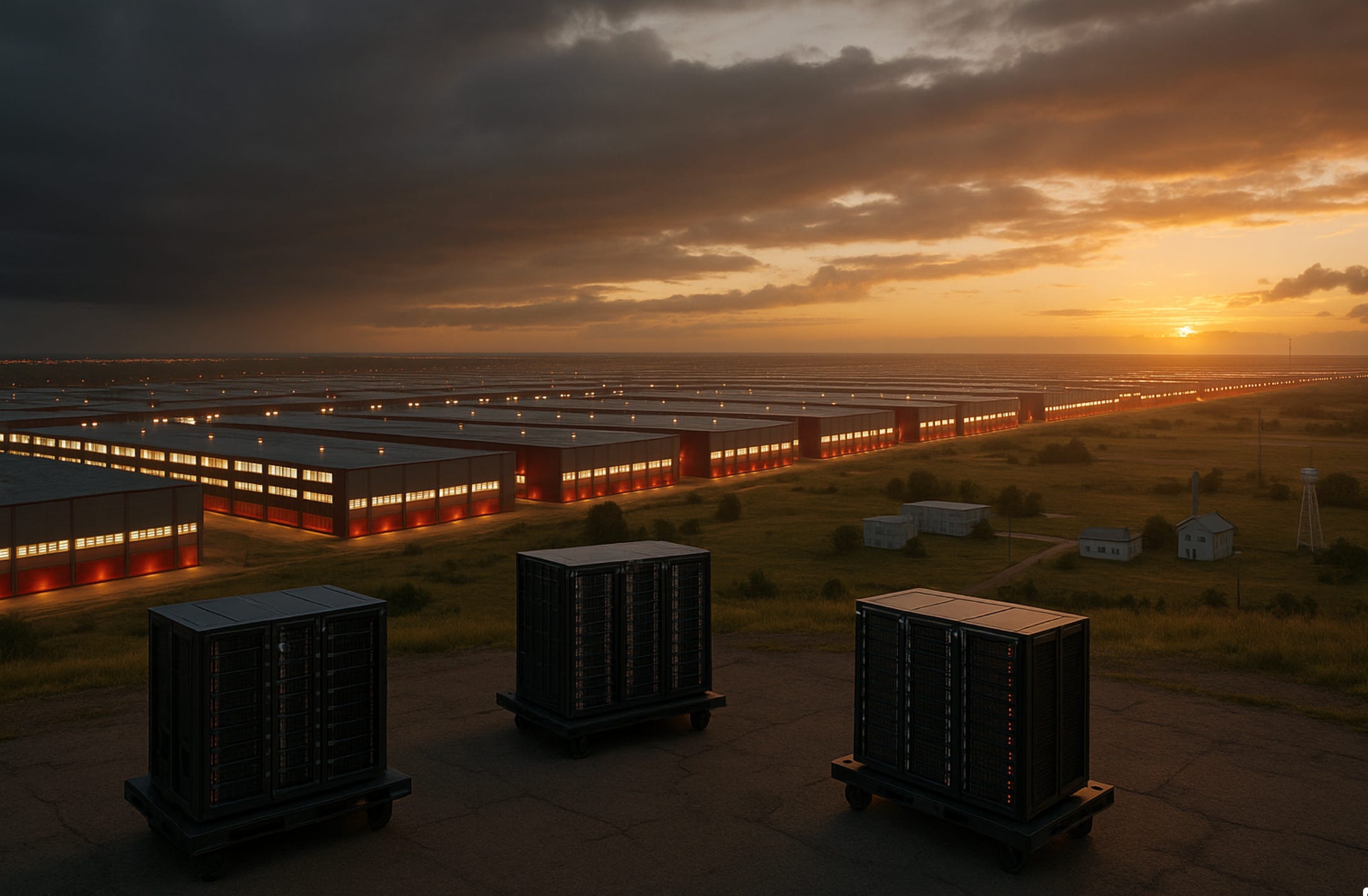
Proprietary LLMs are likely to prove lousy businesses—high opex, thin moats, fast commoditization. But their capex won’t vanish. And the value from it will diffuse broadly and equitably : better models for everyone; upgraded grids; repurposed GPU farms; millions of open repos. No Deep Thought, but better weather forecasting, antibiotics, copilots, and the replacement of bureaucratic cookie-cutter with bespoke algorithmic classification isn’t failure.
In short: AI is unlikely to mint new platform monopolies. It is likely to manure the next generation’s digital commons. The bubble finances infrastructure and code that, post‑panic, underpins broad gains.
That will be the case, unless, monkey’s paw-like, freely provided AI-service flows turn out to be very expensive indeed. We can build our own AI-tools to protect our attention from being harvested by the malignity of the Zuckerbergs. But if we do not, their AI tools will harvest our attention to our detriment.
This now looks to me like the most likely AI-Bubble endgame scenario:
FT Alphaville: What if OpenAI is worth more dead than alive? <https://ftav.substack.com/p/what-if-openai-is-worth-more-dead>: ‘Here’s the theory. Proprietary large-language models[’] core technologies still have value, but their developers’ individual business models marry persistently high operating costs with shallow commercial moats and their innovations quickly become commoditised…. The result is better machine learning for all. Companies will die, but the spoils of more than $1tn in capital expenditures can trickle down equitably to a nation’s underfunded labs, studios, factories and faculties. We won’t get Artificial General Intelligence, but we might get improved weather forecasting and some new antibiotics…. YOLO indeed. A common fear about AI is that the bubble’s bursting will metastasize into a financial crisis demanding of government interventions and value-destructive shotgun mergers — but what if it doesn’t? What if all it leaves behind are worthless share options, defaulted bonds, written-off GPU clusters, some slightly upgraded power grids, and several million open-source repositories full of fairly useful code? LLM commoditisation won’t give us Deep Thought, but can be a force for economic good in myriad small ways. Whereas China’s open-model approach seems to already accept this possibility, the Western version can still succeed if a handful of companies stay irrational for longer than they can stay solvent…
We also get very good on-device natural language interfaces to structured and unstructured databases, which are themselves very valuable. And the GPU clusters can do lots of very useful very high-dimension flexible-form big-data classification analyses, which will change and enrich the world in ways we do not yet know—provided we can keep the Zuckerbergs of the world from hacking our brains to distract and commodify our attention in ways that make us sick.
The most important thing to grasp here is that this is the most likely trajectory because Google, Facebook, and Amazon are not spending money like water on the AI-buildout to make money, but rather to defend their existing platform-monopoly profit flows.
There are lots of others, overlapping sets of them, in the businesses: Microsoft, Open-AI, Anthropic, ByteDance, Baidu, Alibaba, TenCent, Perplexity, MidJourney, StabilityAI, and a host of others—Character.ai, Runway, ElevenLabs, Grammarly, Notion, Adobe Firefly, Atlassian, Palantir, Snowflake, Cohere, come immediately to mind—are hoping to become the natural-language and copilot platform monopolist; Microsoft, Oracle, Google, Amazon, and Salesforce are also hoping to make and are making lots of money selling digital pick-and-shovel services to the Bubbleteers; NVIDIA, BroadCom, and TSMC are making lots of money by making the digital picks-and-shovels; Tesla is off high on ketamine, meth, and booze, staggering around raving at clouds; Apple is hoping to have good-enough on-device models that, with their privacy commitment, they can keep the Android smartphone wolf at the door without having to lose a fortune buying NVIDIA chips; and that is the lineup.
But all of these are maneuvering in the environment in which Google, Facebook, and Amazon are going to spend whatever it takes from anybody else’s being able to make enough money via copilots and natural-language interfaces to then take a run at taking the search-aggregation monopoly, the social-network-aggregation monopoly, or the shopping-aggregation monopoly. And, behind them, Apple stands ready to flick the switch if it decides that privacy plus on-device is not enough of a moat to protect its smartphone sales profits and that it too needs to burn money like water in data centers.
There is no more a path to Open-AI or Anthropic or ByteDance becoming another highly profitable platform monopolist than there was a path in the late 1990s for Netscape to take Microsoft’s Windows and Office profits away from it by turning the browser into the operating system and turning Windows into a collection of poorly debugged device drivers. Indeed, the browser became half of the operating system. But that half was Internet Explorer, provided for free and stapled to the continuing Windows enterprise profit flow.
That is the way things are going right now.
And yet, at the moment, the U.S. economy’s escape from recession relies on the YOLO continuing, as the flow of money willing to be burned to train and infer drives the data-center expansions that fund the massive profits of current data-center operators and, behind them, NVIDIA and the rest. But money burned to train and infer so that consumer and enterprise AI-services providers can then make money by charging customers for things that Google Gemini, FaceBook’s MetaAI, and Amazon’s Alexa-Q will provide them for essentially free.
Recognition that this is the case percolates—and it is percolating: it is Dario Amodei who says: “On the economic side, I have my concerns. Even if the technology fulfils all its promises… some players… are YOLOing… [because they] constitutionally want… to YOLO… or just like… big numbers… [and] may turn the dial too far…” This recognition is likely to start what Minsky and Kindleberger called “profit-taking”.
Then come panic, and crash.
But as long as the AI-buildout is overwhelmingly financed by equity and venture rather than by debt, panic and crash will indeed rhyme with 2000. It will indeed result in “better machine learning for all… [as] the spoils of more than $1tn in capital expenditures… trickle down equitably to a nation’s underfunded labs, studios, factories and faculties…”
Could I be wrong? Yes. But I really do not see how I could be far wrong.
There are, I think, things to watch for as this develops: