
Genes Tag the Journey; Culture Does the Work: The Yamnaya Shock of 5000 Years Ago
The Indo-European spread as a cultural revolution—mobility, pathogens-by-accident, and male-line dominance—rather than biological transformation. The Yamnaya-expansion story is about institutions, ecologies, and how patriarchy scaled. If you want genetic rewriting that matters a damn, go back 100 times as far into the past. And don’t overemphasize even that: my suspicion is that the late homines erecti might well have fit fine if dropped into modern society alongside we contemporary homines sapientes sapientes…
Is what I say here right?
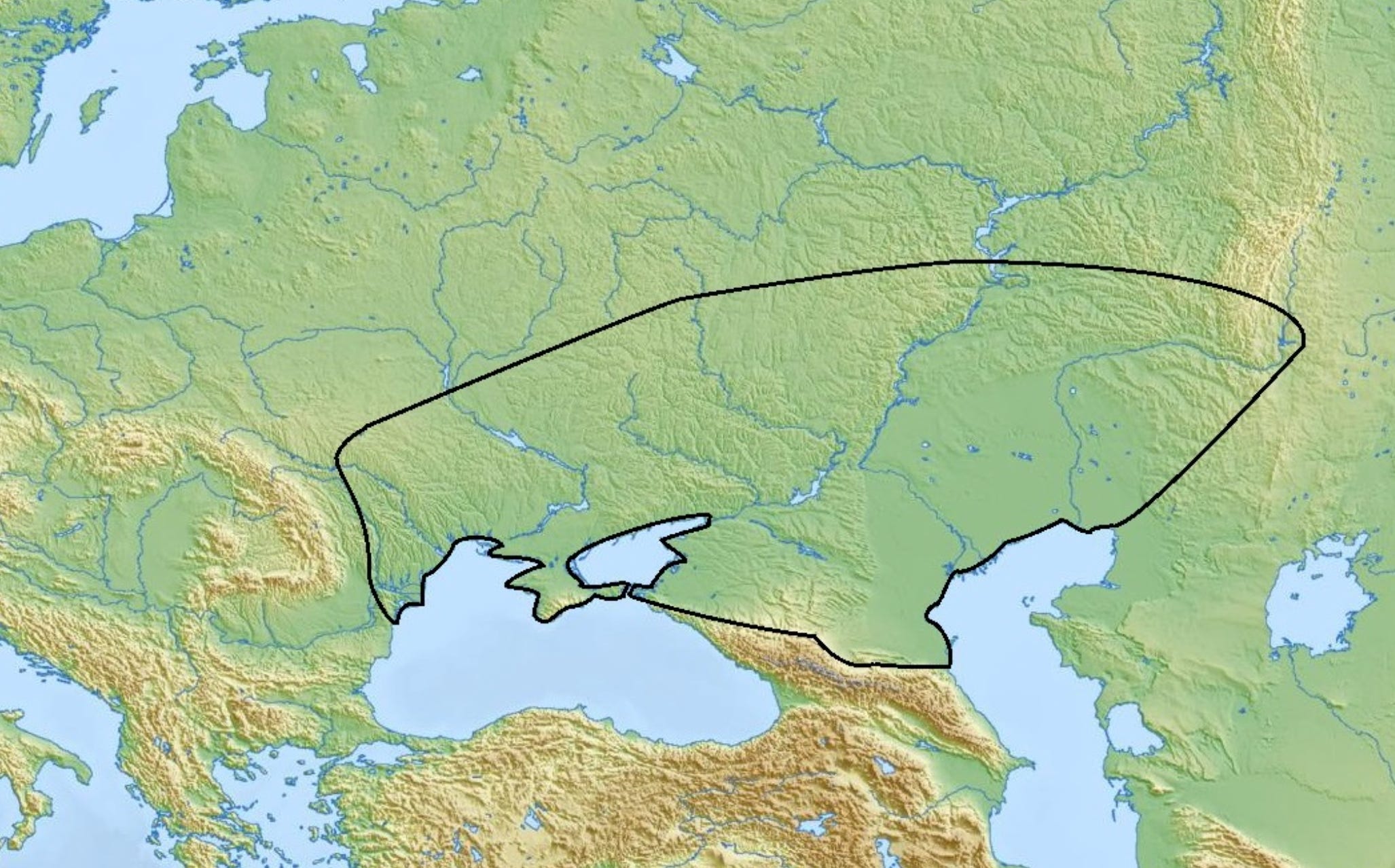
The quirky Razib Khan reports the guesticalculation that 1/12 of humanity’s genes today are, if we trace them back 5000 years ago, derived from 10,000 Yamnaya nomads on the Pontic Steppe, scattered on the grasslands between the Urals and the Carpathians:
Razib Khan: <https://www.razibkhan.com/p/two-steppes-forward-one-step-back>: ‘Nearly half of Northern Europeans’ ancestry today, a substantial minority of Southern Europeans’ (some 20-40%), and an average approaching 15% across highly variable South Asian populations (with rates rising as high as 35% among Brahmins in certain locales), could be modeled as descended from the fourteen genomes retrieved from nine [Yamnaya burial] kurgans…. The Corded Ware [people] were [descended from] Yamnaya with cultural adaptations and local genetic accretions…. Even… Tamil Brahmins harbor some 15% Yamnaya ancestry….
Observers… likely did not see the scattered nomadic Yamnaya as a particularly portentous or formidable…. Yet within less than a millennium they would… reshape the… Eurasian continent… largely replac[ing] Northern Europe’s great megalith-building civilizations, overthr[owing] Europe’s first literate society in Greece, the Minoans, and eras[ing] the memory of the people who had built the grand Indus Valley Civilization….
We find ourselves still living out the consequences of this biologically-driven mass cultural shift, the legacy of some combination of germs’ mercilessness and nomadism’s unconquerability…. I write these posts in… a descendant of the Yamnaya language…. Patriarchy… perhaps one of the most enduring results of the Yamnaya…. Those first pre-literate nomadic barbarians… poured forth out of Eurasia’s great grasslands, tall, dark and violent, plague speeding their emphatic arrival, burning down old civilizations and rewriting the continent’s genetic legacy overnight…
He is right. But this “rewriting the genetic legacy” vibe stuff he adopts seems to me to be much too strong. I don’t see it making a damned bit of difference for you today whether your Yamnaya-descent fraction if 50% or 10%. Your genes do the same thing in either case.
The story of the Yamnaya expansion to the point where 1/12 of the ancestry of humans today can be trace back to a group that was 1/1000 of the human race in the year -3000—that is a culture and a lineage story, not an evolution or a genetic change story. Razib makes rather too much of polygenic scores suggesting that the Yamnaya may have been “dark giants of the east”: “tall, dark, robust, maybe a bit plodding and prone to mentally instability…”. Yes, he is doing it in the service of declaring that the Yamnaya were:
not the ‘blond beasts’ of Nietzsche’s imaginings.. [but] dark-haired and dark-eyed.. skin… darker… than modern Southern European averages… [and] vanishingly few Yamnaya would have expressed blue eyes…
But, still, these are very small possible biology-based differences in averages: in order for such claims to be accurate even as stereotypes we would have to compare groups not within the modern human race, but rather us homines sapientes sapientes to the homines sapientes neandertales or homines heidelbergenses of not five-thousand but of three hundred-thousand years ago.
However, the Yamnaya descendants as they migrated and expanded did bring their culture, their cows, the disease burden of the steppe, their patriarchy—as it really does look like men who were not Yamnaya-descended have left very few descendents today. Of course, we do not know the degree to which the Yamnaya were conquerors rather than productive and rich hence high-status as bringers of valuable biotechnology. We do not know the mix of female choice, sexual enslavement, and rape in the human history that generated what we see as mass y-chromosome lineage extinction as the Yamnaya spread themselves, their language, and their cultural technology from the North Cape to Ceylon, from Mongolia to Cape Trafalgar.
Yes, the gene people can identify genetic similarity and descent to an amazing degree. But the background is that the genes of the Yamnaya were pretty much the genes of everyone else. As I understand it, Looking across aligned segments of the genome, as I understand it, looking for single-nucleotide variations in the genome, within today’s human population:
Two randomly-selected humans differ at 0.1% of nucleotide sites.
Two random Out-of-Africa humans—those whose ancestors all went through the population bottleneck between 50,000 and 70,000 years ago—differ at 0.07%.
Two random Sub-Saharan-Africa non-KhoeSan humans—people who did not move south to the area of the Zambezi and the Limpopo 200,000 years ago (but what then cut them off from substantial gene flow to and from the main East African Plains Ape population?) differ at 0.11%.
Two random KhoeSan humans differ at 0.12%.
A randomly-selected Out-of-Africa and a randomly-selected Sub-Saharan-Africa non-KhoeSan human differ at 0.10%.
A randomly-selected Out-of-Africa and a randomly-selected KhoeSan human differ at 0.11%.
A randomly-selected KhoeSan and a randomly-selected Sub-Saharan-Africa non-KhoeSan human differ at 0.12%.
Yes, this is getting much much too close to getting out the skull-measuring calipers. But the point is that these numbers are very, very small indeed. Look at the contrast with:
Two baboons from the same troop differ at 0.25%.
Two random baboons from the species differ at 0.4%.
A random dog and a random coyote differ at 0.4%
A random human and a random baboon differ at roughly 6% of sites.
A random human and a random chimpanzee differ at roughly 1.2% of sites.
All of us homines sapientes sapientes, are, truly very close cousins indeed.
You have to go further back, we do get the evolution and the genetic change story: