Trump Promised Voters Lower Prices: He Lied—& People Are Angry
Affordability is mostly anger at high nominal prices after a one‑time inflation jump. Even as inflation cooled, prices didn’t retreat. Plus tariff policy operates like a tax that lifts them further. Meanwhile, housing outpaced wages, amplifying the pain. Politically, the promise to cut prices was undeliverable—and now visibly broken. The appropriate response is income‑raising, margin‑shrinking policy, not magical price reversals…
Paul Krugman: Another Talk With Martin Wolf <https://paulkrugman.substack.com/p/another-talk-with-martin-wolf>: ‘We had… from 2021 to 2023… a one-time step jump in prices. People are upset about the jump in the level…. Wages went up a lot and contrary to what many people believe, wages rose more towards the bottom of the wage distribution… an equalisation…. Ordinary struggling, struggling families on the whole were better off in terms of purchasing power [after]. But… you feel that you earned your wage increase and then it was snatched away by inflation…. Trump ran a campaign… about… bring[ing] prices down… cut[ting] the price of energy in half… mak[ing]… groceries much cheaper…. [He] obviously hasn’t delivered… and hasn’t even made an effort to deliver…. I’m glad that people feel betrayed. This is important…
Matthew Yglesias: ‘Affordability’ is just high nominal prices” <https://www.slowboring.com/p/affordability-is-just-high-nominal>: ‘Democrats of all stripes have coalesced around the idea of running on affordability…. [But] what is affordability, exactly?…
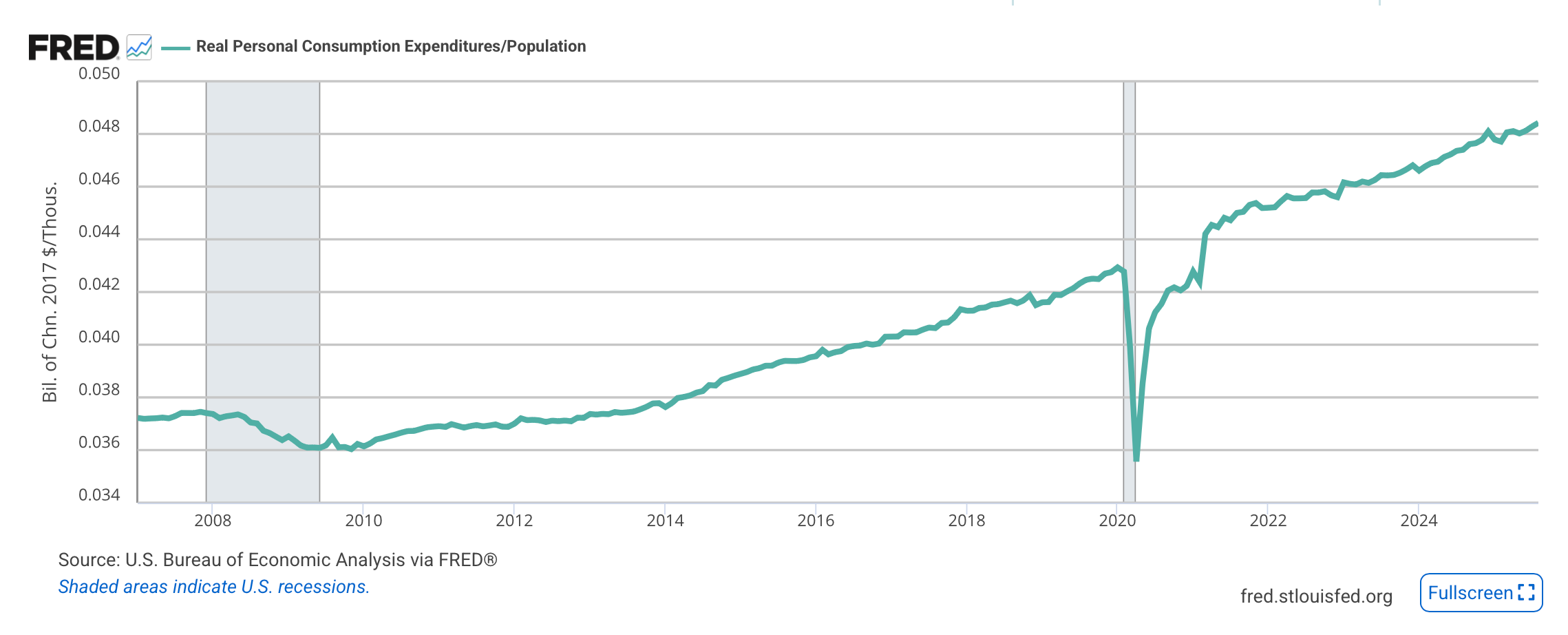
Inflation-adjusted consumption spending per person… [is higher] than ever before…. Affordability is just nominal prices…. Inflation clearly made voters furious. But over the course of 2023 and 2024, the inflation rate came down and voters did not abandon their fury…. Trump… promised people that prices would go down. But prices have not gone down!…Voters want prices to fall, which is what he promised, but that’s not something he could accomplish….
Once you realize that the “affordability crisis” is basically just anger at [the just-past] inflation, I think you see that while Democrats should definitely talk obsessively about their ideas for promoting affordability, they should also be a little bit cautious… The money illusion really is blinding…. People are still going to feel that life isn’t as “affordable” as it should be until macroeconomic inflation concerns are in the rearview, either because a long span of low inflation makes people forget or because a recession gives them something new to worry about…
Admittedly, both Paul and Matt give it the good old college try that there is actually more there there:
Paul Krugman: Another Talk With Martin Wolf: ‘The Consumer Price Index is honest… [and] based on a lot of hard thinking…. But it… doesn’t really take account of interest costs…. Husing is one of those things where prices really have outpaced earnings. And so the sense that my father was able to buy a house and I can’t, that is not wrong…
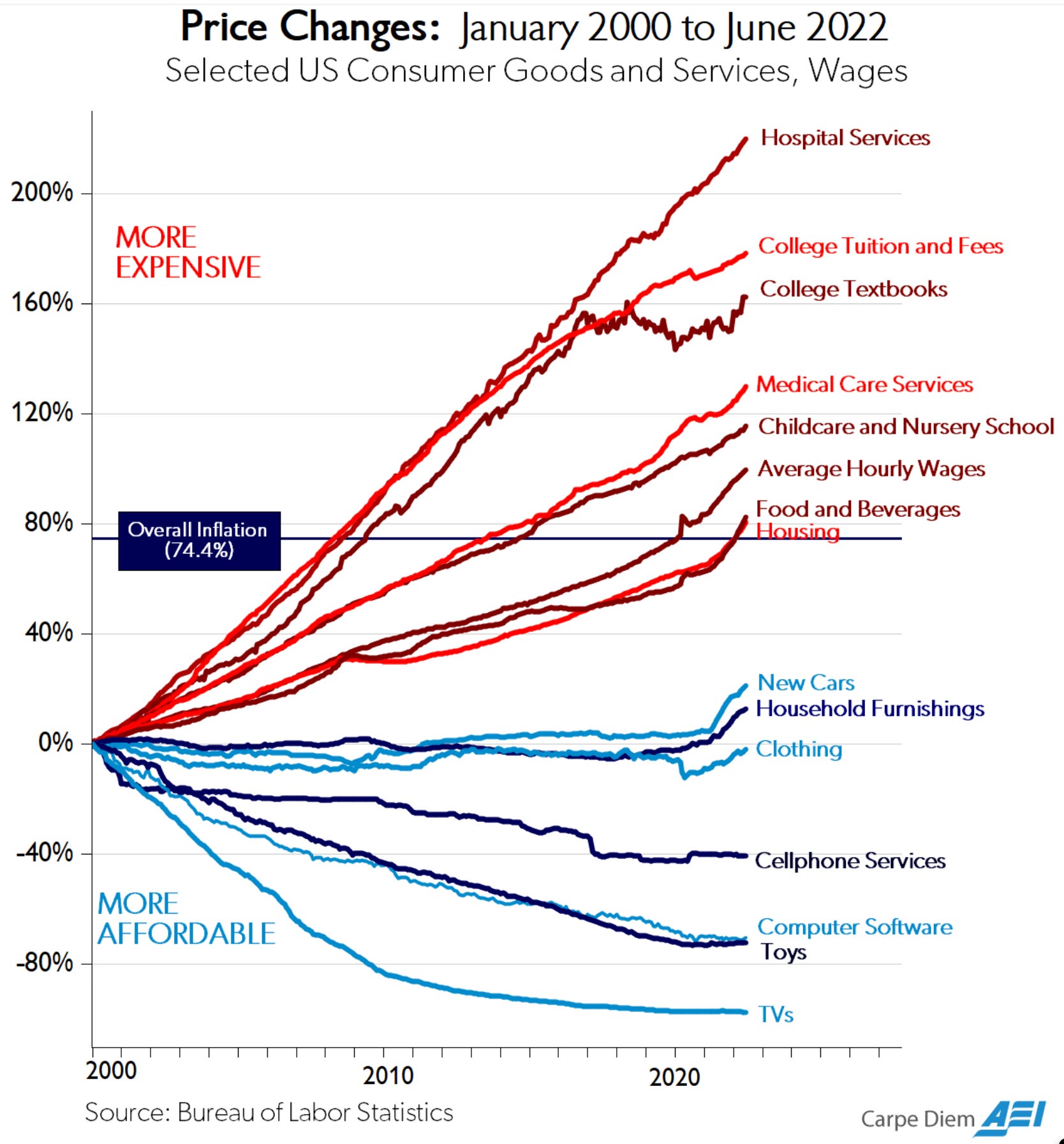
Matthew Yglesias: ‘Affordability’ is just high nominal prices”>: ‘[Is] “affordability”… essentially relative price shifts[?]. I like to quote Agatha Christie’s recollection in her memoir that when she was a young mother, she never thought she’d be rich enough to own a car or so poor that she couldn’t afford a live-in nurse and maid…. Compare… 2025 to… 1985… inflation-adjusted consumption of telecommunications services has improved dramatically. But it is harder to afford child care or a babysitter or other labor-intensive services….. Relative price shifts over the course of my lifetime have been unfavorable to a kind of commonsense view of “the good life”… in achiev[ing] basic life goals in terms of employment, housing, family formation, and fulfilling work…
And then there is often some claim that relative price shifts have been adverse toward the purchases of goods and services essential for the maintenance of self-respect as a successful, achieving member of society: that affordable college, less-expensive medical care, childcare, and housing (in the sense of not just what you purchase but it being within convenient travel distance of everywhere you might want to go) are more important and salient than consumer electronics, toys, clothing, furniture, and cars. But this argument is never made: it is only gestured at.
I think there is a lot of evidence, quantitative economic and polling, and vibes I feel, that Paul and Matt are correct here.
So then what do I have to add?
Well, the most important thing for raising the chances of a good future for America and the world would be to recognize a somewhat cynical somewhat subtext underlying Paul’s and Matt’s gladness that people feel betrayed by Trump’s breaking his promise to make things affordable again by lowering nominal prices. And the second most important thing would be to draw implications for those people who—unlike me!—are not in the inform-the-public business but rather in the projecting-shadows-on-the-walls-of-the-cave business, in the hope of getting those people who will never ascend to see the truth of things to hold beliefs that will at least get them to act in their own true interest, and to advance their own well-being. What are those implications? That Democratic candidates should and democratic policy-advisors validate and endorse:
Banging on the “Trump said he would make things affordable by lowering nominal prices. He lied. He and his appointees have no desire to do that at all. Tariffs are taxes that raise nominal prices!” drum as often and as loudly as possible.
Making good policies that raise people’s incomes and diminish monopoly- and shortage-driven margins and rents.
Keeping from overpromising with respect to actually being able to even start making things “affordable” until 2029 and the end of Republican occupancy of the White House.
Hoping that come 2029 expectations of what the normal values of nominal prices are will be reset, so that then good policies that make people better off can be pursued without the side constraint of guarding against the rage induced by money-illusion sticker-shock.
But do go read both Paul (and Martin Wolf) and Matt, if you have not already. Doing that will make you wiser.
Moreover, the Krugman-Wolf conversation spent a lot of time talking about the labor market and about “AI”. I found six more points made by them worth noting. So let me indulge myself by now going on to spell out what I see as some of their implications: